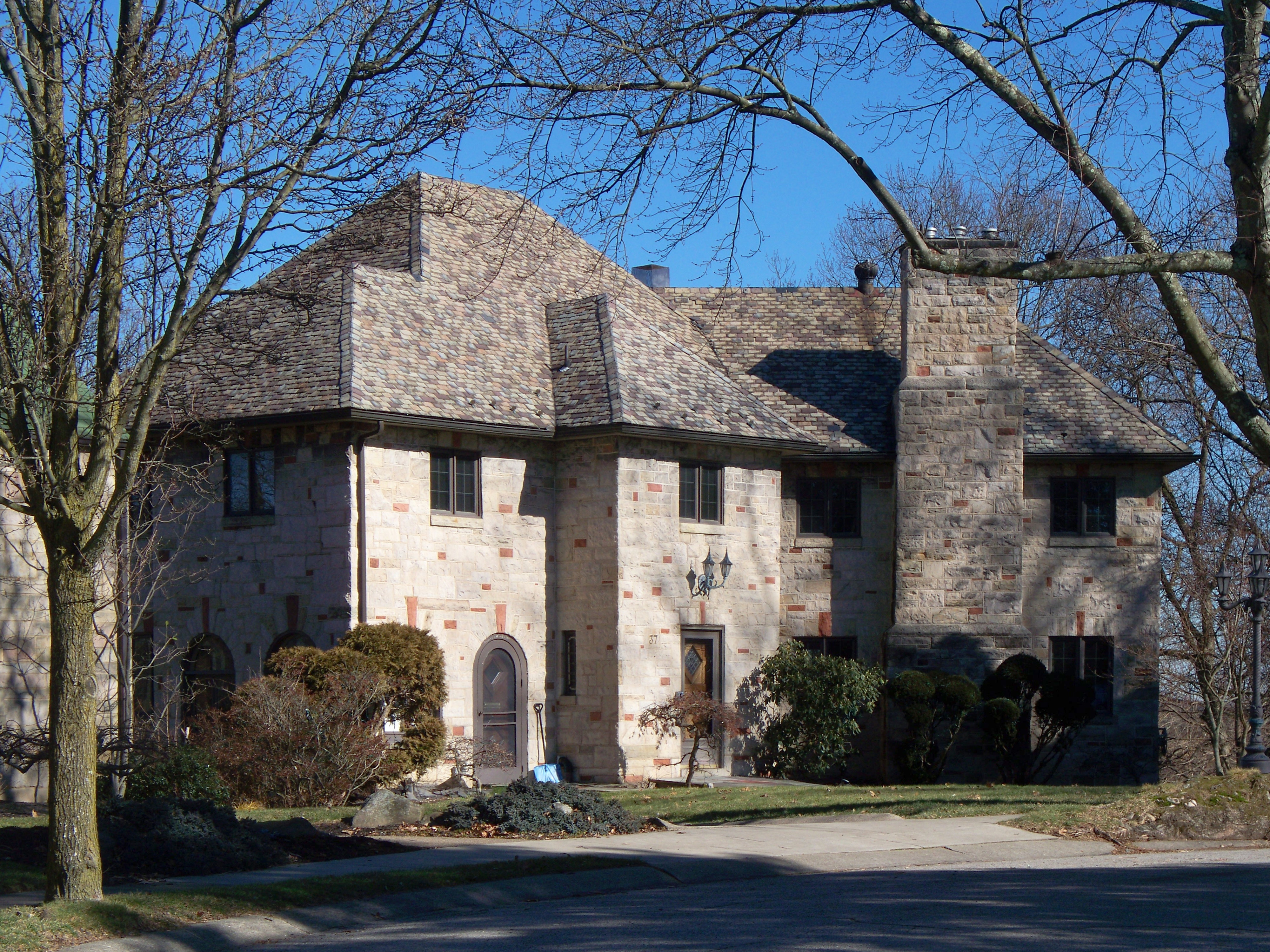
This little house in the Dutch Colonial style caught Father Pitt’s eye as he was wandering in Mount Lebanon.
The materials and colors (though certainly not the roofline) reminded old Pa Pitt of a Dutch colonial house in Hurley, New York: the Bevier house at 25 Main Street, built in about 1720.
This picture was taken in 2000, but not much has changed, according to photographs on line.
Virginia Manor is where the rich rich people live in Mount Lebanon. It’s full of houses designed by some of the most distinguished Pittsburgh architects of the 1920s and 1930s. Osage Road has some of the grandest houses, so here is your look at how the other half lives—unless you are the other half, in which case here is your hand mirror.
Father Pitt has not yet identified the architect of these four apartment buildings in Mount Lebanon, but the style is so distinctive that we can confidently attribute them to the same hand. Adopting the practice of art scholars who name unidentified artists after the most distinctive features of their style, we call this architect the Master of the Jumbled Bricks. Perhaps some reader knows the architect’s real name.
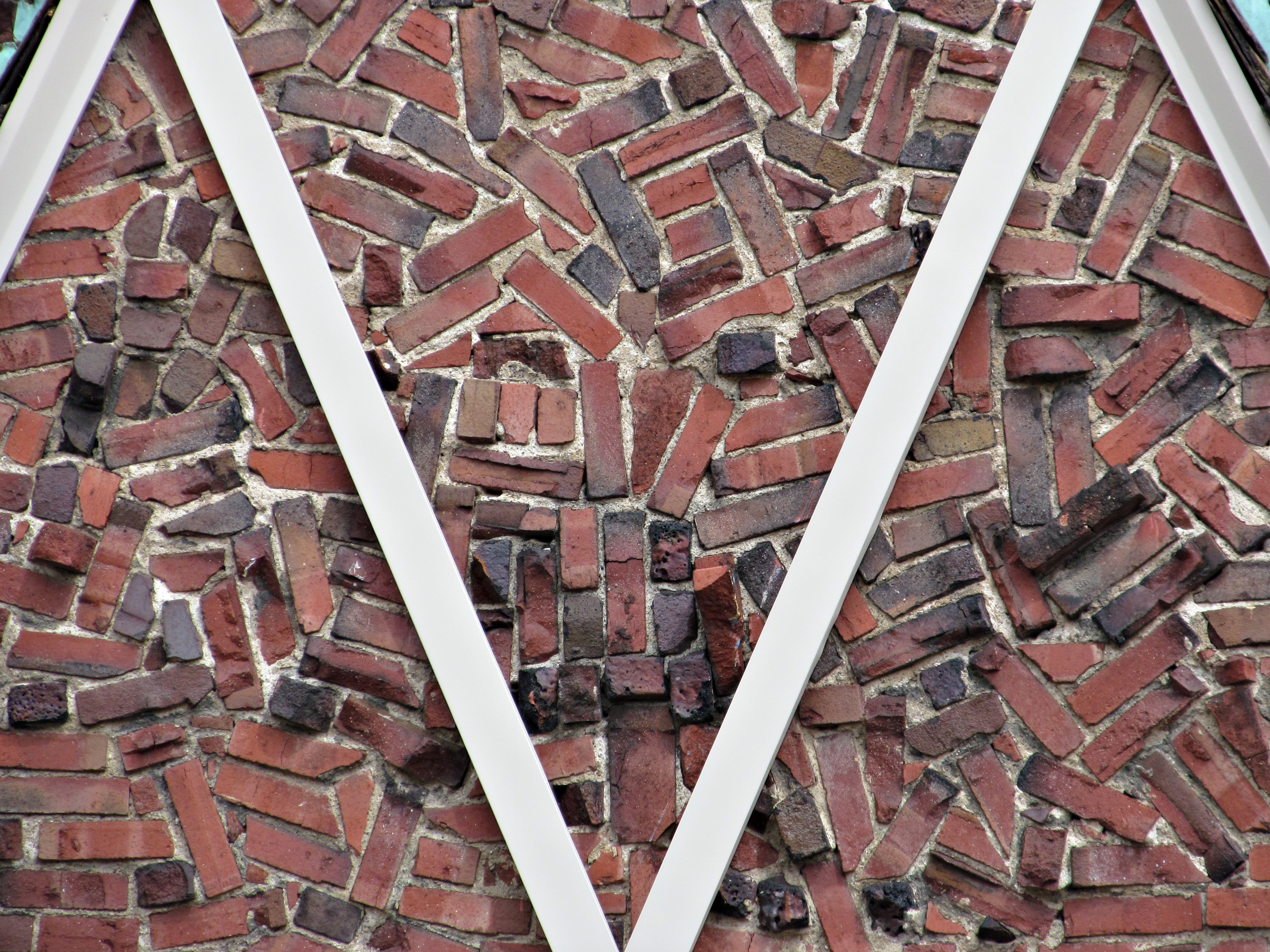
The buildings all share patches of bricks and brick pieces laid in a jumble, as you see above. They also all use irregular (sometimes multicolored) roof slates and ornamental half-timbering, and even the bricks laid in regular courses are given as irregular a texture as possible. They are all in the exaggerated historicist manner that old Pa Pitt calls the Fairy-Tale Style.
We’ll begin with this building on Central Square. The bricks here have had some repair, but we can still see the effort and patient professional work that went into making the building look as though it was built by gnomes.
Not far away, on the other side of uptown Mount Lebanon, another of these apartment buildings stands on Florida Avenue:
Here the jumbling of the bricks is more patterned.
The polychrome irregular roof slates add to the fairy-tale atmosphere.
The next one, on Bower Hill Road, has fewer jumbles; they are placed up at the top among the irregular roof slates as a kind of billboard for the style.
Though the shades are more muted, these roof slates are also different colors.
Finally, the Stratford on Beverly Road.
So far, Father Pitt has found these four apartment buildings in Mount Lebanon designed by this unusually whimsical artist. There are probably others lurking in plain sight. Does anyone know the architect’s real name?
Father Pitt will add that he has some reason for suspecting that it might have been Theodore Eichholz, who was known to work in the fairy-tale style, and who designed an extraordinary whimsy in Highland Park, the Bendet house on Cordova Road, which uses jumbled bricks across the entire front. But this is only a vague suspicion. Anyone with better information is earnestly desired to inform us.
(Update: More and more evidence is pointing to Charles Geisler, resident of Beechview and architect of numerous apartment buildings in Mount Lebanon and Dormont, as well as Squirrel Hill, as the Master of the Jumbled Bricks. This is what the television reporters call a developing story, and old Pa Pitt will update this article with any more certain conclusions.)
The Rose Court apartments were built in about 1928 or 1929, and they have hardly changed at all externally. They are a complex of seven buildings in the Central Square area of Mount Lebanon, built in a subdued Georgian style around pleasant garden courts, so that one side of each building faces a garden.
Longuevue Drive is one of the streets in Beverly Heights, one of the plans from the 1920s that make the Mount Lebanon Historic District a museum of interwar domestic architecture. The variety of styles is delightful. One gets the impression that all the rules have been repealed, and you can have whatever house your most childish fantasy specifies, from a French château to a fairy-tale witch’s cottage.
We have dozens of pictures if you choose to see them, but because there are so many, we put them behind a “more” link.
One of the most remarkable things about the houses in the Mount Lebanon Historic District is how little they change. Many of them are preserved almost exactly as they were built—like this one, built in 1934 from a design by Hannah & Sterling. Hannah is Thomas Hannah, an architect at the end of a long and prosperous career when this house was built; Sterling was the younger P. Howard Sterling, who would continue designing houses in Mount Lebanon after his older partner died. The picture above shows the house as it appears today, and the fuzzy microfilm picture (it’s the lower of these two pictures) from the Pittsburgh Press right after the house was built matches it almost exactly.
St. Clair Terrace is another housing plan laid out in the 1920s, with many of the houses built then or in the next decade. It’s included in the Mt. Lebanon Historic District. Here we have some houses on St. Clair Place.
Now a few of the houses on Roycroft Avenue, including some imaginative ones.
Navahoe Drive is just outside the Mount Lebanon Historic District, but it is lined with architecturally significant houses, mostly from the 1930s. It is a curious thing that there was something of a boom in homebuilding in the Depression years. Labor rates were low, so the conventional wisdom was that, if you could afford a home, you would get more for your money by building a new one than by buying an older one. Thus there were many empty houses owned by banks that had foreclosed on them and could not dispose of them, but also many new houses going up, sometimes in the same neighborhoods.
We have quite a few more houses beyond the “more” link.