
Charles Z. Klauder designed all the buildings on the irregular trapezoid on which the Cathedral of Learning stands. Of the three, this is the one that gets the least attention, and therefore old Pa Pitt was able to have it all to himself for the entire time he spent wandering through it and taking pictures.

The cornerstone was laid in 1935, as it tells us in its own distinctly Deco Gothic way.


The Stephen Foster Memorial is home to two theaters. The larger, the Charity Randall Theatre, is right across the lobby from the main entrance. The Henry Heymann Theatre is down in the basement. It is dogma among theatrical types that “theater” must be given the English spelling, or the proscenium arch will fall on their heads.


Shakespeare and four of his most famous characters in stained glass.

Beethoven and a few lesser composers.

A bright passage illuminated by sunny southeastern windows leads from the lobby to the Stephen Foster Museum.

Along the way we pass Stephen Foster’s own portable melodeon, a little reed organ “used for serenading in Pittsburgh,” as the museum tag says. We have seen this little melodeon before: it is represented in stained glass in the great Stephen Foster window at the Allegheny Cemetery Mausoleum.
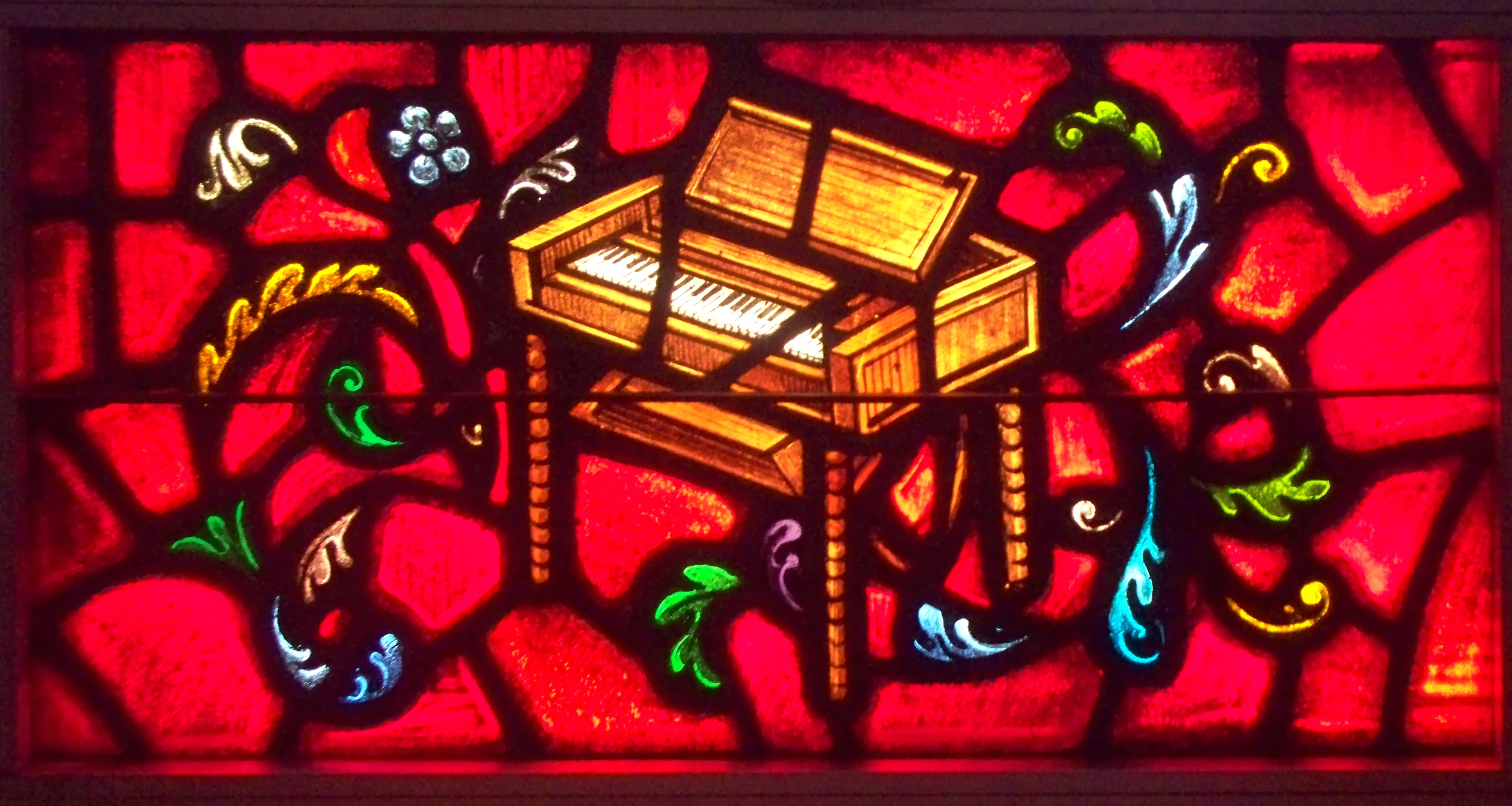
The stained glass in the mausoleum was by Willet of Philadelphia, and because the style is similar, and because Charles Z. Klauder was a Philadelphian, we strongly suspect (but would be delighted to be corrected) that the Willet studio did the stained glass for the Stephen Foster Memorial as well. Stained-glass vignettes in the windows along the hallway represent Foster songs (and there are several more stained-glass windows in the museum, which old Pa Pitt didn’t photograph this time).

Old Dog Tray.

Nelly Bly.

Mr. Stephen Foster himself.

Gentle Annie.

Old Uncle Ned.

The Stephen Foster Museum is in a domed room that is certainly one of Pittsburgh’s remarkable interior spaces. We pause for a moment to look up at the ceiling.

It has been Father Pitt’s contention that Americans don’t look up, and therefore architects feel entitled to ignore the ceiling. But Mr. Klauder did not make use of that privilege. This is a ceiling worth looking up at.

The museum feels timeless. If it were not for a few recent posters pointing out the interesting fact that some people are offended by blackface minstrels these days, you would hardly know you were in the twenty-first century.

Stephen Foster’s own piano, a Dubois & Stodart square grand. He must have bought it used, since the firm of Dubois & Stodart came to an end in 1834, when young Master Foster was eight years old.

A full-size melodeon donated by the McComb family, said to have been played by Stephen Foster when he was a guest at their house. At any rate, it may stand in for the countless melodeons Mr. Foster must have played as he visited friends and admirers, who must inevitably have asked him for a song or two. Melodeons and reed organs were much cheaper than pianos, and therefore likely to be found in any home from lower middle class on up.

We leave the museum by the same hallway and come back out into the lobby.


Wandering the grounds, we come across the Newton Apple Tree, a direct descendant of the tree that bonked Isaac Newton on the head, thus causing gravity.

From the outside, we can see that medieval baptisteries were the model for the room that holds the museum.


Leave a Reply