

Three views of the U. S. Steel Tower from Duquesne University. Below, with Chatham Center in the foreground.
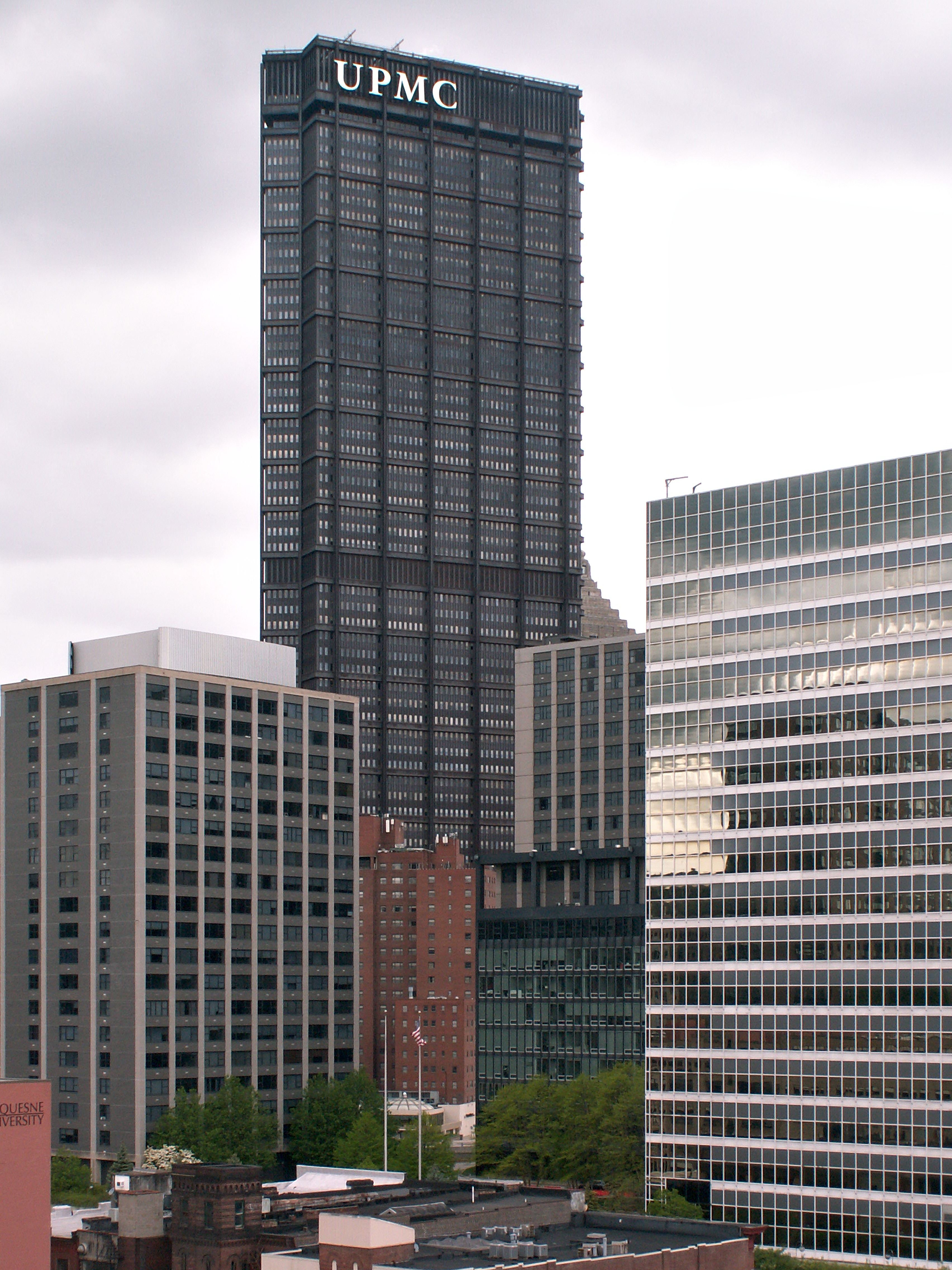

Three views of the U. S. Steel Tower from Duquesne University. Below, with Chatham Center in the foreground.


The back entrance to the City-County Building would seem spectacular if we didn’t know what the front looked like. Below, the building seen from Ross Street.


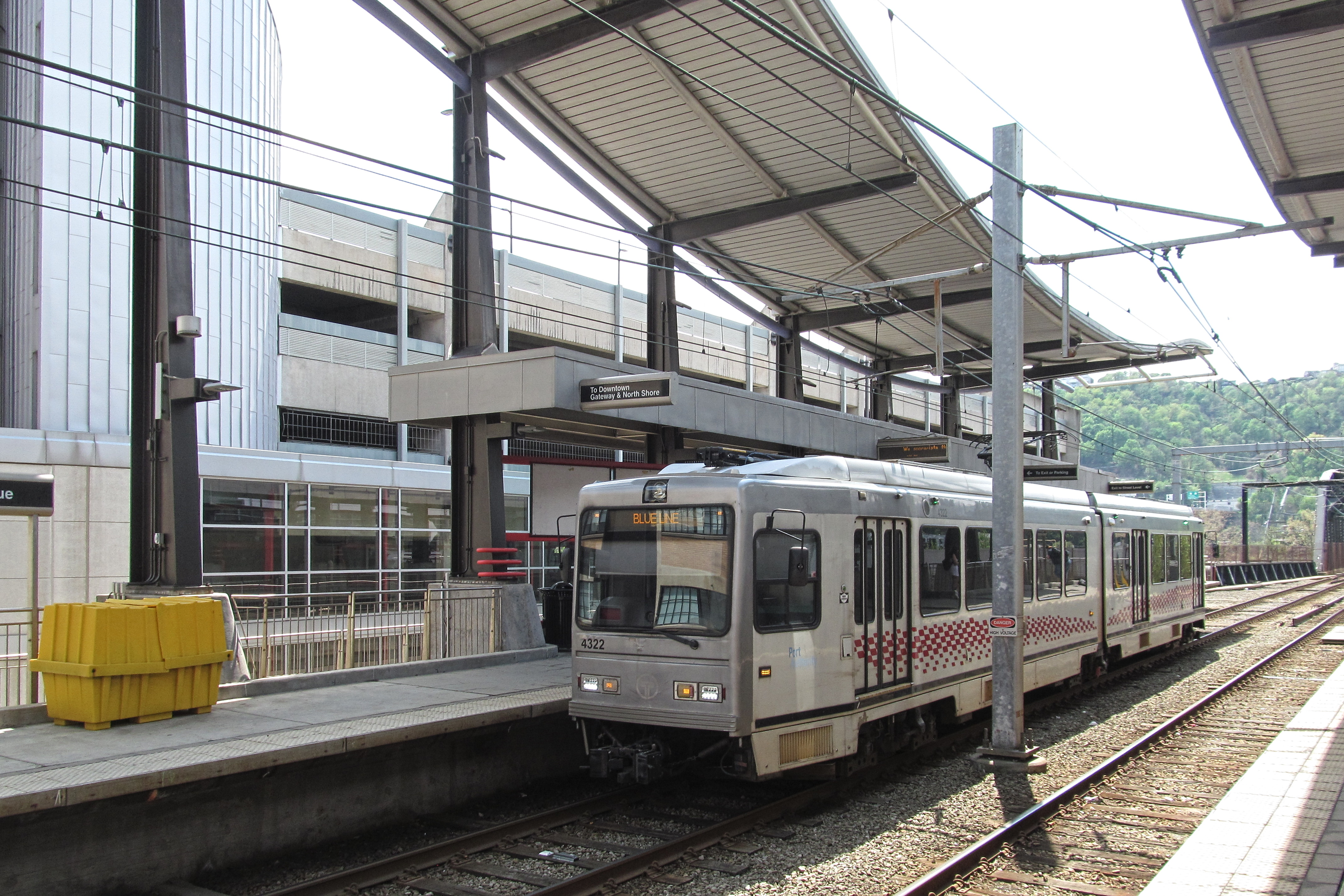
Above, the First Avenue subway station (which is an elevated station, but it’s on the part of the line we call the “subway”) from First Avenue. Below, a CAF 4300-series Blue Line car comes in from the Panhandle Bridge.



The seven-storey building at the corner of Ross Street and Third Avenue was the home of the W. W. McBride Paper Company. Multiple layers of painted signs make it hard to read any one of them, but the name “W. W. McBride” is clear enough.
The Century Cyclopedia of History and Biography of Pennsylvania (1904) has an extensive biography of William Wilson McBride, and we quote the part that has to do with the firm and the building:
In 1890 Mr. McBride bought a half interest in the well-established paper business of Morrison, Cass & Company, of Pittsburg, which owned large paper mills at Tyrone, Pennsylvania. The other half interest was retained by John Cooper, of Pittsburgh, who had been a member of the original firm, and the business was carried on under the name of Cooper & McBride. After four years Mr. McBride bought out his partner and became the sole proprietor, operating under the title of W. W. McBride & Company. In June, 1902, the business was incorporated as the W. W. McBride Paper Company. During 1901 he built a fine seven-story brick building at the corner of Ross Street and Third Avenue, containing the offices, sales department, and storage rooms.
By 1923, according to the Pittsburgh Historic Maps site, the McBride Building had become the Bowman Building, so these signs must all date from before that time.

By a splendid exercise of bureaucratic irony, the old morgue now houses offices of the county health department. It was designed by Frederick Osterling and built—on Forbes Avenue—in 1901. In 1929, it was moved to its current location on Fourth Avenue.

Frederick Osterling’s Romanesque buildings nearly always give us a monster or two to admire.


A streamlined Art Deco classicism makes this building stand out on its corner of Wood Street and Forbes Avenue. Its decorative flourishes, though minimal, were nevertheless too embarrassing for the modernist age, and for many years the building was wrapped in an orange metal shell. The metal panels came off in 2012, “to the spontaneous applause of passers-by,” according to the Pittsburgh History and Landmarks Foundation (PDF).

The building was put up in 1929; the architects were Hunting, Davis & Dunnells, whose successors, LLI Engineering, are still in business.

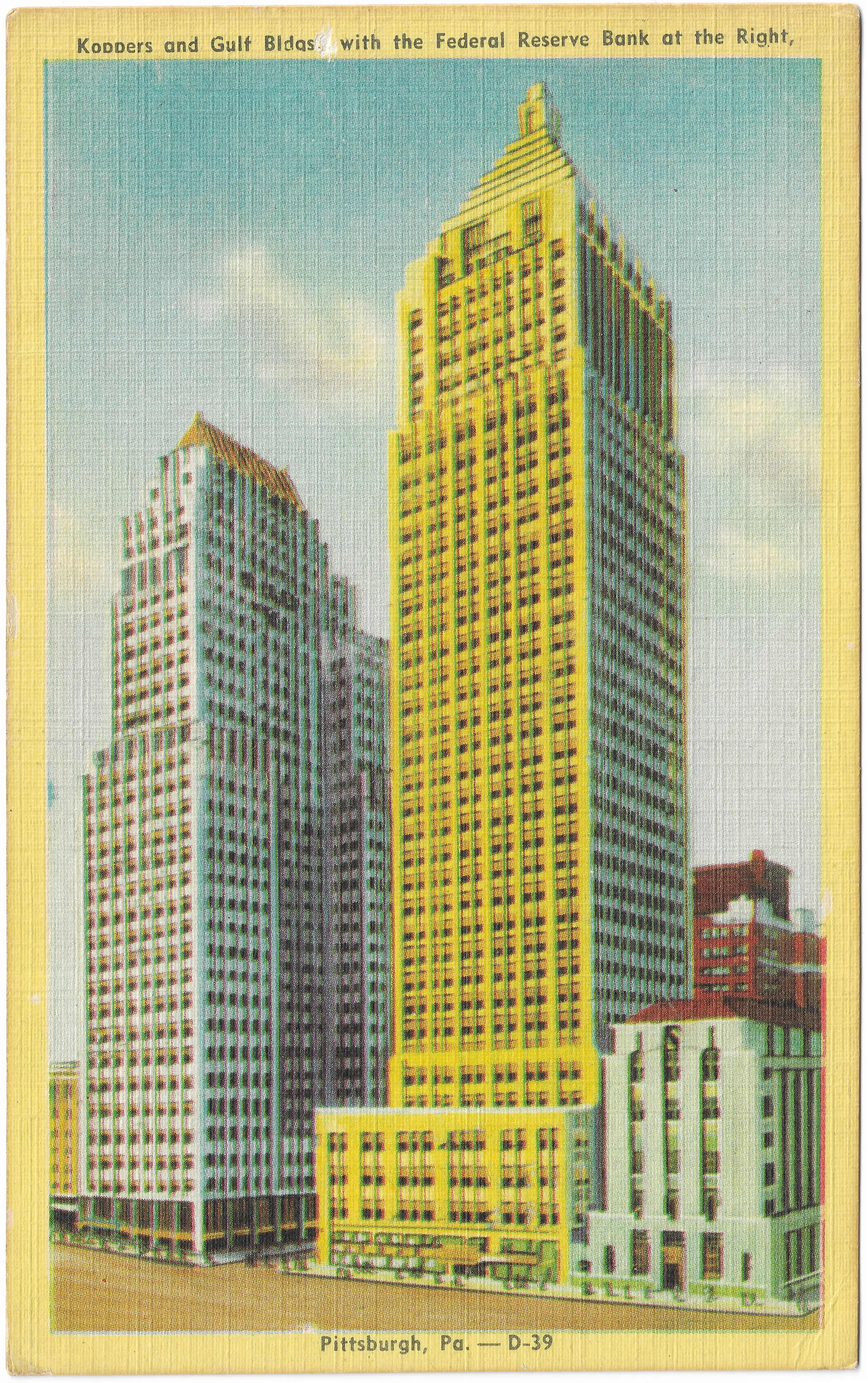
An old postcard from Father Pitt’s accumulation of Pittsburgh miscellanea; we do not know the date, but it must be before 1952, since the back of the card specifies “PLACE ONE CENT STAMP HERE.”

If you see a student of architecture suddenly stop in the middle of the Diamond and burst out laughing, this building is the subject of the mirth.
When it was announced that a gigantic complex to be designed by Philip Johnson was going to take over one corner of the Diamond, the owners of the Nicholas Coffee building, who happened to be ready for a renovation, decided to welcome their new neighbor with a parody of what was then Johnson’s most famous work. At that time, Johnson was notorious everywhere for his AT&T Building (now called just 550 Madison Avenue), which was a deliberate poke in the eye of orthodox modernism; and you have only to see it to get the Nicholas Building’s joke.

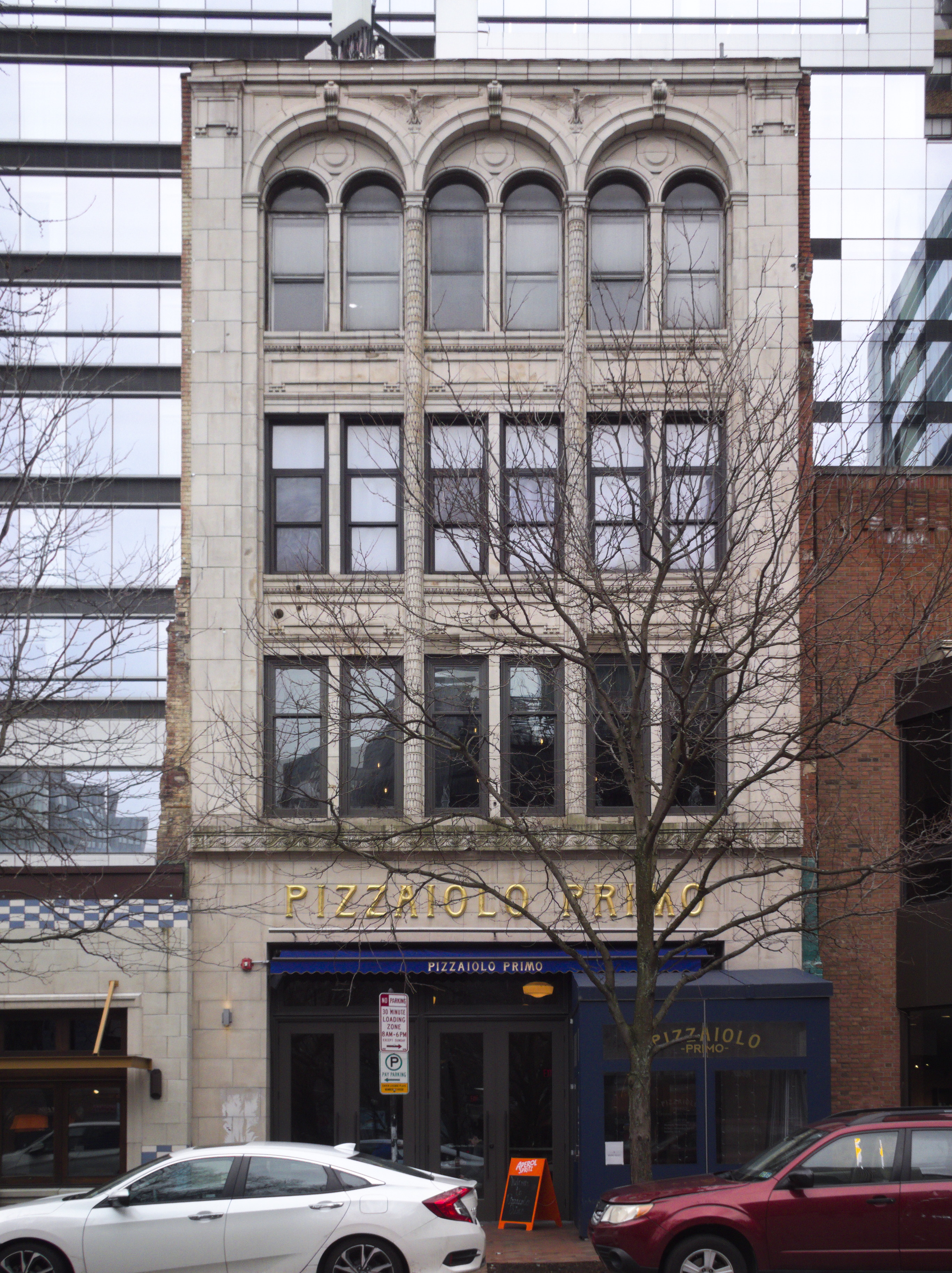
This building on the Diamond has lost its cornice, but the rest of it is intact, and the details are worth a closer look.
