
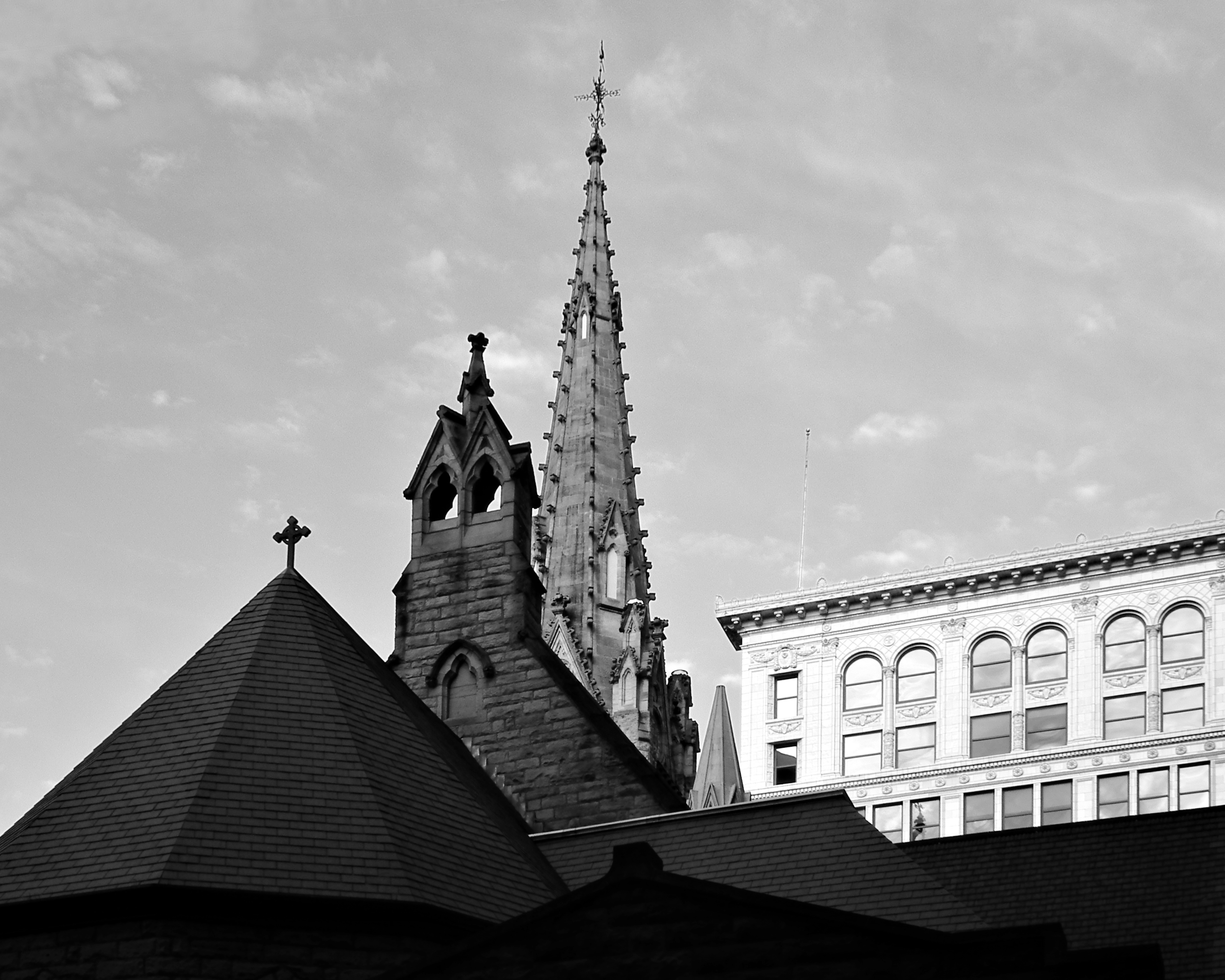
Roof, tower, and spire of Trinity Cathedral and part of the Kaufmann & Baer department store (later Gimbels, and now the Heinz 57 Center).
Roof, tower, and spire of Trinity Cathedral and part of the Kaufmann & Baer department store (later Gimbels, and now the Heinz 57 Center).

The Oliver Building, designed by Daniel Burnham, was the tallest building in Pittsburgh when it was put up in 1910, passing Alden & Harlow’s Farmer’s Bank Building (destroyed in 1997, or arguably thirty years earlier when it was given a fake-modern skin). Only two years later, though, it was passed by Daniel Burnham’s own First National Bank Building (destroyed in 1968 to make way for a modernist skyscraper barely any taller).
The front of the Oliver Building still produces an impression of absolute massiveness, spanning an entire block with a 348-foot-tall wall. The rear, on the other hand, is where the light wells are, which divide the building into three narrower towers, changing the impression to one of loftiness rather than massiveness.

Your eyes are not being fooled by a trick of perspective: the section on the right really does extend a little further toward us than the other two.

The Alcoa Building, designed by Harrison & Abramovitz and built in 1953, was supposed to revolutionize skyscraper design.1 It didn’t, but it had some interesting innovations—swivel windows that could be cleaned from the inside, for example, and of course its aluminum cladding, which was in effect a huge billboard advertising Alcoa’s product. This building did have one important and lasting effect on Pittsburgh: it brought Harrison & Abramovitz into the city, and our skyline would certainly be very different without their work.
Alcoa moved across the Allegheny in 1998, and for a while this was called the Regional Enterprise Tower, but now it holds luxury apartments instead of offices and is calling itself the Alcoa Building again—or, to give the marketers’ full name for it, the Residences at the Historic Alcoa Building.
To old Pa Pitt this building always looks like a stack of 1950s television sets.

The only safe way to get this picture is to have a chauffeur do the driving. The Veterans Bridge is old Pa Pitt’s favorite bridge for crossing the Allegheny, because it is the only one from which he cannot see the Veterans Bridge.
Here is how the Land Trust Company building (later the Commercial National Bank) looked in 1905:

And here is how it looks today:

Much better, isn’t it?

Yesterday’s Rosary March comes up Sixth Avenue. It’s not a very good picture, but old Pa Pitt was not expecting this colorful procession, and did what he could in the seconds he had to record the event from the window of a moving vehicle.


Update: Once in a while old Pa Pitt has a chance to boast about his architectural instincts, and here is one of those occasions. In the original article, he wrote that he suspected Edward B Lee of having designed the remodeling of the theater into an office building. He was right. Source: The American Contractor, December 15, 1923: “Store & Office Bldg. (remod. from theater): $150,000. 5 sty. & bas. H. tile. Liberty av. & Strawberry Alley. Archt. E. B. Lee, Chamber of Commerce bldg. Owner The Fidelity Title & Trust Co., Wilson A. Shaw, chrm. of bd., 343 Fourth av. Gen. contr. let to Cuthbert Bros., Bessemer bldg.”
The original text of Father Pitt’s article follows.
Edward B. Lee was the architect of the Liberty Theater—or Theatre, as theatrical people often insist on spelling it—when it was built in 1912. These pictures were published in The Brickbuilder in 1913, so they show the theater as it was when it was new. Either the theater failed or the owners decided it would be more profitable as an office building, because only eleven years later, in 1924,1 it was remodeled into the Baum Building, and it still stands today.

The shell and outlines are the same, but quite a bit was changed externally. Old Pa Pitt suspects that Lee was the architect of these changes, too, and they were accomplished so elegantly that we would never know the building had not been planned that way from the beginning.


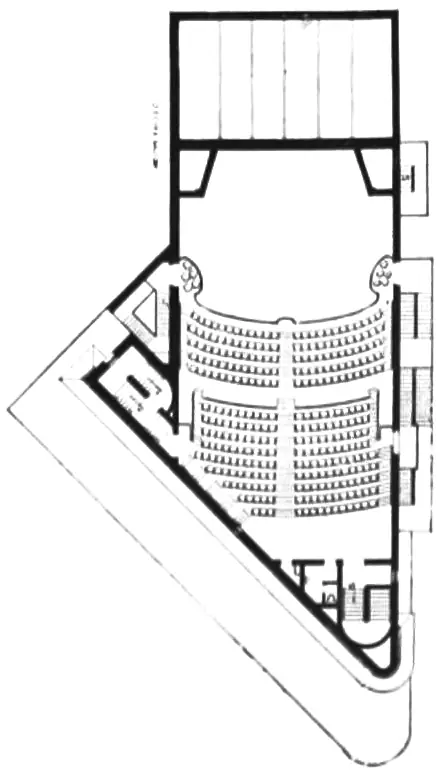
These small drawings (orchestra, first balcony, second balcony) show the aggressive adaptations Mr. Lee had to make to the irregular shape of the lot—a common difficulty for buildings on the southeast side of Liberty Avenue, where the two grids of the irrationally rationalistic eighteenth-century street plan collide.

Detail over the entrance. These decorations disappeared when the building was converted to offices.

Corner detail. The cornice and pilasters survive, but the elaborate terra-cotta decoration between the pilasters vanished in 1924.