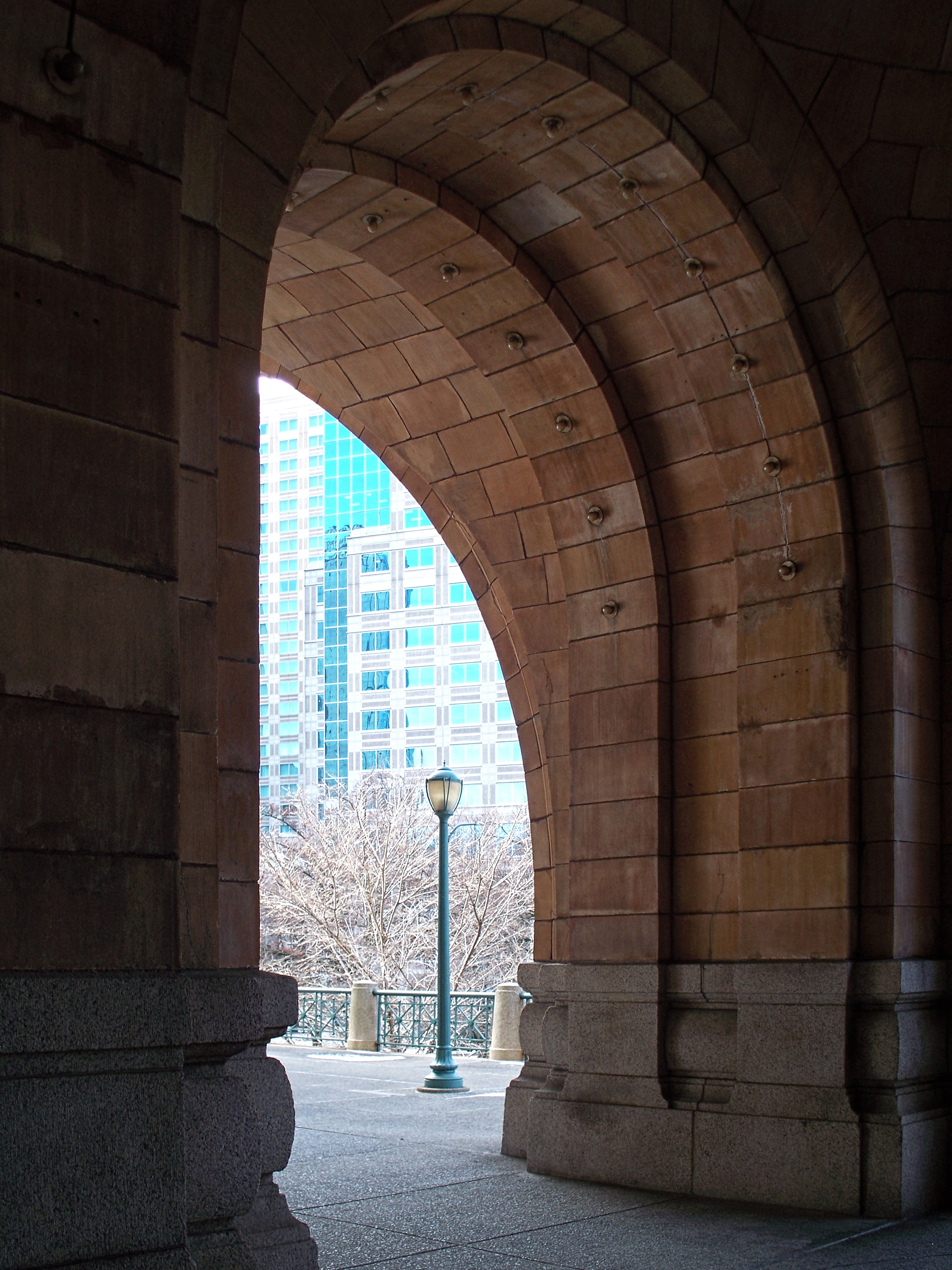
The rotunda of Penn Station is such a remarkable structure that it has its own separate listing with the Pittsburgh History and Landmarks Foundation. The skylight is a fine example of abstract geometry in metalwork.
The current owners of the Pennsylvanian hate photographers and tourists who come up to see the rotunda, and post signs on the walk up to the rotunda warning that this is private property and no access beyond this point and, with dogged specificity, NO PROM PHOTOS. But old Pa Pitt walked up through the parking lot, taking pictures all the way, and therefore saw the signs only on the way back. Sorry about that, all ye fanatical upholders of the rights of private property, but these pictures have already been donated to Wikimedia Commons, so good luck getting them taken off line.
The four corners of the earth, or at least the four corners of the Pennsylvania Railroad, are represented on the four pillars of the rotunda.
“Pittsburg” was the official spelling, according to the United States Post Office, when the rotunda was built in 1900.

This building, put up in 1930–1931, was a branch of the Federal Reserve Bank of Cleveland, and the Clevelanders Walker & Weeks were the architects—but with Henry Hornbostel and Eric Fisher Wood as “consulting architects.”1 Old Pa Pitt doesn’t know exactly how far the consulting went. At any rate, the architects chose sculptor Henry Hering, who had done several prominent decorations in Cleveland, to create the cast-aluminum reliefs for this building. The picture below is from 2015, but it will serve to show the placement of the reliefs:
The three main figures are obviously allegorical; they seem to represent industry, agriculture, and the professions.
Source: Walter Kidney, Henry Hornbostel: An Architect’s Master Touch, where this building is no. 137 in the List of Works. ↩︎
Benno Janssen, Pittsburgh’s favorite architect for clubs of all sorts, designed this small skyscraper, which was built in 1923. The view above is an attempt at a perspective rendering something like what Janssen would have shown the clients. It is actually impossible in our narrow streets, so old Pa Pitt had to divide the picture into multiple planes and ruthlessly distort them. If you enlarge the picture, you can see some of the comical effects of that distortion; but the building itself looks about right now.
This building received a glowing review from one of Janssen’s fellow architects in the April, 1926, issue of the Charette, the magazine of the Pittsburgh Architectural Club:
PITTSBURGH’S DOWNTOWN Y. M. C. A.
Much has been said from time to time in favorable comment of some of our older important buildings, but thus far nothing has been noted to the writer’s attention with respect to some of the more recent structures. To make particular mention—the Downtown Y. M. C. A. building. A building of the high building category, worthy in its class of as favorable comment architecturally as other buildings of our city renowned in their type. Among the higher buildings erected in recent years throughout the county, it is difficult to select one which surpasses the Y. M. C. A. in point of satisfying design. It is of modern interpretation. A building unified, in which the base shaft and top are related parts, knit together in harmonious composition, enhanced by well studied use of materials and nicety of restraint in carefully selected details. It is a building of design vastly in contrast to many of the present era, whose corresponding parts placed one on top of the other without apparent relation other than the different portions may bear a strain or similarity of type.
A building to be judged architecturally must be viewed with a knowledge or at least an understanding of the limiting conditions under which, and more often in spite of which, a design is created. Thus a cathedral, a masterpiece, may not exceed in architectural attainment that of a small parish church. An extensive mansion may not be better architecturally than a small cottage, though the problems and limitations of both are not comparable. One might not say in comparing the fine church with the fine mansion that one is fine architecturally and the other is not, simply because they belong not to the same class of buildings. The stringent restrictions of Y. M. C. A. planning and design require little emphasis. Every one who has stepped into one of these buildings is familiar with the compactness of the intricate plan problem, the extremely small bed room sizes and the admission of no wasted spaces or areas. To gain adequate light and air to all these complicated appointments and rooms, and still in the exterior to obtain a related design having wall surface which bears some semblance of structural possibilities to maintain itself, is no mean problem. The Downtown Y. M. C. A. building has met these obstacles and surmounted them in an admirable manner. It is a worthy piece of architecture, and Pittsburgh may well take pride in the fact that it is hers in more ways than one.
For a very brief period in the 1980s, the style known as “Postmodernism,” which perhaps we might better call the Art Deco Revival, was the ruling trend in skyscraper design. Fortunately Pittsburgh grew a bountiful crop of skyscrapers in the Postmodern decade, and here is one of the better ones. In it we see the hallmarks of postmodernism: a return to some of the streamlined classicism of the Art Deco period, along with a sensitive (and expensive) variation of materials that gives the building more texture than the standard modernist glass wall. This skyscraper is part of Liberty Center, which was begun in 1982 and finished in 1986; the architects were Burt Hill Kosar Rittelman.
With computers, it is possible to make the lights on a Christmas tree an ever-changing animated kaleidoscope of movement and color. According to the laws of American taste, if it is possible, it is mandatory.
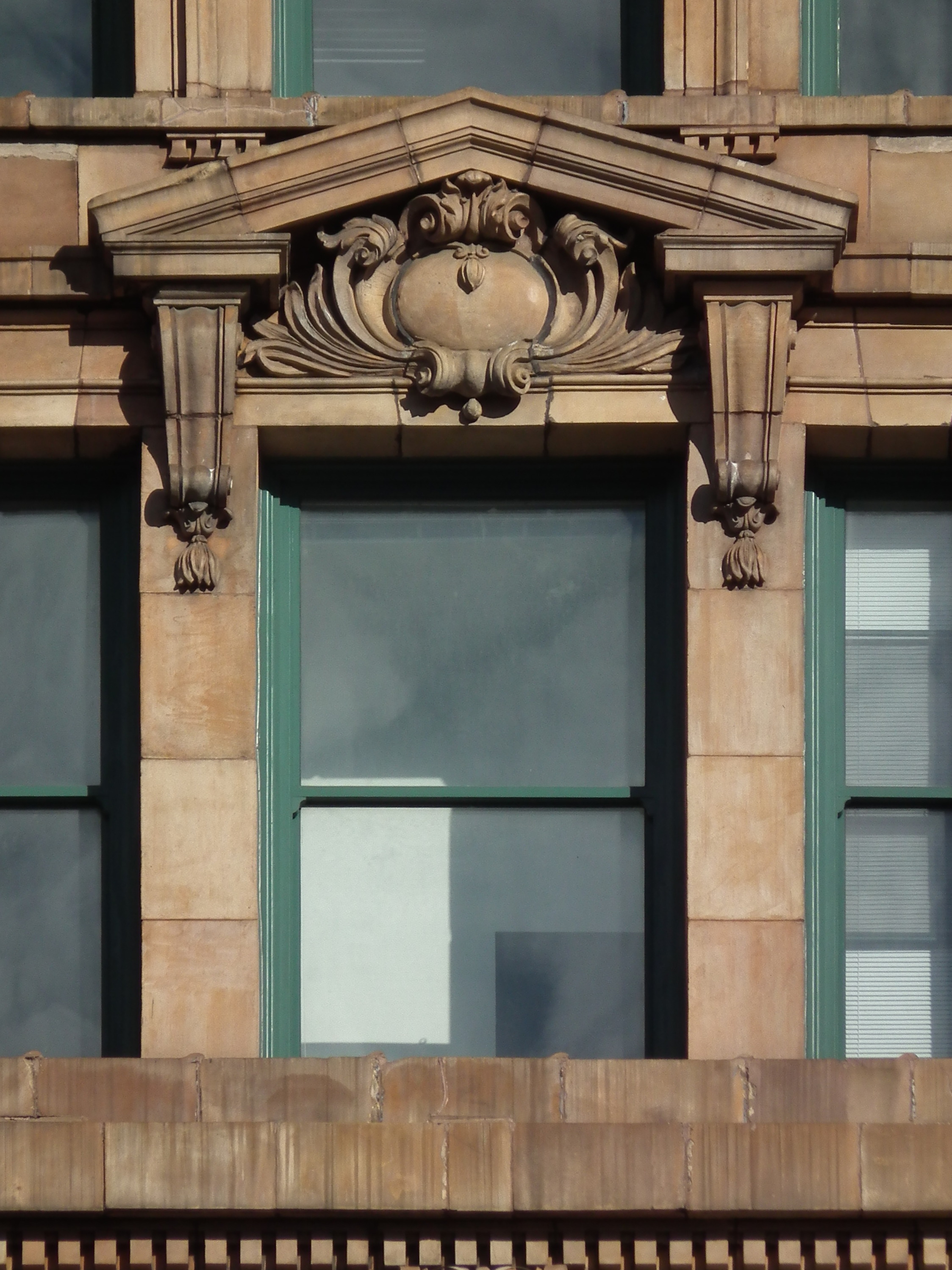
The front of Union Station, which was the official name of what we usually call Penn Station in Pittsburgh, was completely illuminated by winter sun the other day, so old Pa Pitt took the opportunity to pick out some of the multitude of terra-cotta decorations with a long lens.
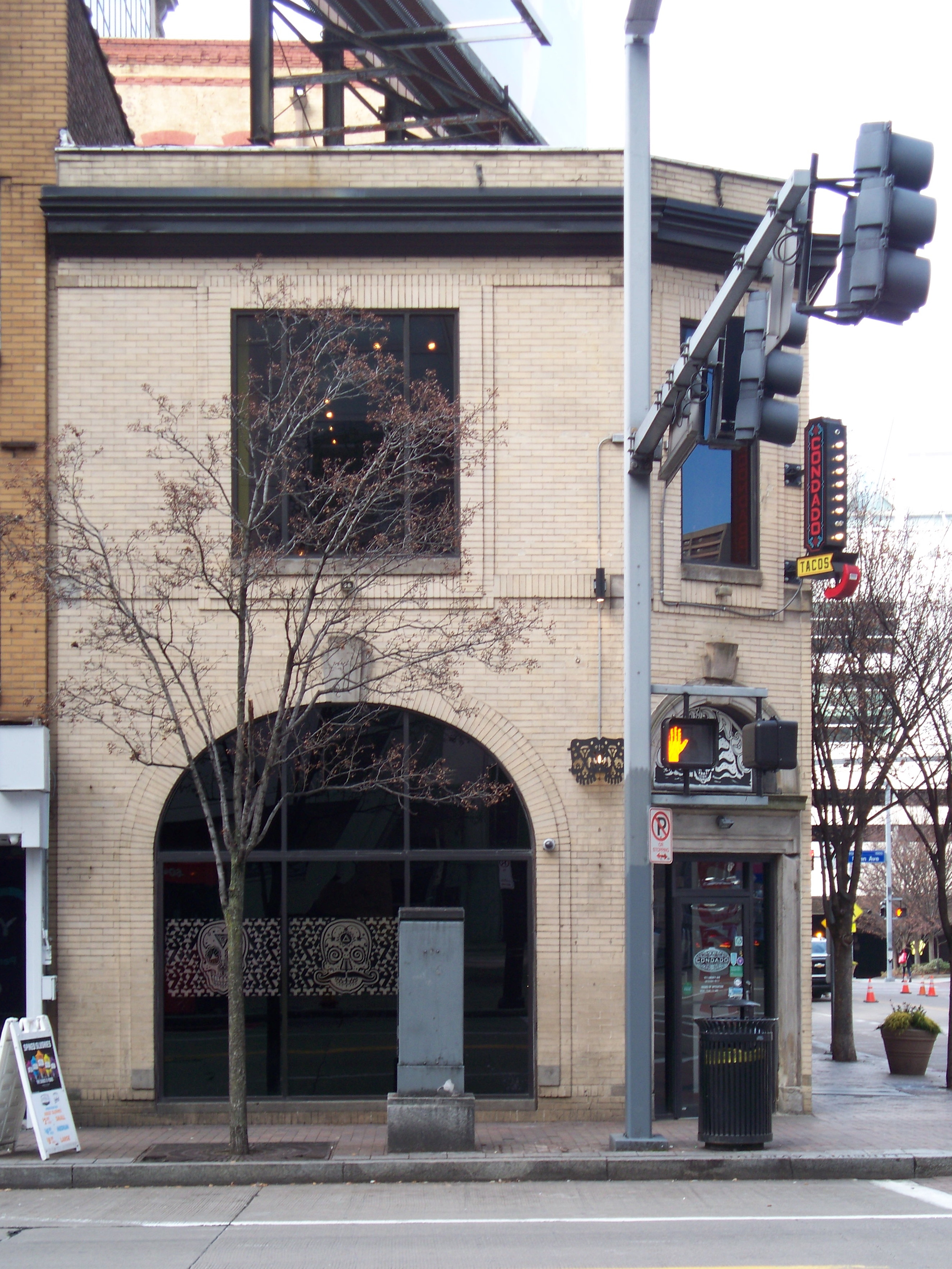
Maximilian Nirdlinger, who is on old Pa Pitt’s short list of architects whose names are most fun to say, designed this little store building in 1914, and we would guess it was completed by 1915. It was a very small and inexpensive project for downtown, but Nirdlinger made sure it was a tasteful one; and it has been updated without losing its essential character, which is classical by way of German-art-magazine modern.
The top of the Keenan Building (designed by Thomas Hannah) reflected in One Oliver Plaza (designed by William Lescaze and now the K&L Gates Center). It occurs to old Pa Pitt that some modernist buildings rely for most of their visual impact on what they reflect: the sky and other buildings, usually. We might say that makes them aesthetic parasites.
This splendid building is well preserved two-thirds of the way down from the top; the ground floor has been replaced, but with a very neutral remodeling that does not clash offensively with the floors above it. Below, one of the elaborate terra-cotta brackets under the cornice.
Americans don’t look up. That is the best explanation old Pa Pitt can come up with. It accounts for a number of phenomena: our blank, undecorated ceilings, or even worse our acoustical-tile ceilings; the disappearance of cornices and the healing of the scars thus left with the aluminum equivalent of duct tape; and the way builders and even architects renovate lower floors of a building without even a glance at what the remainder above looks like. Here we have a bedraggled building from 1883 that could be splendid if it were restored, or just renovated with some minimal taste. But what shall we even call that shingly excrescence on the lower two floors? We also note that all the upper windows are gone except on the third floor, where someone has installed a stock glass sliding door. “I’m just stepping out for a breath of fresh air,” says the visitor…
The Brutalist spiral next door would have been a striking feature in a block of modernist buildings; it seems like, and probably was, a deliberate insult here.