The architect Benno Janssen, one of the titans of Pittsburgh architecture, was very fond of terra cotta, as he showed early in his career in the exuberant Wedgwood patterns of the Buhl Building. The William Penn is more restrained, but it is still a feast for lovers of ornament.
The head of William Penn in ceremonial Quaker headdress.
The Post Office and Courthouse (now called the Joseph F. Weis, Jr. U.S. Courthouse) is Pittsburgh’s grandest monument of the style old Pa Pitt calls “American Fascist.” The post office was on the Seventh Avenue side; it has moved to Liberty Center, but the inscriptions are still here. The building was put up under Secretary of the Treasury Andrew W. Mellon, of whom it was often said that three presidents served under him. The architects were Trowbridge & Livingston, who also worked on some of Mellon’s private projects, like the Gulf Building across the street.
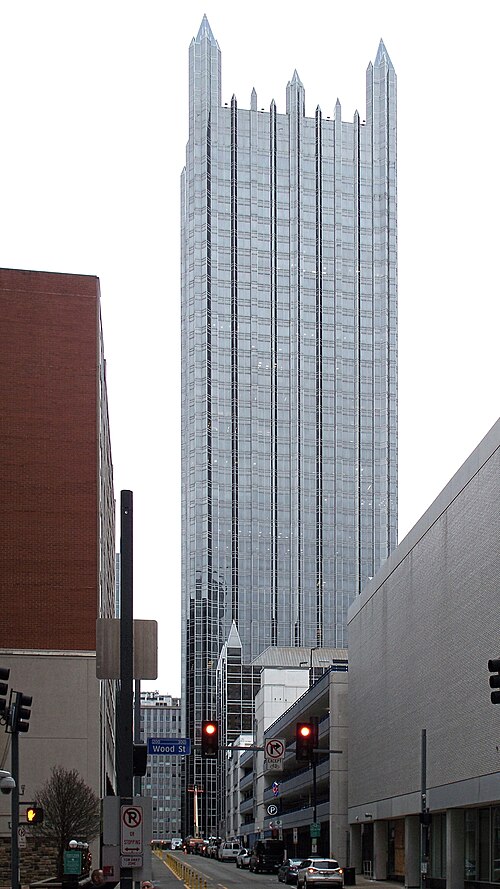
…another aluminum-clad building by Harrison & Abramovitz?
It almost seems as though H. K. Porter, a diverse manufacturing concern that began as a locomotive maker, had pointed to the Alcoa Building and said, “We want that, but shorter.” It is not the same building, but the similarity is striking. This one opened in 1958, five years after the Alcoa Building. It used to have the name “PORTER” in big aluminum letters in that niche at the top, but it now carries the logo of FHLBank Pittsburgh, the tenant with naming rights.
The picture above was taken from Steel Plaza, and that is the back of the U. S. Steel Tower flag waving in the breeze. The U. S. Steel Tower, of course, is another Harrison & Abramovitz design.
Until the 1890s, a Welsh Methodist chapel stood here; but by the early 1900s it had been replaced by this building for the Eichbaum Lithography and Printing Company, a direct descendant of early printer Zadok Cramer’s Franklin Head Bookstore. The architecture is basic industrial Romanesque, enlivened by a more elaborate stone arch for the entrance to the upstairs offices.
A very firehousey-looking firehouse, still in use by city emergency services. According to a city architectural survey, this was built in about 1900 and designed by city architect William Y. Brady. The details are unusual; the style is more or less classical, but instead of Doric or Ionic pilasters, we get unexpected obelisks in relief.
It is interesting to compare this engine house to the one up the street. That one is also attributed to Brady by the city architectural survey, but Father Pitt, on good evidence, attributes it to Charles Bickel. The styles are quite different. It is possible that Brady supervised some alterations to the Bickel firehouse, and that record confused the surveyors.
Good, even lighting on a cloudy day gives us a good perspective view of this building, considered a minor classic of the modernist genre. It was put up in 1956; the architects were Dowler & Dowler. The senior partner, Press C. Dowler, had an extraordinarily long and prosperous career; he worked in every style from late-Victorian Romanesque to pure modernism like this. While other architects languished in the Depression, Press C. Dowler got consistent work from the telephone company, in addition to designing large school projects for the City of Pittsburgh and other municipalities; he continued doing work for schools and Bell well after the Second World War. The other Dowler was his son William.
Thomas Pringle, architect of some of our prominent churches, designed this nine-storey Deco Gothic building for the Salvation Army almost as if it were a skyscraper church, complete with his usual corner tower. Today it is a hotel.
The Boulevard of the Allies side of one of the side-by-side Hartje Brothers buildings. Charles Bickel designed this building and the matching one behind it on Wood Street. This was the later of the two, both built in 1902 for the Hartje Brothers Paper Manufacturing Company. Mr. Bickel was extraordinarily prolific, but old Pa Pitt thinks he deserved his success. For an interesting comparison, look at the Reymer Brothers candy factory and the Concordia Club, and see how Charles Bickel created different effects from the same basic shapes.