Father Pitt

Category: Downtown

  • Americus Republican Club

    Americus Republican Club

    Edward B. Lee designed this clubhouse for the Americus Republican Club in a lush Georgian style. It was built in 1918, and it spans the whole (very short) block from the Boulevard of the Allies to Third Avenue. Since the club moved out, this has been known as the Pitt Building.

    Old Pa Pitt thinks the off-center pediment is an interesting choice for neo-Georgian architecture. It would not have occurred to him if he had been the architect, but the expected symmetry would probably have made a duller façade.

    Update: A correspondent points out that Second Avenue was widened into a boulevard in 1921, and it was done by trimming, moving, or demolishing buildings on the north side of the street. One large building was moved back forty feet. Forty feet would be just enough to account for the asymmetry of this façade. E. B. Lee would have been available to supervise the alterations, but the building’s current form would represent the best he could do under adverse circumstances, not his original grand vision for the Americus Club.

    Another update: The conclusion that part of the building was demolished was correct. “Construction Notes,” Pittsburg Press, October 26, 1920, p. 9: “Preliminary estimates are being received for removing buildings in Second ave. and part of the Americus club building, for the avenue’s widening, the portion taken to be replaced by an addition in the rear.” Thus the Smithfield Street façade was originally symmetrical.

    Window
    Lunette
    Pitt Building
  • A Narrow Firehouse by Charles Bickel

    Boulevard of the Allies front of the firehouse

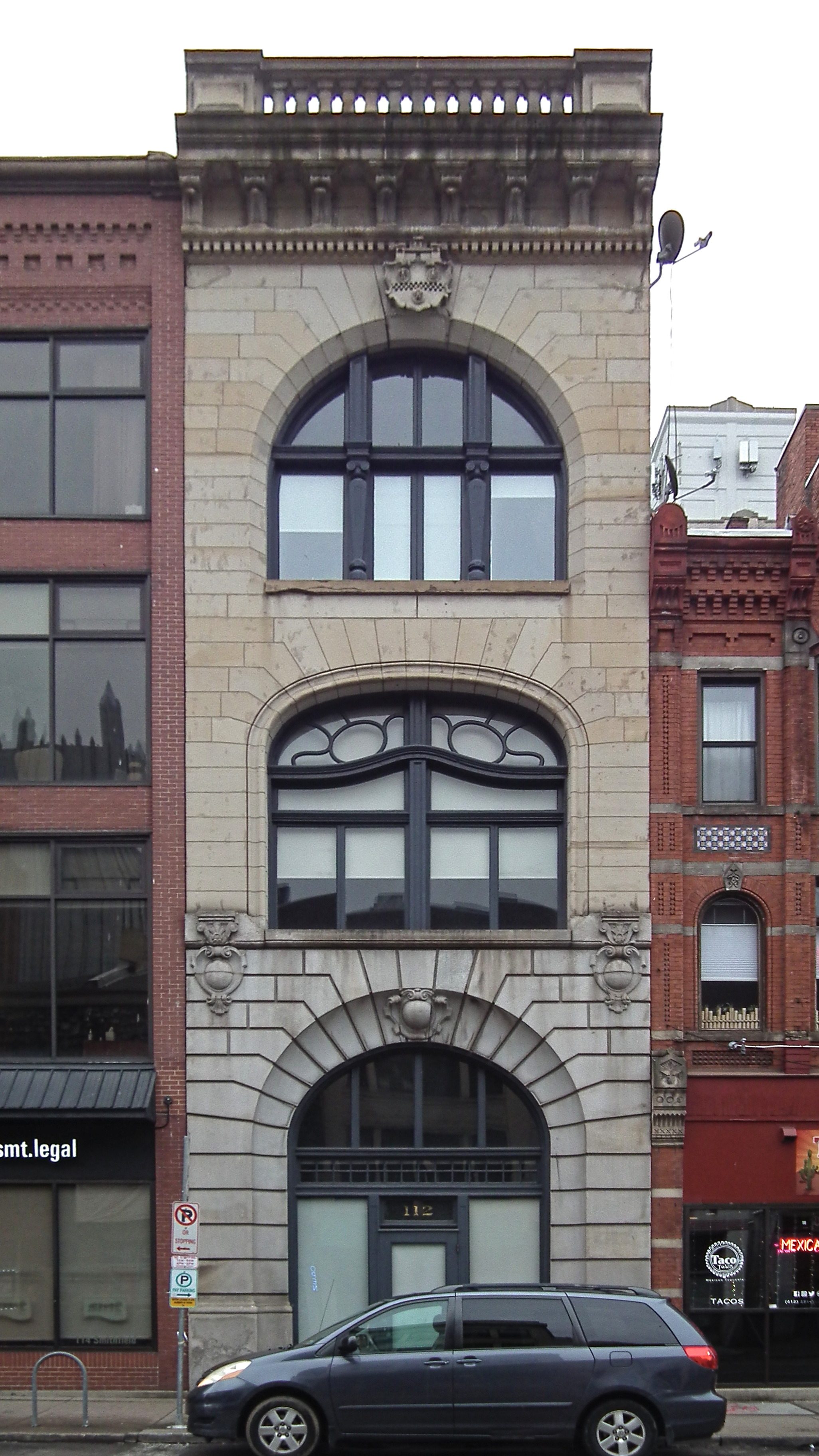
    Given an improbably narrow L-shaped lot to work with, Charles Bickel1 did not despair. Instead, he had fun drawing two quite different but obviously related fronts for the same firehouse. Above, the Boulevard of the Allies front; below, the Smithfield Street front.

    Smithfield Street front

    The style is rich Renaissance with more than a hint of Art Nouveau. Bickel was probably the most prolific architect Pittsburgh ever had, but he did not fill the city with identical boxes. He dabbled in a surprising range of styles.

    Arms of the city of Pittsburgh

    It never hurts to put your client’s coat of arms on the front of the building—in this case, the arms of the City of Pittsburgh.

    Boulevard of the Allies side

    The side of the building is exposed now along the Boulevard of the Allies, showing that it was not very deep, in addition to being very narrow. By 1923, according to old maps, the building was in private hands; the city had built a pair of engine houses half a block away that were probably more suitable for the new horseless fire engines.

    Addendum: A city architectural survey dates this firehouse to about 1900 and attributes it to William Y. Brady. Brady was architect of Engine Company No. 1 down the street, which is in a much heavier style; Father Pitt’s evidence is all in favor of attributing this one to Mr. Bickel.

    1. Our source for the date and architect is the Philadelphia Real Estate Record and Builders’ Guide, September 21, 1892: “Charles Bickel…has prepared plans for a three-story engine house to be erected on Second Avenue, at a cost of $20,500.” That suggests a date of about 1893. Before the First World War, what is now the Boulevard of the Allies was Second Avenue; and three-storey engine houses are unusual. ↩︎
  • Burke Building

    Burke Building

    Designed by John Chislett, our second resident professional architect (Benjamin Latrobe was our first), the Burke Building opened in 1836. It just missed the Great Fire nine years later, and it was substantial enough to remain valuable through the many booms that followed, so that it has survived to be the oldest building downtown outside Fort Pitt. That seems astonishing when we recollect that there had been a city here for 78 years before this building was put up, but flood and fire wiped away much of what came before, and prosperity destroyed the rest.

    We are lucky to have the Burke Building. It is a particularly elegant example of Greek Revival design, and it manages to create a very rich appearance with minimal ornament. Young architects would do well to imitate it.

    Wreaths
    Scallop lintel

    The Brookline Connection site has a page on the Burke Building with some interesting historical pictures.

  • Fort Pitt Blockhouse, by Arsene Rousseau

    Fort Pitt Blockhouse
    From The Charette, December, 1928.

    This sketch was a winner in the Pittsburgh Architectural Club’s Summer Prize Sketch Competition. The artist was Arsene Rousseau (misspelled in the caption), who later became a successful architect in Youngstown.

    The sketch shows the situation of the Blockhouse as attractively as the artist can manage consistent with honesty. It had been restored to its past and present condition by the Daughters of the American Revolution, who maintained a little patch of green in the decaying warehouse and slum district of the Point. We see just a little of the Point Bridge in the background.

    For comparison’s sake, here is how the Blockhouse looked in 1887, before the ladies of the DAR got their hands on it:

    Fort Pitt Blockhouse in 1887
    From Fisher & Stewart’s Guide and Handbook of Pittsburgh and Allegheny, 1887.

  • Cast-Iron Fronts on Wood Street

    Victorian building with cast-iron front

    We have seen these beautiful storefronts before, but only obliquely. Here they are again, because we can never see them too often. This is one of the best Victorian cast-iron fronts in the city. Note that whoever designed the building has tried very hard to make you perceive it as symmetrical, though in fact the section on the right is significantly wider than the other two.

  • 907 Liberty Avenue

    907 Liberty Avenue

    Penn and Liberty Avenues are living museums of Victorian downtown architecture: in very few other places can we get such a vivid impression of what a big city looked like in Victorian times before the age of skyscrapers began. From old maps, we can see that this splendid building appears to have been put up in the 1880s for one W. T. Shannon, who was still the owner in 1923. The upper floors are now loft apartments.

  • Cast-Iron Front on Liberty Avenue

    951 Liberty Avenue

    To judge by old maps, this splendid cast-iron-fronted building was put up in the 1880s for William Carr, and it remained in the Carr family for decades after that. These days the details are picked out in shades of pale blue.

  • August Wilson African American Cultural Center

    August Wilson Cultural Center

    Old Pa Pitt nursed a secret grudge against this building for years, for the very petty reason that it replaced the old Aldine Theatre, which he had hoped to see restored as part of the revival of the theater district downtown. But on its own merits, the August Wilson African American Cultural Center is a striking building that makes the most of its triangular site, and certainly no Pittsburgher better deserves the naming rights to the first theater to meet our eyes on Liberty Avenue. San Francisco’s Allison Grace Williams was the lead architect, and she made the building into a kind of announcement for the Cultural District: here, it tells us, you are entering a place where great things are happening.

  • W. J. Gilmore Drug Company Building

    W. J. Gilmore Drug Company Building

    This feast of deco-Gothic terra cotta on the Boulevard of the Allies was designed by Joseph F. Kuntz, who worked for the Wm. G. Wilkins Company. It opened in 1925. Several of Kuntz’s buildings are notable for their terra-cotta fronts: see, for example, the Maul Building and the Hunt Armory.

    View along the front
    Ornament
    Ornaments
    Ornament
    Metalwork
    Probably cast iron
    Transom
    Ornament
    Perspective view
  • Looking Up

    Koppers and Gulf Towers

    …at the Koppers Building (left) and the Gulf Building (right).