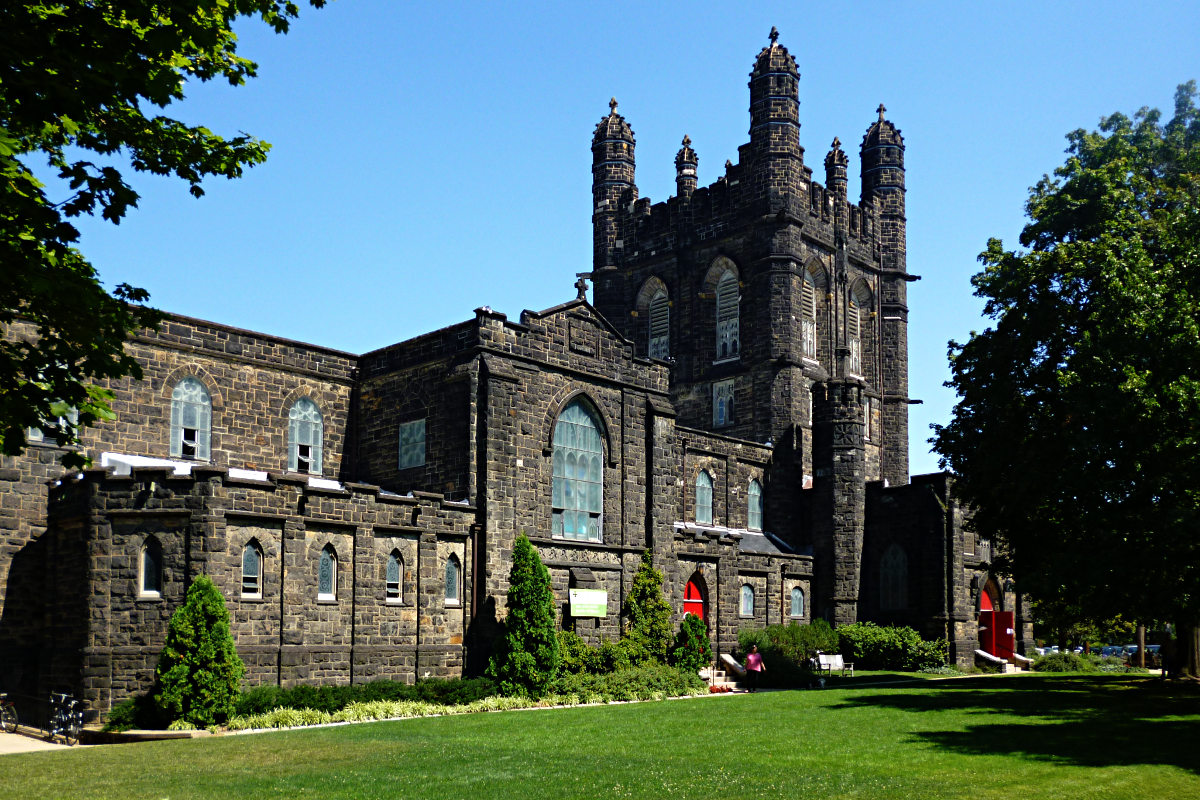
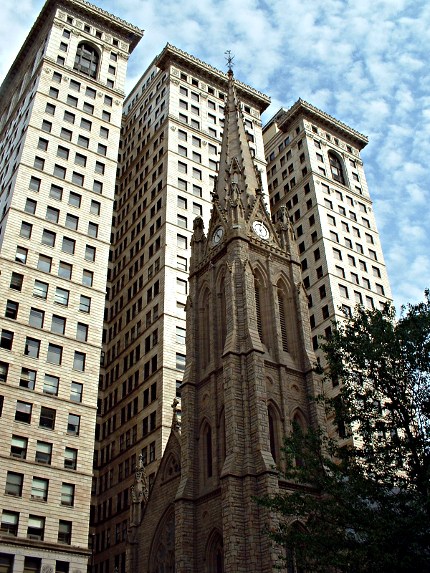
Right on the border between Oakland and Shadyside, the Church of the Ascension is one of the diminishing number of black stone buildings in Pittsburgh. Father Pitt hopes that his pictures will preserve the memory of our black stones when the last stone building has been sandblasted.
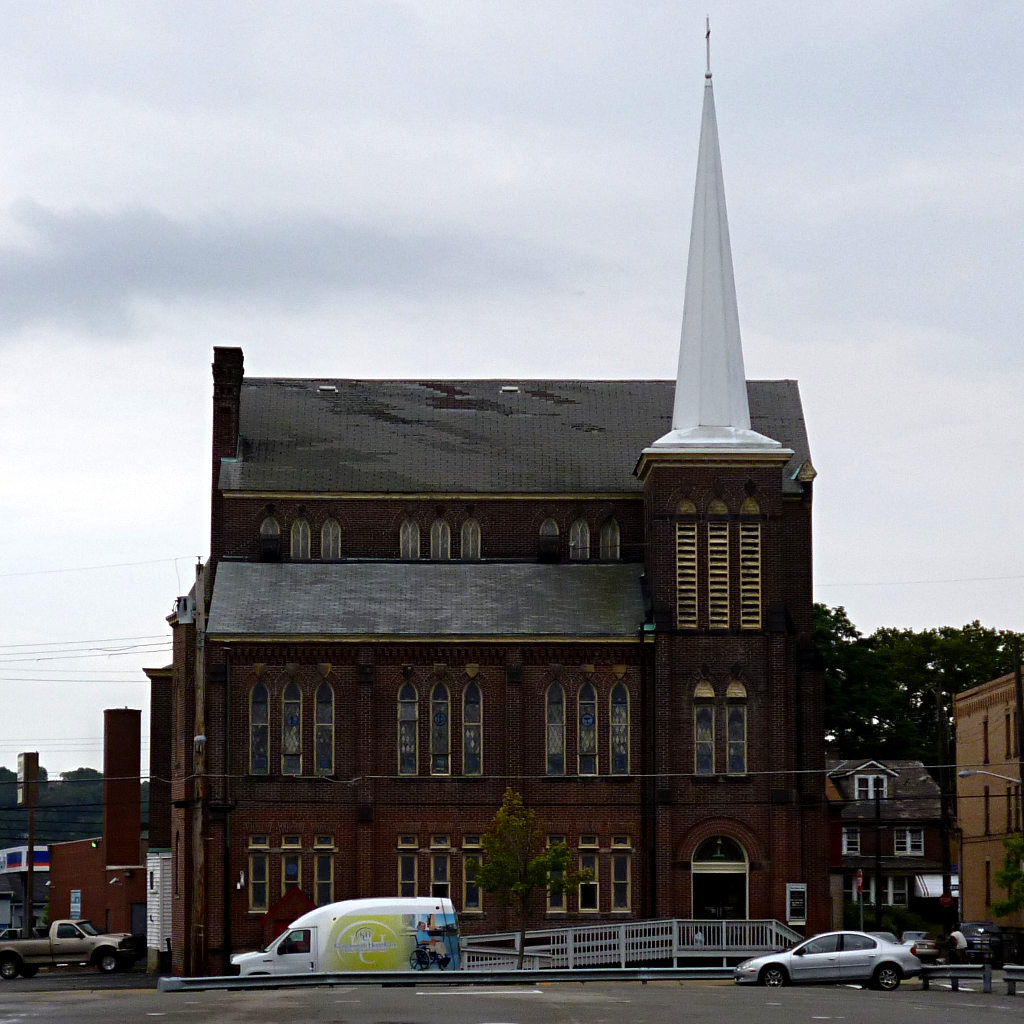
Taller than it is long, Grace Lutheran Church occupies a tiny space in the narrow streets of Troy Hill, a traditionally German neighborhood straddling a narrow hilltop above the Allegheny.
Pittsburgh used to be a city of massive black stone buildings, but, since the end of the age of steel, the buildings have been cleaned one by one, revealing the actual color of the stones as they came out of the quarry. Few of the black stone buildings are left. Here is one of them: Fourth Presbyterian in Friendship. Over the years, the stones are gradually losing their sooty coating, revealing what looks like red sandstone underneath. But they are still strikingly black, the way all proper Pittsburgh stones used to be.
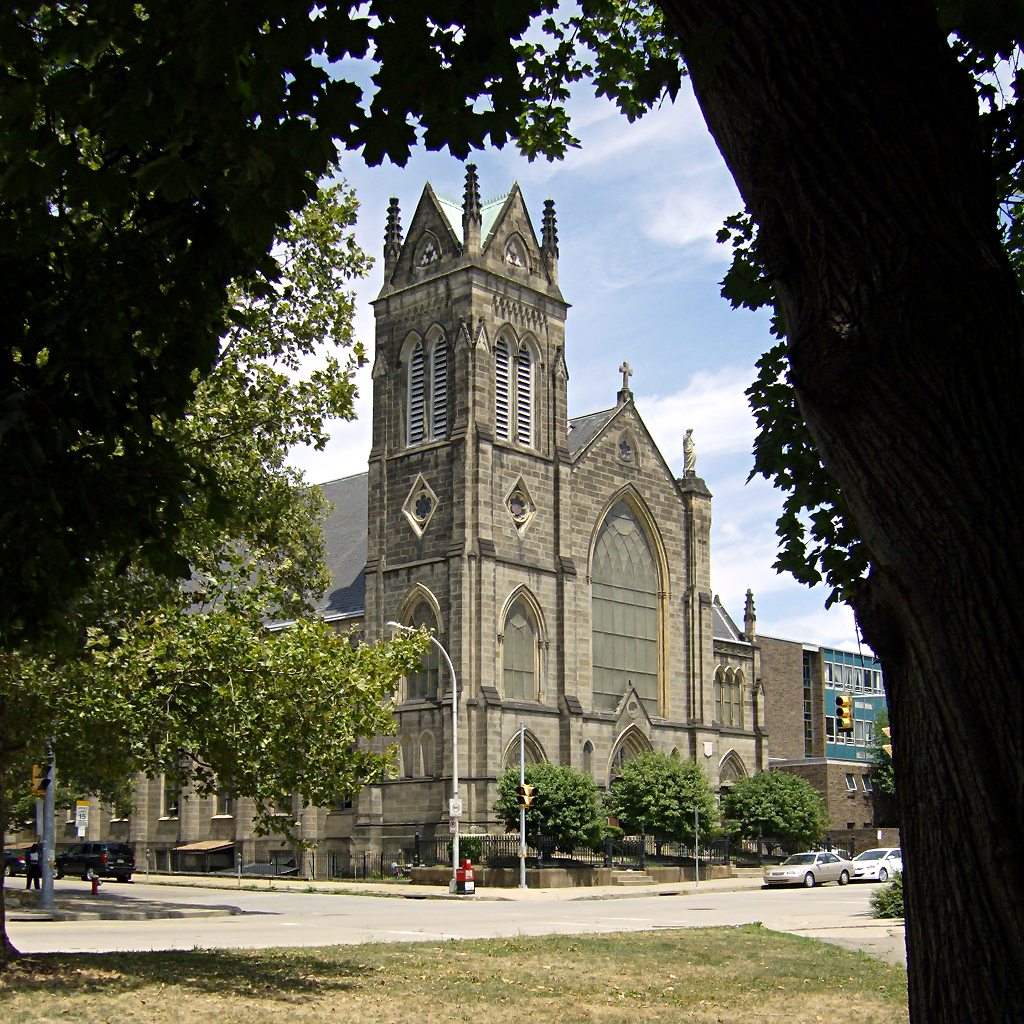
This splendid old church may look a bit prouder than the ordinary Catholic parish church, and it has every right to its pride: for a little more than a decade, it was the cathedral for the Diocese of Allegheny. In 1876 the rapidly growing Diocese of Pittsburgh was split, with Allegheny (then an independent city) as the seat of the new diocese. It was a bad plan from the beginning: Allegheny had all the wealthiest parishes, but Pittsburgh was generously allowed to keep all the debt. The shockingly un-Christian infighting that resulted ended only in 1889, when the Diocese of Allegheny was suppressed. But a Catholic diocese isn’t that easy to get rid of, and there is still a titular Bishop of Allegheny. He lives in Newark, where in his day job he is auxiliary bishop of the diocese there.
St. Peter’s is just across Arch Street from the National Aviary, a short walk from the North Side subway station.
Addendum: This church was built in 1872; the architect was Andrew Peebles, who also designed First English Lutheran downtown.
The massive tower of East Liberty Presbyterian Church rises above almost everything else in East Liberty, even competing with the Highland Building. The design is by Ralph Adams Cram, arguably America’s greatest Gothic architect.
You can tell St. Bernard’s congregation is a community of well-off business types, because the church’s Web site has both a mission statement and a page of “goals and objectives.” But the building itself is quite beautiful, especially its gloriously colorful tile roof. The architect was William R. Perry, who also designed, on a somewhat smaller scale but with equally splendid taste, the bandstand in West End Park. These pictures were taken from the Mount Lebanon Cemetery.
The narrow streets and sudden drops in Troy Hill make for some unusual adaptations. Stuffed into a tiny lot, Grace Lutheran Church is as tall as it is long, with its main sanctuary on the second floor. It’s impossible to get a picture of the building without wires in front, and removing the wires with an image editor would be dishonest, which is Father Pitt’s way of saying “too much work.”