Category: Churches

  • Saints Peter and Paul: Our Most Endangered Landmark?

    KONICA MINOLTA DIGITAL CAMERA

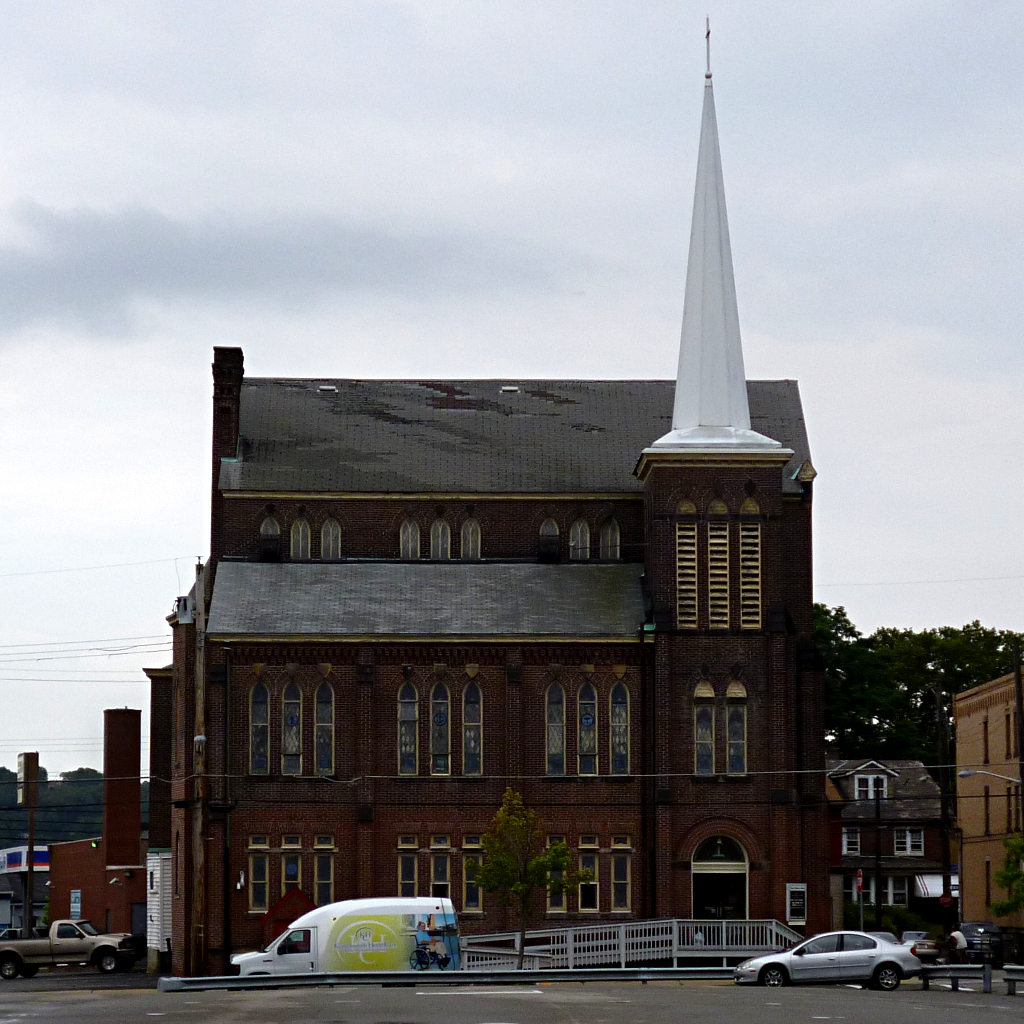
    There are still too many endangered landmarks in Pittsburgh, in spite of a strong local preservation movement. This one is probably doomed. All that has saved it so far is that it would cost a good deal of money to tear down, and the revival of central East Liberty has not reached this part of the neighborhood yet. As much as it would cost to tear down, it would at this point cost much more to restore, and for what? No church would spend that kind of money, and it is really suitable for no other use.

    KONICA MINOLTA DIGITAL CAMERA

    KONICA MINOLTA DIGITAL CAMERA

    KONICA MINOLTA DIGITAL CAMERA

    The cornerstone is dated 1857, but that comes from the older and smaller church that preceded this building. The Rev. A. A. Lambing in 1880 described that building thus: “The church, situated on Larimer Avenue, is of brick, about 75 feet in length by 40 in width, and has a tower rising from the centre in front to the height of about 100 feet…. The church, though neatly finished, lacks the leading characteristics of any particular style of architecture.” The plaque below has the data for this building:

    KONICA MINOLTA DIGITAL CAMERA

  • St. Paul’s Cathedral

    2014-01-15-Saint-Paul-Cathedral-02-bw

    St. Paul’s Cathedral, the cathedral of the Roman Catholic Diocese of Pittsburgh, in the Fifth Avenue monumental district. (The Oakland neighborhood has at least three cathedrals—Roman Catholic, Greek Orthodox, and Antiochian Orthodox—or four if you count the Cathedral of Learning.) A cathedral is the architectural equivalent of a coral reef; over the centuries, it accumulates a diverse ecosystem of art and history. St. Paul’s is only a little over a century old, but it’s beginning to show signs of the rich diversity that only time can bring.

  • St. Paul

    KONICA MINOLTA DIGITAL CAMERAThe statue of St. Paul (by Joseph Sibbel) over the main entrance to St. Paul’s Cathedral in Oakland. He is reading from, presumably, one of his own letters, and he casually holds the sword that beheaded him.


  • Old St. Luke’s, Woodville

    KONICA MINOLTA DIGITAL CAMERA

    Old St. Luke’s Church in the little village of Woodville (an unincorporated part of Scott Township) was founded in 1765. It was stuck in the middle of the Whiskey Rebellion, which divided the congregation, one of whose members was General John Neville, a tax collector who barely escaped with his life. (Woodville Plantation, the house to which he escaped, is still standing nearby.)

    The current building dates from 1852. In the burying ground surrounding the little stone church are some very old graves, including some Revolutionary War veterans and “the first white child born in the Chartiers Valley.” The oldest stones were native shale, which is a very poor material for gravestones; but some of the obliterated inscriptions have been duplicated in plaques beside the stones.

    OLYMPUS DIGITAL CAMERA
    2013-10-27-Old-St-Lukes-01
    OLYMPUS DIGITAL CAMERA
    KONICA MINOLTA DIGITAL CAMERA
    2013-10-27-Old-St-Lukes-02
    KONICA MINOLTA DIGITAL CAMERA
    Old St. Luke’s
  • Heinz Chapel

    KONICA MINOLTA DIGITAL CAMERA

    The Heinz Memorial Chapel at the University of Pittsburgh, designed in fantasy-Gothic style by Charles Z. Klauder, who designed a whole complex of fantasy-Gothic buildings for Pitt with the Cathedral of Learning at its center.

  • Clock, St. Thomas Episcopal Church, Oakmont

    KONICA MINOLTA DIGITAL CAMERA

    Built in 1906, St. Thomas in Oakmont has a proper clock tower made of fine old Pittsburgh black stones, with a proper clock that (unfortunately) has stopped.

    KONICA MINOLTA DIGITAL CAMERA

  • Church of the Ascension

    2013-08-24-Shadyside-Church-of-the-Ascension-01

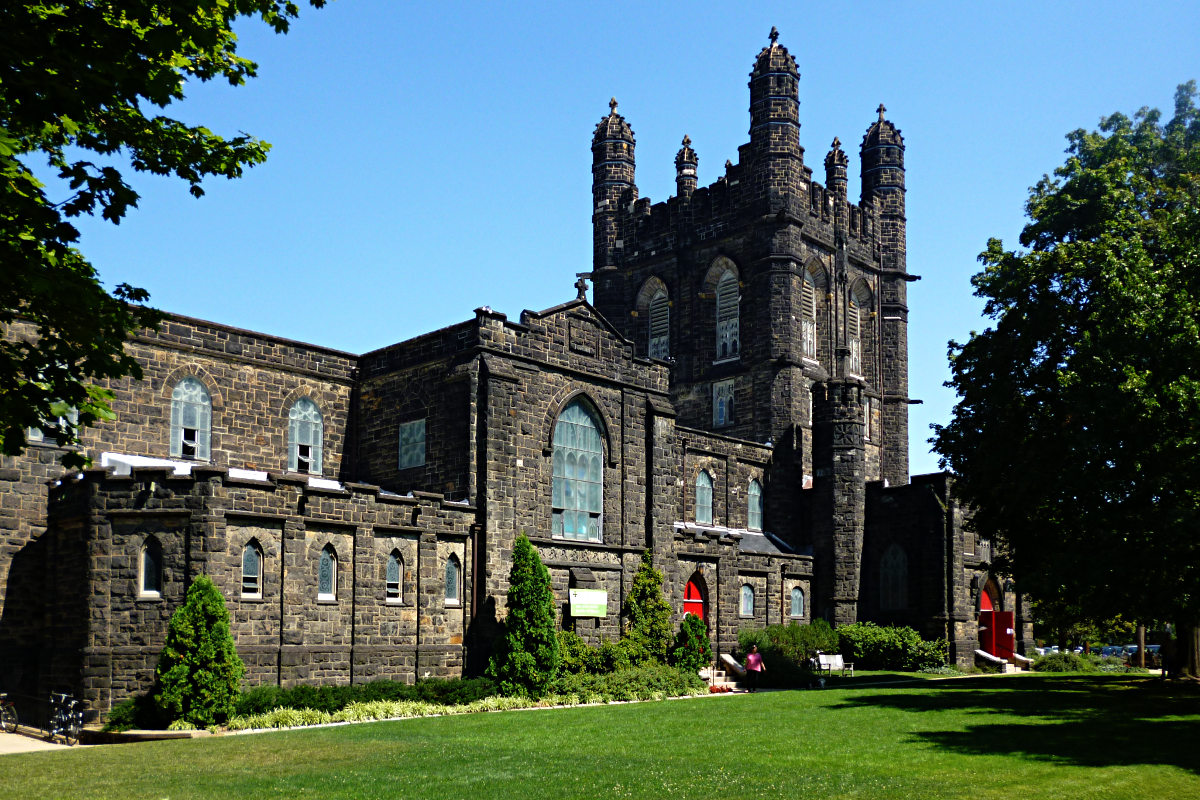
    Right on the border between Oakland and Shadyside, the Church of the Ascension is one of the diminishing number of black stone buildings in Pittsburgh. Father Pitt hopes that his pictures will preserve the memory of our black stones when the last stone building has been sandblasted.

    2013-08-24-Shadyside-Church-of-the-Ascension-03
    2013-08-24-Shadyside-Church-of-the-Ascension-02


  • St. Augustine

    2013-08-18-Lawrenceville-St-Augustine-01

    St. Augustine reads to the people of Lower Lawrenceville from the front of the church that bears his name.

  • Grace Lutheran Church, Troy Hill

    2013-07-22-Troy-Hill-Grace-Lutheran-01

    Taller than it is long, Grace Lutheran Church occupies a tiny space in the narrow streets of Troy Hill, a traditionally German neighborhood straddling a narrow hilltop above the Allegheny.

  • Black Stones of Fourth Presbyterian in Friendship

    2013-06-27-Friendship-Fourth-Presbyterian-01

    Pittsburgh used to be a city of massive black stone buildings, but, since the end of the age of steel, the buildings have been cleaned one by one, revealing the actual color of the stones as they came out of the quarry. Few of the black stone buildings are left. Here is one of them: Fourth Presbyterian in Friendship. Over the years, the stones are gradually losing their sooty coating, revealing what looks like red sandstone underneath. But they are still strikingly black, the way all proper Pittsburgh stones used to be.