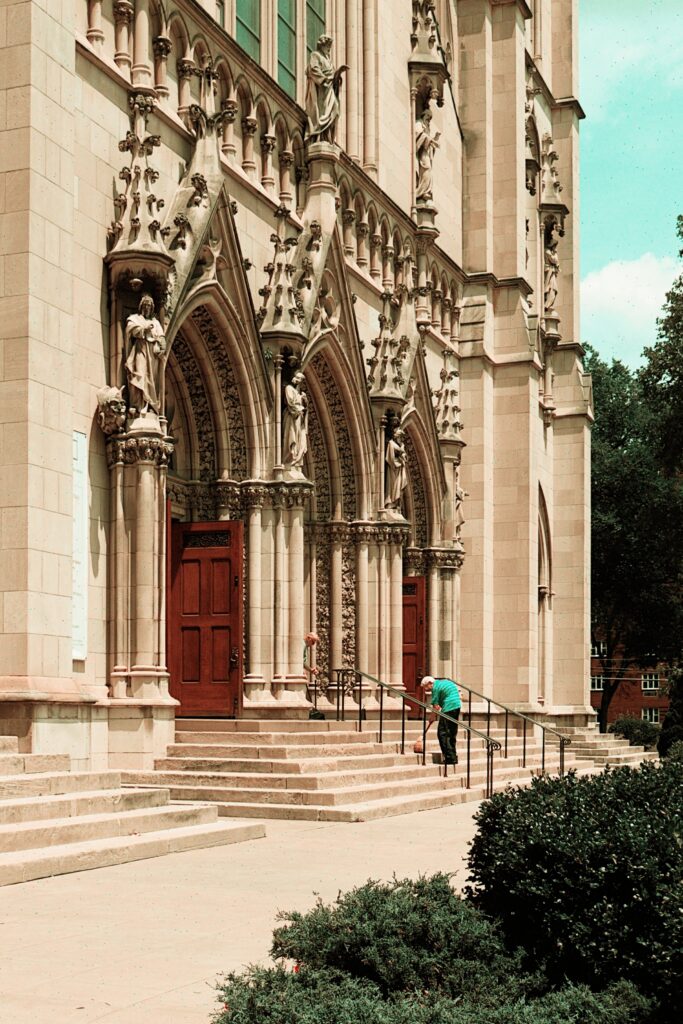

A small but very tasteful church (finished in 1909) that faces the beautiful expanse of West Park across North Avenue. The architect, according to this brochure, was Robert Maurice Trimble, a native of Allegheny.

A small but very tasteful church (finished in 1909) that faces the beautiful expanse of West Park across North Avenue. The architect, according to this brochure, was Robert Maurice Trimble, a native of Allegheny.

Like most of the other churches on the South Side, this one—at 15th and Roland Streets—has been repurposed, in this case as a studio. But its outward appearance has hardly changed.


Like many other churches on the South Side, this one is becoming loft apartments. The exterior, at any rate, will be preserved.
Camera: Canon PowerShot 590 IS.
Addendum: The architect was Marius Rousseau, according to the parish’s Golden Jubilee book.

Now Brush Creek Salem United Church of Christ, this beautiful and stately building is nearly 200 years old: it was built somewhere around the years 1816-1820, serving the colonial-era community of Brush Creek outside Irwin. The adjacent Brush Creek Cemetery has marked burials going back to the 1700s, with some extraordinary works of folk art among the tombstones.


Formerly Union Presbyterian Church, this congregation has been here more than two centuries. In the adjacent burying ground are several Revolutionary War veterans, and the hilltop church with the cemetery below is irresistibly picturesque.
Old Pa Pitt, however, could not get a good picture of the church today, because he was there in the afternoon when the sun was shining in the wrong direction. So instead he gives you the next best thing, which is an atmospheric picture. You can always compensate for a picture’s defects by turning it black and white and calling it art.

North Zion Lutheran Church is about a mile due south of Zion Lutheran Church in Baldwin Borough. Father Pitt will leave worrying about the cardinal directions to foreigners; Pittsburghers expect everything to be turned upside-down or sideways. The main part of the little church was built in 1859, and the congregation that inhabits it has been here for more than two centuries. Burials in the graveyard adjacent go back to 1812, but the earliest legible tombstones seem to be from the 1840s.

This splendid Gothic church sits on Sixth Avenue right next to Trinity Cathedral (Anglican/Episcopal) and right across from the Duquesne Club, forming a perfect triangle of old money. The architect was Theophilus P. Chandler, Jr., who also designed Third Presbyterian in Shadyside and the Duncan mausoleum in the Union Dale Cemetery.
An interesting feature of the front is the outdoor pulpit, perfectly positioned for thundering denunciations at the rich robber barons coming out of the Duquesne Club. But that never happens.


Now the home of St. John of God Parish, this is a splendid Gothic church that many another Catholic diocese would be proud to have for its cathedral. The fact that there are literally dozens of churches equally splendid in Pittsburgh and its surroundings is something Pittsburghers simply accept, but it absolutely astonishes outsiders. This one took four years to build; it opened in 1905. The architect was Akron-based William P. Ginther.


Here we see the main entrance and the top end of the improvised wooden wheelchair ramp, which looks like a Kennywood ride—perfectly safe but rather exciting.

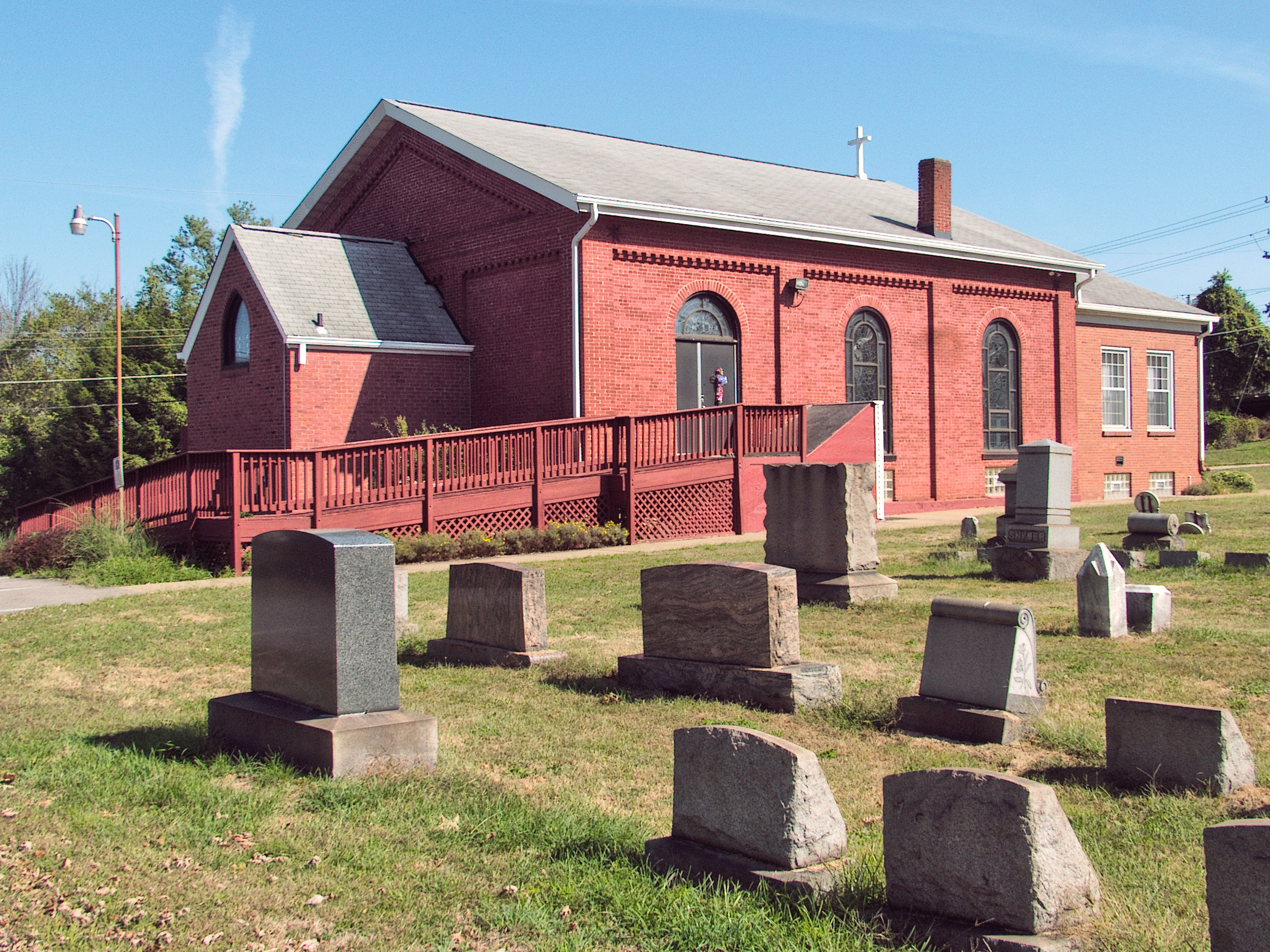
This was originally the German parish in this part of McKees Rocks. Above we see it from the parish cemetery, which is on a hilltop overlooking McKees Rocks in Kennedy Township.

William P. Ginther also designed the adjoining rectory, which is certainly a fine place to keep one’s priests.


In the original version of this article, Father Pitt said that he did not know the original purpose of this building, but he guessed it was a convent. The guess was right: note the comment from Shelley below, for which old Pa Pitt is very grateful, confirming that this was where the sisters lived. A correspondent informs us that the architects were Link, Weber & Bowers, and the convent was built in 1930.