
It is almost impossible to take an ugly picture of the terminal at Allegheny County Airport. It was designed by Stanley Roush, the king of public works in Allegheny County. The airport engineer was G. Brooks Ross, shown here hard at work on his plans.

When it opened in 1931, the Allegheny County Municipal Airport was at least arguably the largest and most sophisticated airport in the world. When we consider that 1931 was only four years after Lindbergh’s flight, and that the site and general size of the airport had been decided on in 1928, we realize what a huge gamble this airport was: the future of air travel was unknown, and it required far-sighted faith to believe that an airport of this size would be required in years to come. (Even now a 737 can land here if it’s necessary.) It also required quite a bit of complicated financial trickery from the Republican majority on County Council and their allies, as Post-Gazette cartoonist Cy Hungerford points out.

Under the old county charter, County Council had two members from the majority party and one from the minority party. Everything was done behind the sputtering Democrat’s back, and he found out about it in the papers like the rest of us as the cost of the Municipal Airport went up and up. This, by the way, was one of the last great projects of the Allegheny County Republican machine, before the Democratic tide swept in with Franklin Roosevelt.

The faith was more than justified. By the end of the Second World War, air traffic had increased to such an extent that an even larger airport was needed; and County Airport had already filled its site to the practical limit. Thus Greater Pitt was built out in the western suburbs, and all the scheduled commercial flights moved there. But County Airport, much closer to downtown, remained the favorite airport for private and corporate planes. Today it is still the fifth-busiest airport in Pennsylvania, with about 160 flights a day.

And that is the almost unique combination of needs that pickled this airport in the 1930s. (We say almost unique because Cincinnati’s municipal airport of the same era has survived for the same reasons.) Greater Pitt has been rebuilt twice since it opened in 1952, because the needs of commercial air traffic keep changing. But this airport has remained exactly the right size for the traffic it handles. The striking Art Deco terminal is such a perfect period piece that it often plays The Airport in movies set in the 1930s; except for covering the inscription with a suitable city name (and carefully framing to cut out the more recent control tower), the building is ready for filming.
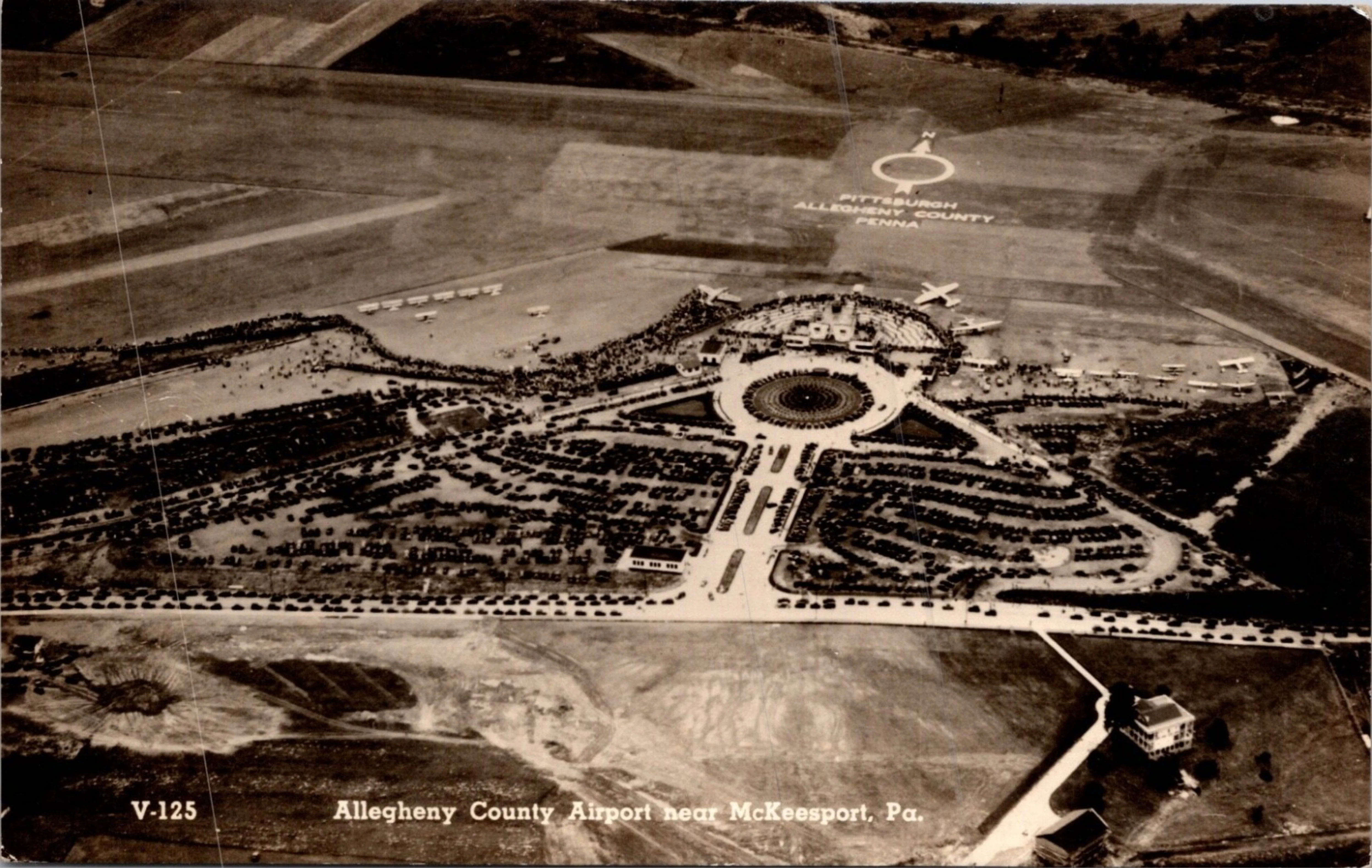
No current pictures can convey how carefully this airport was designed to make its impression from the air, but fortunately we have this 1941 postcard. Not only was the air traveler supposed to be impressed by the magnificent portal to Pittsburgh, but the design was also—in the days when all air navigation was visual—extraordinarily helpful to pilots. The broad boulevard that leads to the terminal was a fat arrow pointing due north toward the airport. The directions were immediately obvious. For pure decoration, the zigzag patterns of the terminal were echoed in a semicircle of pavement behind the building—now, alas, plain asphalt. Today, the view from above is a cluttered mess, because the airport grew more buildings and the area around it suburbanized. But when it opened in 1931, the airport was a beautiful abstract design from the air, complete with a huge identifying label in the airfield.

Now let’s step inside the terminal and wander around for a bit.
And first, before we go on, we should note that one concession remains from the old days. There is still a barber shop at the entrance to the waiting room; it has been grandfathered in through all the recent restorations and renovations.

Art Deco lettering still marks the various facilities in the terminal, although this particular facility no longer exists. No one wants a public telephone anymore.


A compass rose greets us as we walk down into the waiting room. The terminal is oriented exactly along the cardinal directions.


The interior of the building is not quite as perfectly preserved as the exterior. It went through various renovations, and is now going through a combination of renovation and restoration that has brought it closer to its original appearance while adding modern facilities and accessibility.


Between flights, you can relax in the comfortable seating area on the balcony and keep up to date on the latest aviation information. Well, maybe not quite the latest.

This odd beast is a rotating-beam ceilometer, which is not something you see every day. It measures the height of the base of the clouds above. Of course, to do that, it needs a separate detector, and it needs to be outside, or it will never measure anything but the height of the ceiling in the waiting room. This faithful servant, originally installed in the 1970s, is now retired; it has been replaced by more sophisticated equipment.

If we walk out the back door, we find ourselves right against the airfield. Picnic tables are set up behind the terminal, and families bring their children to watch the planes take off and land.


Plaques on the rear of the building mark a 1936 expansion. Here the architect was Henry Hornbostel. Almost alone among big-name Pittsburgh architects, Hornbostel was a lifelong Democrat, and he was ready when the Democratic tide rolled in. He got himself appointed Director of Parks and Aviation (note that interesting combination), and we the people still benefit from some of his extraordinary public works—see, for example, the unique neo-Maya golf clubhouse in South Park.


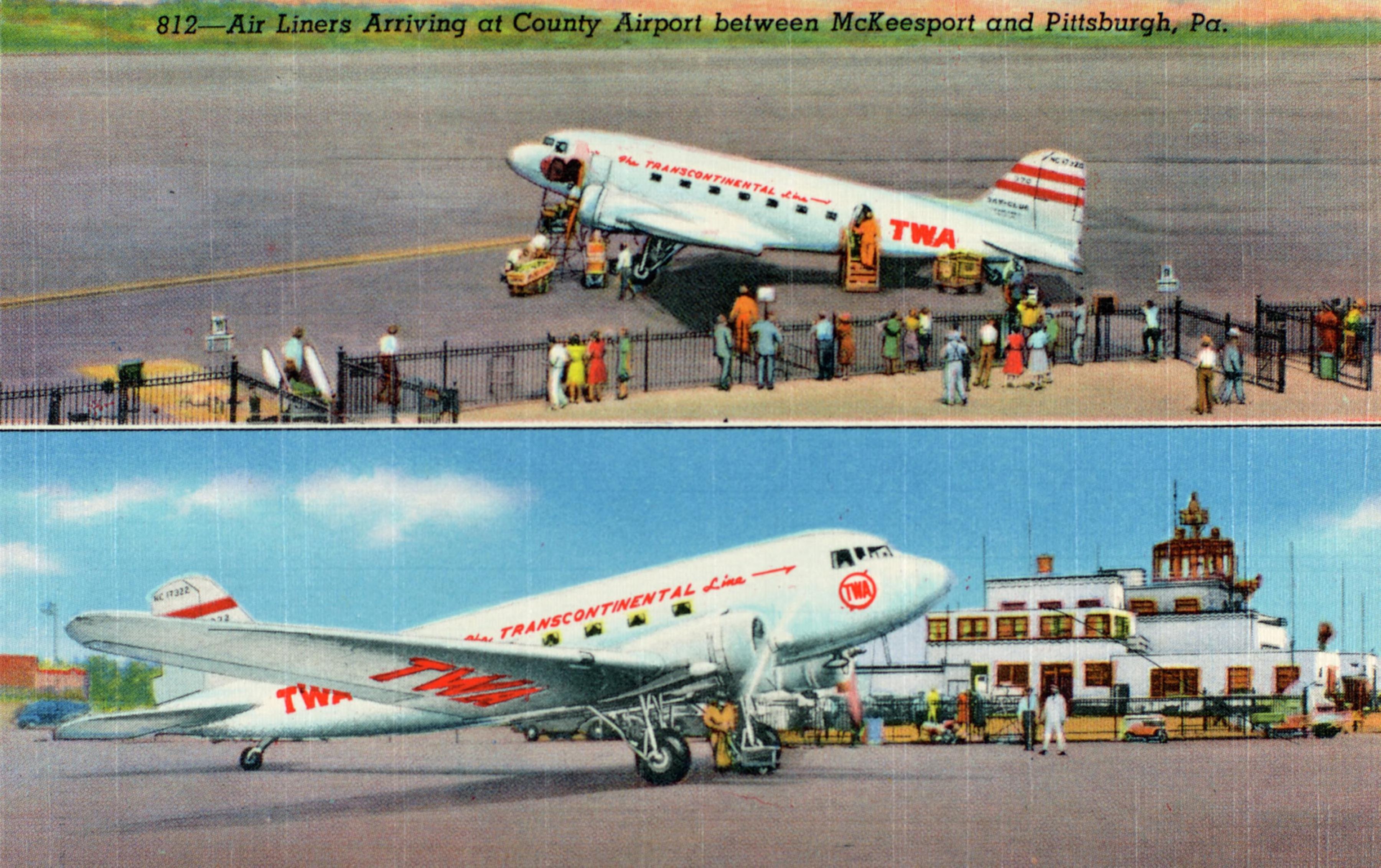
The rear of the terminal would have impressed arriving passengers with the idea that Pittsburgh was an up-to-date place with all the latest modern ideas. This 1941 postcard helps us imagine that impression.


The terminal is only the public face of the airport. Many more buildings make up the workings of a large airport. Here are a few hangars, where airplanes go to rest after a workout.

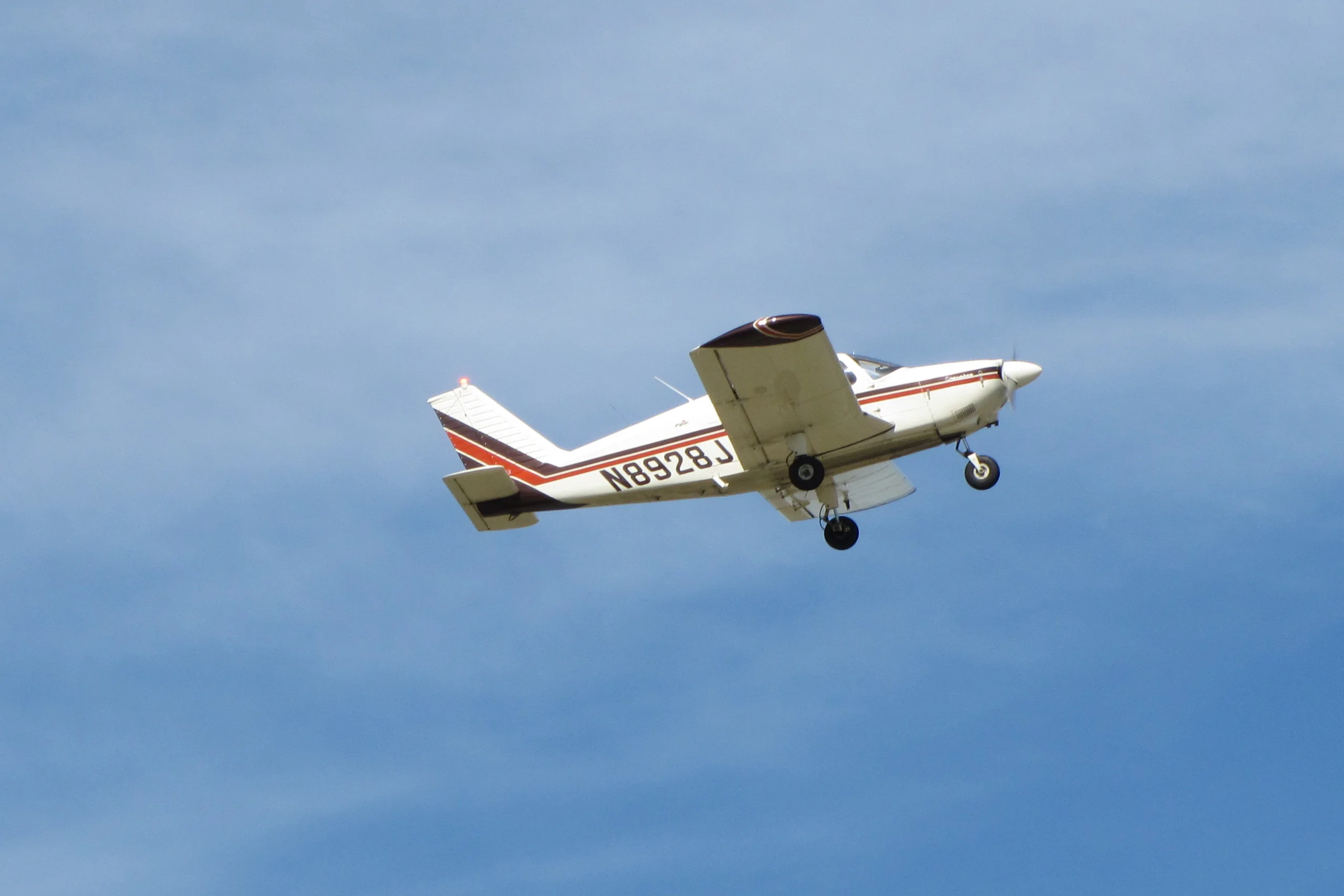
This low-wing single-engine plane is going through its checklist getting ready for takeoff. With all the marvelous advances in technology we have seen since the Wright Brothers, the checklist is still one of aviation’s most powerful discoveries.

Now we walk back around to the front again to admire some of the details of the terminal.

The decorations at the entrance seem to have been inspired by pre-Columbian American architecture and art.


These Deco urns flank the entrance, festooned with decorations emblematic of flight.


And, of course, even the building itself has wings.

A number of outbuildings carry the black-and-white design, with its emphasis on horizontality, to other parts of the grounds.


So now that you have seen County Airport, you owe yourself a visit. There are no security checkpoints to hold you up, no traffic jams at the terminal—just a beautiful building with gobs of history and some interesting explanatory exhibits. Bring a picnic lunch, take over one of the tables in the back, and watch every kind of private aircraft come and go. There are many worse ways to spend an afternoon.


Leave a Reply