Tag: Fountains

  • Allegheny County Airport

    Allegheny County Airport terminal with fountain

    It is almost impossible to take an ugly picture of the terminal at Allegheny County Airport. It was designed by Stanley Roush, the king of public works in Allegheny County. The airport engineer was G. Brooks Ross, shown here hard at work on his plans.

    G. Brooks Ross with ruler at desk
    Pittsburgh Post-Gazette, March 28, 1929.

    When it opened in 1931, the Allegheny County Municipal Airport was at least arguably the largest and most sophisticated airport in the world. When we consider that 1931 was only four years after Lindbergh’s flight, and that the site and general size of the airport had been decided on in 1928, we realize what a huge gamble this airport was: the future of air travel was unknown, and it required far-sighted faith to believe that an airport of this size would be required in years to come. (Even now a 737 can land here if it’s necessary.) It also required quite a bit of complicated financial trickery from the Republican majority on County Council and their allies, as Post-Gazette cartoonist Cy Hungerford points out.

    Cartoon showing many kinds of aircraft spending the tax-payer’s dough
    From the Pittsburgh Post-Gazette, September 12, 1931.

    Under the old county charter, County Council had two members from the majority party and one from the minority party. Everything was done behind the sputtering Democrat’s back, and he found out about it in the papers like the rest of us as the cost of the Municipal Airport went up and up. This, by the way, was one of the last great projects of the Allegheny County Republican machine, before the Democratic tide swept in with Franklin Roosevelt.

    Tower and inscription: Allegheny County Airport

    The faith was more than justified. By the end of the Second World War, air traffic had increased to such an extent that an even larger airport was needed; and County Airport had already filled its site to the practical limit. Thus Greater Pitt was built out in the western suburbs, and all the scheduled commercial flights moved there. But County Airport, much closer to downtown, remained the favorite airport for private and corporate planes. Today it is still the fifth-busiest airport in Pennsylvania, with about 160 flights a day.

    Terminal

    And that is the almost unique combination of needs that pickled this airport in the 1930s. (We say almost unique because Cincinnati’s municipal airport of the same era has survived for the same reasons.) Greater Pitt has been rebuilt twice since it opened in 1952, because the needs of commercial air traffic keep changing. But this airport has remained exactly the right size for the traffic it handles. The striking Art Deco terminal is such a perfect period piece that it often plays The Airport in movies set in the 1930s; except for covering the inscription with a suitable city name (and carefully framing to cut out the more recent control tower), the building is ready for filming.
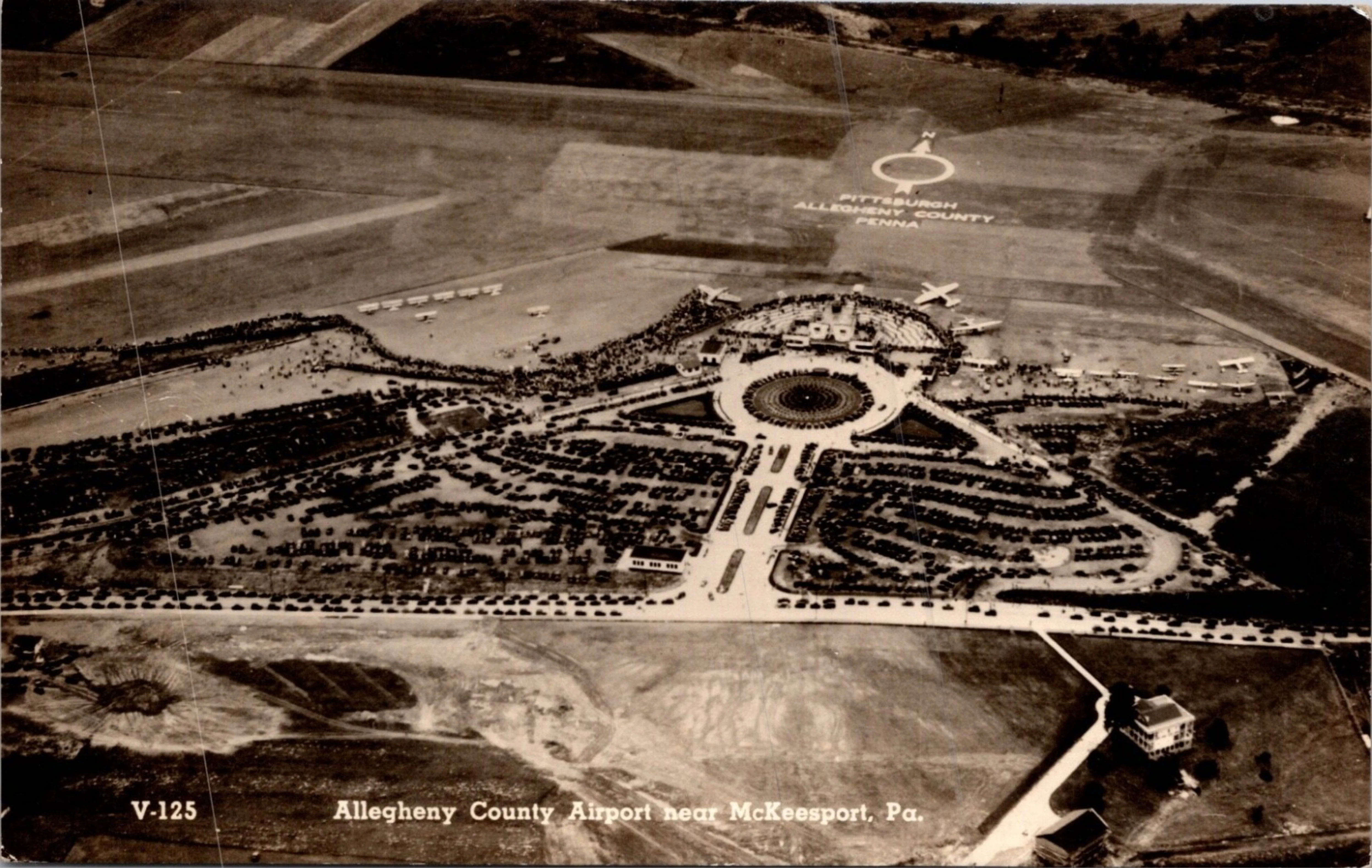
    No current pictures can convey how carefully this airport was designed to make its impression from the air, but fortunately we have this 1941 postcard. Not only was the air traveler supposed to be impressed by the magnificent portal to Pittsburgh, but the design was also—in the days when all air navigation was visual—extraordinarily helpful to pilots. The broad boulevard that leads to the terminal was a fat arrow pointing due north toward the airport. The directions were immediately obvious. For pure decoration, the zigzag patterns of the terminal were echoed in a semicircle of pavement behind the building—now, alas, plain asphalt. Today, the view from above is a cluttered mess, because the airport grew more buildings and the area around it suburbanized. But when it opened in 1931, the airport was a beautiful abstract design from the air, complete with a huge identifying label in the airfield.

    Waiting Room entrance

    Now let’s step inside the terminal and wander around for a bit.

    We have dozens of pictures to show you, so to avoid weighing down the front page too much, we’ll put the rest behind this link.
  • Courtyard Garden of Dover Gables, Shadyside

    A peek at Dover Gables

    The thick and high evergreens leave just enough gap to make the entrance to an enchanted world. So it seems from the street, and the garden beyond the mystic gate does not disappoint us.

    Garden court of Dover Gables
    Dover Gables

    Dover Gables is still a bit of a mystery to old Pa Pitt; no one seems to have pinned down the architect. The combination of simple Tudor-style rows of houses with lush landscaping crams the greatest load of picturesqueness possible into a tiny patch of land.

    Fountain
    Canon PowerShot SX20 IS.

    We have more pictures of Dover Gables from three years ago.


    Comments
  • Fountain at Heinz Chapel

    Fountain at Heinz Chapel

    Once again, old Pa Pitt has set his shutter to the highest speed possible, just because no one else these days would take a picture of a fountain that way. If you would like a picture taken with a slow shutter speed that shows the fountain as an eruption of cotton candy, you can take your own picture.

    In honor of Pat and Charlie Gibbons 50th anniversary, June 9, 1968
    Fountain at Heinz Chapel
    Canon PowerShot SX20 IS.

    Comments
  • Northeast Fountain, Allegheny Commons

    Northeast Fountain

    There are not enough fountains in Pittsburgh, and too many have vanished or been allowed to decay. This one was restored in 2019, and it is now a favorite spot for hospital workers from Allegheny General across the street to sit and relax on their lunch breaks.

    Northeast Fountain
    Northeast Fountain
    Northeast Fountain
    Northeast Fountain

    Old Pa Pitt has written elsewhere about how much he hates the cliché of slow shutter speeds for moving water. In these pictures, he made sure to use no shutter speed slower than a thousandth of a second.

    Northeast Fountain
    Northeast Fountain
    Northeast Fountain
    Northeast Fountain
    Northeast Fountain
    Sony Alpha 3000 with 7Artisans F/1.4 35mm lens; Canon PowerShot SX20 IS.

    Comments
  • Oliver Building from Mellon Square

    Oliver Building with fountains of Mellon Square in foreground
    Composite of two photos from the Canon PowerShot SX20 IS.
  • Waterfall at PNC Firstside Center

  • Entrance to One Mellon Center (BNY Mellon Center)

    Entrance to BNY Mellon Center

    In theory there is no reason to take digital pictures in black and white, since they can always be desaturated later. In practice, knowing that the picture will never have any colors in it makes one think more in terms of lines and shadows. Here are two pictures taken with a camera from the Neolithic era of digital cameras, which Father Pitt keeps set to black-and-white mode.

    Fountains in front of the entrance to One Mellon Center
    Samsung Digimax V4.

    Comments
  • Gateway to Gateway Center

  • Gateway Center Fountain in Pink

    Gateway Center fountain dyed pink

    The fountain at Gateway Center dyed pink for breast-cancer awareness.

    Gateway Center fountain dyed pink
    Fujifilm FinePix HS10.
  • Gateway Center

    Gateway Center

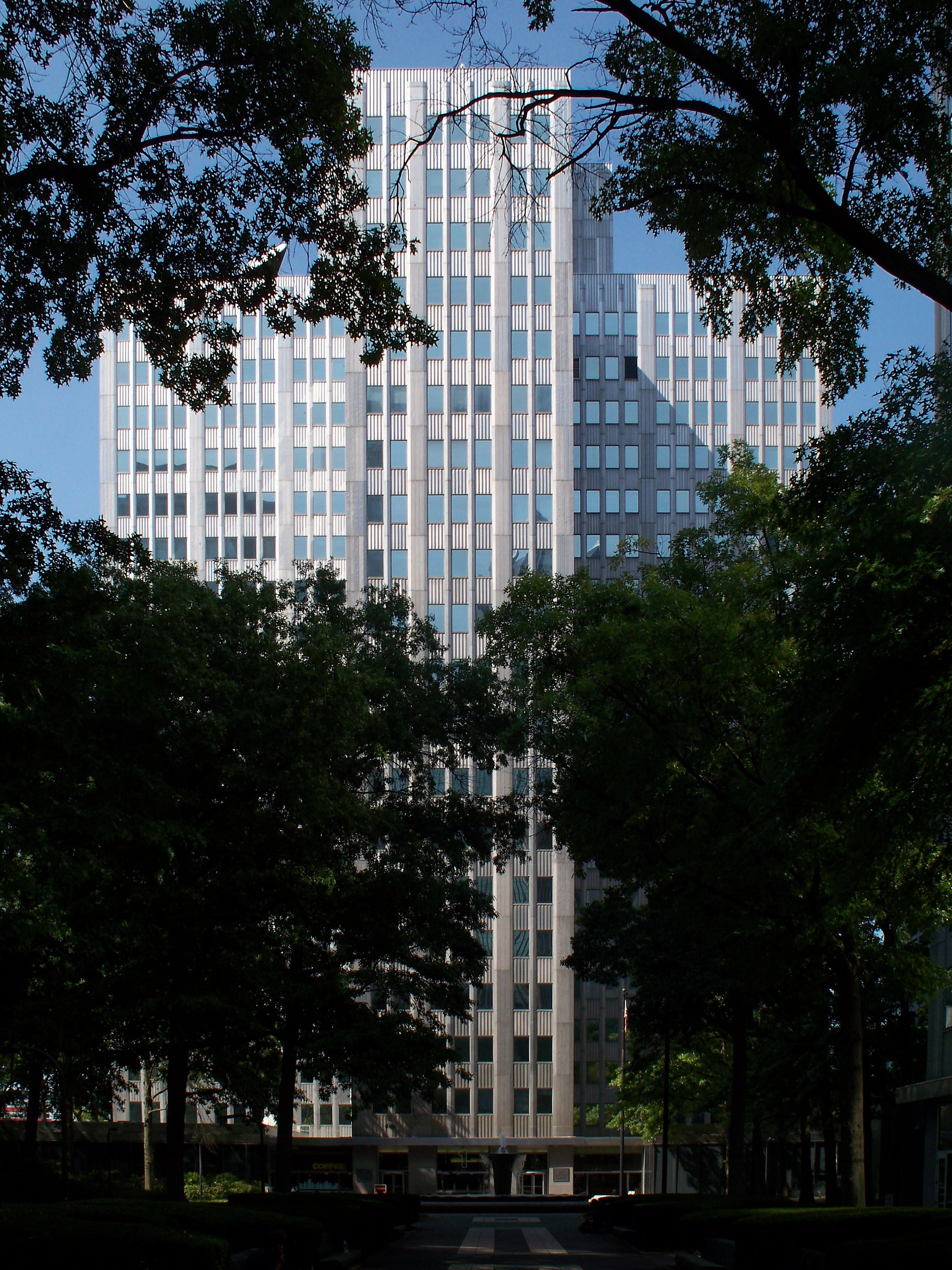
    The gleaming modernist towers of Gateway Center in afternoon sunshine.

    Gateway Center
    Fountain at Gateway Center

    Did you notice how Father Pitt did not slow down the shutter speed for the flowing water, the way every photography site on the Internet dogmatically insists you must do it? Did you notice the fascinating patterns of falling water that were captured by the deliberately fast shutter? Are you ready yet to abandon the dentist’s-office-wall-decor cliché of slow shutter speeds for waterfalls and fountains? You can join the rebel alliance!

    The picture above is made from three separate photographs at different exposures, which gives us a better range of detail—but it also adds to the complexity of the play of falling water. To approximate the golden color of the late-afternoon sunshine, it was then put through a simulated Kodachrome 64 filter, with many thanks to the obsessive fiddler who did his best to match the color and light response of Kodachrome film so that the rest of us can have at least an echo of that Kodachrome look. Since Kodachrome has been extinct for fifteen years, this is as much as we can do.

    One Gateway Center
    One Gateway Center
    Gateway Center
    Gateway Center
    Kodak EasyShare Z1285; Canon PowerShot SX150 IS; Samsung Galaxy A15 5G.