Father Pitt

Category: Downtown

  • Tower Two-Sixty

    For the first time since the 1980s, downtown Pittsburgh has two skyscrapers going up at once (the other being the Tower at PNC Plaza). The project was begun as “the Gardens at Market Square,” but became “Tower Two-Sixty” at about the time construction began. The skeleton has risen, and now the skin begins to take shape.

  • William Penn Hotel

    Here we see the William Penn Place side of the William Penn Hotel. The Grant Street front presents a solid wall to the street, but this side is divided by two light wells, which are necessary in a building that takes up a whole city block. The arched bridges connecting the upper floors are graceful touches that add to the apparent unity of the design, which is the work of Benno Janssen, one of Pittsburgh’s favorite architects for many years..

  • Dallmeyer Building, Liberty Avenue

    Dallmyer Building

    The Dallmeyer Building spent decades behind a nondescript modernist façade until a few years ago, when the modern accretions were ripped off to reveal this perfect gem behind them.

  • Oliver Building

    Front elevation of the Oliver Building

    Henry W. Oliver wanted to leave a mark on Pittsburgh, and he certainly did. Virgin Alley was renamed Oliver Avenue, and he planned this building to be the tallest in Pittsburgh. It was the tallest when it opened in 1910, although Oliver himself didn’t live to see it finished. As architect, he hired Daniel Burnham, the great Chicago beaux-arts master for whom Pittsburgh was practically a second home—there are more Burnham buildings here than anywhere else but Chicago.

    Base of the Oliver Building
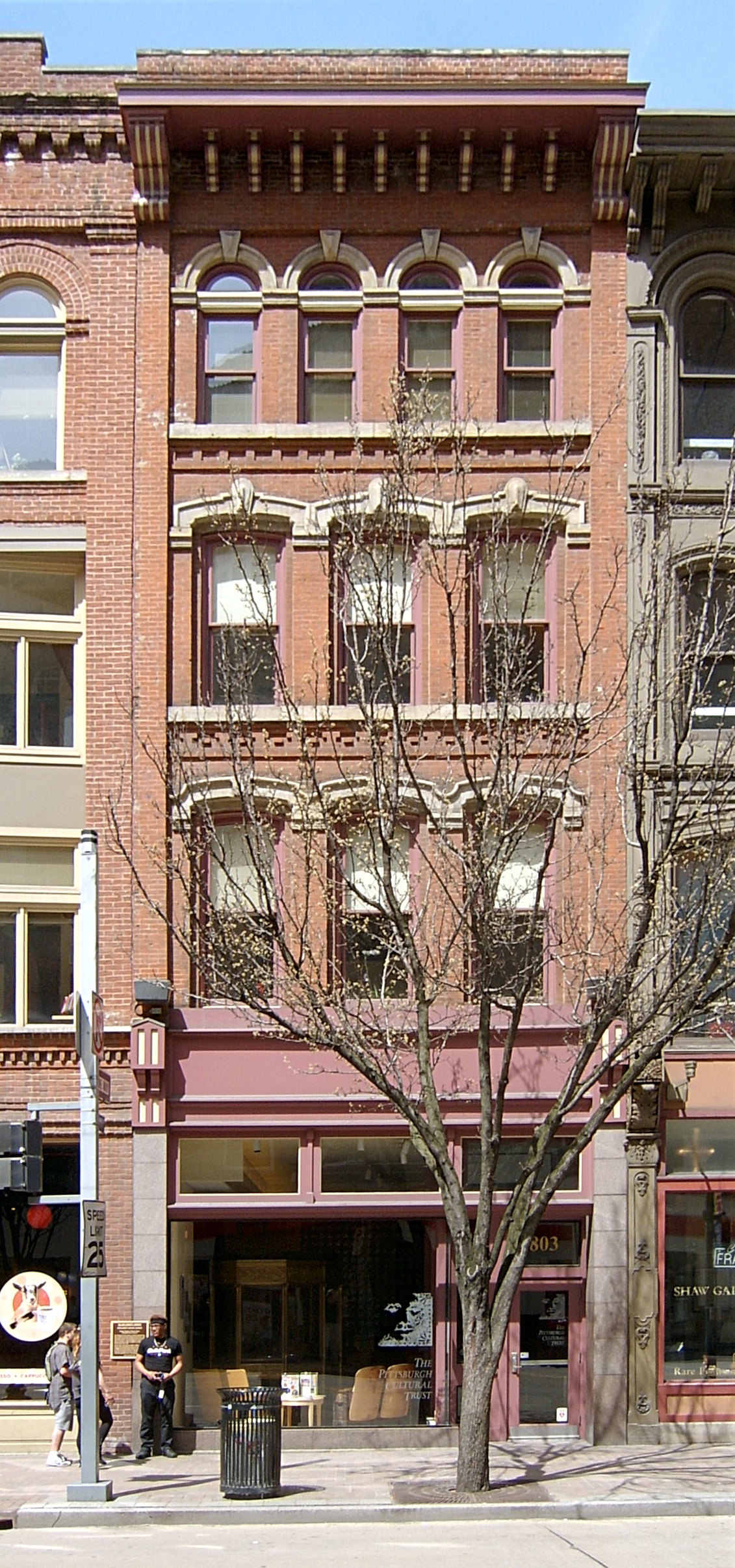
  • 803 Liberty Avenue

    The Pittsburgh Cultural Trust lives in this gorgeously restored building with a wonderfully checkered history. It has been, among other things, a hotel and an adult bookstore, where (presumably) all the books were over 21 years old.

    Camera: Samsung Digimax V4.
  • 819 and 821 Penn Avenue

    Both these buildings are quite utilitarian, with ground-floor storefronts and upper-floor workshops; but each is adorned with its own distinctive classical detailing. The Greek-key pattern shows up on both, but no. 819 in particular adds a profusion of other ornaments that distinguish it from its neighbors.

    Once again, the narrowness of Penn Avenue makes it difficult to get a complete picture of the façades of these buildings, so the tops are a little blurry.

  • McNally and Bonn Buildings, Penn Avenue

    These two buildings, like many in the Cultural District, are going residential. Though the styles are radically different—the McNally Building light and classical, the Bonn Building heavy and Romanesque—they are only three years apart: the McNally building was put up in 1896, the Bonn Building in 1893.

    Penn Avenue is a very narrow street, and getting a picture of the whole front of a nine-story building involves a lot of fiddling, most of it done by the Hugin stitching program automatically. Thus the picture is a bit fuzzy toward the top.

  • Hoffstot Building and Neighbor, Liberty Avenue

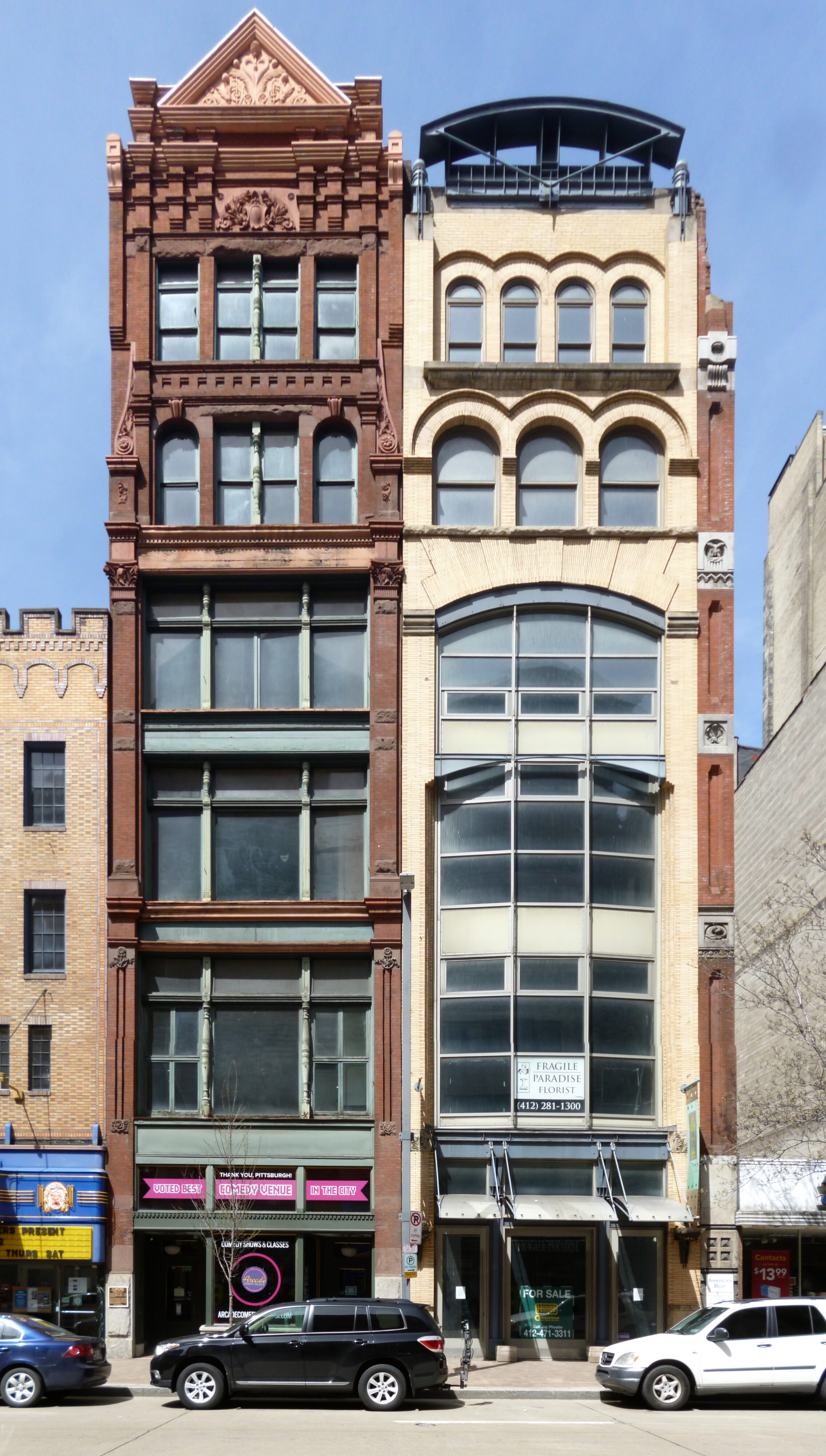
    Two buildings on Liberty Avenue

    The Hoffstot Building (left) and its neighbor at 813 Liberty Avenue both have the large windows that indicate workshops of some sort on the upper floors. No. 813 has grown some curious postmodern excrescences at the top and an industrial-looking awning at ground level. It also preserves the left edge of a demolished building, now replaced by a one-story shop, that must have been interestingly ornamental.

  • Renshaw Building and Kirkpatrick Building, Liberty Avenue

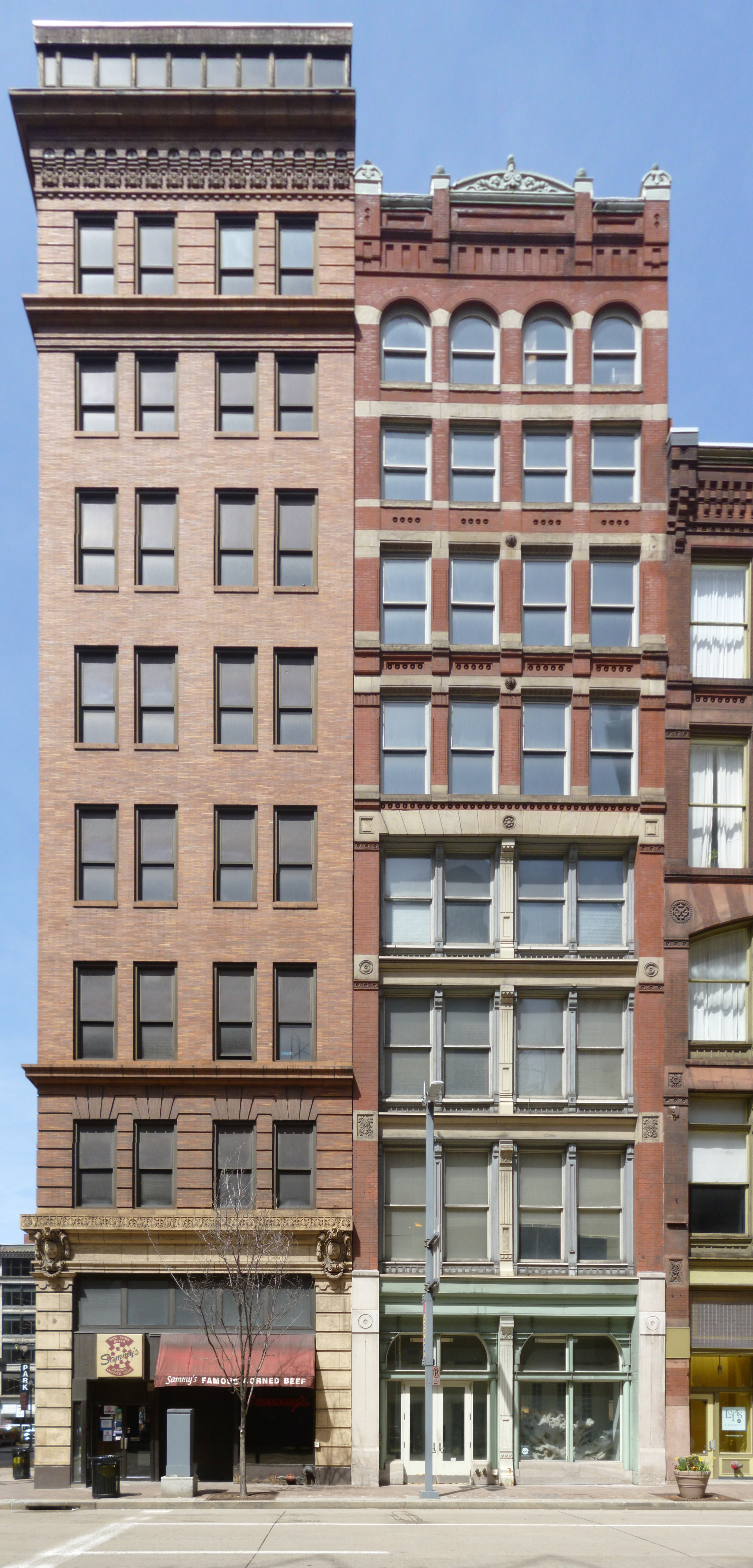
    The Renshaw Building (left) was built in 1908; it is architecturally interesting for the way it duplicates the base-shaft-cap form of a standard beaux-arts skyscraper in miniature.

    The Kirkpatrick Building was built a quarter-century earlier in 1884. A cast-iron front on the first four floors gives way to standard Victorian Romanesque brickwork in the upper half.

  • Maginn Building, Liberty Avenue

    The Maginn Building was one of several Romanesque designs by the prolific Charles Bickel. The large windows of the upper floors indicate that it was built as some kind of workshop or small factory, of which there were many in this section of town.