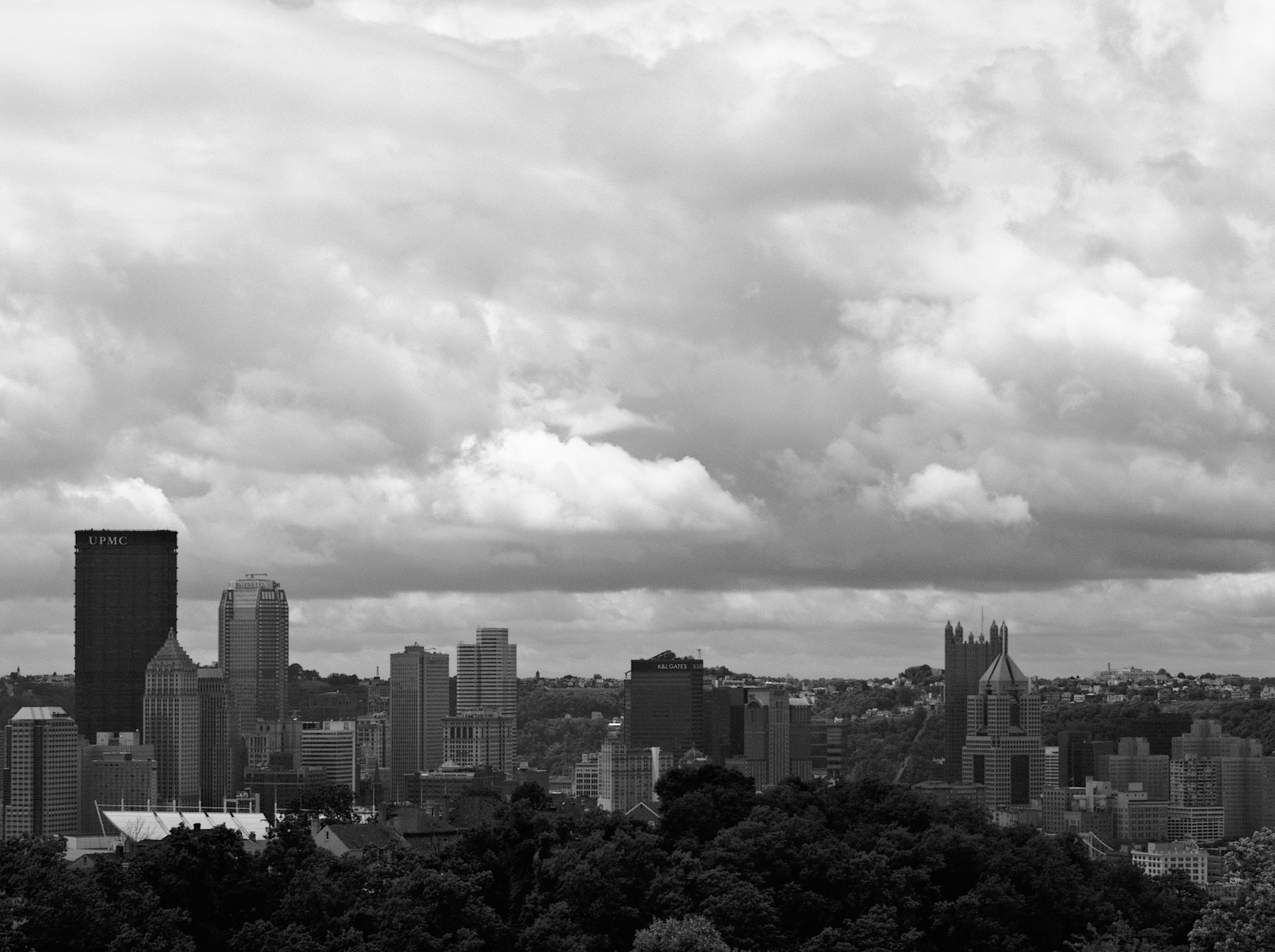
Mount Washington is the favorite skyline viewing post, but the views from across the Allegheny are impressive in their own way. These pictures were taken just as the sun was setting.
This is an early work of Tasso Katselas, whose public buildings litter our landscape. Every generation seems to produce a favorite court architect, the darling of the Allegheny County nobility, and Tasso Katselas was that architect until his retirement about ten years ago.
This particular building, built in 1966 as Allegheny Towers, is on many short lists of the ugliest buildings downtown, and Father Pitt tends to agree with that assessment. It is a parking garage halfway up; then, on top of that, there is a stack of miscellaneous apartments that look as though someone piled them there temporarily, intending to slide them into a finished building later. There is no rhythm to the apartment section, not even a jazzy syncopation; the windows are random noise. Compare it to the one arm of the cool and elegant Two Gateway Center behind it and to the left, or the textured glass wall of PPG Place behind that, and its lack of harmony will be immediately apparent.
But Father Pitt would not have you dismiss Tasso Katselas on the basis of this one building, which is probably very comfortable for the residents. He has given us buildings Father Pitt loathes with a passion, and buildings Father Pitt loves with an immeasurable love. His Pittsburgh International Airport terminal is peerless: the best airport terminal Father Pitt has ever seen. It minimizes the distances between the farthest gates; it controls security easily (and remember that it was built at a time when security was not nearly so much of an obsession as it is now); and it is the only airport terminal Father Pitt knows where every word of the pages and announcements is clearly audible. How many times have you been in another airport and found yourself thinking, “I hope Mrnmkh Pthhrmrmpt recognizes his name, because I certainly don’t”? That never happens at Pitt, and it took some serious architectural thinking to make those acoustics happen.
And that is the thing that probably made Tasso Katselas’ career: his buildings may be beautiful or ugly, but they are almost always practical. They work very well for their intended purposes, because the architect has clearly taken accommodating those intended purposes as his first duty, rather than as a luxury that one might be able to afford after one has indulged one’s pet design obsessions.
Built in 1921 for the Keystone Grocery and Tea Company, a grocery chain that did not live a long life (Father Pitt has not been able to find any reference to it after 1927), this is now Shannon Hall, student housing for the Art Institute of Pittsburgh. It is a fine example of how a utilitarian building can be made, if not beautiful, at least not ugly, by well-worked-out proportions and a tasteful choice of materials.
“Towers in a Park” was the ideal urban paradise of the International Style architects. It seldom worked well, and Father Pitt will tell you why: because the architects concentrated on the towers, and neglected the park. Gateway Center is one of the few really successful towers-in-a-park developments, and it is successful because the park is so attractive—benches everywhere, beautiful landscaping, and (of course) the vendors’ tents of the Three Rivers Arts Festival every June.
This building now houses the Wood Street station on the ground floor (and below, of course) and the Wood Street Galleries, a free museum of installation art, on the upper floors. It was put up for the Monongahela National Bank, and the architect was Edward Stotz, who also gave us Schenley High School—another triangular classical building. It makes one wonder whether Mr. Stotz printed “Specialist in Triangles” on his business cards.
The elevator towers at the corners are later additions. They make a mess of the carefully worked out proportions of the building—Father Pitt thinks they make the whole structure look a bit like a fat rabbit—but at least they are done with similar materials.