The Bank Tower, as it is now called, has a brand-new painted sign on the back side. The building, finished in 1902, was designed by the prolific firm of Alden & Harlow, Andrew Carnegie’s favorite architects.
[A correction: An earlier version of this article identified Alden & Harlow as a Boston firm, but they had moved to Pittsburgh by this time, leaving their former partner Longfellow behind.]
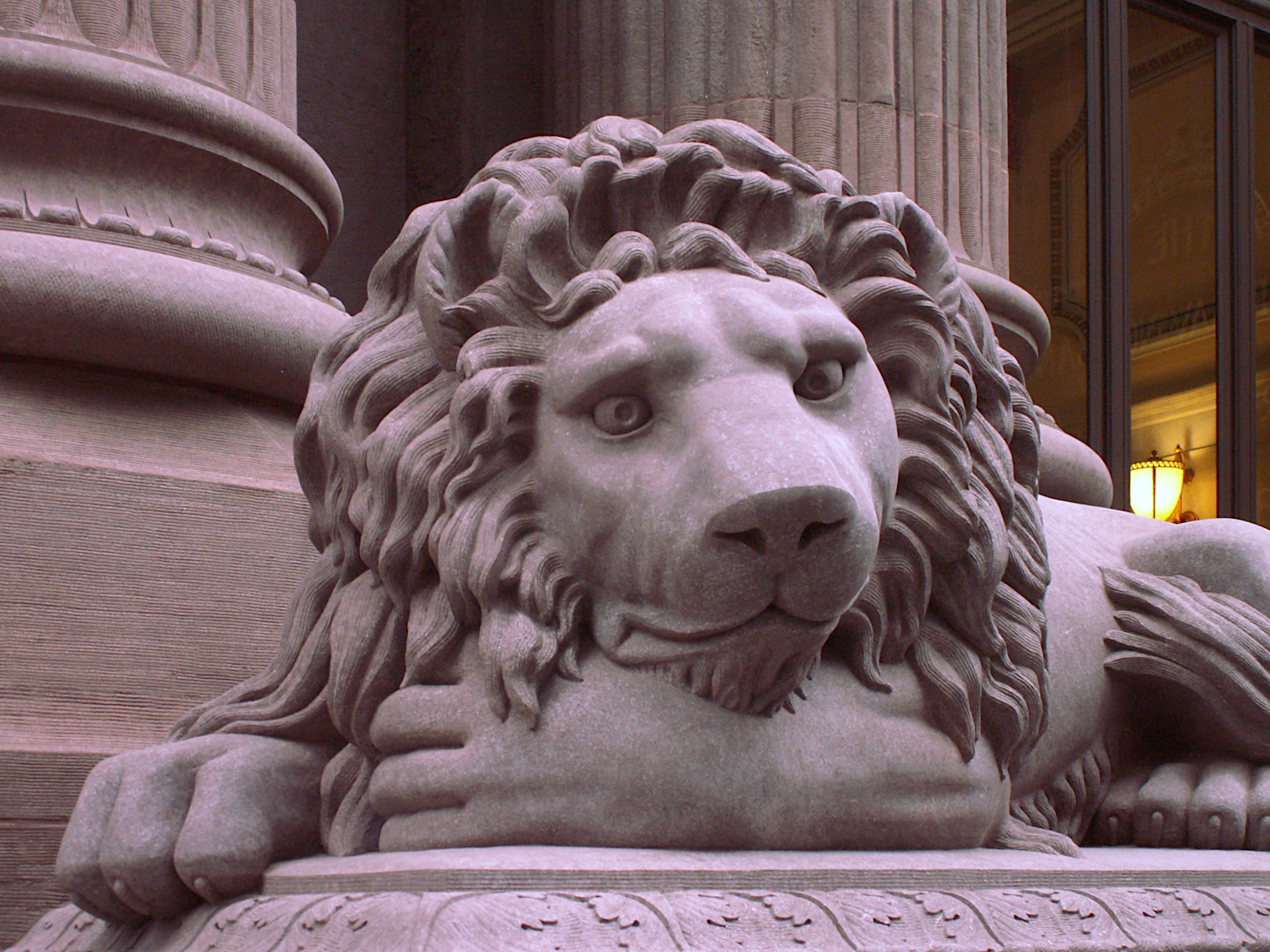
No street in Pittsburgh, and possibly in the country, is denser with lions than Fourth Avenue. These little lions decorate the Commercial National Bank building by Alden & Harlow, one of the small but richly ornate banks that filled in the gaps between the famous bank towers.
Frederick Osterling found a niche for a while making Richardsonian Romanesque buildings in a city that couldn’t get enough of Richardsonian Romanesque once it got a look at Richardson’s courthouse. Osterling attacked the style with more enthusiasm than most, and his works are certainly more than just Richardson knockoffs. The rich detail of the Times Building (1892) is a good example of his work.
The picture above was put together from ten individual photographs. Considering the narrow street, it is a very accurate rendering of the façade; but old Pa Pitt apologizes for a bit of fuzziness near the top. Below, the two grand arches of the Fourth Avenue entrance, with their wealth of intricate carved detail. [Addendum: The carving was almost certainly by Achille Giammartini, who also worked with Osterling on the Marine Bank and the Bell Telephone Building.]
The Times Building runs all the way through from Fourth Avenue back to Third Avenue, and the Third Avenue entrance arch is certainly impressive.
The back side of the People’s Savings Bank building is merely functional, except for this curious stairwell, whose bronze cap seems to have flown in from another and much more fantastical world.
This Fourth Avenue tower is smaller than some of the others, but just as splendid as its most ostentatious neighbors. It was designed by Alden and Harlow in their usual exquisite taste.
Your money is safe, because these lions, though they are invariably friendly to customers, will not tolerate thieves at all. The originals were sculpted by Max Kohler in 1871; they have been moved inside the lobby for preservation and replaced with these painstakingly accurate duplicates.
The architects, MacClure and Spahr, gave this classical tower an unusual rounded corner, and drew attention to the main entrance by placing it in that corner.