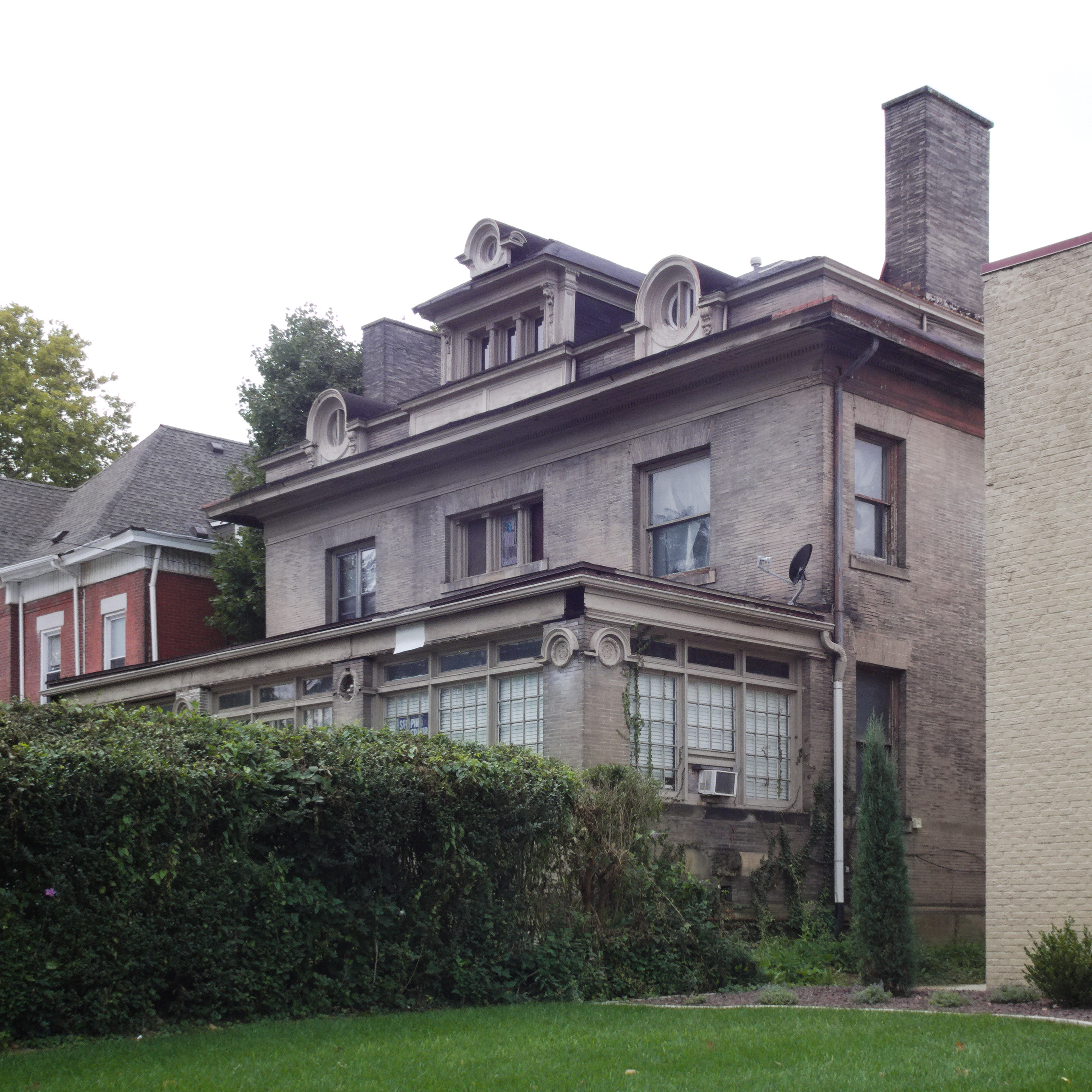
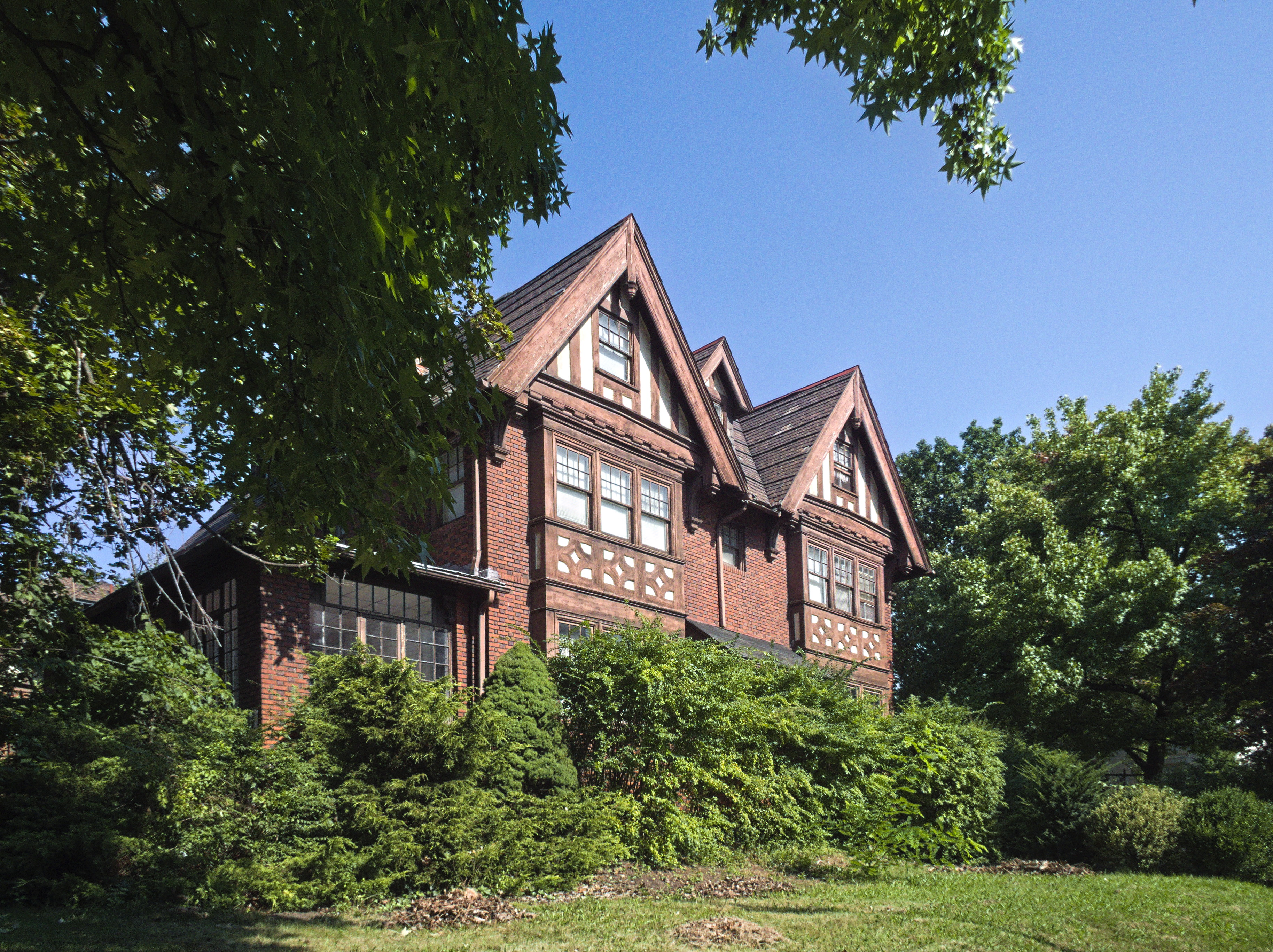
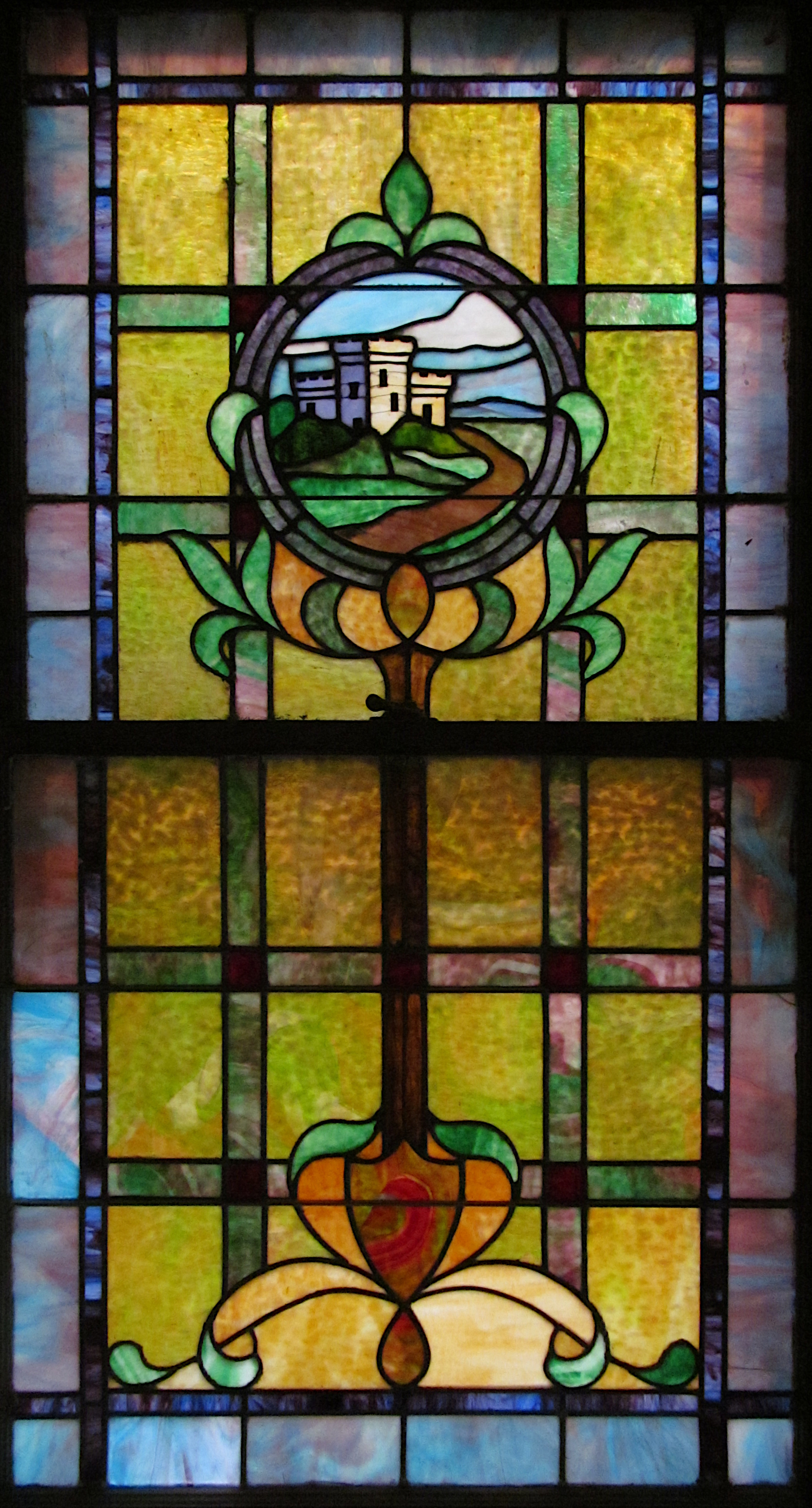
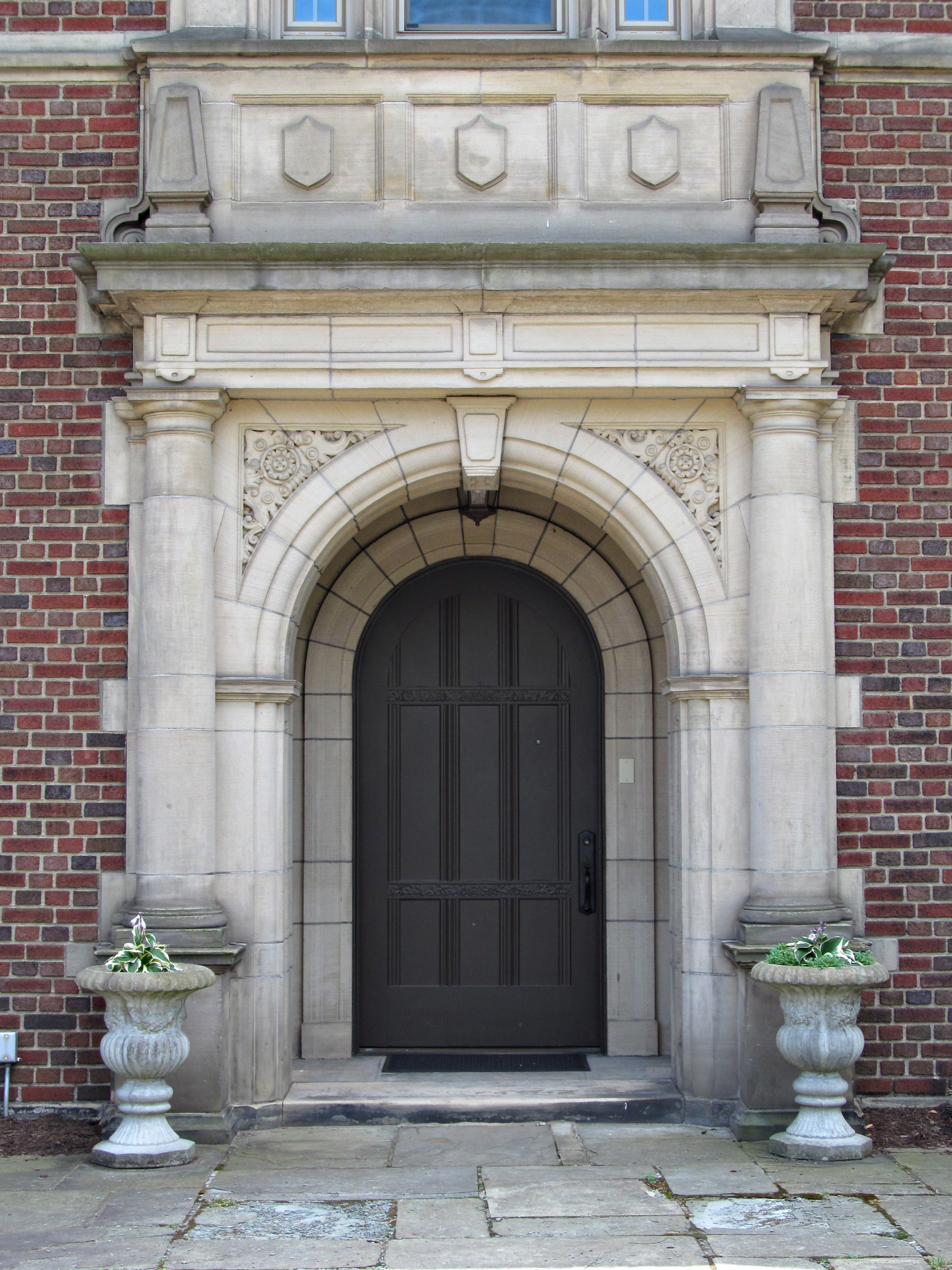
A splendid country house overlooking the town of Chartiers (now the western half of Carnegie). Several real-estate sites on line list this house as built in 1900 or 1901, but clearly it is decades older, and very well preserved. According to our old maps, it appears to be the Doolittle house (but old Pa Pitt would be happy to be corrected). This section of Carnegie northwest of the railroad, the “Doolittle Place Plan,” was built on the former Jacob Doolittle estate, and Doolittle Avenue runs along the northeast side of the house.
Knoxville was a fairly rich neighborhood at one time, especially in the area around the old Knox mansion (where the abandoned Knoxville Junior High School is now). This is a good sample of some of the fine houses that still stand in the neighborhood; it needs some work, but it is in good shape overall, and it has not lost most of its distinctive character.
Just about every ugly thing that can happen to an old house has happened to this once-grand Second Empire mansion on the back end of Warrington Avenue. It has been sheathed in artificial siding. All the windows have been replaced with windows and doors in the wrong shapes. Almost all the trim has been removed (if you enlarge the picture, you can find a tiny remnant in the pediment over the front entrance). The porch has been replaced with treated lumber, which manufacturers assure us never has to be painted and therefore is always allowed to decay into even uglier colors than it was originally. The front entrance has been replaced with cheap doors from a home center.
Yet, with all that, there is still a pleasing symmetry to the house that gives it a kind of senescent dignity. At present, it stands in a nice working-class neighborhood where houses are worthless, or at least not worth enough to make any substantial work on this one profitable. But it has a magnificent view of the city, and if someone with a little money were to adopt it, it could be remade into an attractive single-family mansion again, or a more attractive apartment house.
Old Pa Pitt does not know the history of this house. On the Pittsburgh Historic Maps site, it first appears on the 1890 layer, suggesting that it was built in the 1880s. From then until 1923, it is marked as belonging to Mary L. Bayer or M. L. Bayer.
In 1903, this rendering of a “House for J. J. Matthews, Esq., North Negley Ave., Pittsburgh, Pa.,” was published in the American Architect and Building News as one of the week’s outstanding examples of new architecture. The architect was Charles M. Bartberger, well known in Pittsburgh for some prominent schools and the Industrial Bank on Fourth Avenue. The house still stands in a somewhat bedraggled state today, with its porch filled in and a couple of stained-glass windows missing; otherwise the front has not been altered.
Schenley Farms is that quiet little enclave of grand houses in the Oakland university district. It is a museum of styles that were popular in the early twentieth century, and one of the most popular for grand houses was the Tudor style. Half-timbering (ostentatious beams with stucco between them), steep-pitched roofs, bays, and oriels (overhanging bays) are frequent marks of the style. Here’s a little gallery of Tudor houses from a short walk in the neighborhood.
A stained-glass window in an early-twentieth-century house in Beechview. Stained glass like this was especially popular between about 1890 and 1920, just when the streetcar suburbs that later became city neighborhoods were mushrooming. These windows are often stolen if the house is vacant for a while, but even so thousands still decorate houses all around the city.
Uptown is a neighborhood in transition, and it still is not entirely clear what it will become. Will these rowhouses become valuable properties worth restoring? Or will they be knocked down for skyscraper apartments? Or will the development mania grind to a halt before it reaches this block? These two houses are in pretty good shape and worth preserving for their nearly intact fronts. Both have some fine woodwork. The one on the left has had some unfortunate renovation done to the dormer, but otherwise nothing bad has happened to it. It has newer windows, but in the right size and shape, and if you painted those aluminum frames they would be indistinguishable from the originals. The one on the right is even more perfectly intact. Note its proper Pittsburgh stair railing: in Pittsburgh, railings are a plumber’s art.
A good example of how a frame house can be restored to look very attractive without breaking the bank. The most important thing is to preserve the trim if at all possible, or to substitute new trim that has the same proportions as the old. This house in what we might call vernacular Second-Empire style is on Pius Street.
Warwick House was built in 1910 for Howard Heinz, son of the ketchup king H. J. Heinz. The architects were Vrydaugh and Wolfe, and the construction budget was $75,000. After the Heinzes it passed through the Hillmans, and now it belongs to the Catholic Diocese of Pittsburgh, from which it is rented by Opus Dei, the Catholic organization famed for its albino assassins. But the organization seldom sends the assassins out against anyone but renowned curators; the rest of us are quite safe. At an open house this summer, old Pa Pitt was graciously allowed to take a few pictures of the beautifully maintained Jacobean interior. Above, the window in the grand staircase.
This picture of the front is not the best; the light was from the wrong direction. It means we will have to return soon at a different time of day.
The front door.
The front hall; the door to the library is on the right, the grand staircase on the left.
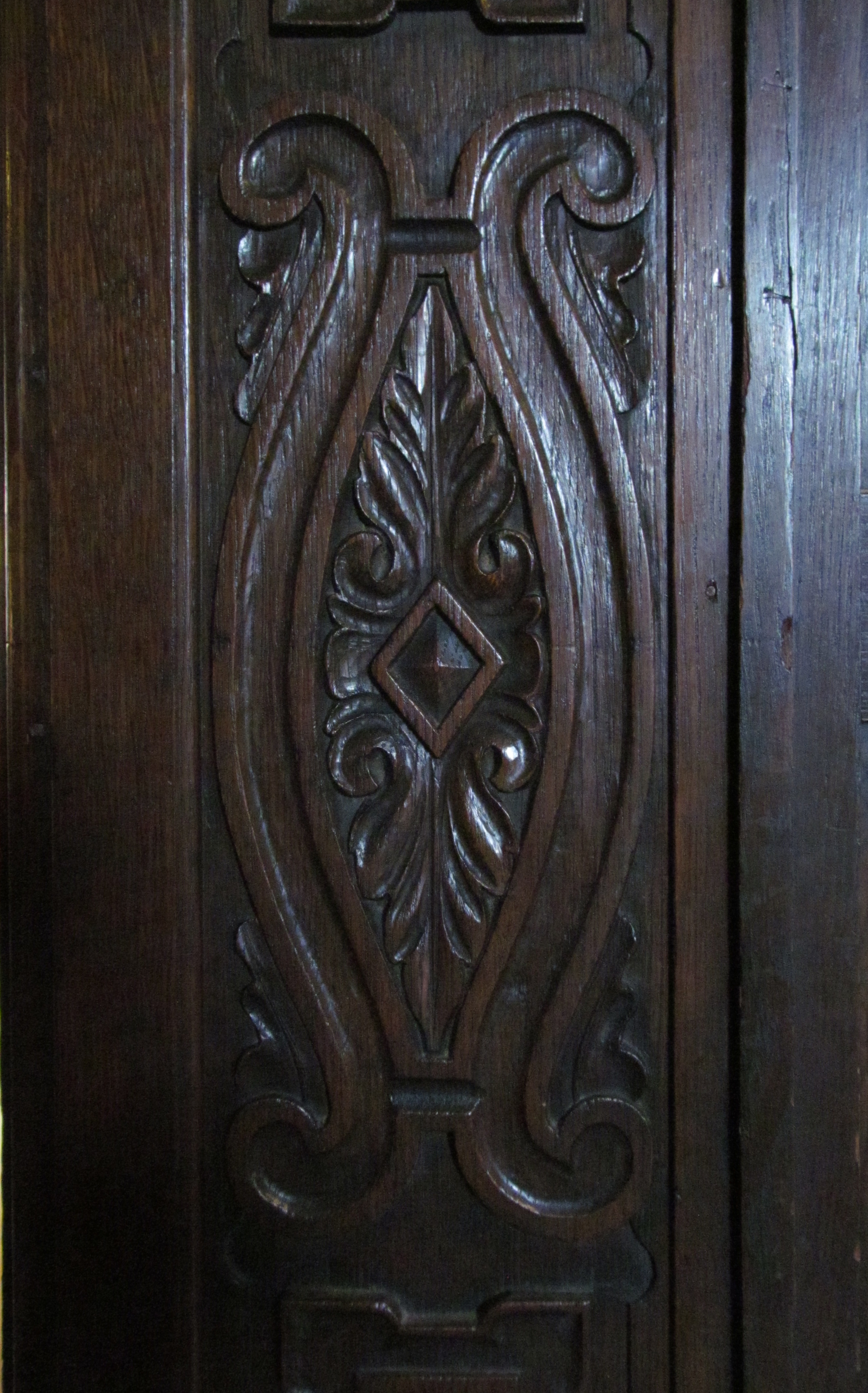
A little bit of the decorative woodwork in the front hall.
The grand staircase.
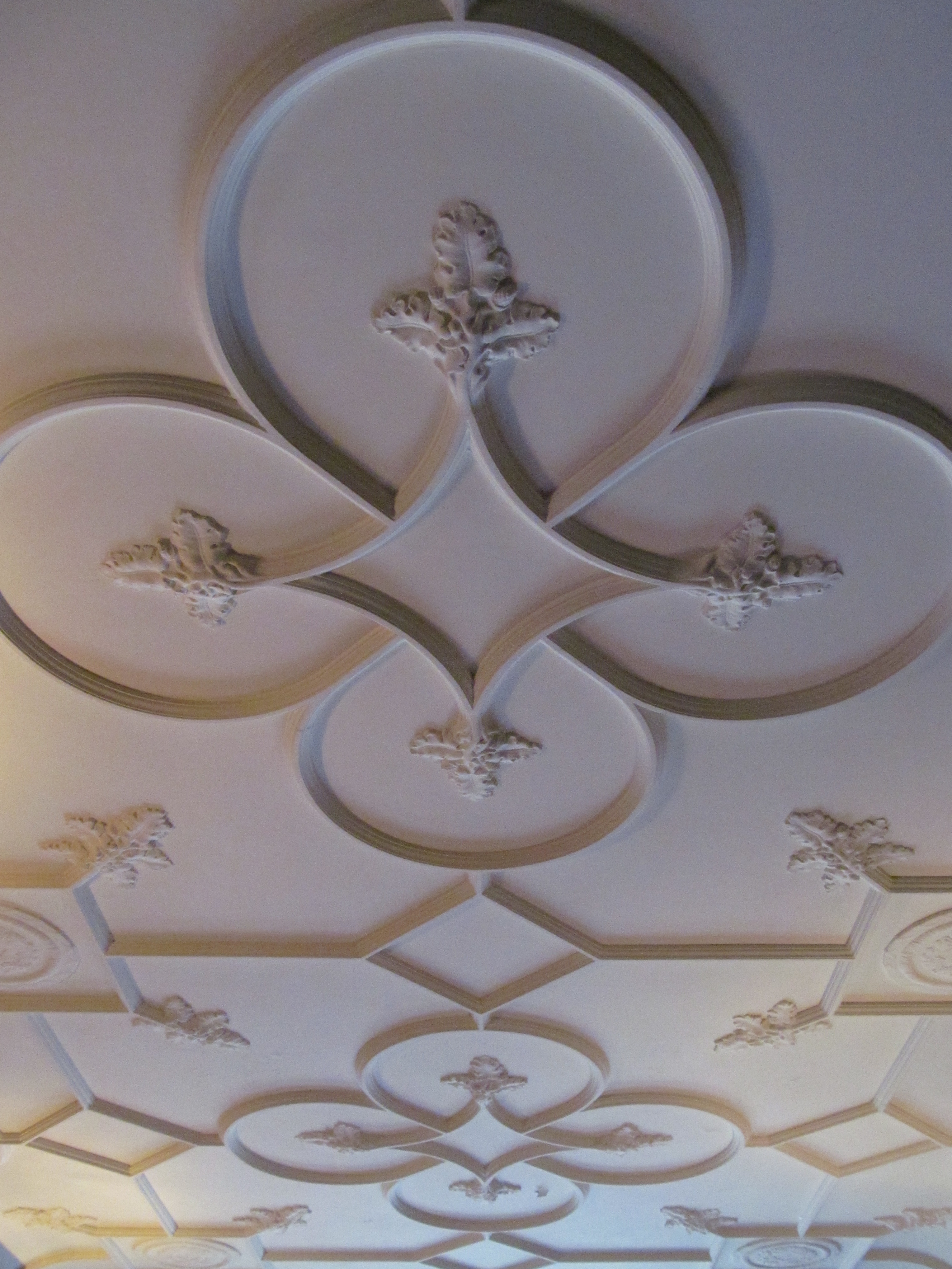
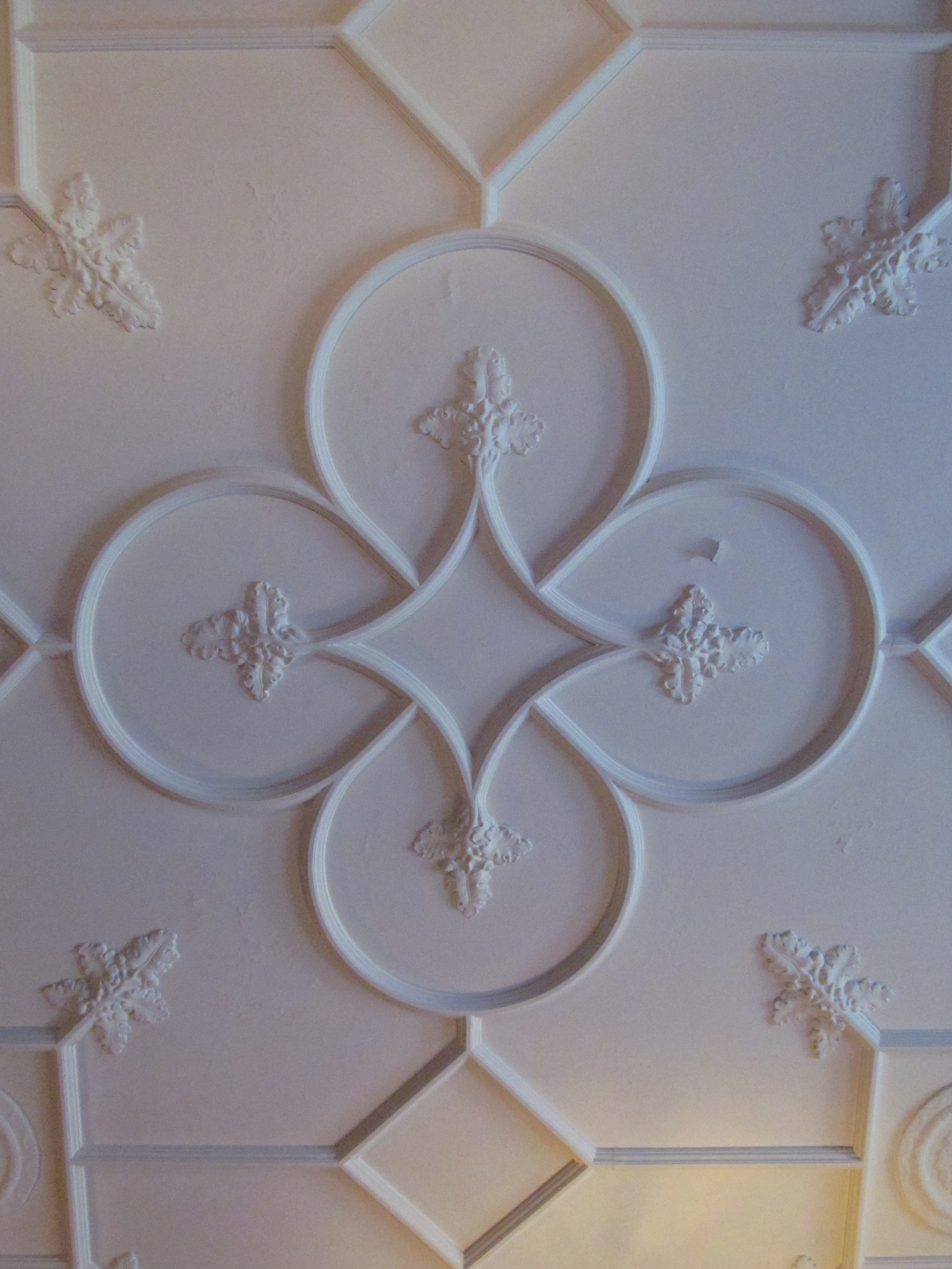
Modern American houses forget about the ceiling, as if people never looked up. Warwick House does not make that mistake. This is the decorated ceiling in a side hall.
The former ballroom was converted into a chapel by the late Henry Menzies, an ecclesiastical architect whose specialty was refurbishing modernist churches of the 1960s and 1970s to make them suitable for liturgical worship. He liked to use a baldacchino to give proper emphasis to the altar. (The ballroom was added to the house later, probably in 1929 according to the current residents.)