Update: Thanks to our correspondent David Schwing, we know the story of this church better. It was a Shingle-style frame church dedicated at the end of 1896.1 In 1953, it was “Perma-Stoned,”2 so that the end result is an odd mixture of Shingle-style forms—like the flared roof—and 1950s aesthetics.
The original text of the article follows.
Father Pitt is not quite sure what to call this style: maybe arts-and-crafts Mediterranean.
The corner-tower entrance is typical of Pittsburgh churches, but the stone porch is not.
The arches and spindly columns of the belfry are the touch that says “Mediterranean” to old Pa Pitt.
From this angle we can see that the building has the usual Pittsburgh problems to solve: the lot gains almost two floors’ worth of height from lower to upper corner.
McDonald was a very Presbyterian town, with at least four Presbyterian churches all within an easy walk of one another. In 1897, two Presbyterian churches went up in McDonald side by side—a Presbyterian church and a United Presbyterian church. They seem to have been called First Presbyterian and First United Presbyterian at first, but later took the names Trinity and Calvary. After the denominations merged, so did the congregations—but they kept the two buildings, now called the Calvary Center and the Trinity Center of McDonald Presbyterian Church.
The United Presbyterian church, now Calvary Center, was the larger of the two. According to a correspondent (see the kind comment below), the architect was Sidney Winfield Foulk of New Castle.
Behind the church is a neat and prosperous-looking foursquare parsonage built of matching brick.
The smaller Presbyterian church, now the Trinity Center, was designed by the Washington (Pennsylvania) firm of McCallum & Ely.
The little village of Rennerdale sits halfway between Carnegie and Oakdale on the Noblestown Road. This corner-tower frame church, with its Colonial-style details, reminds us of the Noblestown Methodist Episcopal Church designed by James Allison; and since we know that Allison designed other buildings in the area, it would not surprise us to find that he was responsible for this one. It has been swathed in artificial siding, as our few surviving frame churches usually are; but the siding men did an unusually good job of making sure that the windows and doors were properly framed. The church still belongs to its original congregation.
Yesterday we looked at the Oakdale Public School, one of the earliest commissions for James E. Allison. Here, just a short distance to the west in the old village of Noblestown, is another Allison building1 from a little over a year later—a small frame church that, although it has been coated with artificial siding, still retains some of its distinctive character. The form is the irregular square popular in small Romanesque churches of Victorian times, but the details are Georgian, including the big window. The half-round protrusion in front indicates a Sunday-school room built on the popular Akron Plan. The congregation dissolved a few years ago, but the building is in use by a veterans’ organization called Heroes Supporting Heroes.
Now St. Paul Baptist Church. Built in 1887, it was designed by Brooklyn architect Lawrence B. Valk, whose church designs can be found all over the country. (In about 1900, Valk and his son moved to Los Angeles, where they became bungalow specialists but continued turning out the occasional church.)
The tower with its huge open Romanesque arch dominates the intersection of Fifth Avenue and Penn Avenue. After the tower, the most eye-catching thing is the porch, with its even huger arch and its crust of terra-cotta tiles.
The side entrance also gets a big arch, and even the basement door gets a stony arched porch.
On the corner of North Avenue and Middle Street stands this small but imposing German Lutheran church, built in 1877. Father Pitt is fairly sure the Lutherans have gone, though the church site (last updated in 2010) is still on line. The Urban Impact ministry remains.
“St. Matthew’s German Evangelical Lutheran Church, built 1877.”
Connoisseurs of such things will note that this is a church with the sanctuary upstairs.
The hefty tower was added in a burst of prosperity about 25 years after the church was built.
Meanwhile, just across narrow Middle Street was a different kind of Lutheran church. And although old Pa Pitt gave this article a humorous headline, he is fairly sure there was no battle. Pittsburgh learned the virtue of tolerance: those other Lutherans across the street may be completely wrong about everything that is most important in life, but they’re our neighbors, and we wave to them when we see them on the street.
St. Mark’s was built in 1892. After its Lutheran congregation left, it was a Church of God in Christ until a few years ago. It has recently been expensively refurbished and painted black (it used to be painted brick red). Old Pa Pitt has not heard who was responsible for the refurbishing, but all the stained glass was removed, which is often the sign of a Pentecostal congregation moving in.
Except for the loss of the glass, the church is in very good shape externally, and it is a fine example of Pittsburgh Rundbogenstil—the round-arched German style that mixes classical and Romanesque elements.
Edward Stotz was the architect of this church, built in 1905.1 The parish closed twenty years ago, but the church has found other tenants and is kept in good shape.
A later relief of the Annunciation is over the main entrance.
The congregation dissolved in 2020, so here is an excellent opportunity for an investment in a beautiful building in a trendifying neighborhood. It is in very good shape, and it has enough architectural distinctiveness to make its new owner proud. It also commands a prominent corner on Brownsville Road.
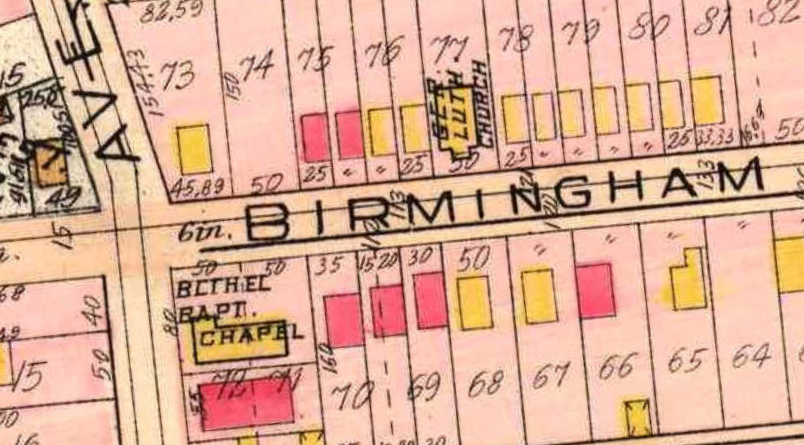
Now Zion Christian Church. The cornerstone tells us that the congregation was founded in 1908, and its first building was at the corner of Birmingham Avenue and Hays Avenue (now Amanda Street)—a small frame chapel that must have quickly become woefully overcrowded, since this building many times the size was constructed less than twenty years later.
Plat map showing the original location of Bethel Baptist.
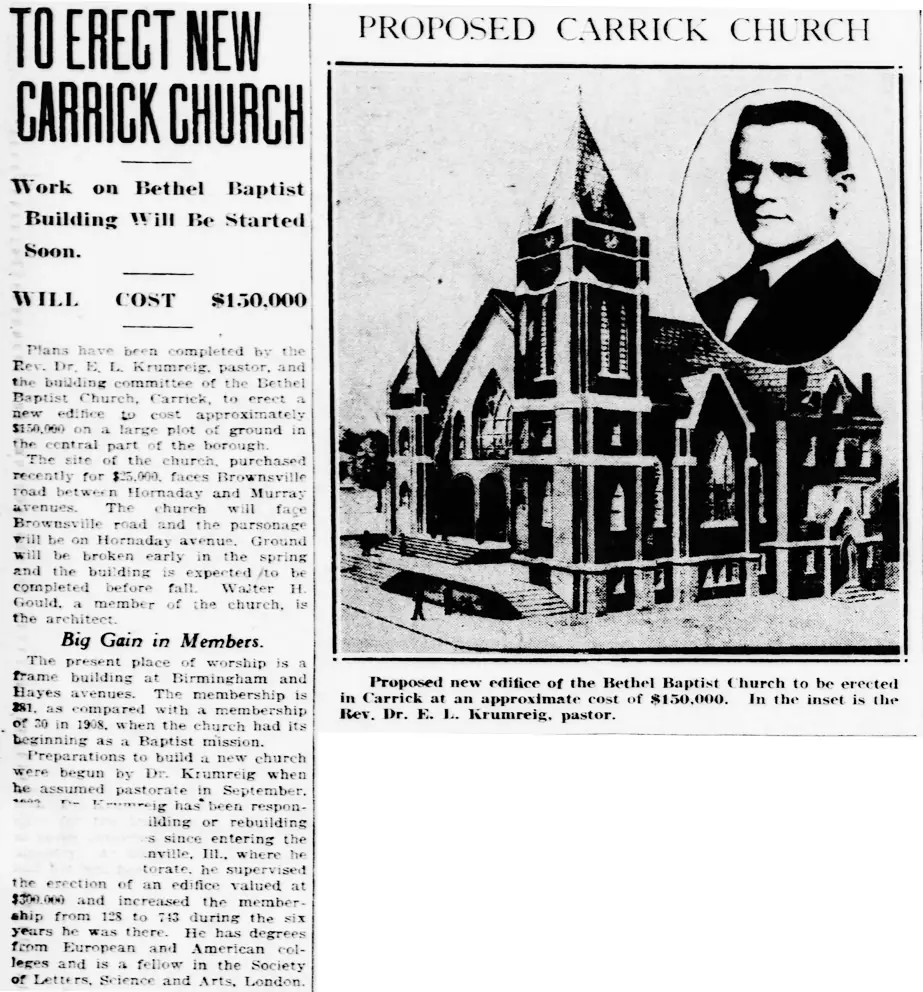
“The membership is 381, as compared with a membership of 30 in 1908,” says the Gazette Times of February 18, 1925, when the plans for the new building were announced.
Pittsburgh Gazette-Times, February 18, 1925
The architect was Walter H. Gould, “a member of the church,” and so far this is the only building attributed to him that Father Pitt knows about. However, it is an accomplished if not breathtakingly original design, so there must be other Gould buildings lurking about, probably in the South Hills neighborhoods. Comparing the published rendering above with the church as it stands today shows us that the tower grew about a floor’s worth of height between conception and construction—a rare example, perhaps, of an architect being told that his original design was not ambitious enough.