Columbia Hospital merged with Pittsburgh Hospital and East Suburban General in Monroeville to form Forbes Health System. The location in Wilkinsburg closed some years ago, but unlike some other large buildings in Wilkinsburg, this complex found new uses. The largest part is a nursing home, and several other businesses and services occupy smaller sections.
The original hospital buildings were designed by John Lewis Beatty, whom we have met before mostly as a designer of Protestant churches. They are faced with a very attractive cinnamon brick that is actually made up of randomly assorted but related shades.
If we walk around to the forgotten back alley behind the hospital, we discover the old abandoned emergency entrance. We can also see some more of the older buildings in the complex.
In 1956, the hospital announced a big new addition and planned to raise a million and a half to pay for it. The architects were Prack & Prack, longtime specialists in large industrial and institutional buildings.
John Lewis Beatty, who gave us many fine churches throughout the city and suburbs, was a grand old man of Pittsburgh church architecture by the time he designed this church, built in 1928. Today the building belongs to Nabhi Christian Ministries, and it seems to be in very good hands.
Old Pa Pitt will admit that Braddock can be a sad place, but here is something to celebrate. This historic Black congregation is still going after nearly a century and a half, and its neat little building is beautifully kept.
The cornerstone of the building was laid late in 1906, when the Rev. Dr. J. T. Wanzer was pastor. The architect of the church was John Lewis Beatty,1 who was one of our most successful designers of Protestant churches. In this case the budget was small, but Mr. Beatty gave the congregation a building to be proud of. Certain economies were necessary: only the front is stone, the rest being ordinary red brick. But that front leaves an impression of solid respectability.
The Pittsburg Press used to publish an extensive column of “Afro-American Notes,” and in the edition for December 17, 1905 we find a paragraph about the plans for New Hope’s new building:
The New Hope Baptist Church of Braddock, Pa., is undoubtedly one of the most progressive churches in Braddock. They are making great preparations to begin their new building in the early spring. The Rev. J. T. Wanzer deserves great credit for the good work he is doing for the upbuilding of religious Christianity among the negro race. He is without doubt a good worker. Services every Sunday morning at 11 a. m. and evening at 7:30 p. m. All are welcome.
It was not always easy being Black in Braddock. While the plans for the church were in preparation, two of its most prominent members had a run-in with a gang of “hoodlums,” as we read in the Press:
Much bad feeling is being engendered by a gang of hoodlums, who infest the corner of Fourth street and Hawkins avenue, North Braddock, and attack negroes. Last night Reuben Poles and James Price, the former a trustee of the New Hope Baptist Church, colored, of Braddock, and the latter superintendent of the Sunday School, while on their way home from a church meeting, were called vile names, followed for several squares by five fellows, all over 20 years of age, and finally attacked. Poles was beaten into insensibility with a beer bottle.2
As we see from the language of the Press report, which describes the assailants as an infestation, most respectable citizens were disgusted and appalled by such “hoodlums.” But they were a fact that Black residents of the borough had to deal with. Undaunted, the members of New Hope finished their church—and they are still here, 120 years later, worshiping in the same building.
The addition to the left is well matched to the main church; it was probably built in the 1920s or 1930s.
“Will Build Churches,” Press, October 30, 1906, p. 7: “J. A. House, of West Homestead, has the contract for building the New Hope Baptist Church at that place, to cost $14,000. It was designed by Architect J. L. Beatty.” Though the article says the church is in West Homestead, that is an error. The Post for the same day mentions the contract, but leaves out the architect, and places the church correctly in Braddock. Notes of the Builders, Post, October 30, 1906, p. 13: “A two-story brick and stone church for the New Hope Baptist Church of Braddock, to cost $14,000, will be built by Contractor J. A. House, of West Homestead.” ↩︎
John L. Beatty, who designed a number of good Gothic churches in our area, was the architect of this grand church for the First United Presbyterian congregation of Crafton.1
The dates of the foundation of the congregation (1908) and the building of the current church (1927).
The congregation had money for two huge windows in the 1960s or 1970s.
“Crafton Church to Build,” Gazette Times, February 15, 1927. “The First United Presbyterian Church of Crafton is having plans prepared for a new church building to seat 500 persons at the corner of Bradford and Haldane streets, Crafton. The Rev. A. W. Caldwell is pastor. John L. Beatty is architect.” ↩︎
We have seen pictures of the outside of this church before—here, for example, is a picture from May of 2021:
The other day the current inhabitants, the Union Project, were kind enough to turn old Pa Pitt loose in the sanctuary to take as many pictures as he wanted.
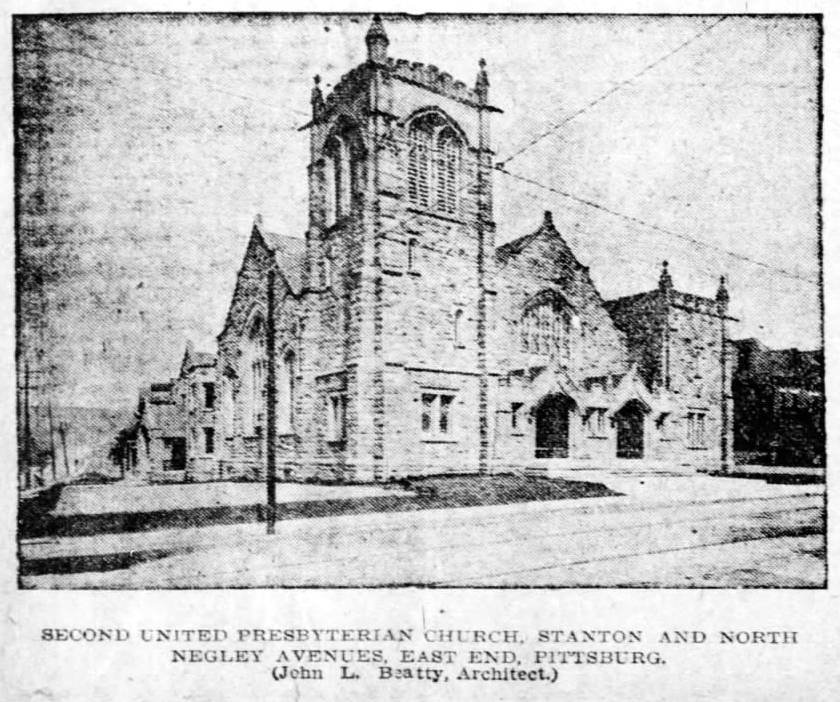
The architect was John L. Beatty, who designed the building in about 1900. A newspaper picture from 1905 (taken from microfilm, so the quality is poor) shows the exterior looking more or less the way it does now.
Pittsburg Press, April 29, 1905.
After a disastrous fire, much was rebuilt in 1915, again under Beatty’s supervision.1 Another fire in 1933 would necessitate rebuilding part of the tower.
The church was built for the Second United Presbyterian congregation, which had moved out to the eastern suburbs from its former location downtown at Sixth Avenue and Cherry Way (now William Penn Place)—exactly one block from the First United Presbyterian Church, which moved to Oakland at about the same time. Later it became the East End Baptist Church, and then was renamed the Union Baptist Church. When that congregation folded, the church was bought by a Mennonite group that founded the Union Project. It is now a community center for pottery, because “everyone should have access to clay.” The sanctuary—which has been preserved mostly unaltered, except for the removal of pews and other furnishings—is available for large events.
The sanctuary is roughly square, which is typical of many non-liturgical Protestant churches in Pittsburgh at the turn of the twentieth century. Above, looking up at the center of the ceiling.
The stained glass was restored as part of a remarkable community effort in which people in the neighborhood learned the art of stained-glass restoration themselves. It would have cost more than a million dollars to have the work done professionally, but volunteers learned priceless skills, and the glass is beautiful.
The vestibule includes some of the original furniture from the church, and some smaller stained-glass windows.
Source: The Construction Record, January 16, 1915: “The Second United Presbyterian Congregation has selected Architect J. L. Beatty, 146 Sixth street, to prepare plans for repairing the church on Stanton and Negley avenues.” ↩︎
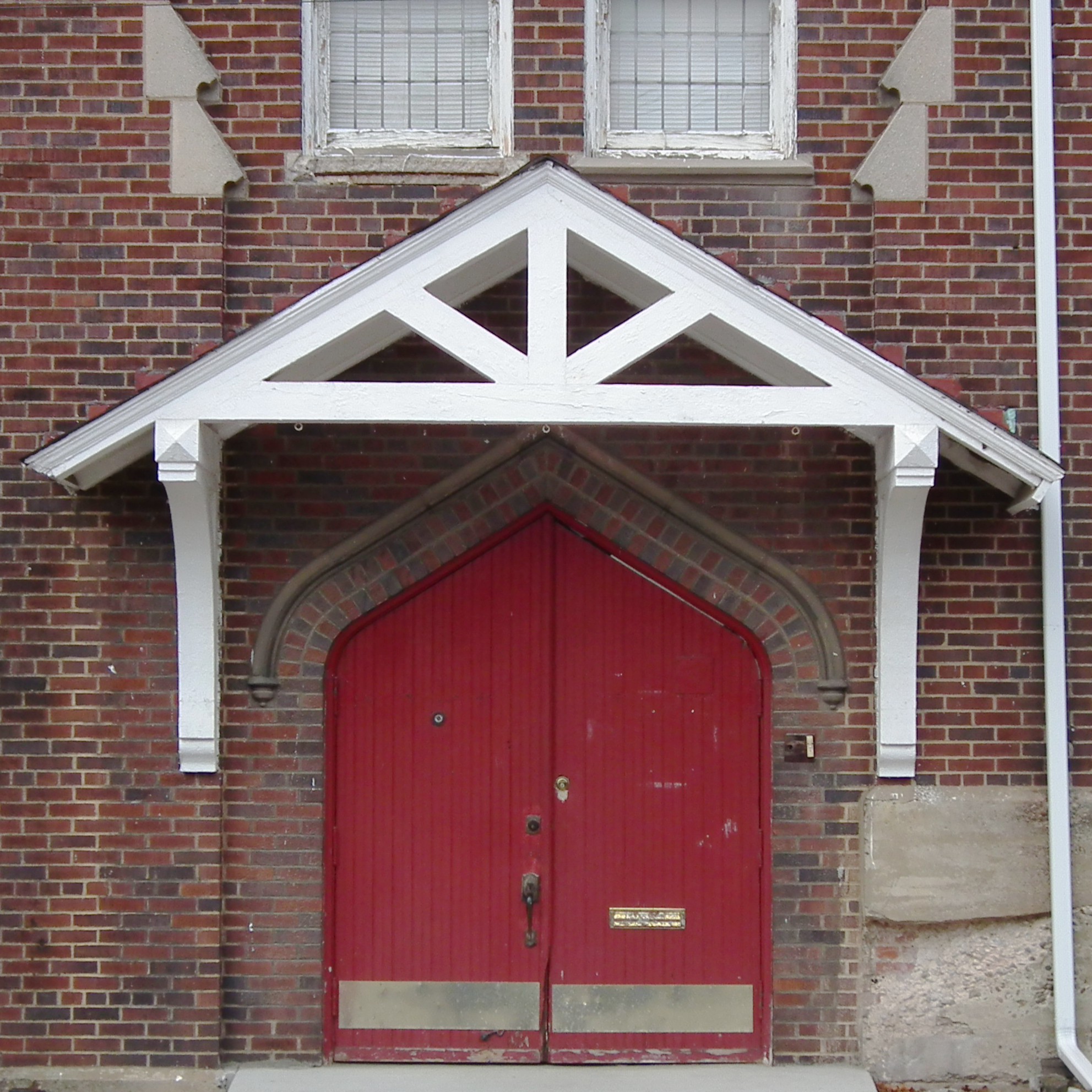
Now Emmaus Deliverance Ministries. Designed by John Lewis Beatty, this late-Gothic-style church was built in about 1925. (The cornerstone has been effaced, which old Pa Pitt regards as cheating, though he understands that a new congregation likes to make a new beginning.)
A Gothic church must maintain a delicate balance: it wants to be impressive, but it also wants to be welcoming. The simple woodwork over the entrances (this one is the basement entrance) gets the balance right: it fits well with the style of the building, matching the angle of the Gothic arches, but it sends the message that we’re just plain folks here.
This church has an unusually eclectic history. It began as the Second United Presbyterian Church. Father Pitt does not know the original architect, but in 1915 there was a devastating fire, and a large reconstruction project was supervised by the architect John Louis Beatty. In 1933 the Presbyterians moved out, and this became the East End Baptist Church. Now it is the Union Project (an arts venue) and the meeting-place of the Jonah’s Call Anglican congregation.
About two and a half years ago, old Pa Pitt published some pictures of this church, but something seemed different about it. It took a moment to realize: the decorative details on the tower have been cleaned. Back in 2021, all the stone had been cleaned except for the very top of the tower:
But now the tower is clean to its very tip:
This little pinnacle is still the color the whole church used to be.
One of the many black stone buildings that still remained in Pittsburgh in the 1990s. Like almost all the others, Sixth Presbyterian has since been cleaned and restored to its original color.
Father Pitt has always wondered why the Presbyterians kept numbering their churches. “First Presbyterian” is an honorable distinction. “Fifth Presbyterian” just sounds tired. And then why stop at six? There is a Seventh Presbyterian in Cincinnati, for example. (Update: They did not stop at six; in fact both Presbyterian and United Presbyterian churches in Pittsburgh went into the double digits. Sixth Presbyterian is the highest number still going that we know of.)
Addendum: The architect was John Lewis Beatty; the church was built in 1902.1
Record & Guide, February 12, 1902. “J. Lewis Beatty, Jackson Building, has prepared plans for the Sixth Presbyterian church and they have been approved by the Building Committee, of which Dr J. Guy McCandless, Director of Public Works, is the chairman. It will be 32 x 132 feet, of sandstone, hardwood interior finish, handsome furniture and fixtures. The cost will be about $60,000.” The measurement of 32 feet has to be incorrect; no church of any consequence is that narrow. About 82 feet would be plausible, according to the lot measurements on the 1923 Hopkins map. ↩︎