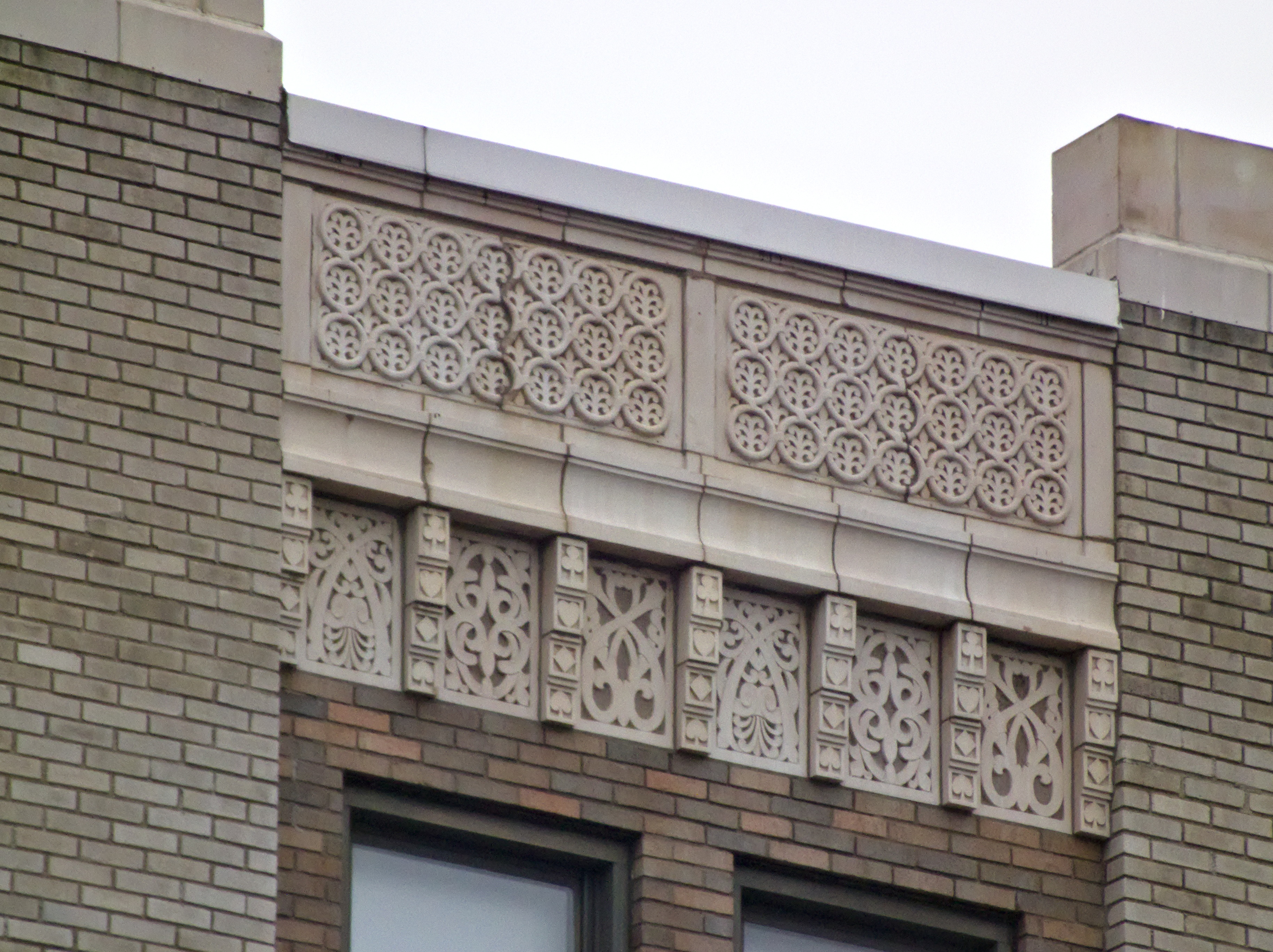
According to a city architectural inventory (PDF), Hampton Hall was built in 1928, and the architect was H. G. Hodgkins, who seems to have been based in Chicago, to judge by listings in Chicago trade magazines that show up in a Google Books search.
The interior includes quite a bit of Nemadji tile, and old Pa Pitt had never heard of Nemadji tile until he found this page on Hampton Hall from a site of Historic U. S. Tile Installations. The exterior is fairy-tale Tudor, designed to make apartment dwellers feel as though they were great lords of Queen Elizabeth’s time.
The entrance is flanked by bears holding shields, as bears are wont to do.
Originally the Schenley Apartments, but now Schenley High School has been turned into apartments as the Schenley Apartments, so using the original name would be confusing. This huge complex was built in 1922 as luxury apartments to go with the Hotel Schenley. The architect was Henry Hornbostel, with the collaboration of Rutan & Russell, the original architects of the hotel. In 1955 the University of Pittsburgh bought the Schenley Apartments (for less than they had cost to build in 1922), and since then the buildings have been Pitt dormitories. Above, we see the complex from the grounds of Soldiers and Sailors Hall; below, the steps up from Forbes Avenue.
Since we have a large number of pictures, we’ll put most of them behind a “Read more” link to avoid weighing down the main page of the site.
Thanks to a kind correspondent, old Pa Pitt has an opportunity to prove himself right about one thing and wrong about something else. Being wrong is almost as good as being right, because it means learning something new.
Our correspondent sent two pictures that appeared in an advertisement that ran in the Post-Gazette in 1929. The ad was for Frigidaire refrigerating systems, as used in prominent buildings in the city.
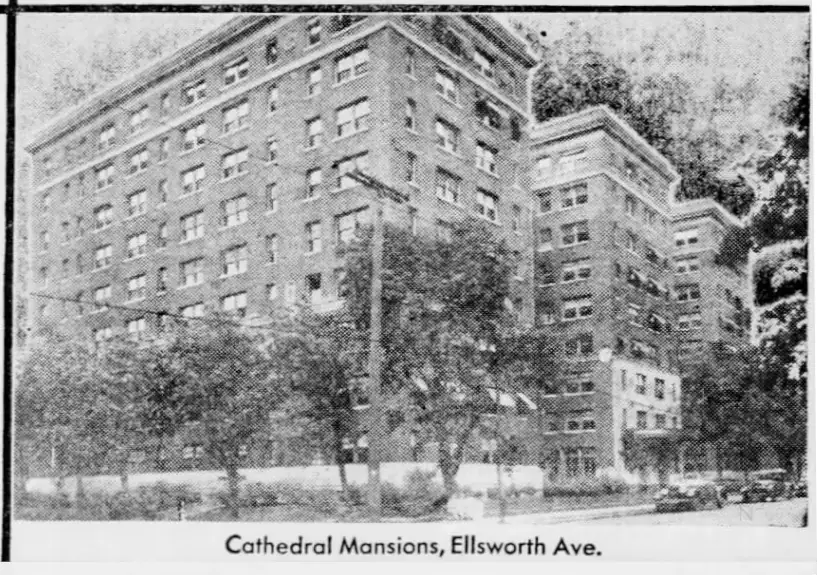
First, the Cathedral Mansions apartments on Ellsworth Avenue.
At that time we mentioned that we suspected it had lost a cornice. Father Pitt was right about that, as you can see from the 1929 picture.
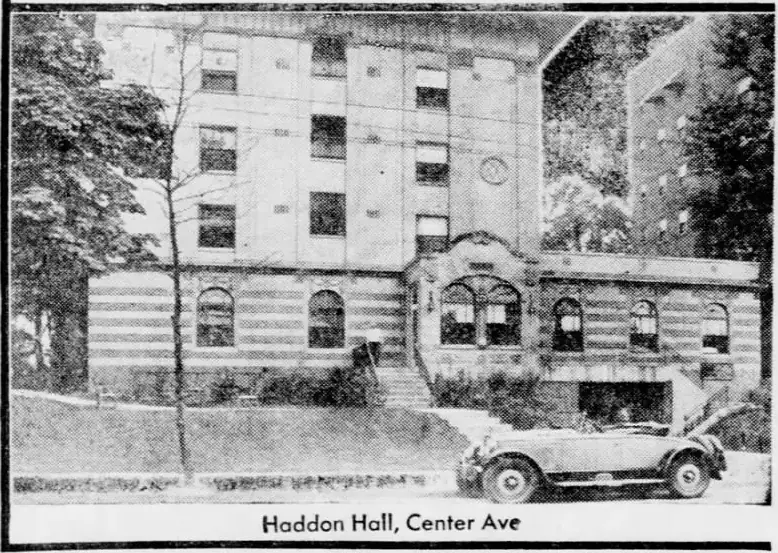
Now, here’s the one we were wrong about:
This building is now an apartment building called Hampshire Hall. As “Haddon Hall” it was a hotel with apartments. Here is what it looks like today:
The obvious change is that modernist growth on the front. When he published these pictures, Father Pitt wrote, “It appears to be a glass enclosure for what was once an elegant verandah.” That is wrong. It seems to have been a replacement for the original dining room or lounge of the hotel. It was probably put there in about 1961: a newspaper ad from December 22, 1961, promotes the Walt Harper Quintet’s appearance at the “newly remodeled Haddon Hall Lounge.”
Many thanks to our correspondent for the pictures, which give us new information about these two notable buildings. If anyone knows the architect of either one, but especially Haddon Hall/Hampshire Hall (which is in a distinctive modernist-Renaissance style), Father Pitt would be grateful for the information.
A fairly early work of I. M. Pei (built in 1964), this was part of the massive redevelopment of the Lower Hill that cleared out all the poor people and replaced their houses, stores, clubs, bars, synagogues, churches, and schools with a modernist wasteland. It was originally called Washington Plaza, and it was meant to be an International Style city-in-a-tower, with everything you would need on the premises and no reason ever to go out into the grubby outdoors. For most of its life, it was gleaming white; the muddy brown came in with the new name.
Correction: Father Pitt had originally mistyped the date as “1864,” which in geological time is not much of a difference, but in stylistic time is almost enough for the universe to have been destroyed and created again. Much gratitude to “sandisk” for the correction (see the comment below).
Since we mentioned the smaller King Edward Annex a couple of days ago when we looked at the old King Edward Apartments, here it is. The city’s architectural inventory (PDF) dates it at about 1925 (Update: This is a little too early; see below), which seems plausible. It looks a bit worn, and the top of the building is definitely not the way the architect imagined it. But it still has a restrained dignity, especially if we ignore the missing cornice. Old Pa Pitt has a suspicion that average Americans simply don’t see the tops of buildings, so when they are mutilated no one but Father Pitt notices.
Addendum: The King Edward Annex was built in about 1927; the architects were Hannah and Sterling. Source: The Charette, Vol. 7, No. 2 (February 1927): “209. Architect: Hannah & Sterling, 209-9th Street, Pittsburgh, Pa. Owner Arthur McSorley. Title: Apartment House. Owner now taking bids. Location: Melwood Street, Pittsburgh. Approximate size: 28 apartments; four stories, fireproof. Cubage: 300.000 ft.”
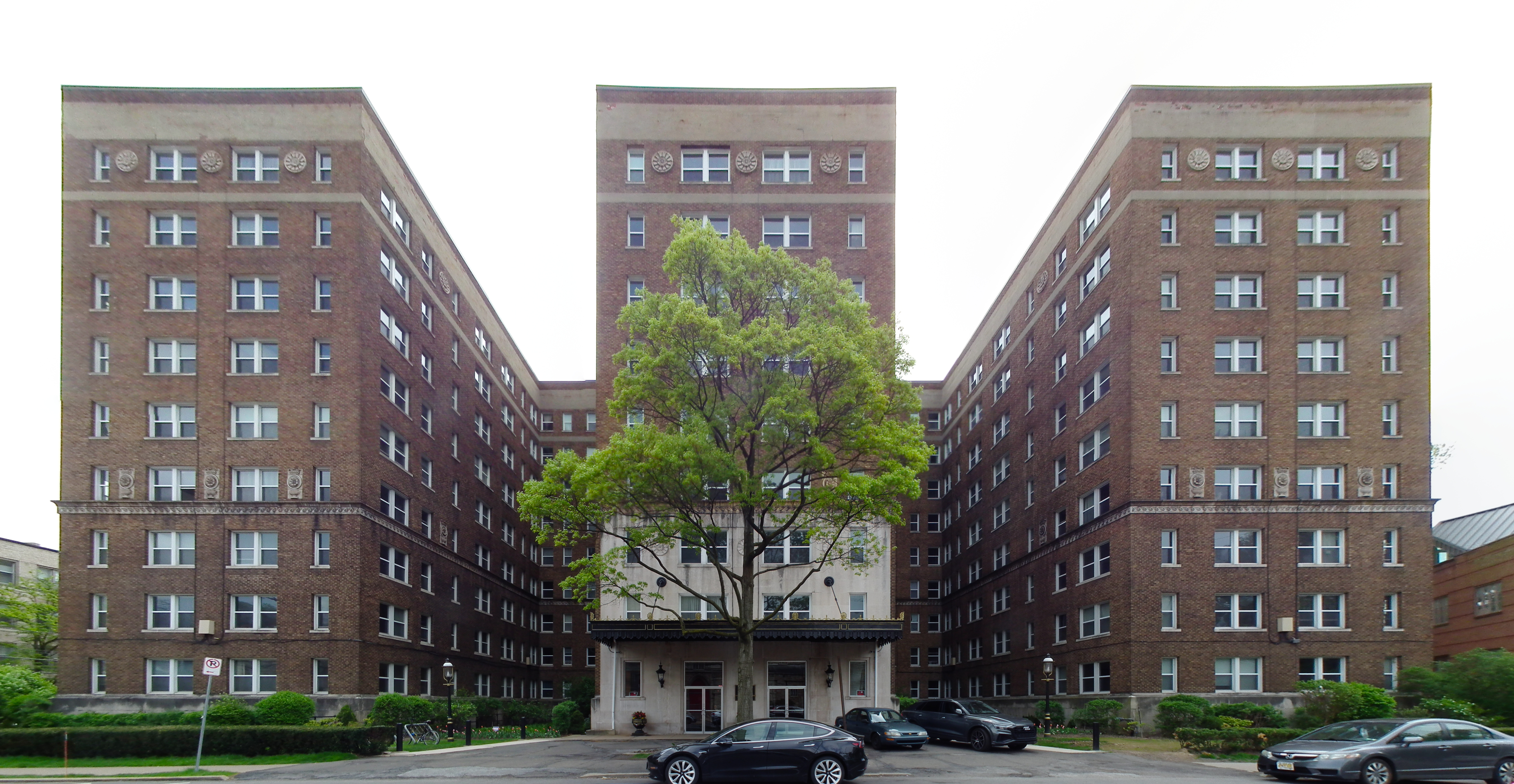
A modernized form of classicism, or a classicized modernism, makes an attractive apartment block on Ellsworth Avenue at the western edge of Shadyside. It is mostly a group of rectangular boxes, but a few classical details—like the Vitruvian-scroll molding above the third floor—give it some character. Father Pitt suspects that it has lost a cornice; it might have been late enough to do without a cornice, but that Vitruvian scroll looks as though it ought to be echoing something at the top of the building, and slight signs of damage up there suggest that something was peeled off at some point.
Addendum: Thanks to the research of a kind correspondent, we now have a picture of Cathedral Mansions in 1929, and it does indeed have a proper cornice.
Another addendum:Another correspondent provides the information that the architect was John M. Donn, the Washington (D. C.) architect who also designed the Investment Building downtown. The information comes from an Iron City Sand and Gravel advertisement in the Pittsburg Press, Monday, November 22, 1926 (page 30).
A simplified Italian Renaissance style, with the ornamentation kept to the minimum. Note the variant spelling of the name on the nameplate over the entrance: when this apartment block was put up, the spelling of Centre Avenue had not been standardized to the British spelling preferred by real-estate developers.
This small apartment building on Centre Avenue is named for its most obvious and distinctive feature: a two-storey Doric colonnade that has just been freshly painted.
Addendum: According to the city architectural inventory (PDF), the Colonnade was built in 1907.
This Art Deco apartment block was built in 1928 or shortly after. At first glance it looks like a simple rectangular modernist box, but a second glance reveals some rich decorative details.
The building is on Centre Avenue, which is a neighborhood border on city planning maps; thus it is technically in Bloomfield, but most Pittsburghers would probably say Shadyside.
Addendum: The architects were Marks & Kann, according to the Charette, the magazine of the Pittsburgh Architectural Club.
Addendum: This was originally called Haddon Hall, and it was built as a hotel, or at least it was a hotel early in its history. We now have a picture of Haddon Hall in 1929, before the modernist growth on the front.
This is a distinctive building, and old Pa Pitt searched almost fifteen minutes for the architect without success. He would be delighted if someone could tell him who designed this little outcropping of dignified Art Nouveau. Father Pitt might suspect Kiehnel and Elliott as the architects most likely to be working in this style in Pittsburgh, but that is nothing more than a wild speculation.
The glass-block windows in the front stairwell were probably stained glass when the building opened, and we can hope that those windows are preserved in a private collection somewhere.
The modernist addition on the front is not as delightful as its architect probably hoped it would be. It was probably put there in about 1961: a newspaper ad from December 22, 1961, promotes the Walt Harper Quintet’s appearance at the “newly remodeled Haddon Hall Lounge.” (In an earlier version of this article, Father Pitt wrote, “It appears to be a glass enclosure for what was once an elegant verandah.” That was wrong: old photos from before the remodeling show no verandah.)