
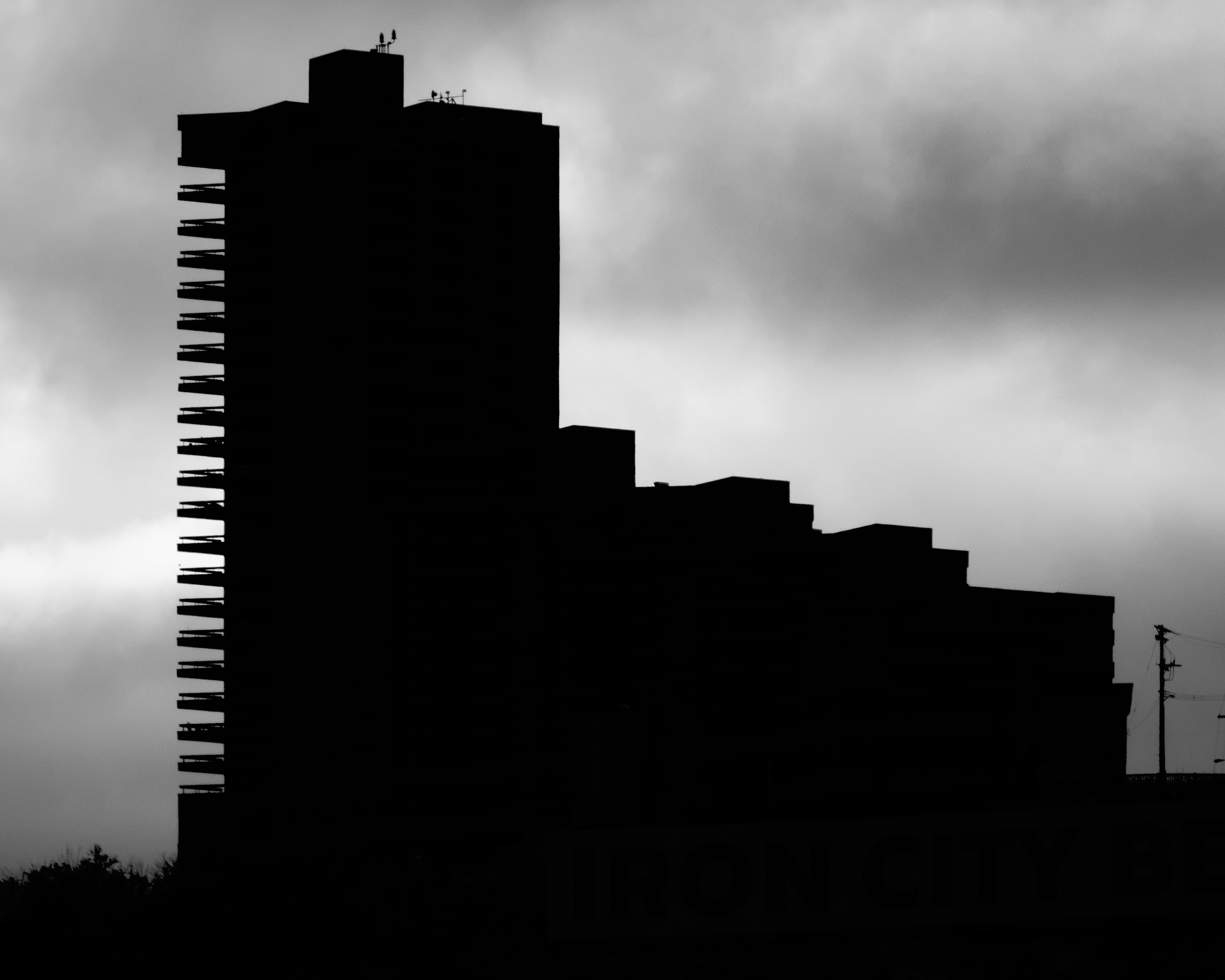
The Trimont apartments on Mount Washington, outlined against winter clouds.
The Trimont apartments on Mount Washington, outlined against winter clouds.

Old Pa Pitt’s fascination with small apartment buildings is hard to explain, except that—as he has mentioned before—they often gave lesser architects a chance to execute unusual ideas. This building is made of very simple elements, but arranged in an unusual rhythm, the balconies forming strong verticals that are accented by brick projections at the roofline.
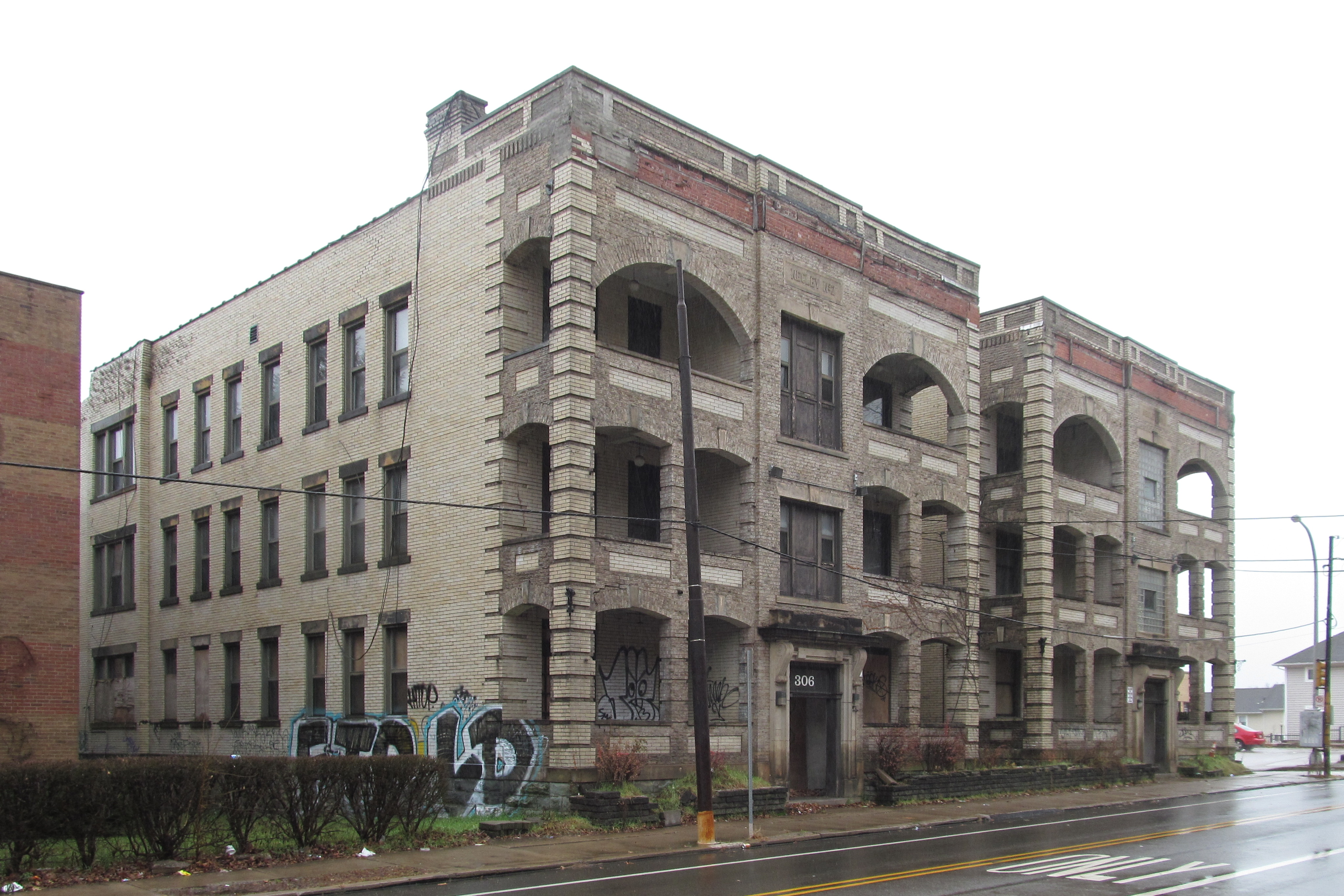
A matched set of probably doomed apartment buildings at the intersection of Negley Avenue and Rural Street, seen on an appropriately gloomy day. They were built between 1910 and 1923, and although they are mostly utilitarian boxes of apartments, their fronts are distinctive and interesting.

The treatment of the balconies creates a pleasingly complex rhythm, with broad and shallow rounded arches at the top, and slightly peaked Jacobean arches on the two lower floors. The windows in the center may have been stained glass, long since replaced when they were sold either by thieves or by an owner who could not afford to maintain them. The brick quoins add pleasing complexity to the texture.

Some kind of cornice or decorative strip has done missing from the fronts, revealing cheaper red brick behind it that was never meant to be seen.

A small apartment building along the Red Line in Dormont, with some of the Spanish Mission details that were very popular in Dormont a century ago. It was also popular to give small apartment buildings women’s names; across the street are two very similar buildings named Thea and Esther.


A fine example of the fairy-tale fantasy style that was popular in the 1920s and 1930s. The roof would probably have been green tile originally.


An eighteen-storey condominium tower built in 2007. Back then, only fifteen years ago, it was the first condominium tower put up in downtown Pittsburgh in nearly forty years. It proved that such an enterprise could be profitable.

A small apartment building in a vernacular Tudor style; its battlemented bay sets it apart from other apartment buildings in the neighborhood.

Addendum: This building, to judge by old maps, appears to have been a large-scale expansion of a single-family house, which was swallowed up in the new construction. Thanks to a commenter, we tentatively identify the apartment building as a design by Henry M. Kropff, built in 1912.

Updated update: Our correspondent David Schwing has been studying the career of the developer John McSorley. See his comment below, where he identifies these as two of McSorley’s buildings. The one for which old Pa Pitt could not find a name is called the Ontario. The architects were the Chicago firm of Perry & Thomas.
The intersection of Maryland and Ellsworth Avenues in Shadyside is flanked by apartment buildings with distinctive rounded corners. Above, the Panama. Below, a building that must have looked very modern when it was put up (in the original version of this article, we said “probably around 1920,” but it turns out to have been 1911, which makes it even more strikingly modern); it seems to have no name but its addresses. (Addendum: It was originally called the Ontario.)


Some stained glass illuminated from the inside. Above: over the entrance to the Brayton apartments.

In a parlor window.

The entrance to a Tudor apartment building on Negley Avenue at Walnut Street.

At the west end of Holden Street we find this row of Renaissance apartment buildings with corner balconies; their exteriors have not been modified much since they were built, although the railings have been replaced in the first-floor balconies, and the last of those balconies has been filled in. The front doors are accented by segmental pediments (pediments with rounded rather than triangular tops) and columns with “modern Ionic” capitals (Ionic capitals where the curly volutes project from the four corners).


We presume that the Elmont has its name inscribed below the pediment like the others, but a fabric awning obscures it.
