

Above: Snow on seedheads of Purple Coneflower (Echinacea purpurea).
Below: Snow on seedheads of Garlic Chives (Allium tuberosum).

Above: Snow on seedheads of Purple Coneflower (Echinacea purpurea).
Below: Snow on seedheads of Garlic Chives (Allium tuberosum).

The Letitia Holmes house, with Harry Darlington’s one-room-wide mansion clinging to the right of it. Mrs. Holmes’ splendidly dignified Italianate house was built in about 1870, and instead of repeating its history here old Pa Pitt will simply refer you to a well-researched page on the Holmes house in the Allegheny West neighborhood site. Letitia Holmes was a widow when she built this house, but she built it for elegant entertainments: the room with the tall windows to the right of the front door is a ballroom that spans the entire depth of the house.

Half a block deep, four storeys tall, and one room wide—that is the adaptation railroad magnate Harry Darlington made to build a big mansion on a tiny lot. This narrow but substantial Romanesque pile was built in about 1890.
To the left of it is the Holmes house, about which more soon.

The unmistakable dried seedpods of Liquidambar styriciflua on the ground in the West Park arboretum. Sweetgum is not native to our area—its range ends a little south of us—but it is so widely planted that it is one of our more common trees.


If you were a millionaire in Pittsburgh in the late 1800s, of course you expected to have a mansion by Longfellow, Alden & Harlow. They were Andrew Carnegie’s favorite architects, after all. This Renaissance palace on Ridge Avenue is particularly splendid. Although it now belongs to the Community College of Allegheny County, its grand interior spaces have not been altered very much.

The cloister-like arcade in front is one of the most striking features of the house.
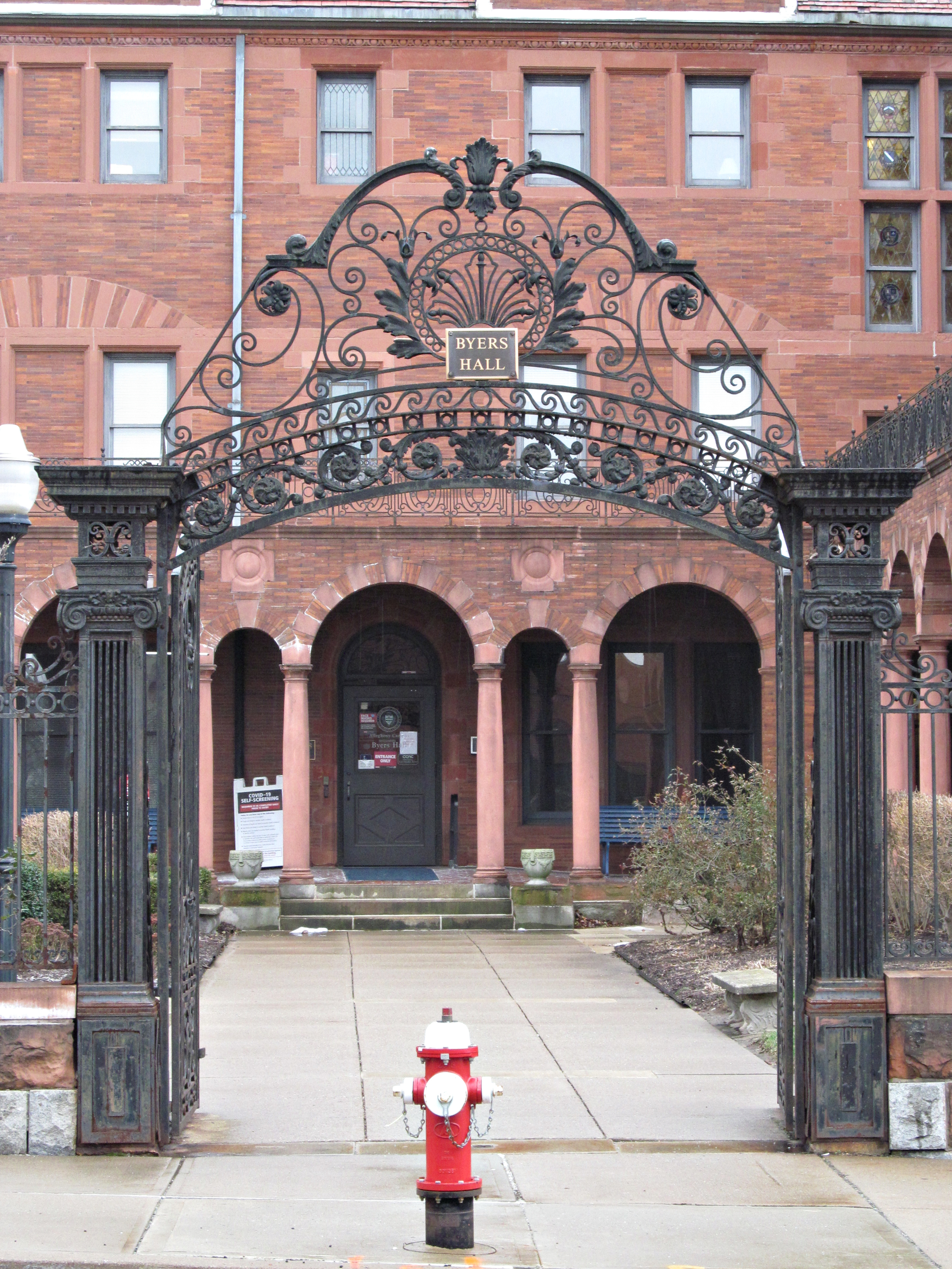
This gate, which is either original or at least quite old, is kept in beautiful shape.

Dormont Presbyterian Church (now North Way Community Church) in winter sunlight.
Suppose you suddenly dropped through a hole in time and found yourself in the Pittsburgh of 1815. How would you find your way? What was the population? What were the street names then? Where would you find a watch, or a suit of clothes, or wholesale German imports? Was there a library? How would you post a letter?
In case that happens remember this name: James M. Riddle, on the south side of 3d, between Market and Wood streets, and nearly opposite the Farmers’ and Mechanics’ Bank. Mr. Riddle has published a complete directory of the booming Borough of Pittsburgh, and no visitor from the future should be without it.
You will notice that there are no addresses. Though it had already grown to be one of the ten largest cities in the country, Pittsburgh had not yet numbered its houses and buildings. Instead, an address would be given as “S side of Virgin alley between Wood and Smithfield,” and if you wanted anything more specific, you would probably have to ask someone on the street.

The top of the Union National Bank Building (now the Carlyle luxury apartments) reflected in the Patterson Building.

This building sits in what may be the densest block of great architecture in North America, and no one pays attention to it. It is not mentioned in the various guides to Fourth Avenue, so old Pa Pitt does not know the architect or whether the building even has a name. When the building was put up, it was apparently at 93 and 95, according to the numbers over the doors; but its address is now 311 Fourth Avenue. A classified ad in the Dispatch from 1890 mentions the firm of Black & Baird as lending money at 95 Fourth Avenue. The National Real Estate Journal in 1922 shows 311 as the home of the Freehold Real Estate Co.; if the address numbers had changed by then, this is that building.
As a work of architecture, the only thing that can be said against it is that it does not compete with the works of Daniel Burnham, Alden & Harlow, Frederick Osterling, and the other great names whose works line this street. If it is a work of one of those masters, then it is a lesser work—but certainly not one to be ashamed of. In any other block it would be one of the more distinguished buildings. The large windows on the second and third floors suggest workshops of some kind. The ornamentation is artistic and in exactly the right proportion to accent rather than unbalance the architectural forms.
Any readers who know more about the origin and history of this building are earnestly invited to comment.

The Boulevard, as it’s known in the neighborhood, is Pittsburgh’s broadest commercial street—which strikes out-of-towners as absurd, but Pittsburgh has never been a city of broad streets. The breadth comes from the history of the street: when streetcars ran in Brookline, they ran in a separate right-of-way in what is now the middle of the street, with a narrow lane for automobiles on each side of the tracks—just like Broadway in Dormont today, where the Red Line cars still run. That history also accounts for the Boulevard’s other peculiarity: unlike most business streets, it has almost all the businesses lined up on one side of the street, with the other side more residential.
In every way this is an eclectic street. There’s a high occupancy rate in the storefronts, but very few chains are here, giving the neighborhood an unusually rich collection of odd little one-off shops. The architecture is also eclectic: in one block we can see everything from the beginning of the twentieth century to twenty-first-century International Style revival.
