

A dolphin fountain at the Grandview Park entrance where Bailey Avenue turns into Beltzhoover Avenue. Since this picture was taken in 2001, the stones have been cleaned of their decades of industrial soot.
A dolphin fountain at the Grandview Park entrance where Bailey Avenue turns into Beltzhoover Avenue. Since this picture was taken in 2001, the stones have been cleaned of their decades of industrial soot.

This fine arched tunnel, stone faced with a brick interior, was built as part of the great Wabash Pittsburgh Terminal Railway boondoggle, one of the boondoggliest boondoggles in a city known for boondoggles.

Just off Saw Mill Run Boulevard is a little parking lot. You have to look for it: it’s on the turnoff to Woodruff Street, and it’s almost invisible till you’re right there. From there you can reach the arch, which is well worth a visit for its own sake. The interior in particular is more interesting than interiors of tunnels usually are. The engineers had fun with this one.
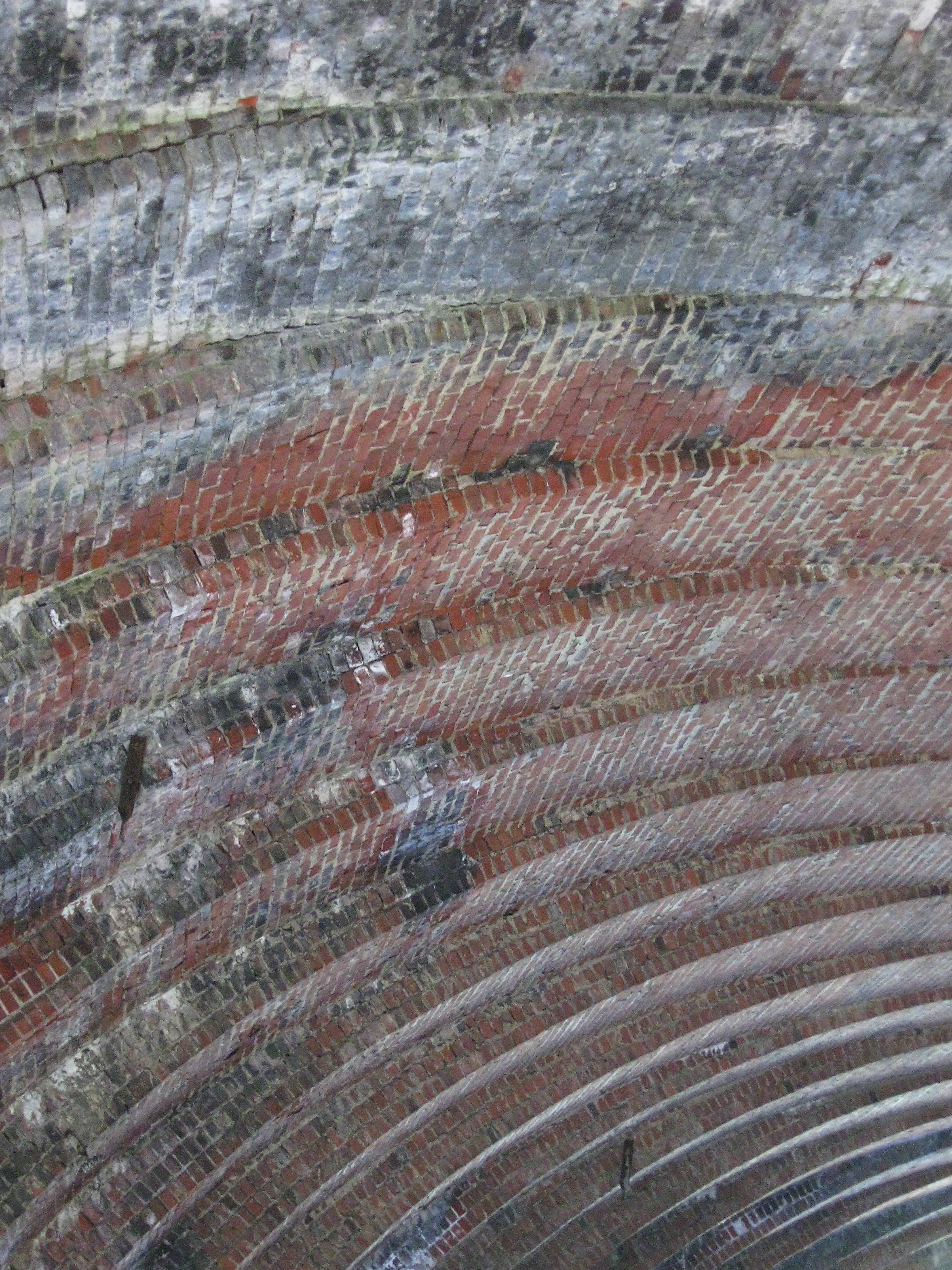

If you walk through the tunnel into the green world beyond, you’ll find that you’re walking on a broad path of gravel and occasional asphalt. This was Watkins Lane, the only way into a little farm village called Seldom Seen, or Shalerville before that. Like a surprising number of isolated bits of the city of Pittsburgh, it remained a farming village, with farming, even into the twentieth century. It was abandoned by some time in the 1960s, and the forest has reclaimed it. We’ll see more of Seldom Seen in the future.
Stream valleys in the Pittsburgh area are valuable as being the only nearly level routes through the landscape, and you will never find a major stream valley without railroad tracks in it. But as we can see here, the Saw Mill Run valley has had three railroads in it at once, one of which is still active.

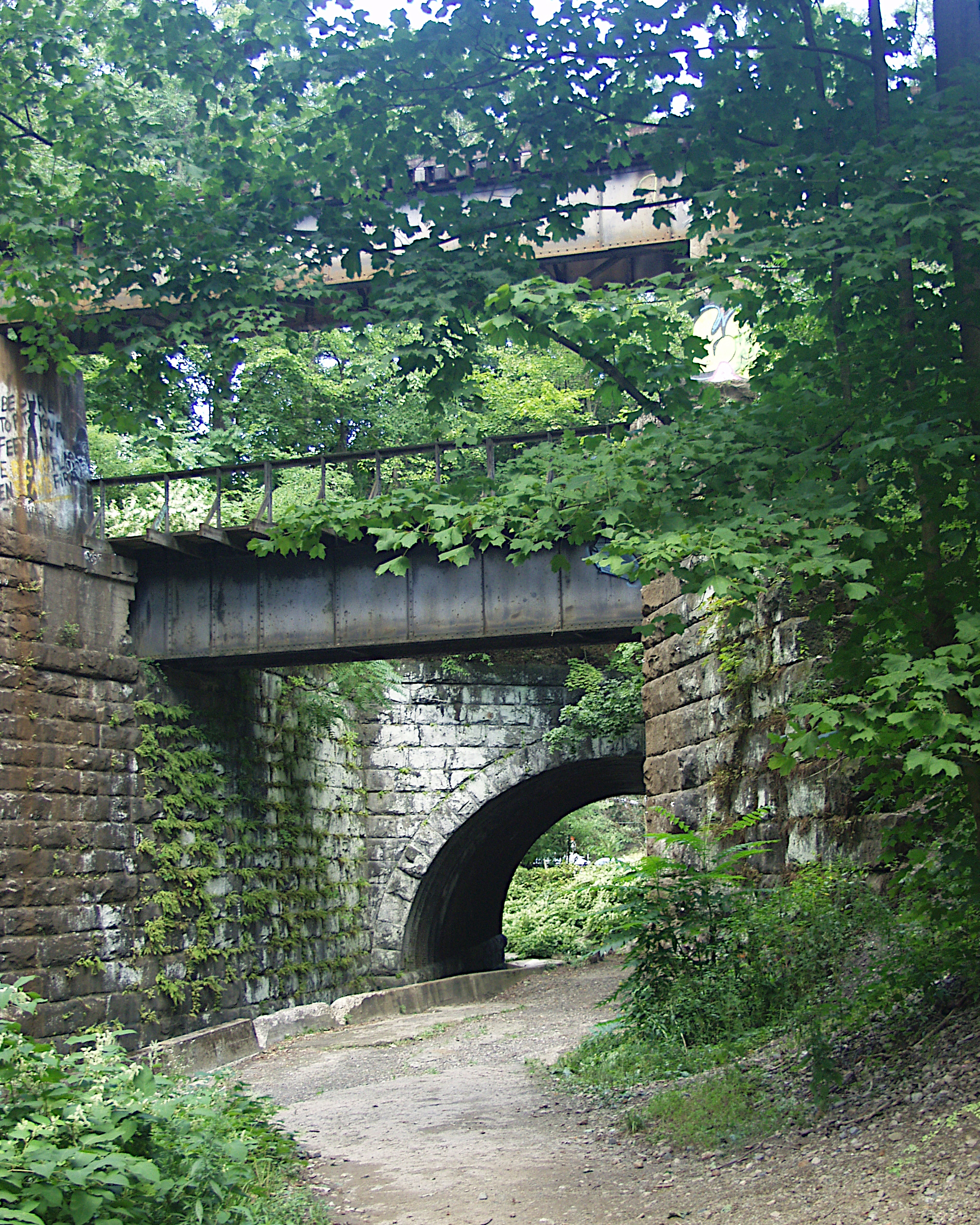

In the spring Saw Mill Run is often a raging torrent, but it is much more placid in the summer.

Few drivers pause on their way up the mountain to notice the art that went into designing the railings along the McArdle Roadway, which opened in 1933. (The lower section, that is; the upper section, from the Liberty Bridge to Grandview Avenue, had already opened in 1928.) There was a time when even the most utilitarian public works were expected to be decorative as well.

Instead of one obvious central business district, Mount Washington has several small business districts, of which the densest and perhaps most interesting is the one that takes up two blocks of Shiloh Street just off Grandview Avenue. Several of the buildings show a decided German influence, and this one (built in 1893) is a particularly good example of what we might call South Hills German style. (Before the First World War, the back slopes of Mount Washington were known as the “South Hills”; Beechview and the neighborhoods farther south were described as “beyond the South Hills.”)
Like most of the buildings on Shiloh Street, it is irregularly shaped, a long trapezoid with its street front on an oddly-angled short side of the building.
This is an enormous composite picture; be prepared for nearly 20 megabytes of data if you click on it.

Today this house is used as a clubhouse for residents of Chatham Village. It was built in 1844 or 1849 (Father Pitt has seen both dates) for Thomas James Bigham, a notorious abolitionist who was rumored to harbor fugitive slaves here. Fortunately for him, there was not much sympathy for slave laws in these parts: Pittsburgh was riddled with Underground Railroad stations.

These pictures were taken in late evening light (individual pictures taken with a Canon PowerShot S45, then stitched with Hugin to produce the wide angles you see here). There’s a fair amount of grain if you look closely. Low-light performance is one aspect of digital cameras that has definitely improved, and Father Pitt would do much better in low light with a more recent camera. He would also pay about a thousand dollars for a more or less equivalent camera, rather than the six dollars he paid for the old Canon.

The evening sun greets us as we come up out of the woods from one of the hillside trails in Grandview Park.

From Motion Picture World, 1912.
Father Pitt does not know the exact location of either of these establishments. The fact that the Casino was remarkable for having been in the same place for eight years shows how temporary these early theaters often were. Pittsburgh, of course, invented the movie theater, and by 1912 no neighborhood was complete without one. The larger ones, like the Casino below, also booked vaudeville acts.
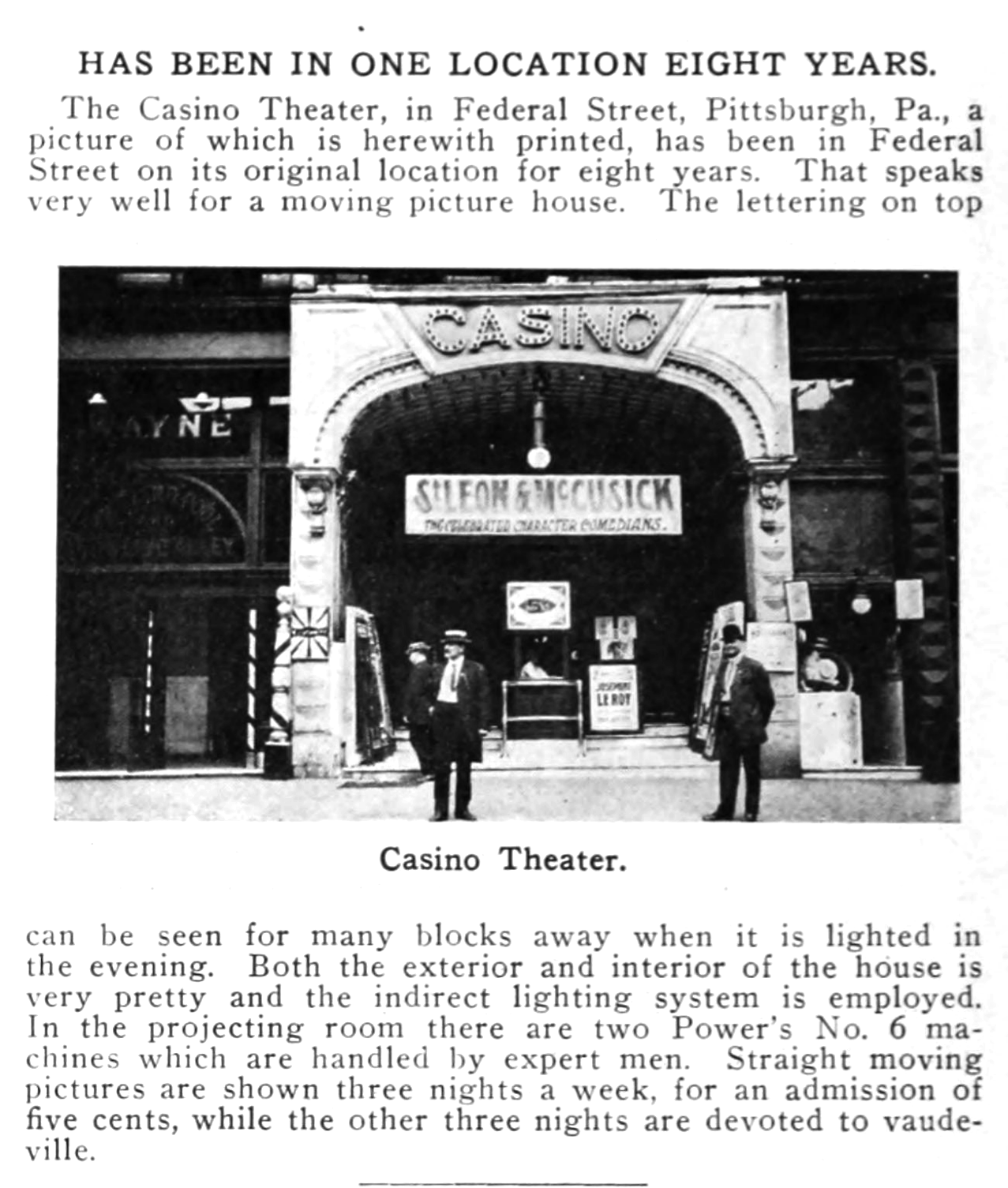
From Motion Picture World, 1912.

This church sits on one of those impossibly narrow Pittsburgh streets, and it would have been very difficult to get a picture of the whole front this way without the marvels of Hugin stitching technology. A little wide-angle distortion makes the pinnacles turn inward, but overall this is a very good representation of the front of the building. It is no longer a church; now it is an apartment building, but either an appreciation of the architecture or a limited budget has kept the current owners from making any significant changes to the exterior.

Here is a huge picture of the front of St. Mary of the Mount on Grandview Avenue, Mount Washington. It’s made from eight individual pictures, all cleverly sewn together by Hugin. If you click on the picture, you can enlarge it to 4,692 × 6,569 pixels, or about 30 megapixels. (It could have been larger, but old Pa Pitt decided that 30 megapixels was probably large enough.) Many thanks to Wikimedia Commons for being willing to host huge pictures at such a level of detail.
The architect was Frederick Sauer, whose conventionally attractive churches do nothing to prepare us for the eccentric whimsy he could produce when he let his imagination run wild.


