A two-car train enters Mount Lebanon station from the subway tunnel that goes under part of Dormont and Uptown Mount Lebanon. Part of the platform is under reconstruction at the moment, so only the front car will open its doors.
The Red Line is partly closed for the next two months as Pittsburgh Regional Transit sorts out an accumulated backlog of construction projects. The section from Potomac south to Overbrook Junction is still open.
First of all, old Pa Pitt hopes these aluminum letters are insured at replacement value, because it would be a crime against design to lose their cool perfection.
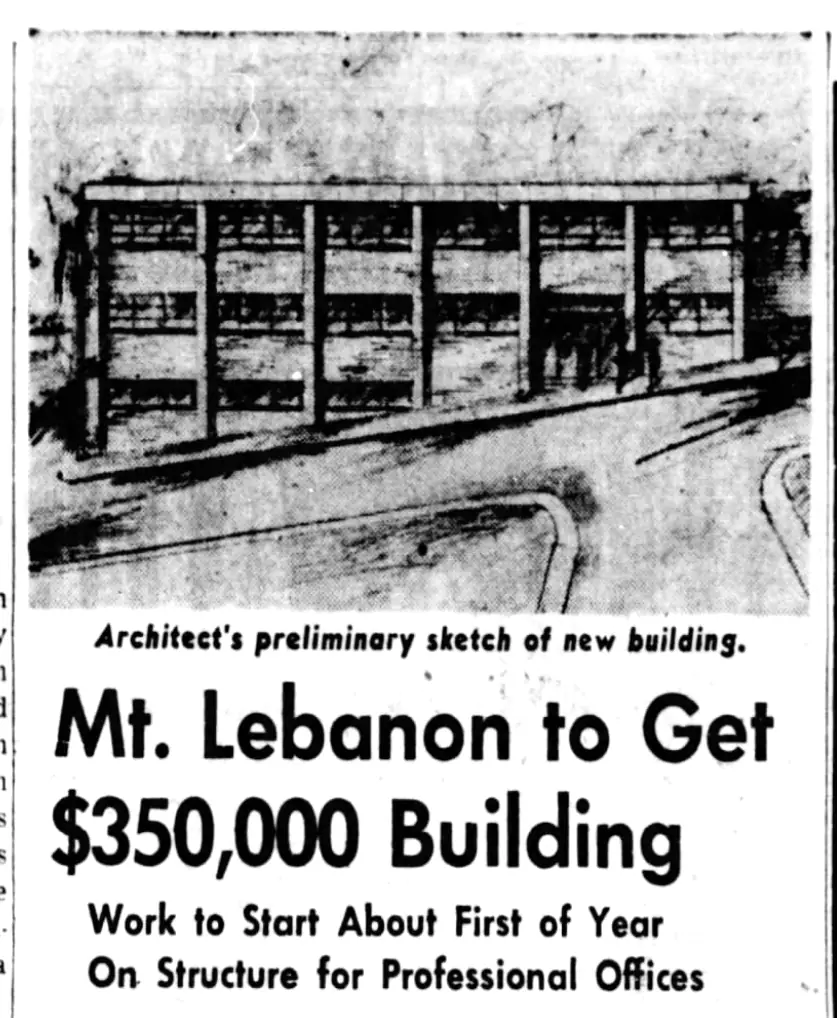
Arthur Tennyson, a Mt. Lebanon native, was an architect who flourished in postwar Pittsburgh, when “modern” was the buzzword and simplicity was in demand. This building was designed in 1956 for medical offices. It opened in 1958, and although its population has diversified a little and a few minor alterations have been made, it remains, sixty-six years later, mostly unaltered and mostly in use for its original purpose.
From his preliminary sketch, we can see that the building grew a bit from Mr. Tennyson’s original conception. Because of the sloping lot, it would be hard to say exactly how much it grew; it would be safest to say that roughly a floor was added.
Pittsburgh Press, September 23, 1956.
The most eye-catching feature is the facing of mint-green glazed brick laid in a stack bond (that is, gridwise) rather than the usual running bond. The stack bond adds to the impression of horizontality and stability on a site where the lot plummets diagonally two floors.
The building was a bit unusual in that the doctors who originally had their offices here were shareholders in the building as well as tenants. “The idea of constructing the building,” said the Press article, “originated with the doctors themselves, who are share owners in Mt. Lebanon Professional Building, Inc., the backer of the project.”
Markham Drive in Mount Lebanon is not yet included in the Mount Lebanon Historic District, but it ought to be. It is a street of architecturally distinctive houses, mostly from the 1930s, that are in an extraordinarily fine state of preservation, at least externally. We have already seen one of them: the “Transition House” designed by Brandon Smith to entice conservative home-buyers to accept modern construction methods. Here is a generous album from the rest of the street.
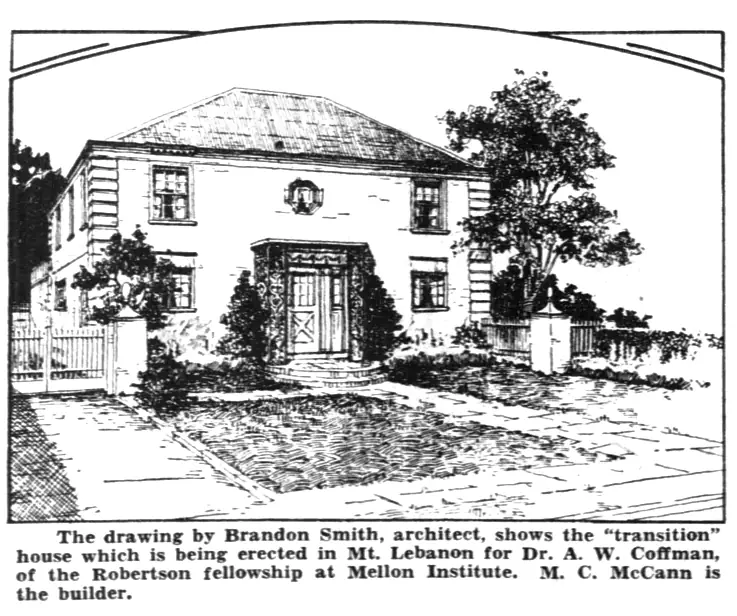
What, you may ask, is a “transition house”? It is a house designed to look traditional but use the most modern construction methods available in 1936. The idea was that the public could be induced to accept modern construction if it came without the modernist offenses against traditional aesthetics. Architect Brandon Smith—best remembered for some extravagant mansions in Fox Chapel—gave it all the decorative flourishes a 1930s suburbanite might expect from a “Colonial,” but under the stone and brick were super-modern materials developed at the Mellon Institute of Industrial Research.
Our information and the architect’s drawing above come from an article about the house in the Pittsburgh Press, published when the house was under construction in 1936. The whole article will interest a few architectural historians, so we have transcribed it below.
All the older schools in Mount Lebanon were designed by Ingham & Boyd, and here we see a fine example of their style. An Ingham & Boyd school is an implied guarantee that your children will grow up to be respectable citizens. The buildings are in a restrained classical style, with just enough ornament to show that good money was spent on this structure. This particular school is named for a poet who was a big deal in the early twentieth century and has been almost completely forgotten since then.
Sunset Hills is a Mount Lebanon plan developed in the 1920s and 1930s. Most of the houses are more modest than the ones in Mission Hills or Beverly Heights. Many of them, however, are fine designs by their architects, and in particular several are among the best examples of the Spanish Mission style in Pittsburgh.
Does your garden shed match the architecture of your house? And does it have two floors?
This house is almost a traditional Pennsylvania farmhouse, but with Mission arched porch and stucco.
Crescent Drive is just a block and a half long, but it has the broad assortment of styles that makes the whole Beverly Heights plan such a delight to wander in. Here’s an album of houses on the street.