When a new generation of architects feels utter contempt for the work of the previous generation, this is the result. Fortunately, the contempt extended to ignoring the details of the original building, which are therefore preserved, except for the loss of the cornice. Like several other previously abandoned buildings in the historic center of Homestead, this one has now found another use.
The school was named for Charles M. Schwab, who was superintendent of the Homestead Works and later the first president of United States Steel.
A fine example of Tudor Gothic applied to a small church. This is one of the decreasing number of churches in Homestead still inhabited by their original congregations. It is also one of the few churches dedicated to St. Mark the Evangelist that give us his full name.
Note the tidy little Tudor parsonage in the rear.
Addendum: The architect was Andrew Lisle; the church and parsonage were designed together in 1916 (and therefore probably finished in 1917). Source: “Gets Contract for Church in Pitcairn,” Pittsburg Press, August 6, 1916. “Bids have been received and are now under consideration by architects and owners as follows:… for a church and parsonage for the St. John’s Lutheran congregation at Homestead, Andrew Lisle, Architect…”
This glorious Romanesque church was closed in 2009, but it was taken over by a community education organization called Dragon’s Den, which has kept it up beautifully, and in the well-preserved interior has added “a state-of-the-art two-level challenge course, climbing wall, and a 160-foot zip line that connects the choir loft to the former altar.” Now you know what to do with a big vacant church.
Addendum: The architect was Frederick Sauer, who gave us a number of fine churches and the whimsical Sauer Buildings in Aspinwall.
The rectory is overshadowed by the magnificent church, but it is certainly a striking design in its own right.
There has been an A. M. E. church on this site for a long time: a frame church appears on an 1891 map of Homestead. This modest but rich little Tudor Gothic building, with its matching parsonage, dates from 1920, and faces a pleasant park on a pleasant street. It fits well with its neighbors, not overwhelming them but still announcing itself as a church.
Ten years ago this building was abandoned, and the jungle was rapidly swallowing it (here’s a Street View image from Google Maps). Now it’s beautifully restored and in use.
Addendum: According to the Pittsburgh History and Landmarks Foundation, this post office was built in 1912, with James Knox Taylor listed as architect; but since he was Supervising Architect of the Department of the Treasury, we don’t know how much he had to do with the design. It is certainly true that the designs coming from his office had a certain similarity, implying that he was the dictator of taste if not the architect of the details.
That white van pulled in just before old Pa Pitt got into position for this picture. Sometimes we think it might be worth our while to invest in a tow truck.
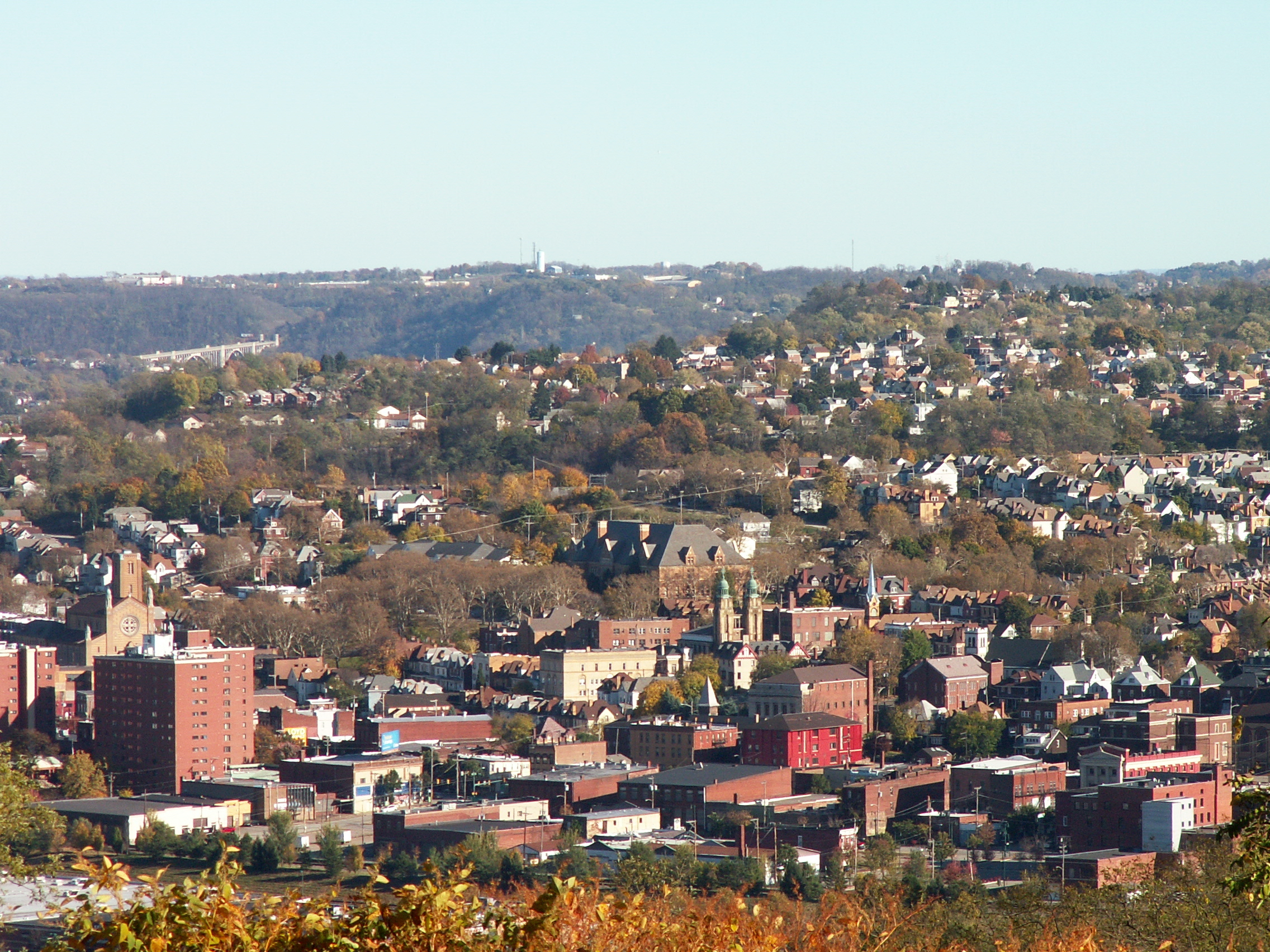
Yesterday we visited McKeesport, a city that has suffered much and probably still has more to suffer. But when our frequent correspondent “von Hindenburg” bemoaned the tragedy of McKeesport, we promised to lift his spirits with some pictures from Homestead, another Mon Valley city (technically a borough) where the news is more cheerful. We’ll be seeing quite a few pictures from both places over the next few days or weeks, and the comparison is instructive.
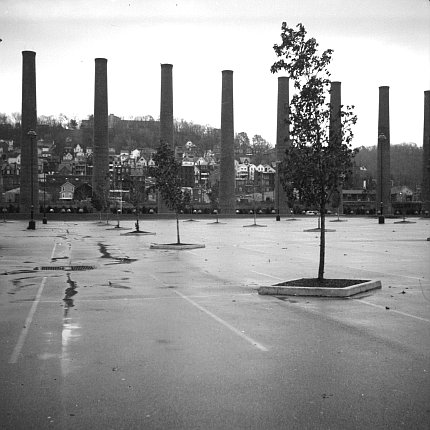
Both cities lost their reason for being with the end of heavy industry. In McKeesport, the politicians who had presided over the city’s decline had only one strategy for revival: bring back heavy industry. It was never going to happen. In Homestead, politicians seem to have realized that, if the place had a future, it would be as a bedroom community and shopping area for metropolitan Pittsburgh. The gigantic Waterfront development that replaced the Homestead Works brought in money. Father Pitt criticized it for being isolated from the rest of Homestead, but the prosperity has seeped through anyway, and now the Eighth Avenue business district, once nearly deserted, is filling up with brewpubs and smoothie bars and axe-throwing emporia and other signs of prosperity.
Homestead is far from free of problems. But it is beginning to look like an attractive place to live again. McKeesport has what the real-estate agents call potential, but right now it’s definitely a fixer-upper.
A row of smokestacks from the vanished Homestead Works looms over a parking lot for the gigantic Waterfront shopping center that replaced the factories.