The Hilltop neighborhoods outgrew this telephone exchange, and a new Art Deco palace of telephony was built up the street. But the building remained standing, and has been converted to apartments.
James Windrim, the Philadelphia architect who did all of Bell of Pennsylvania’s work for some years in the early twentieth century, supervised alterations and additions to this building in 1923 or 1924,1 but he may not have been the original architect.
If you’re stuck in a dumpy old wooden building and your business is prospering, but not prospering that much, you can make a good impression by putting a new front on the building and leaving the rest. That’s what happened here. This is actually a wood-frame building—except on the street face, where the owner added a spiffy new brick and stone front. Old maps reveal the secret: a thin line of brick appears on the front of the wooden building between 1910 and 1923. Mission accomplished: the building looked new and expensive, but the owner wasn’t deep in debt.
A typical FDR-era public building, put up in 1940 in the modernized hybrid of Art Deco and classical style that old Pa Pitt likes to call American Fascist.
The Eighteenth Ward includes all of Allentown, Beltzhoover, and Bon Air, as well as part of Mount Washington. These memorials stand at the corner of Warrington and Estella Avenues. Above: the people who served in World War I, with hundreds of names. Below, the ones who served in World War II, with even more names. The pictures are very big, so if you enlarge them most of the names should be readable.
The Alla Famiglia restaurant was one of the pioneers in the ongoing revitalization of Allentown, and its owners have spiffed up this building beautifully. They have also expanded into the old movie theater next door.
These two buildings probably date from the 1880s. Though they were identical, they seem always to have been under separate ownership. At Pittsburgh Historic Maps, they first appear on the 1890 layer as belonging to Elizabeth Fisher (the building on the left) and Mary A. Curtis. The ground floors have been altered a bit, but the upper floors retain much of their original detail.
An attractively modernistic little apartment building—Father Pitt would guess it dates from about 1940—in good shape, with not too many alterations. Small details like decorative brickwork elevate it from mundane to elegant. And note the corner windows, the badge of mid-century modernity.
The Limbach Building is a good representative of what has been going on in Allentown over the past few years. Allentown was traditionally a German neighborhood, and the Limbach Building is a well-preserved example of the style old Pa Pitt calls German Victorian. Above we see it as it was just a few days ago; below in July of 2021. The building is in better shape now, and the downstairs tenant—a gym called “Death Comes Lifting,” whose slogan is “Fitness for the Misfits”—is weirder. Thus the whole progress of the Allentown business district is epitomized in one building: better and weirder.
It is especially cheering to see that someone is taking good care of the distinctive dome on the turret. The building would lose half its German flavor without that detail.
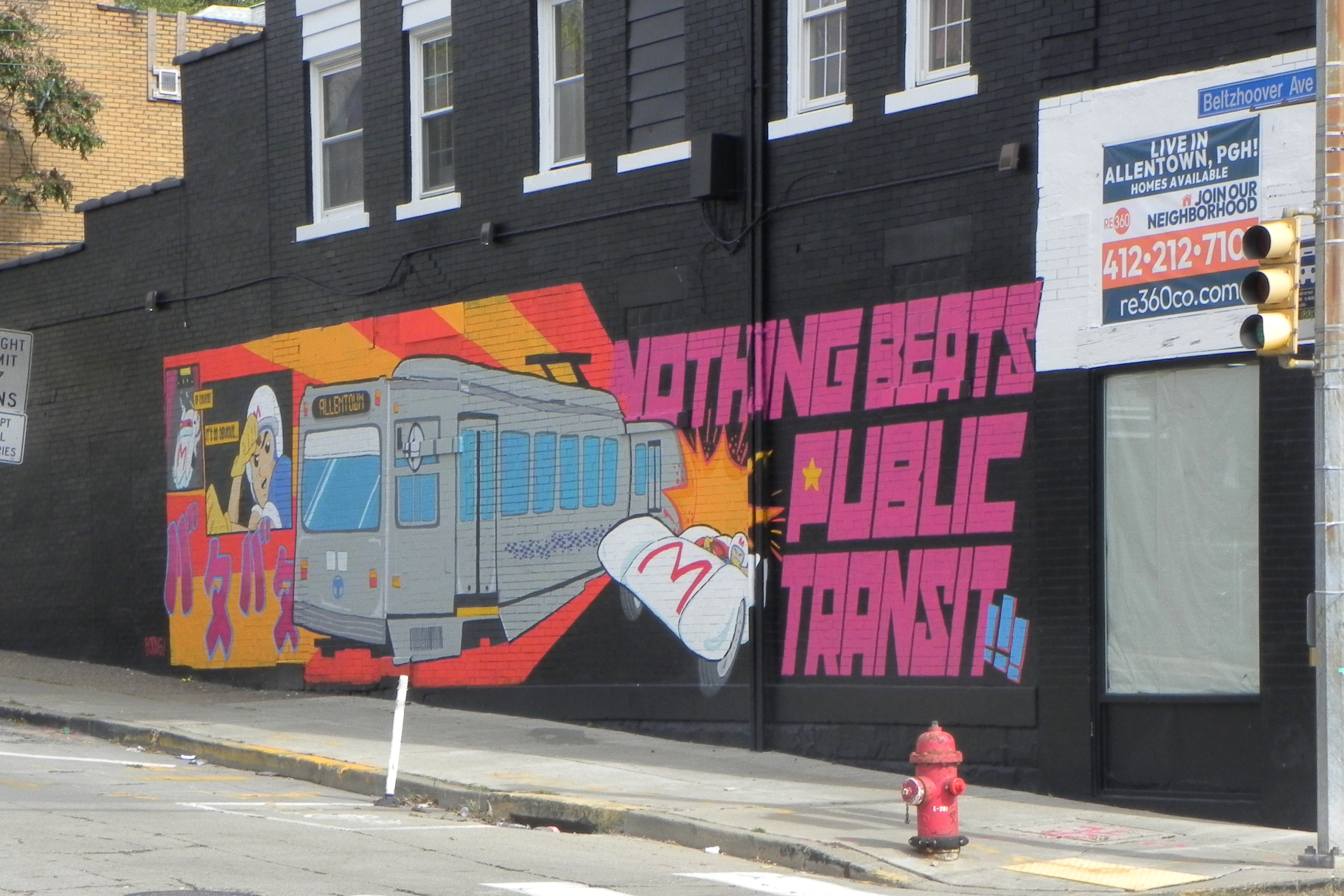
All summer long, all the rail routes have been detoured through Allentown. Stop and consider for a moment how thoroughly odd Pittsburgh transit is: do you know of any other subway system that keeps up an alternate route over the top for times when one of the tunnels has to be closed?
The few riders who look up from their phone screens have a chance to notice that Allentown is changing. Over the past few years, the Warrington Avenue business district has been going through a rapid trendification. It’s full of weird little shops too low-budget for the high rents of Lawrenceville.
A Romanesque church whose immense chimney dwarfs its stubby little tower, this is probably the only church in the neighborhood still serving its original congregation.