We already saw the David Roney mansion; here are a few more houses on Judges’ Row, the line of mansions facing Riverview Park in Observatory Hill. Many of them can hardly be seen in the months when the leaves are on the trees, so we visited them in the late winter.
A few houses in different styles within one block of Perrysville Avenue. We begin with a house that, in its layout, is a typical Pittsburgh Foursquare, but blown up to mansion dimensions.
The porch with its rounded ends is a treasure, and we hope it can be preserved. Porches are the first things to decay in a house like this, and it would be hard to find a craftsman who could duplicate this one.
A later generation of foursquare; this one preserves a fine tile roof.
Yet another generously sized foursquare. This one combines some classical detailing with a bit of the Victorian incised decoration of a generation earlier.
This one is clearly a traditional Pennsylvania I-house from the days when this area was way out in the country on the Perrysville Plank Road. If we interpret the old maps correctly, it was there at least as early as 1882, but probably well before then. It was a frame house, however. At some point probably in the 1920s or later, it was neatly dressed in a new coat of bricks and given a new front porch.
This little cottage has a distinctive angular Craftsman style, and many of the details of its woodwork are well preserved.
Finally, here is a unique house that has just come out from under sentence of condemnation and is now being refurbished for a new life. The entrance with classical pilasters and rounded pediment is unusual and attractive, and the bright sunroom in front would make a fine small conservatory for an orchid collector.
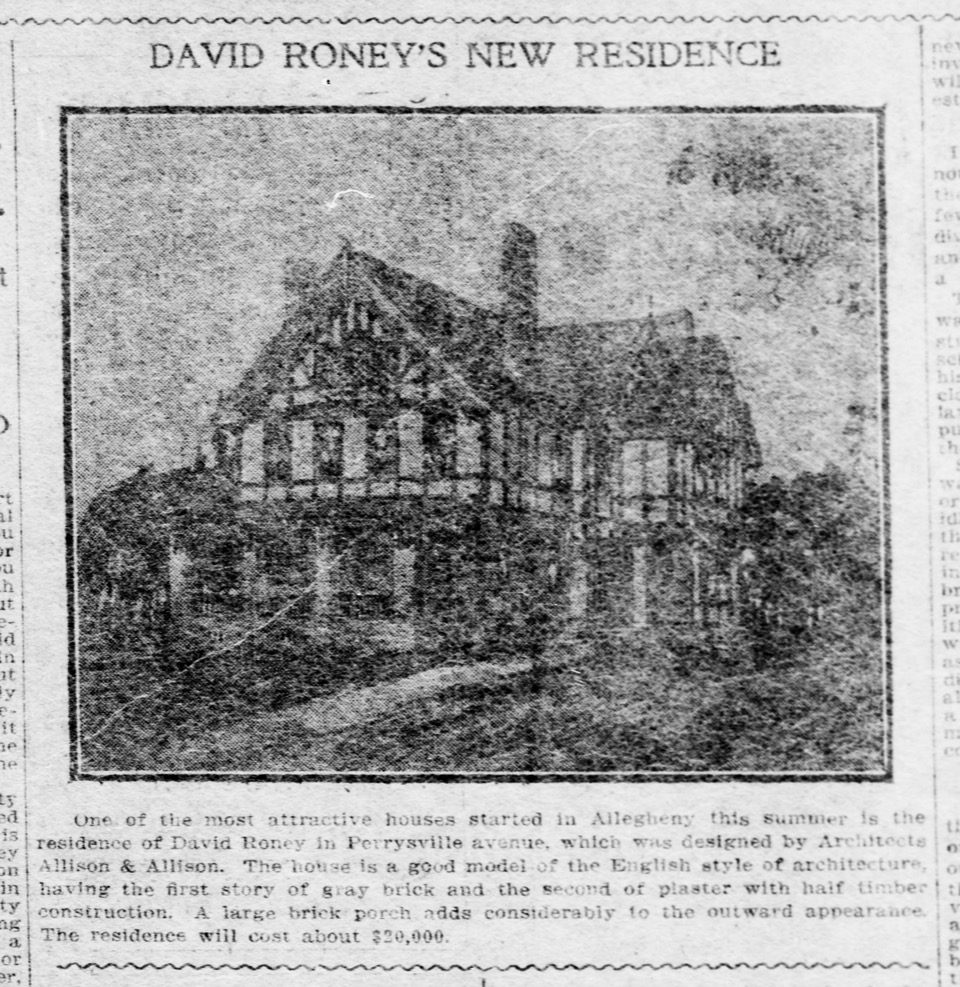
The architects of this striking Tudor mansion on Judges’ Row (as this stretch of fine houses facing Riverview Park is still called in the neighborhood) were Allison & Allison, who also designed the Watson Memorial Presbyterian Church up the street. The Gazette for September 5, 1905, printed an illustration of the house with this description:
One of the most attractive houses started in Allegheny this summer is the residence of David Roney in Perrysville Avenue, which was designed by Architects Allison & Allison. The house is a good model of the English style of architecture, having the first story of gray brick and the second of plaster with half timber construction. A large brick porch adds considerably to the outward appearance. The residence will cost about $20,000.
The Atlas Theatre opened in 1915 as the Perrysville but was almost immediately put up for sale and renamed the Atlas. It was remodeled with Art Deco front in 1938. The last movie it showed, in 1953, was Bonzo Goes to College. Apparently that killed it. After that, it was a retail store for a while, but it has been many years since anything inhabited this building.
Walking down Perrysville Avenue one day not long ago, Father Pitt spotted a distinctive outline through the branches. It was the tower of a Second Empire mansion.
Old Pa Pitt was very excited. Here was a Second Empire mansion he had not known about before. That was very interesting. He started investigating, and found that the discovery was actually much more interesting than that.
Historians of Perry Hilltop are earnestly invited to help us out with the history of this house, which has caught old Pa Pitt’s imagination. The house is in deplorable shape—especially the side you can see through the overgrown shrubbery from Perrysville Avenue, where billows of garbage seem to be spilling out of the building.
But what is fascinating is that, where old Pa Pitt expected a Second Empire mansion, he found something much older. The shallow pitch of the roof and the broad expanse of flat white board underneath the roofline say “Greek Revival” in a loud voice.
This appears to be the side of the house, although Father Pitt has reason for believing that it was originally the front. The large modern Perrysville Plaza apartment building is next to it, but walking around to the back of that building reveals the front of the house—with its distinctive Second Empire tower.
The tower is pure Second Empire, but the roof still says Greek Revival. The house must have been Second Empired, probably in the 1880s. The attic windows in the gable ends were added then: they match the ones in the tower.
The Second Empire remodeling was not the last big change. You may have noticed that there is something a little off about the brick walls. This appears to have been a frame house originally. Old plat maps show it as a frame house through 1910; later maps show it as brick. A brick veneer must have been added at some time around the First World War. The new brick walls swallowed all the window frames and other trim that would have given us more clues about the original date.
There was a house here belonging to the “Boyle Heirs” in 1872, the earliest plat map we have found. An 1882 map shows a carriage drive leading to the plank road that became Perrysville Avenue, with a circle at the end of the house near the road—bolstering old Pa Pitt’s guess that the end was originally the front.
There are few Second Empire mansions remaining in Pittsburgh, and even fewer Greek Revival ones. This house ought to be preserved, but it probably will not be. The neighborhood is neglected enough that it has not even been condemned yet, which means that it will continue to decay until either it becomes an intolerable nuisance or the land becomes valuable enough to build something else on. Father Pitt will label it Critically Endangered.
All we can do, therefore, is document that it exists, and Father Pitt has done the best he can do without trespassing.
Perrysville Avenue started as a plank road, with tollgates, but in the second half of the nineteenth century it began to fill up as the spine of a pleasant suburban neighborhood of Allegheny. Today Perry Hilltop is a strange mixture of appalling decay and beautiful restoration: it has never quite got off the ground as a trendy neighborhood, but some of the houses have been beautifully preserved. The splendid Dutch Colonial mansion above, for example, is in very good shape. Note the original windows. It was probably built around the turn of the twentieth century.
A Victorian frame house that preserves some of its original details, including the trim around the windows. It appears on an 1882 plat map, so it probably dates from the 1870s.
This center-hall manse has a third-floor dormer that, fortunately, no one has ever had the money to modernize.
This house was probably built at some time around the First World War.
Designed by Allison & Allison, this stony Romanesque church was renamed Riverview Presbyterian in 1977, when, we suppose, no one remembered Watson anymore. After sitting vacant for a while, it now has a nondenominational congregation called Pittsburgh Higher Ground, and we wish them long life and prosperity in this beautiful building.
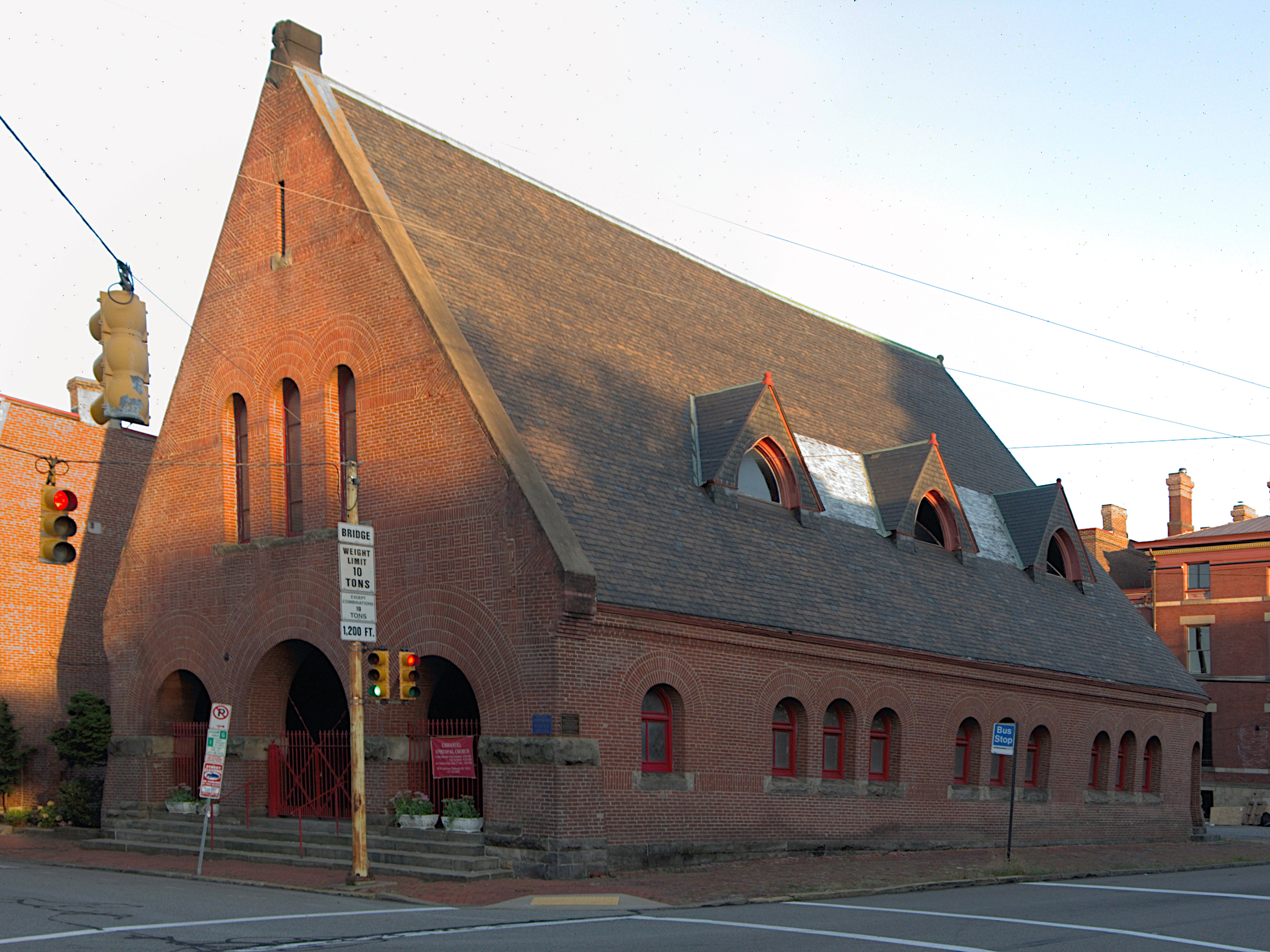
Old Pa Pitt thinks writers on architecture tend to throw the name “Richardsonian” in front of the term “Romanesque” far too thoughtlessly, but there is no question about this church. It is very Richardsonian, right down to the little triangular dormers on the roof. Compare them to the ones on Richardson’s famous Emmanuel Episcopal Church in Allegheny West:
This is the architectural equivalent of a direct quotation.
Now Emmaus Deliverance Ministries. Designed by John Lewis Beatty, this late-Gothic-style church was built in about 1925. (The cornerstone has been effaced, which old Pa Pitt regards as cheating, though he understands that a new congregation likes to make a new beginning.)
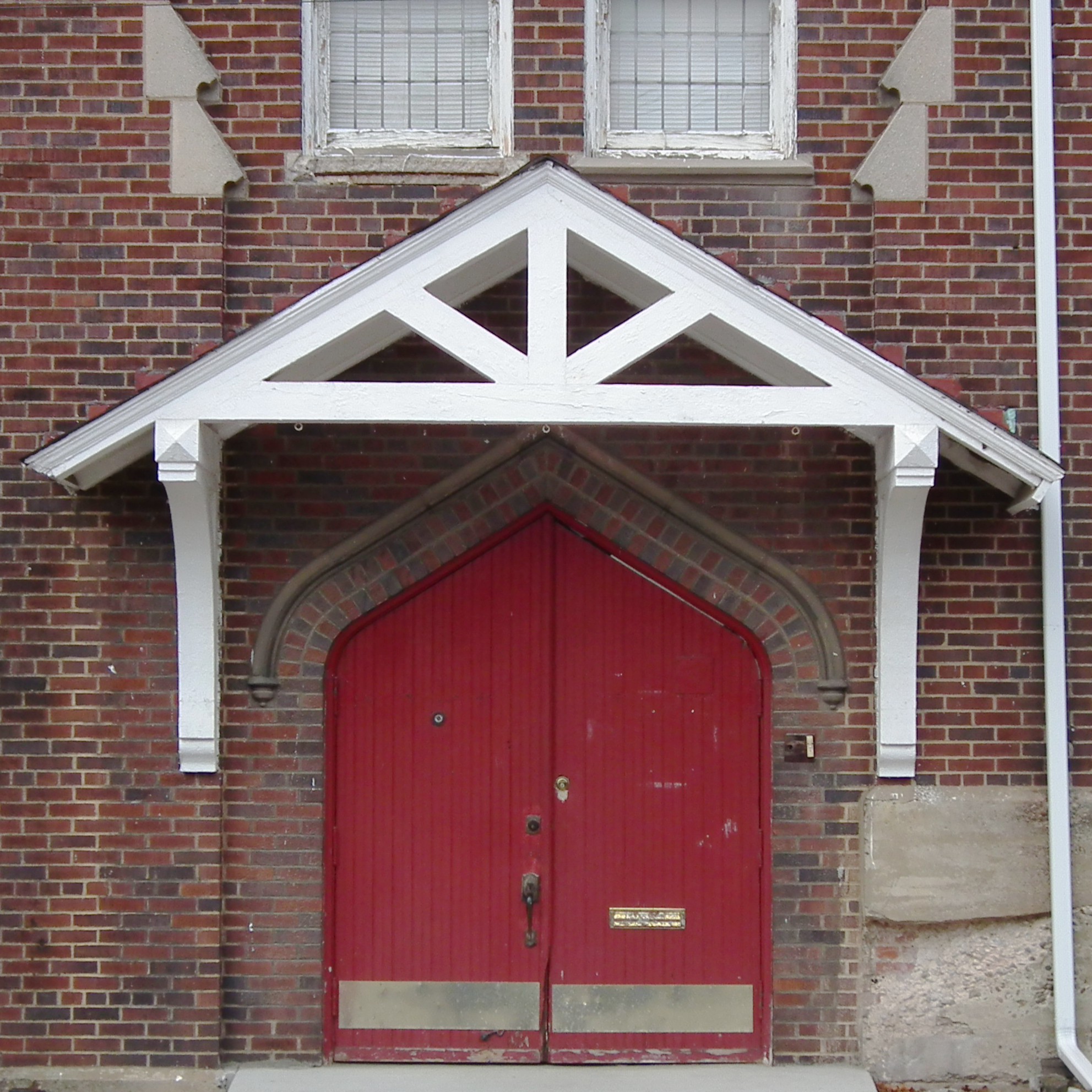
A Gothic church must maintain a delicate balance: it wants to be impressive, but it also wants to be welcoming. The simple woodwork over the entrances (this one is the basement entrance) gets the balance right: it fits well with the style of the building, matching the angle of the Gothic arches, but it sends the message that we’re just plain folks here.