-
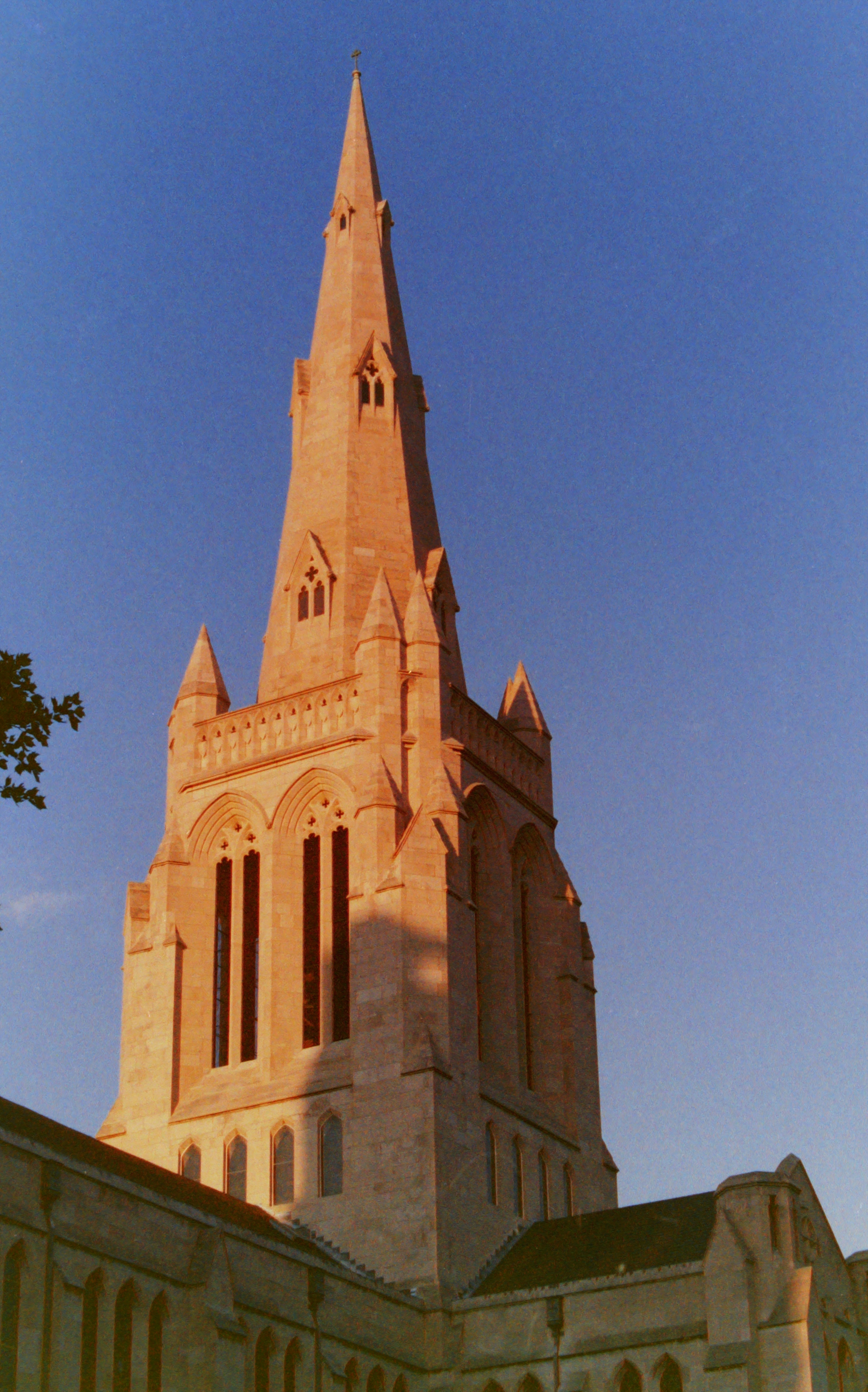
Tower of Calvary Episcopal Church at Sunset
-
Arsenal Bank Building, Lawrenceville

Built in 1884 in a Victorian Gothic style—Father Pitt calls it Commercial Gothic—this was a bank until 1943, according to the Lawrenceville expert Jim Wudarczyk. After that it was offices for quite a while, and then was refurbished as a restaurant and apartments above. This is not a great work of architecture, but the details are interesting and worth a close look. The builder reveled in his corner location and made that corner the focus of the whole building. Old Pa Pitt can’t help thinking that the treatment of the windows could have been improved by making it either more interesting or less interesting; the stone accents are either too much or too little.
-
A Dim Religious Light

But let my due feet never fail
To walk the studious cloister’s pale,
And love the high embowed roof,
With antique pillars massy proof,
And storied windows richly dight,
Casting a dim religious light.
There let the pealing organ blow,
To the full-voic’d quire below,
In service high, and anthems clear,
As may with sweetness, through mine ear,
Dissolve me into ecstasies,
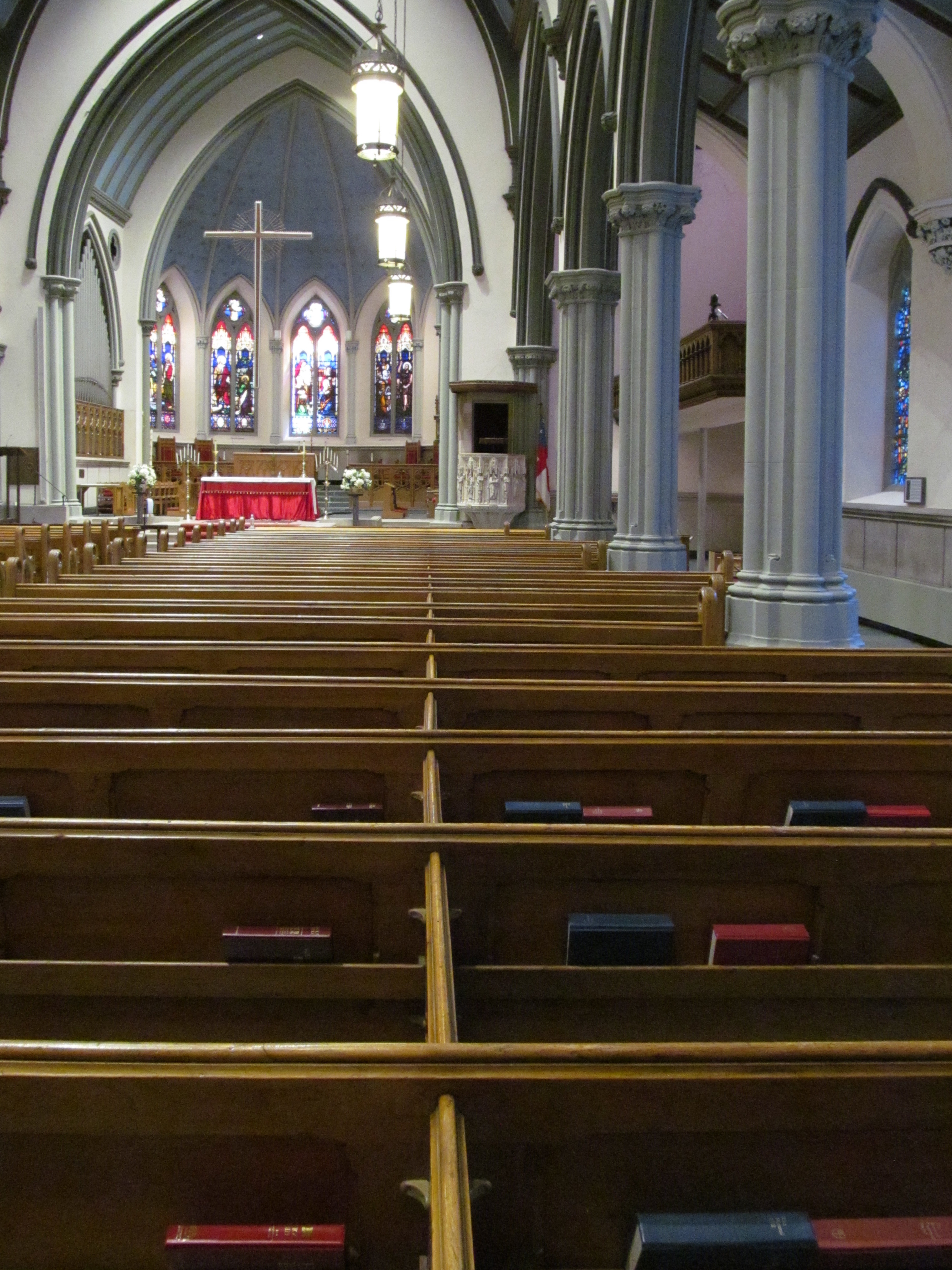
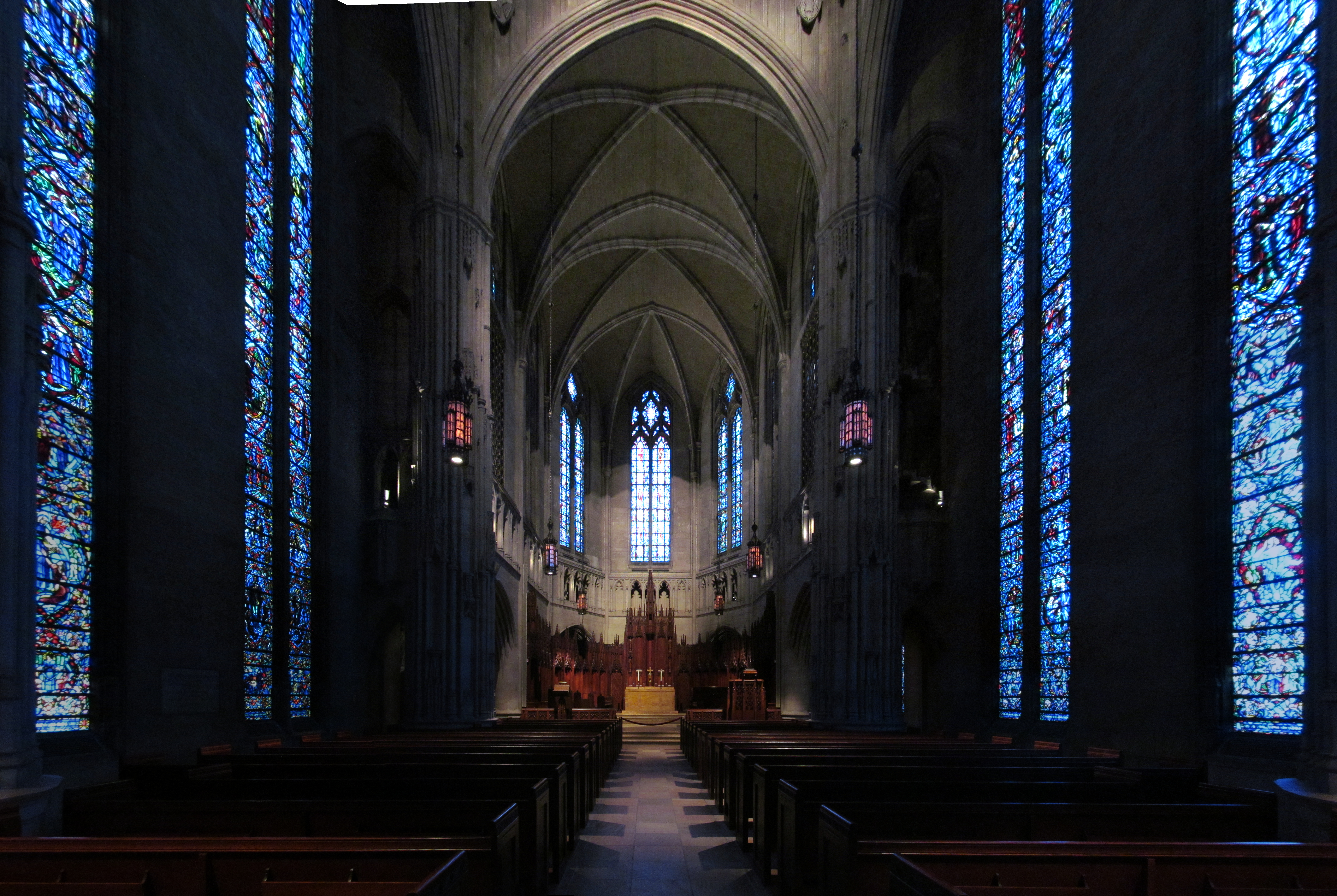
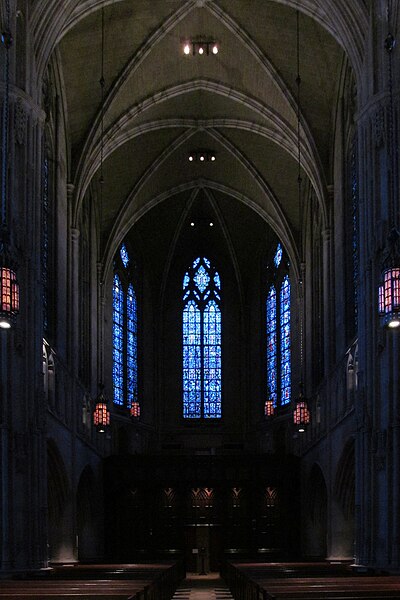
And bring all Heav’n before mine eyes.It is difficult to convey in a photograph the impression we get from entering a glorious Gothic church like Heinz Chapel. In general photographs are too light, either because the photographers laudably attempted to capture the many artistic details of the Gothic interior, or because they used automatic exposure and let their cameras do the thinking. Old Pa Pitt has tried very hard in these pictures to give some impression of the relative lighting as we enter the chapel from the bright light outside. Most of the light is dim, but a pool of light shines in the distance, drawing us toward the altar.


No matter how bright it may be outside, turning to leave the church is walking away from the light.
-
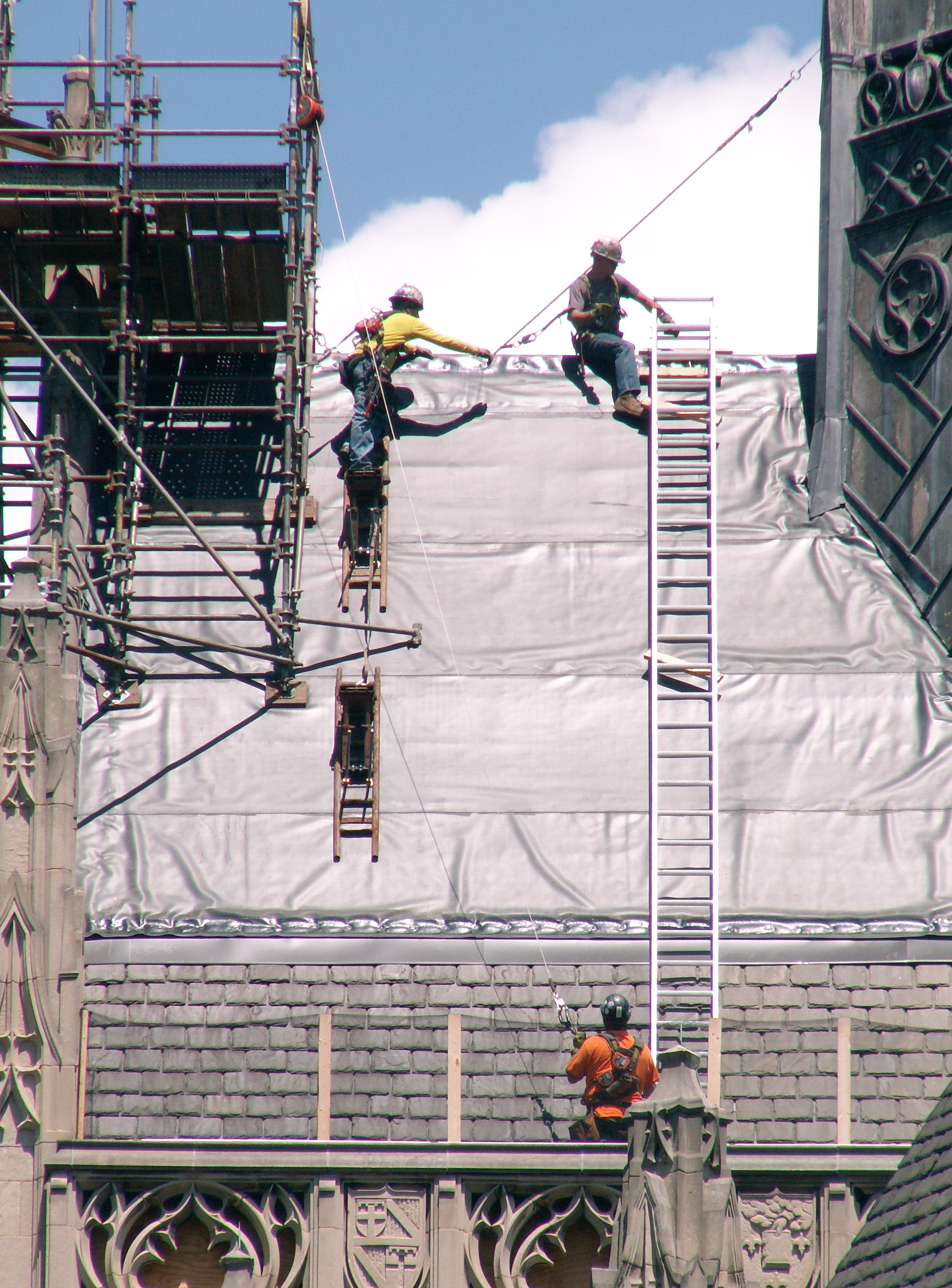
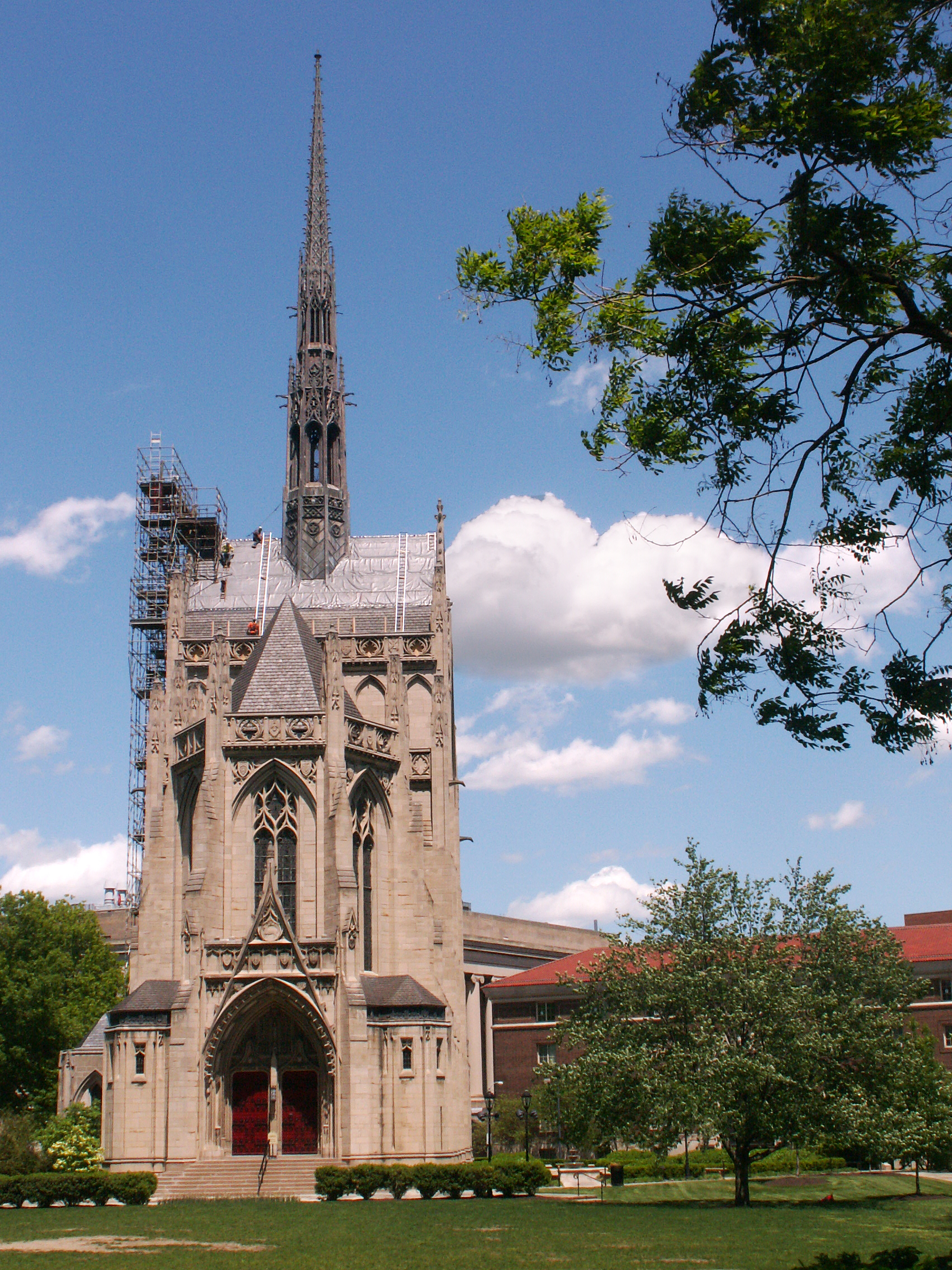
Working on the Roof of Heinz Chapel
-
Sixth Presbyterian Church, Squirrel Hill, in 1994

One of the many black stone buildings that still remained in Pittsburgh in the 1990s. Like almost all the others, Sixth Presbyterian has since been cleaned and restored to its original color.
Father Pitt has always wondered why the Presbyterians kept numbering their churches. “First Presbyterian” is an honorable distinction. “Fifth Presbyterian” just sounds tired. And then why stop at six? There is a Seventh Presbyterian in Cincinnati, for example. (Update: They did not stop at six; in fact both Presbyterian and United Presbyterian churches in Pittsburgh went into the double digits. Sixth Presbyterian is the highest number still going that we know of.)
Addendum: The architect was John Lewis Beatty; the church was built in 1902.1
- Record & Guide, February 12, 1902. “J. Lewis Beatty, Jackson Building, has prepared plans for the Sixth Presbyterian church and they have been approved by the Building Committee, of which Dr J. Guy McCandless, Director of Public Works, is the chairman. It will be 32 x 132 feet, of sandstone, hardwood interior finish, handsome furniture and fixtures. The cost will be about $60,000.” The measurement of 32 feet has to be incorrect; no church of any consequence is that narrow. About 82 feet would be plausible, according to the lot measurements on the 1923 Hopkins map. ↩︎
-
Community of Christ, Beechview

A fine example of the modest Arts-and-Crafts interpretation of Gothic that was fashionable for small churches in the early twentieth century. The building has hardly changed at all since it was put up in 1921, and it is still in use by the congregation that built it. The Community of Christ was formerly known as the Reorganized Church of Jesus Christ of Latter-Day Saints; it is a fairly liberal church that accepts but does not insist on the Book of Mormon as scripture and otherwise gets along better with mainstream Protestant denominations than it does with the much larger Church of Jesus Christ of Latter-Day Saints, which accounts for about 98% of Mormons.

Addendum: The architects were Carlisle & Sharrer, productive architects of small and medium-sized churches and houses for the upper middle classes.1
- Source: The Construction Record, April 22, 1911: “Architects Carlisle & Sharrer, Jenkins Arcade building, have plans in progress for a one-story brick veneered church, to be erected at Beechview, for the Latter Day Saints’ Congregation. Cost $10,000.” ↩︎
-
Gothic House in Shadyside

Old Pa Pitt is not quite sure how to classify this house. It is a sort of Jacobean or Tudor Gothic, but with very Victorian woodwork on the gables. We shall call it “Jacobean with gingerbread.”
Addendum: This is the Remsen V. Messler house; the architects were Peabody & Stearns, who designed several other Tudorish mansions around here, as well as the Liberty Market (now Motor Square Garden) and the Horne’s department store.
-
Beechview Methodist Church

This neat little church was probably the first church to be built in the new neighborhood of Beechwood, which was later renamed Beechview when it was taken into the city of Pittsburgh. It has been well refurbished for a Spanish-speaking congregation. Some of the original stained glass is gone, and the tower is bricked in, but on the whole it looks much the way it looked more than a century ago. We also note the aggressive slopes for which Beechview is notorious.

Beechview itself was laid out in 1905, so this would have been one of the earliest buildings.

Beechview’s streets changed their names when the neighborhood entered the city, because Pittsburgh didn’t need yet another set of numbered streets. Sixth Avenue is now Methyl Street; Pennsylvania Avenue is now Hampshire Avenue.

-
First Unitarian Church, Shadyside
-
St. Elizabeth’s, Strip District

The Strip was once a densely populated immigrant neighborhood, and until 1993 there were three Catholic churches within five blocks—an Irish one (St. Patrick’s), a Polish one (St. Stanislaus Kostka), and this Slovak church. By 1993 hardly anyone lived in the Strip, and in the parish consolidations this church was closed. After a few vacant years it became a night club. Then it became a church again: now it belongs to Orchard Hill Church. In a way this new ownership continues both strands of the building’s history: Orchard Hill is the kind of nondenominational church where worship is a stage show with a band.