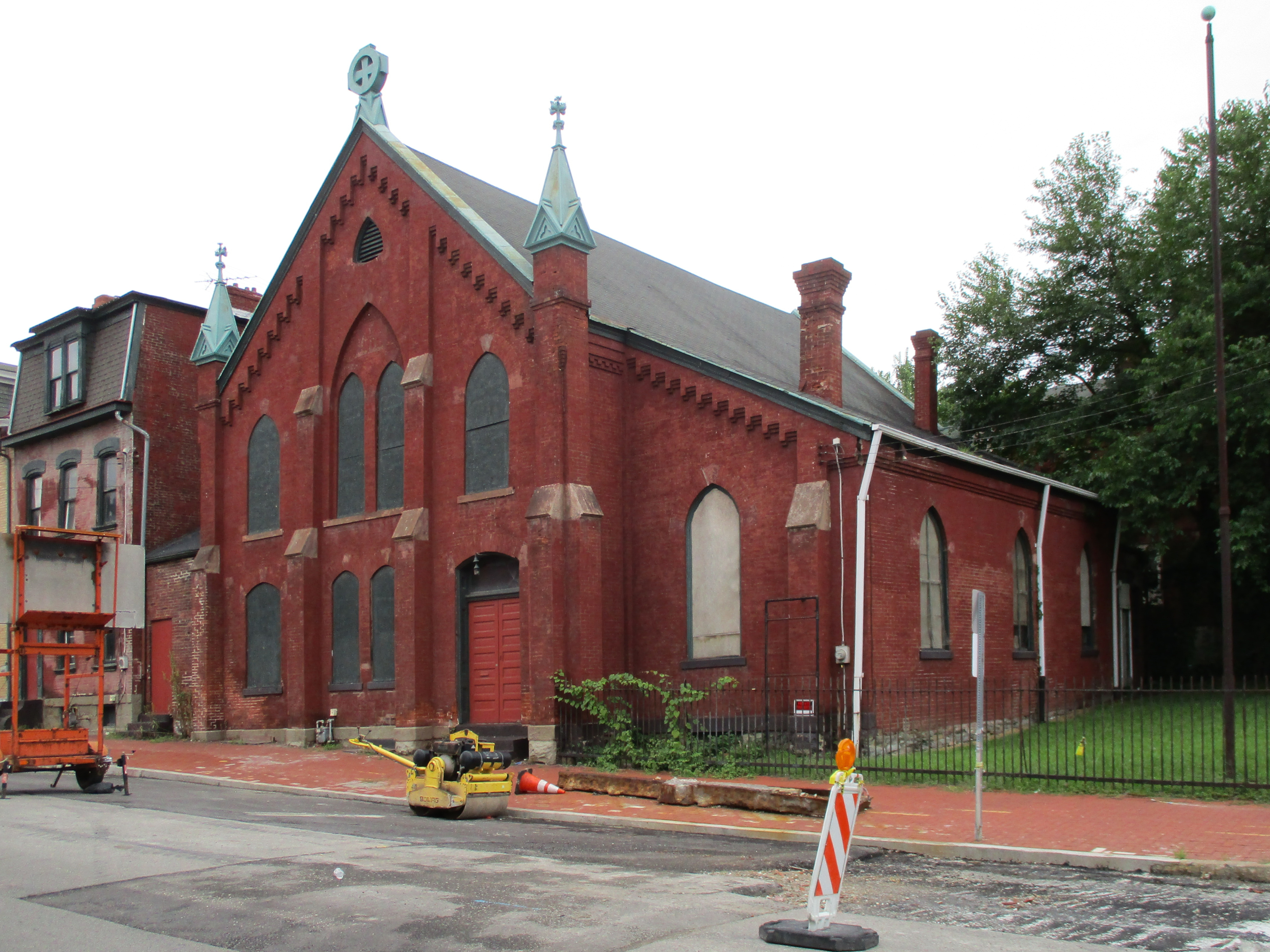
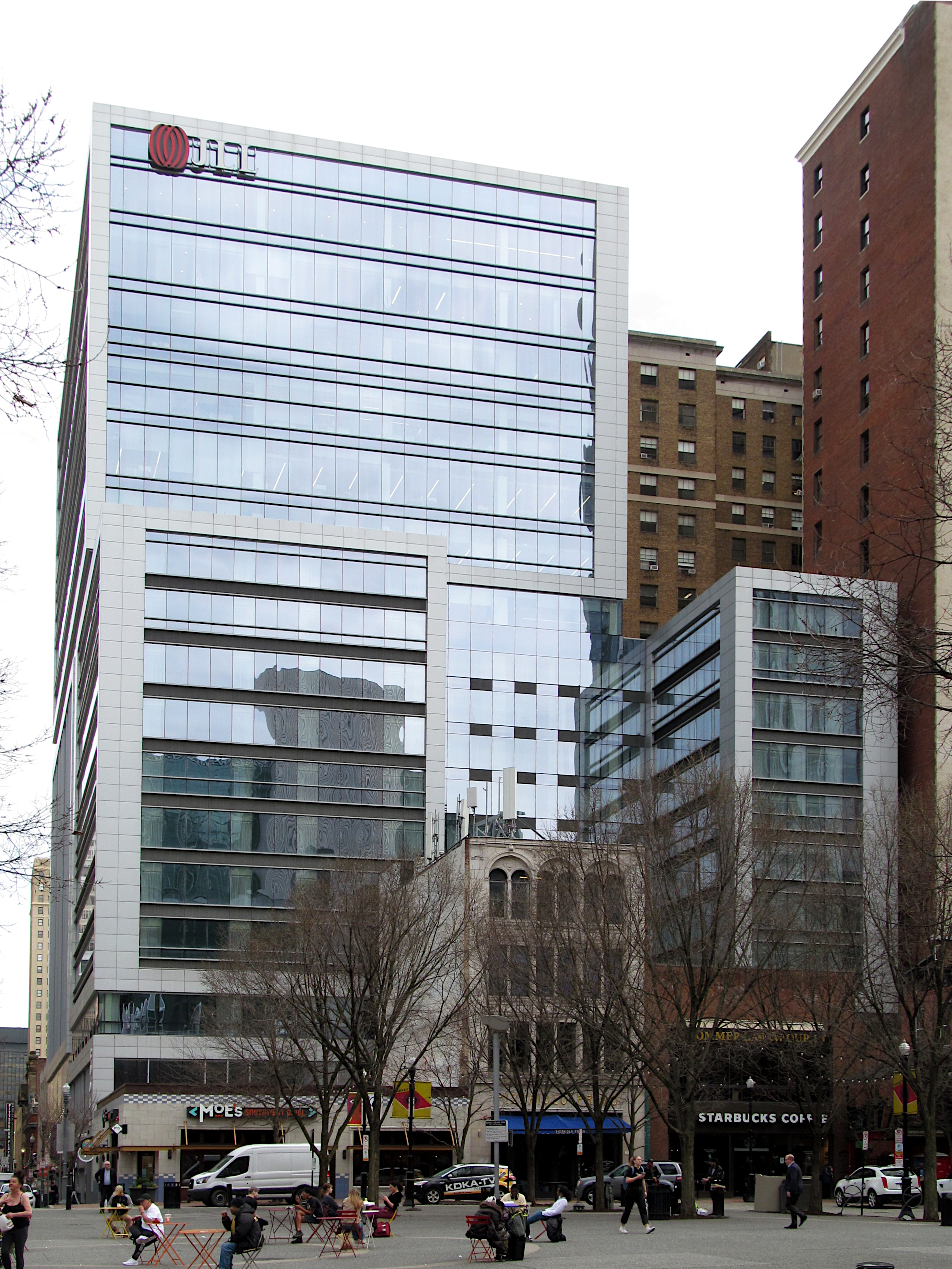
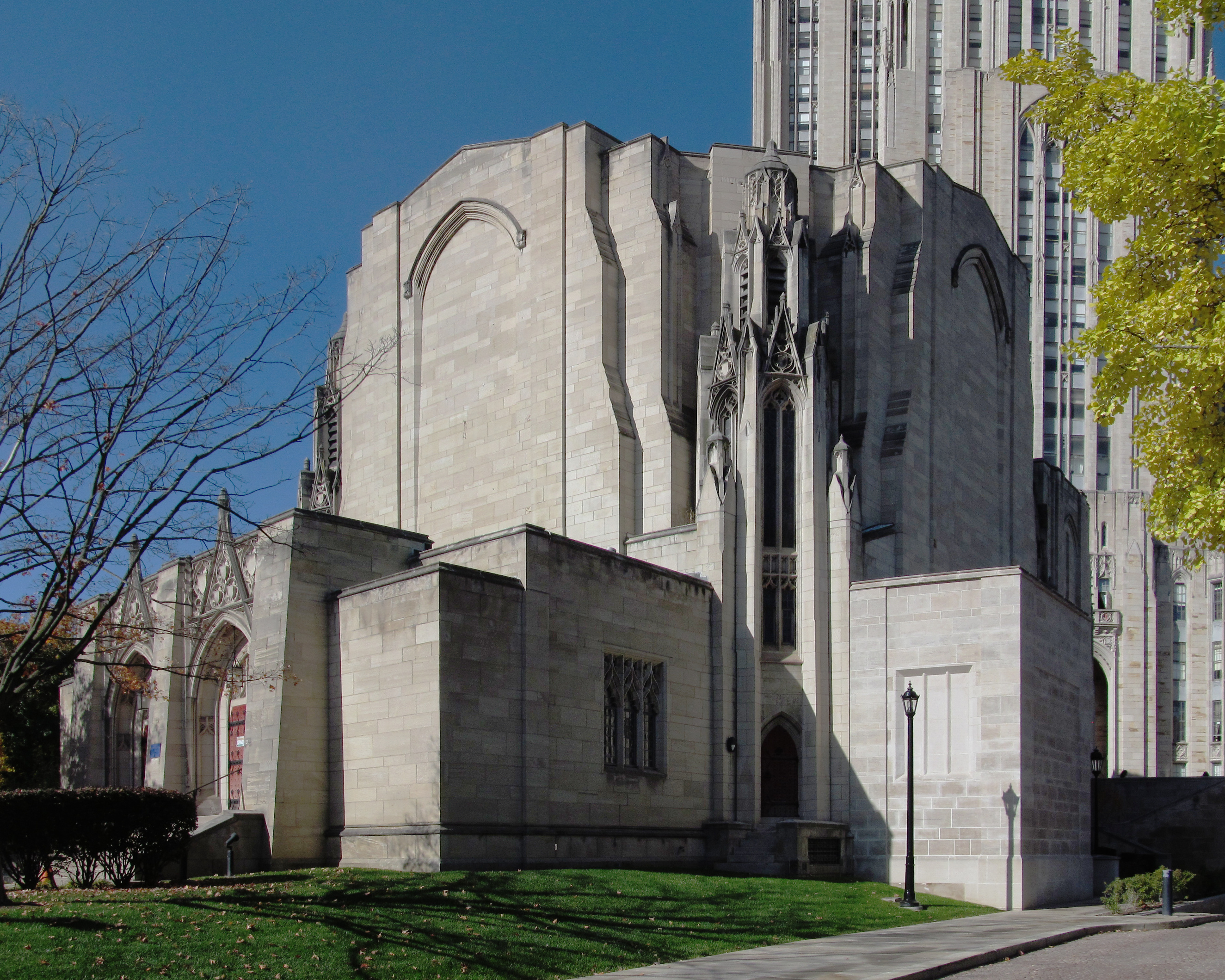
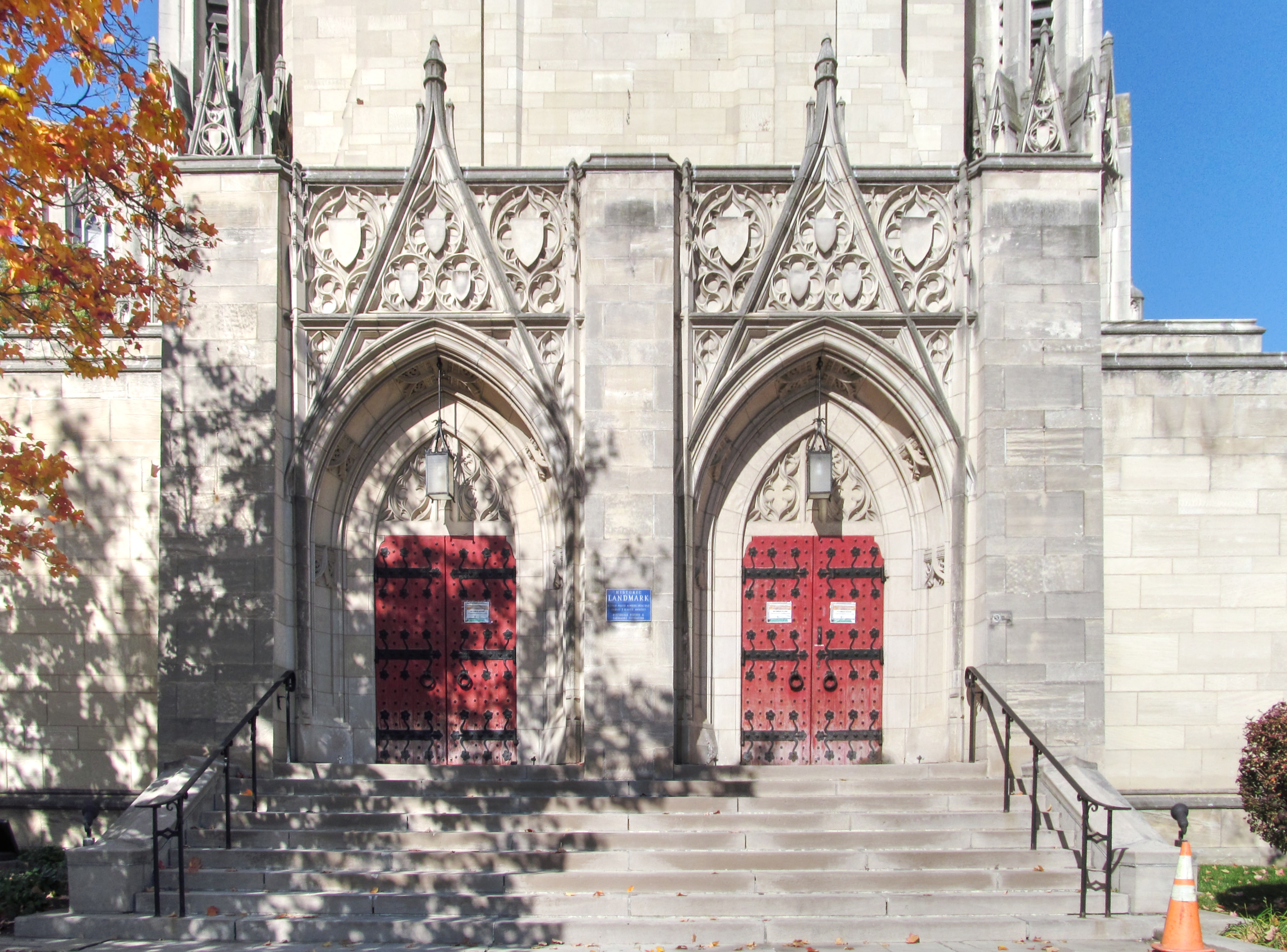
This church in the Soho section of Uptown was built in the 1880s. It began as the Central Presbyterian Church; in 1897 it merged with First Presbyterian downtown and became the Central Chapel of the First Presbyterian Church. The style is typical Pittsburgh small-church Gothic. More recently this was the Corinthian Baptist Church, and although it is now boarded up, someone at least maintains the grounds.
This Kodak bridge camera has a very long Schneider lens, and in pictures at the far end we notice some vignetting if the background is plain enough. It could be corrected in the GIMP, but in this picture the vignetting adds to the artistic effect. How is that for an excuse for laziness?
Charles Bickel designed this Romanesque industrial building with considerable inspiration from H. H. Richardson’s Marshall Field’s Wholesale Store in Chicago, which set the pattern for Romanesque industrial buildings for a generation. Bickel’s design is simpler, and by placing the arches at the top he makes the building feel taller (in fact it is shorter by one storey than Richardson’s building was).
The Reymer Brothers were in the candy business, but Pittsburghers remember them best for Reymers’ Blennd, or Lemon Blennd, the deliberately misspelled lemon-and-orange-flavored drink that cooled off generations of children in the summer. The Reymers’ Blennd brand was picked up by Heinz at some point; It seems to have vanished just this year with the demise of its last owner, Byrnes & Kiefer. It is certainly fondly remembered. Here is what claims to be the World’s #1 Lemon Blennd Site, and there are others if you go looking.
About seven years ago old Pa Pitt published this big composite picture of the old Strand Theatre on Forbes Avenue across from Oakland. A little while ago Father Pitt came across this item in The Moving Picture World for August 14, 1915.
New House in Oakland, Pa.
Natatorium Building Being Remodeled—Will Be Made Into Up-to-Date Picture Theater—Located Between Atwood and Meyran Avenues—Designed to Seat 750 People—Those Who Are Interested in the New Project.
Special to Moving Picture World from Pittsburgh News Service.
OAKLAND is to have a new moving picture theater in the Natatorium building. The lower floors, being remodeled, show careful attention to details and give promise of a thoroughly up-to-date and practical theater. The building, between Atwood and Meyran avenues, runs to a paved alley way in the rear, and with this private alley complies fully with the city laws on the subject of exits. The plans call for the abandonment of the present swimming pool and the lowering of the auditorium floor to the Forbes street level. The present stone steps leading to the entrance will be done away with. The auditorium ceiling will be 24 feet high. The floors above the auditorium will not be disturbed by the alterations, although the stairs will be moved to the left of the entrance, and a new elevator lobby constructed. It will seat 750 persons.
The owners of the Oakland Natatorium building are the Oakland Amusement Company; George H. Schwan is the architect; C. H. Keer Construction Company are the contractors, and the lessee is James B. Clark. The operation company will be the Rowland and Clark theaters, which also operates the Regent, in East Liberty, the Belmar in Homewood, the Arsenal in Lawrenceville, the Bellevue and the Oakland and the Schenley Photo play in Oakland, which latter house will be discontinued on the completion of the new house. Construction starts July 26, and the date set for the opening is November 1.
Was this the building? None of Father Pitt’s sources had mentioned that it was a converted bathhouse, but once he had the name “Natatorium” it took only a short time to find this picture:
This is from the Historic Pittsburgh site, which has an incredible collection of treasures. Unfortunately they are served up by a fiendishly complicated system that builds each picture from a mosaic of tiny pieces, so the high-resolution versions are impossible to get with any reasonable amount of work. Librarians often restrict access to public-domain works, either out of proprietary feeling or, more likely, out of a hope that it will make them less likely to get sued if they make a mistake about the copyright status. It is also true that “There may be a fee to acquire hi-res files,” according to the site FAQ, which adds a profit motive.
At any rate, here’s our building, with a sign out front advertising “Turkish Bath—Swimming Pool,” and a huge painted sign on the side probably advertising the same (we can see only the bottom of the sign in this picture). We can also see the Iroquois Building across the street, and the Schenley Hotel in the distance. So, yes, the Strand Theatre was originally a high-class bathhouse.
Thanks to the kindness of a reader, we have this flyer for the Oakland Natatorium which was used as a backing for an old photograph and thus preserved until it was found more than a century later. Notice the $1 price of admission. It would be about $30 in today’s money—quite a luxurious indulgence. Perhaps the promoters misjudged the market.
The architect of the original Natatorium Building was R. B. Melvin. The remodeling into a theater was supervised by George Schwan and Harry S. Bair.1
This is a revision. Originally Father Pitt had written that he had not sorted out who the original architect was. ↩︎
The Skinny Building and its neighbor the Roberts Building have been bought by PNC. Here they are shrouded for renovation work. The last old Pa Pitt heard, PNC was planning on displaying art in the upper windows of the Skinny Building.
This splendid terra-cotta façade on Forbes Avenue used to belong to Donahoe’s Market and Cafeteria (note the D above every second-floor window). Father Pitt enjoys the challenge of getting a complete picture of a large façade on a narrow street. Here the stitching has succeeded admirably; except for a little distortion at the ends of the building, this is probably just how the architect drew the upper floors. Old Pa Pitt doubts whether an architect had anything to do with the current incarnation of the ground floor; it looks like the work of a contractor who had a brother-in-law in the corrugated-steel trade.
One of the many black stone buildings that still remained in Pittsburgh in the 1990s. Like almost all the others, Sixth Presbyterian has since been cleaned and restored to its original color.
Father Pitt has always wondered why the Presbyterians kept numbering their churches. “First Presbyterian” is an honorable distinction. “Fifth Presbyterian” just sounds tired. And then why stop at six? There is a Seventh Presbyterian in Cincinnati, for example. (Update: They did not stop at six; in fact both Presbyterian and United Presbyterian churches in Pittsburgh went into the double digits. Sixth Presbyterian is the highest number still going that we know of.)
Addendum: The architect was John Lewis Beatty; the church was built in 1902.1
Record & Guide, February 12, 1902. “J. Lewis Beatty, Jackson Building, has prepared plans for the Sixth Presbyterian church and they have been approved by the Building Committee, of which Dr J. Guy McCandless, Director of Public Works, is the chairman. It will be 32 x 132 feet, of sandstone, hardwood interior finish, handsome furniture and fixtures. The cost will be about $60,000.” The measurement of 32 feet has to be incorrect; no church of any consequence is that narrow. About 82 feet would be plausible, according to the lot measurements on the 1923 Hopkins map. ↩︎
The Burke Building was built in 1836, and rather surprisingly (considering that Pittsburgh was founded in 1758) it’s the oldest building downtown outside Fort Pitt. The Great Fire of 1845 just missed it. The architect was John Chislett, Pittsburgh’s first resident architect, who also designed the Butler Street gatehouse for the Allegheny Cemetery.
One of the cluster of Gothic buildings by Charles Z. Klauder at the heart of the University of Pittsburgh, this looks like the baptistery for the Cathedral of Learning. It houses a museum of Stephen Foster, two theaters, and the Ethelbert Nevin Collection. There was a time when Ethelbert Nevin might have got a museum of his own, but he missed his chance, and now he is an appendix to Stephen Foster.
The exceedingly improbable Skinny Building, which is five feet eight inches deep, seen in wintry December light. The picture was taken two years ago, but Father Pitt didn’t like the harsh lighting and high contrast in the original picture. Looking at it again just recently, he thought perhaps the lighting could be made into the subject of the picture if it were a black-and-white picture.
The building has been sold to PNC, which plans to display art in the upper floors.