


This church was built as the First Ruthenian Church (a Presbyterian church for Ruthenian immigrants), and later became a Byzantine Rite church. Now, like many other things on the South Side, it’s a bar.
Addendum: The architect was Chauncey W. Hodgdon, whose churches were usually in the Gothic style, but who adopted a mixture of classical and Byzantine for this very unusual congregation.1
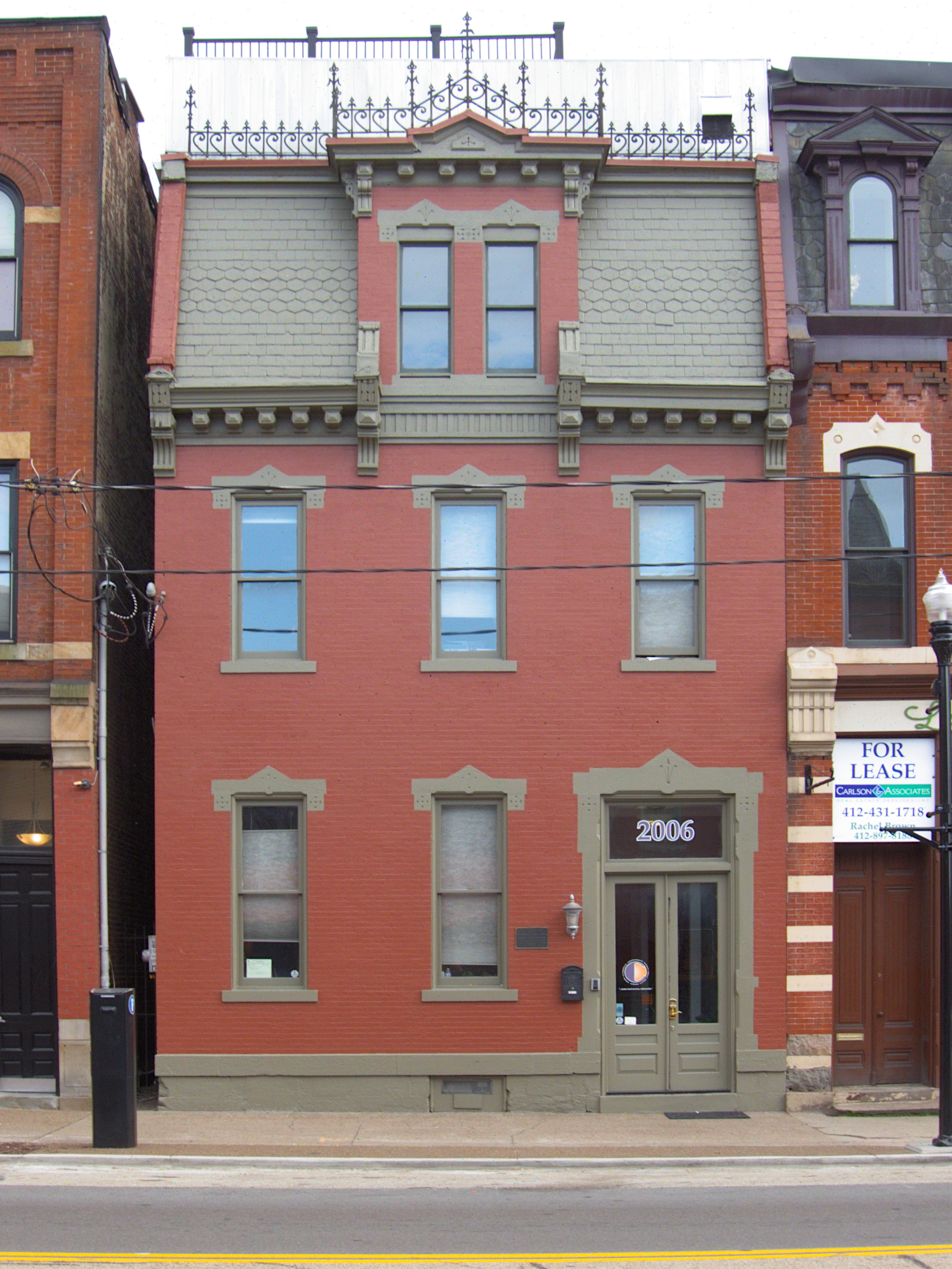
Carson Street is the commercial spine of the South Side, but occasionally we run across a house left over from the time before Carson was almost exclusively commercial. Most of them have small offices on the ground floors now, but they retain their domestic external appearance. This house strikes Father Pitt as a halfway point between Second Empire and Italianate styles in local rowhouses; it’s notable for its prickly decorative ironwork on the roof.

The Maul Building at Carson and Seventeenth is noted for its ornate terra-cotta exterior. Unfortunately the cornice has been lost, but the rest of the building, which dates from 1910, is still one of Carson Street’s commercial treasures.


For years this building has been hidden behind a garish modernist façade. Renovation work shows us a modest mid-nineteenth-century building typical of old Birmingham, the narrow-streeted section of the South Side up to 17th Street.
Update: The building has been restored to something more like its original appearance.

The old St. Joseph’s Hospital became Carson Towers, a senior citizens’ apartment building, in 1977. But the central part is the original hospital building from 1911 (or 1907, depending on the source you read), preserving the original inscription. An article in the City Paper explains some of the history. This PDF has a picture of the original building. The caption says that “The sculpture over the front door is the only part of the original façade still visible on the building that is now Carson Towers,” but the most superficial comparison will show that this entire central section is virtually unchanged, except for more modern windows too small to fit the old frames.
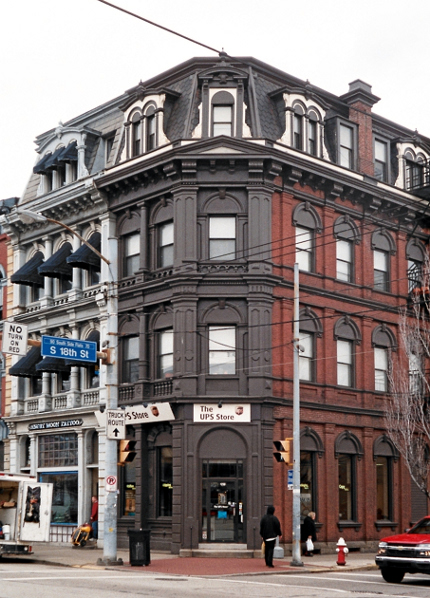
Some say that Carson Street on the South Side is the best-preserved Victorian commercial street in the United States. Pittsburghers know it more for its bars and nightclubs, but the whole street is a feast of every kind of Victorian style. Here, a corner location gave some proud shopkeeper a chance to indulge in a bit of Second Empire flourish.
