The complete third-floor mural sequence in one large composite image.
John White Alexander gave us one of the great mural sequences in America in the Grand Staircase of the Carnegie Institute. The Crowning of Labor, also known as The Apotheosis of Pittsburgh, is the part of the sequence that gets the most attention. But it was all meant to lead upward to a climax on the third floor.
The Carnegie Museum of Art site has an informative page on the Grand Staircase and its murals, with of course an obligatory paragraph to tell you that because they are old they are evil. The figures on the third floor were meant to represent crowds of ordinary people marching toward enlightenment—to be represented in Carnegie’s Noble Quartet of Art, Science, Music, and Literature. But the artist died before he could paint Enlightenment, so that, like the rest of humanity, these people will never reach it.
Here are all the murals in the sequence individually.
When the murals were restored a few years ago, one square was left unrestored in this mural to show us how a century of Pittsburgh atmosphere had affected the paintings.
Who else would do this for you? Here is a huge composite photo of the dedicatory inscription on the Carnegie Institute building in Oakland: “This building dedicated to literature science and art is the gift of Andrew Carnegie to the people of Pittsburgh.” If you enlarge the picture below, it is 19,662 pixels wide. You can use it for all kinds of illustrations. For example, suppose your magazine has a department devoted to literature. Well, here is the word “LITERATVRE” cut in stone, big enough for any practical purpose. Or “ART IS THE GIFT”—you could make something of that.
The Hall of Sculpture in the Carnegie (as seen by the ultra-wide auxiliary camera on old Pa Pitt’s phone, so don’t expect too much if you enlarge the picture), designed in imitation of the interior of the Parthenon.
The vestibule at the original entrance to the Carnegie Institute building, seldom used now because visitors come in through the modernist Scaife Galleries addition. This picture was taken hand-held in dim light with the ultra-wide auxiliary camera on old Pa Pitt’s phone, so please forgive its obvious flaws.
Ever since Lord Elgin bought the Parthenon sculptures and other bric-a-brac on eBay in the early 1800s, there have been debates about whether the Turks had any right to sell them, and whether they really ought to be where they are (in the British Museum), or whether they ought to be back in Athens. The arguments are still going on, and the United Nations has tried to sort out the dispute to no avail.
But here they are in Pittsburgh, and no one has to have a fight about it, because these are plaster casts of the originals. They are almost indistinguishable visually from the original art, and they can be experienced in three dimensions like the originals, and you don’t have to cross the Atlantic to see them.
In the late 1800s, the world’s great museums had the idea that it would be good for people to be able to experience the great sculpture and architecture of the world in three dimensions, just as if it were in their own city. The craft of making plaster casts had been brought to a peak of perfection, and museums eagerly bought up these casts and formed large collections.
Then, as the twentieth century rolled on, the collections became mortal embarrassments. Art was valuable only if it was original, and plaster casts are not original. Only three of the great plaster-cast collections survive, and this is one of them. It is the only one that was never kicked out of its original home.
Museum curators are beginning to wake up to the value of these collections. From a visual point of view, the experience of viewing them is almost exactly the same as the experience of viewing the originals. An art student can sketch them from different angles, can observe how the shadows fall across the drapery, can crane her neck to look at the bits that aren’t visible in photographs.
Artemis.
Father Pitt is sure that someone, somewhere, can find a reason for being angry about these plaster casts. But for most sane people, here are some of the remaining glories of classical art for you to enjoy guilt-free and without a passport.
Hestia, whose usual epithet in Hesiod was Please Do Not Touch.Comments
A view across the Bellefield Bridge toward the Carnegie Library in Oakland. The bridge is still there, but you can’t see it. The hollow was filled in with the bridge still in place, and the Mary Schenley Memorial Fountain sits on top of the buried bridge now.
This view shows the library building before the enormous expansion in 1907. The two towers were victims of the expansion—but also perhaps victims of some negative criticism. The building in general—designed by Longfellow, Alden & Harlow—was highly praised, but some critics thought the towers a bit embarrassing. When Alden & Harlow (Longfellow had decided to stay in Boston) designed the new addition, the towers came down.
There is often a greeter standing in the lobby of the main Carnegie Library in Oakland to say “Welcome to the Library” to every patron who walks through the door. But even when the greeter isn’t greeting, the building itself conveys the same message.
Ornate light fixtures hang in the vestibule and lobby.
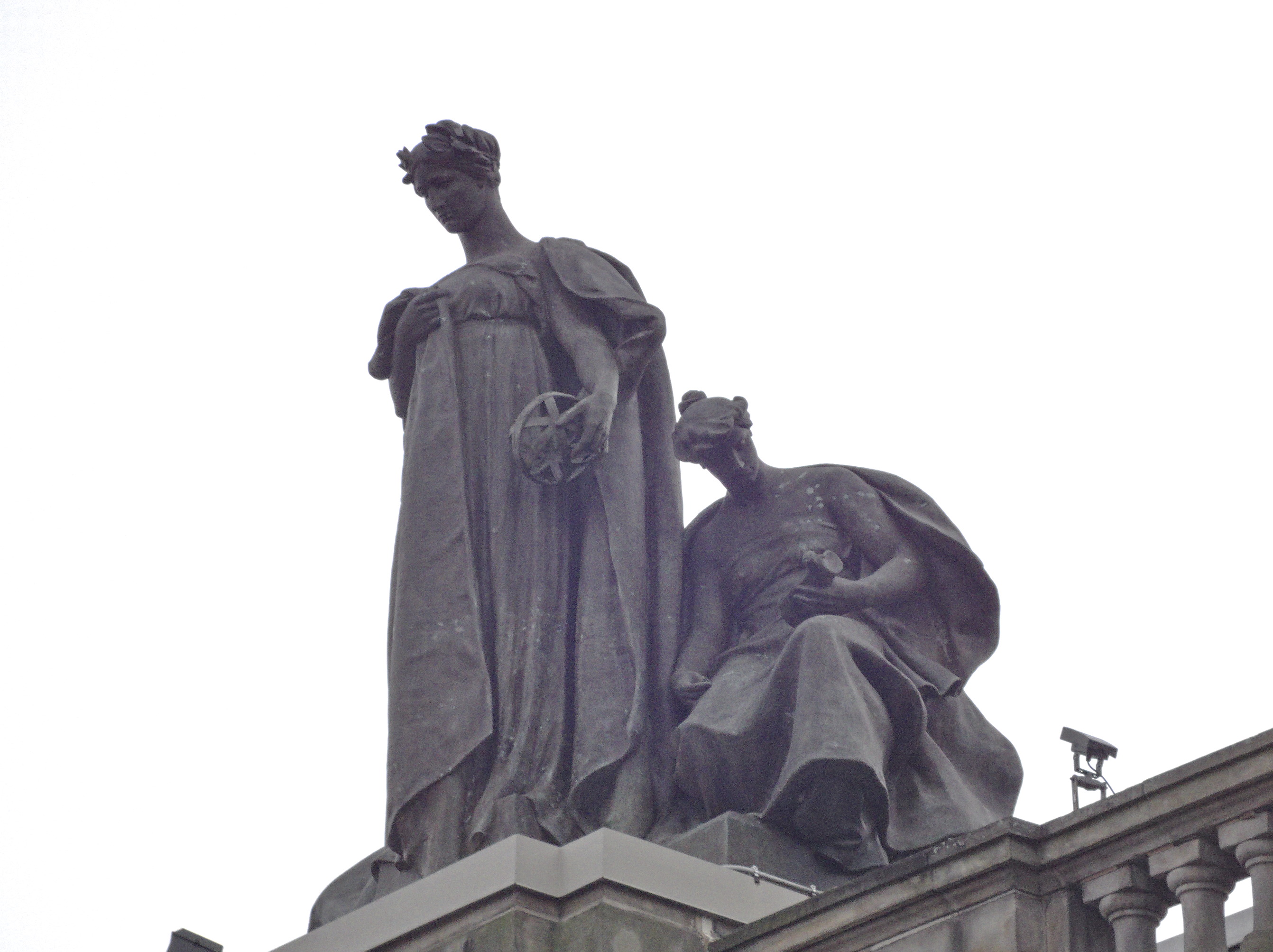
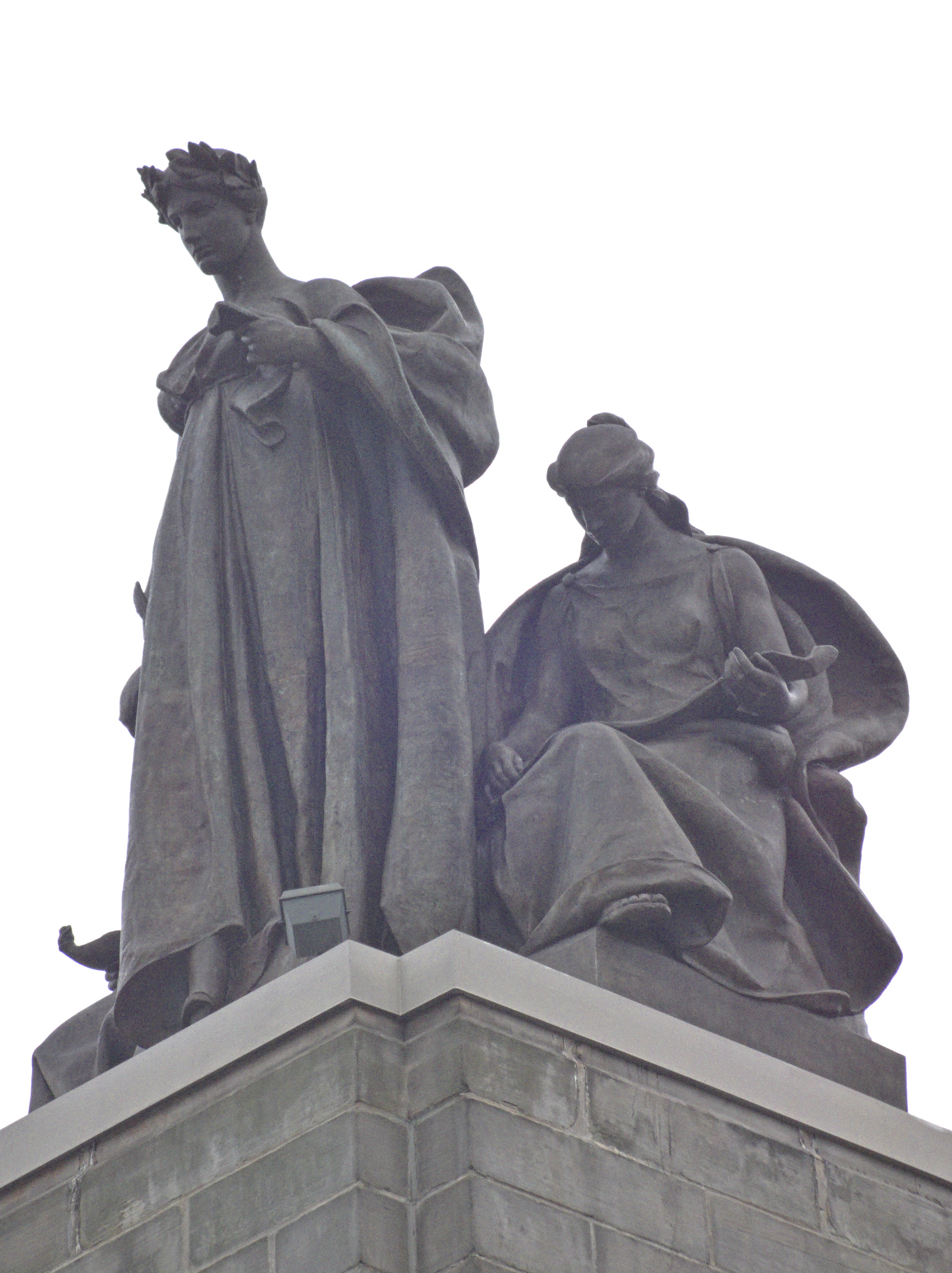
John Massey Rhind, Andrew Carnegie’s favorite sculptor, decorated the Carnegie Institute building with bronzes representing the Noble Quartet—science, art, music, and literature—to which the Institute was dedicated. At street level, each member of the quartet is represented by a portrait of one of its famous representatives. Above each statue, on the roof, is an allegorical group of female figures representing the abstract ideal. We have seen the pictures of the statues before, but since old Pa Pitt just recently took pictures of the allegorical groups, he thought it might be interesting to see everything together at once.