Tag: California Avenue

  • Two Civil-War-Era Houses in Marshall-Shadeland

    2640 California Avenue

    Two houses that both seem to date from the Civil War era; they both appear on an 1872 plat map of Allegheny City. This one has just had some spiffing up. It is an Italianate variant of the typical Pennsylvania I-house with an addition in the back (although the addition in this case may have been part of the original plan). It has been divided into two dwellings, but the outlines of the house and many of its details are well preserved.

    2640
    Side of the house, showing rear wing

    The outline of the house on the 1872 maps shows the wing in the rear, so it is at least that old.

    2628 California Avenue

    This house was inhabited until recently; it looks as though it had a fire and is undergoing repairs. It has a more complicated history. It also appears on the 1872 map, and later maps that distinguish the materials of buildings show that this was a wood-frame house. At some point around 1900 it was divided into two dwellings. Some time after 1923 it was sheathed in buff Kittanning brick, giving us an 1860s form with 1920s exterior details.

    2628
    Canon PowerShot S45; Kodak EasyShare Max Z990.

    Comments
  • St. Gabriel’s School, Marshall-Shadeland

    St. Gabriel’s School

    You may have noticed this old school if you looked out the window while your chauffeur drove you down the Ohio River Boulevard. It was built in 1922 for St. Gabriel’s, a Slovak parish, whose church stood across California Avenue from the school. In the late 1960s, when the expressway portion of the Ohio River Boulevard was built, the church was demolished; the congregation moved into the school while it built a big new modern church on the hill above. (We may see that building later: it still stands, though not in use as a church.)

    St. Gabriel’s School
    To get this picture of the front, Father Pitt had to stand on the narrow, sloping Belgian-block median between California Avenue and the ramp to the Ohio River Boulevard while cars whizzed by on both sides. Since he lived to bring the camera back, you have this picture.

    The school has been closed for years, but the building is kept standing. It seems to be in use as a warehouse.

    Cornerstone with A. D. 1922
    Crest with cross
    Cross ornament
    Ornamental shield
    St. Gabriel’s School
    Kodak EasyShare Max Z990.

    Comments
  • Flatiron Building in Marshall-Shadeland

    2650 California Avenue

    Father Pitt was looking at Wikipedia’s list of flatiron buildings in the United States and thinking that he could multiply the number by ten or so just from buildings in Pittsburgh and the surrounding suburbs. So he has begun a collection of these flatiron buildings, meaning buildings that are triangular like a clothes iron. Here is one that he found especially attractive. The shape is dictated by the acute angle between California Avenue and Woodland Avenue, and of course it has the usual Pittsburgh problem of irregularity in three dimensions to deal with. The form of the building is typical of early-twentieth-century commercial architecture, but the Art Nouveau patterns picked out in light Kittanning brick set this building apart from others like it.

    Flatiron building
    Canon PowerShot S45.

    Comments
  • Greater Allen African Methodist Episcopal Church, Brighton Heights

    California Avenue side of the Greater Allen African Methodist Episcopal Church

    This church was built in 1907 as the Eleventh United Presbyterian Church. The architect was Thomas Hannah.1 Now it belongs to the Greater Allen African Methodist Episcopal congregation, which has kept it in beautifully original shape, right down to the uncleaned black stones, which Father Pitt loves.

    Cornerstone with A. D. 1907 inscribed
    Davis Avenue side
    Davis Avenue side straight on
    Rear of the church

    1. Record & Guide, May 8, 1907, p. 293. “Plans have been prepared by Architect Thomas Hannah, Diamond Bank Building, for a church to be erected in Allegheny for the Eleventh United Prestyterian [sic] congregation, at California and Davis avenues. Cost $35,000. Rev. Charles F. Wishart, pastor.” Our article has been revised with this information; old maps, apparently mistakenly, show it as a Congregational church. ↩︎
  • Three Flemish Houses by Frederick Osterling, Brighton Heights

    Osterling houses on California Avenue

    This trio of Flemish-style houses is one of the most remarkable features of the Brighton Heights neighborhood. Frederick Osterling lived in Brighton Heights and designed several houses worth seeing there; these from about 1900 were beautifully restored as the “Osterling flats” a few years ago.

    Center house
    All three houses
  • St. John the Baptist Carpatho-Russian Orthodox Church, Marshall-Shadeland

    St. John the Baptist Orthodox Church

    The congregation moved to a generic late-twentieth-century church building in the North Hills this year, finally following most of its members to the suburbs. (The congregation was secure enough to be able to move without taking out a loan, which is good news for them even if it’s bad news for the North Side.) That leaves this building in an uncertain state. Right now it is still being well maintained, but its neighborhood is not yet valuable. Perhaps with the revival of city living, it will be worth doing something with in the next few years.

    Cornerstone with a date of 1937

    The church was built in 1937, when the Depression was still with us and its congregation probably was not rich. The building is a curious construction in a style old Pa Pitt has decided to call “Modular Byzantine.” The parade of identical rectangles across the tall face of the church makes it look as though it was put together by a methodical and meticulous child playing with blocks.

    Corner view of the church, showing slope of lot

    Because of the extreme slope of the lot, the front has to be very tall if there is going to be any back at all. Since the main entrance is on the lower level, we can add this to our list of churches with the sanctuary upstairs.

    Dome with Byzantine cross

    The gold domes are a landmark on this section of California Avenue, and we hope they can be preserved.

  • Greenstone United Methodist Church, Avalon

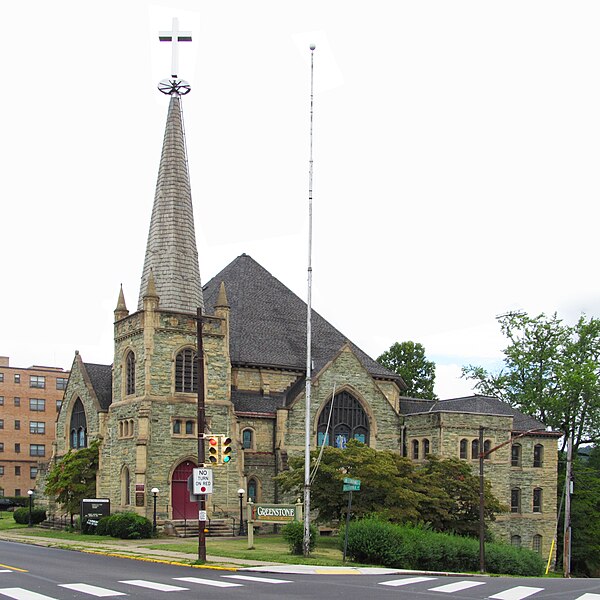
    Greenstone United Methodist Church, Avalon

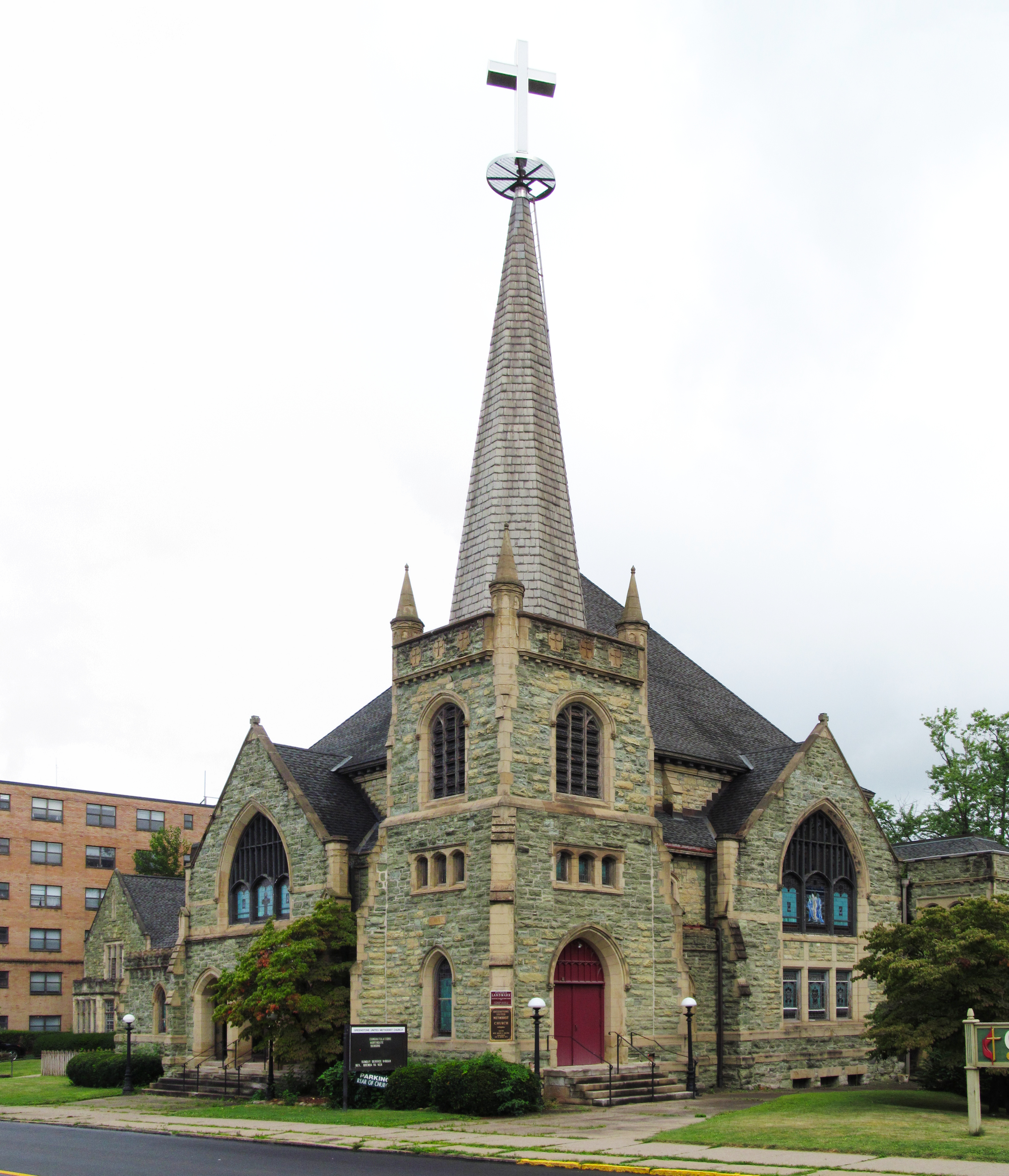
    This church was built in 1906; the Pittsburgh History and Landmarks Foundation was unable to identify the architect, and so far Father Pitt has had no better luck. (Update: The architects are now identified as Vrydaugh & Wolfe; see the end of this article.) It used to be called the Bellevue Methodist Church—Methodist Episcopal, as opposed to Methodist Protestant, since there was one of those, too. This one is in Avalon, which used to be called West Bellevue, and its striking green stone gave it the name by which everybody called it. In 1982, the congregation bowed to the popular will and renamed the church Greenstone.

    This is one of the relatively few churches of this type that have kept their spires.

    The picture above is one of those rare pictures where old Pa Pitt decided to remove all the fat ugly utility cables, because they were just too distracting.

    Greenstone Methodist
    California Avenue front

    The composite picture above shows some of the matching Sunday-school wing. The stitching worked perfectly for the building, but it made a noticeable break in the car parked on the street, which you can see if you enlarge the picture. Father Pitt left a note on the windshield.

    Here is a map.

    Addendum: Perhaps unsurprisingly, given the style—and especially that low tower with four corner pinnacles—this church was designed by Vrydaugh & Wolfe.1 This means that Vrydaugh & Wolfe had two of the four corners of this intersection covered: diagonally across from this church is their Church of the Epiphany.

    1. Source: The American Architect and Building News, July 23, 1904: “Architects Vrydaugh & Wolfe will be ready for bids in a few days on the Methodist Episcopal Church, of Bellevue. The building will be erected at Lincoln and Home Aves., at an approximate cost of $60,000.” ↩︎
  • House on California Avenue, Avalon

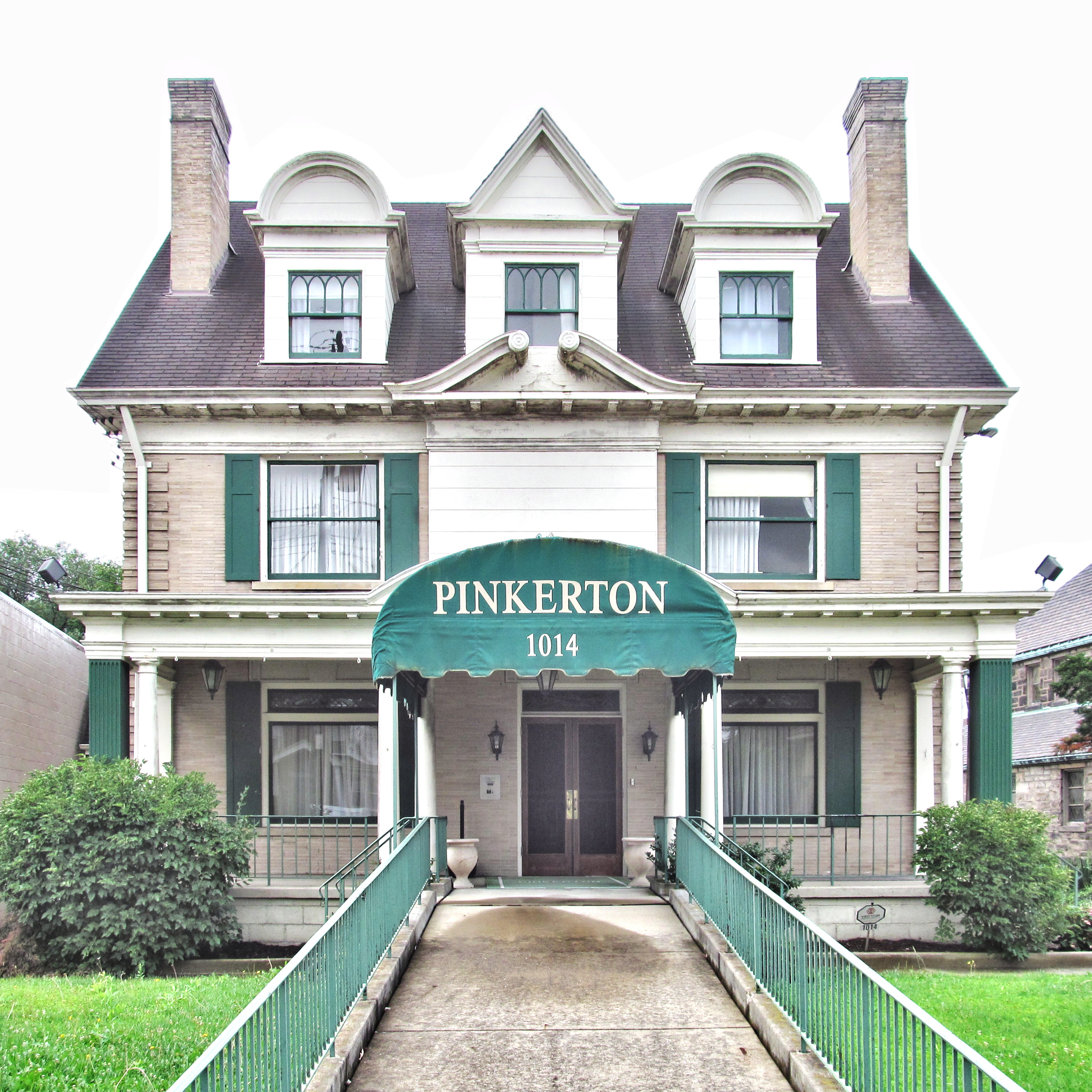
    The Bellevue line just narrowly misses this house, making it the first building in Avalon outside Bellevue, and the first on California Avenue outside the city, since California Avenue turns into Lincoln Avenue while it passes through Bellevue. The house was used as the Orion C. Pinkerton funeral home, but when old Pa Pitt took this picture a few days ago, the house was for sale.

    This is clearly the work of an architect rather than just a builder, and enough details are preserved that it would be worth restoring. That blank spot above the awning, for example, probably had a stained-glass window in it, and it could have one again.

    The off-center front door bothers Father Pitt. He finds it hard to imagine an architect designing the house that way originally. Yet the ornamental brickwork above the door matches that above the windows, as if it had always been that way. At the cost of making the picture look a little artificial, Father Pitt has compressed the shadows and highlights to make the details under the porch roof mire visible: enlarge the picture and judge for yourself what is going on with that front door.

  • Saint George Ukrainian Catholic Church, Brighton Heights

    St. George Ukrainian Catholic Church

    This is one of Father Pitt’s favorite modernist churches in the city. It seems like an effortless blending of architectural modernism with the ancient idioms of Eastern Christian tradition, but of course things in art that seem effortless always take a great deal of effort. If modernism in church design always came out looking like this, old Pa Pitt would have adopted it enthusiastically.

    Tower
  • California Avenue Methodist Episcopal Church, Brighton Heights

    California Avenue Methodist Episcopal Church

    We’ll have to wait for winter to get a good view of the whole front of this interesting church, which is obscured by a lush growth of mimosa trees. But we can appreciate some of the details now.

    The architect was James N. Campbell. Old Pa Pitt knows of only two churches by Campbell still standing in Pittsburgh: this one and the old Seventh Presbyterian Church on Herron Avenue, Hill District. (There are probably others as yet unidentified.1) Both churches have similar styles, and both have similar histories. They both became African Methodist Episcopal churches: this one was Avery Memorial A. M. E. Zion Church for quite a while. They both were abandoned. This one may still have some hope: it looks as though someone has been trying to refurbish it, perhaps as a private home. But it also looks as though the renovations have stalled.

    Since Father Pitt considers this an endangered building, he has collected some pictures of the more interesting details to preserve them for posterity in case the worst should come to pass.

    Tower
    Entrance
    Bay
    Windows
    Stone ornament
    Tower again
    1. Update: Father Pitt has since identified two other churches by Campbell still standing and in good shape: Carnegie United Methodist Church and the First Presbyterian Church of Ingram, now the Ingram Masonic Hall. They both show strong similarities in style to this one. ↩︎