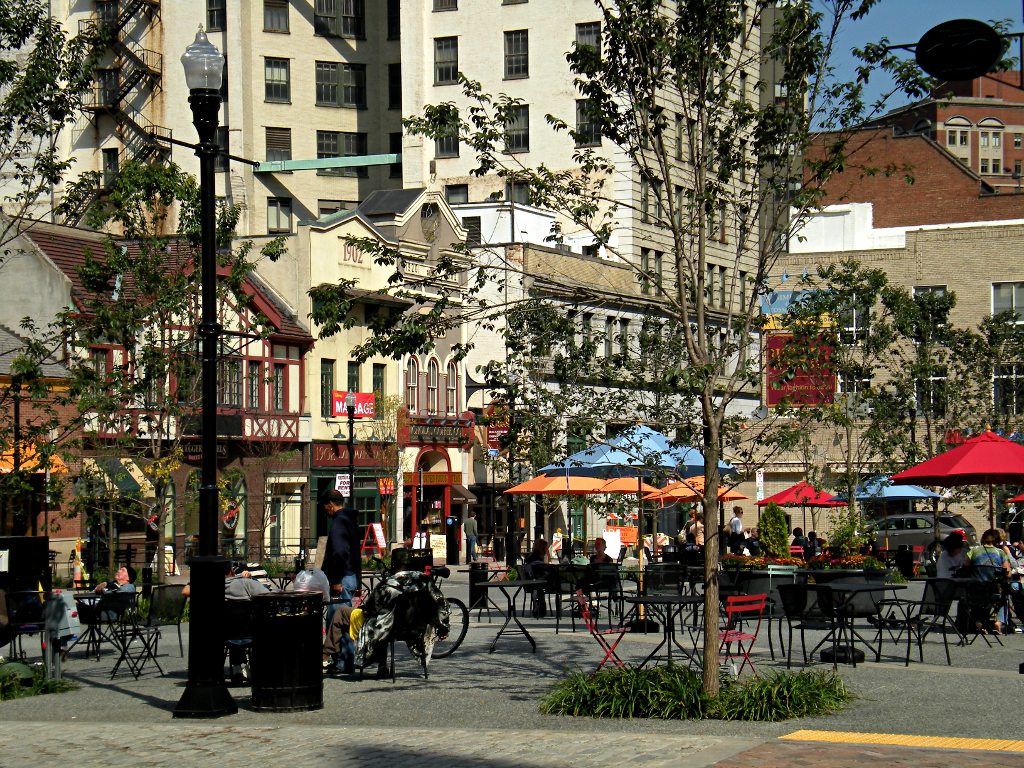
The Diamond (or “Market Square” as it’s called on maps) has been torn up and rebuilt. Forbes Avenue no longer goes through it; instead, all traffic must skirt the edge of the square. The plan has been radically simplified, making the space more versatile. Whether it was worth all the money spent on the rebuilding is a question best left to political writers rather than your humble servant.
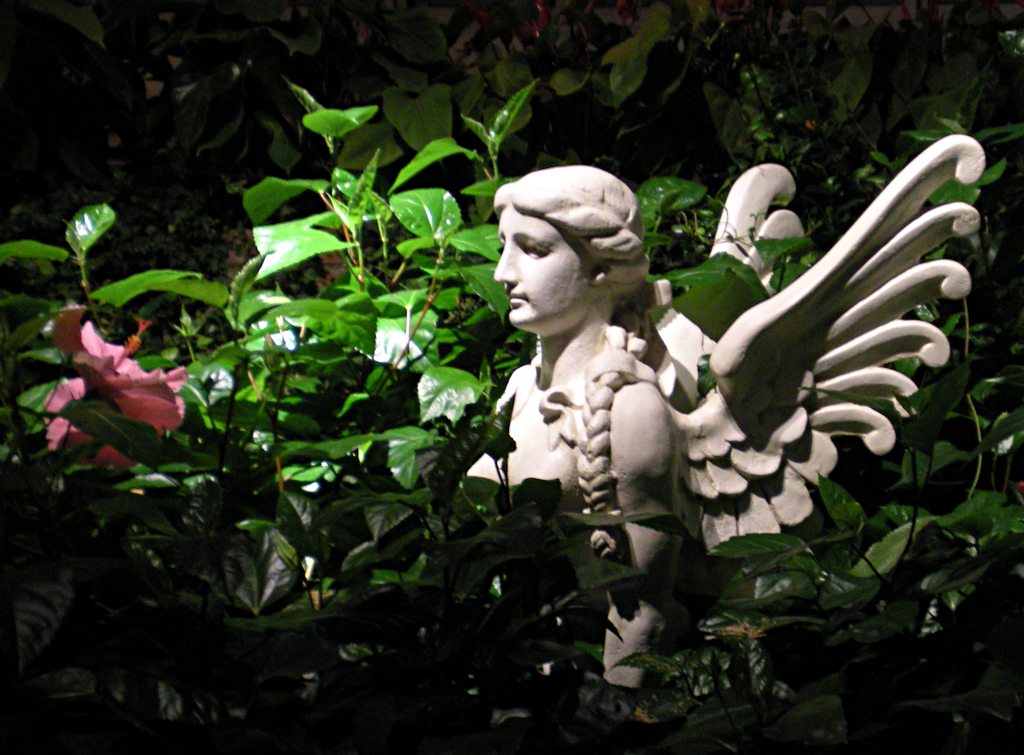
A winged sphinx contemplates a hibiscus flower in the Sunken Garden at Phipps Conservatory. On Friday nights, the conservatory is open until 10:00 in the evening.
Rainbows glow as the late-afternoon sun hits a fountain in Bessemer Court, Station Square. Behind the fountain is a Bessemer converter salvaged from a steel mill; behind that is the Monongahela with downtown Pittsburgh on the other side.
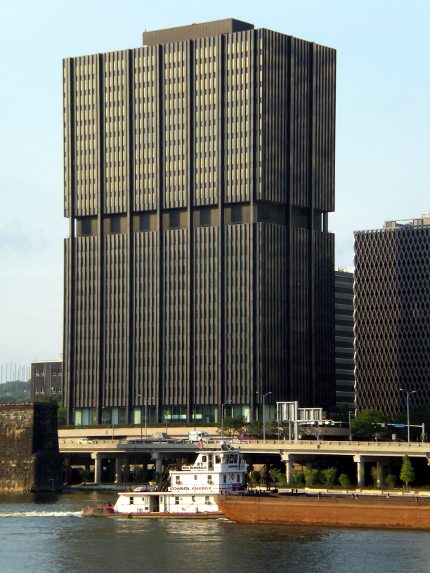
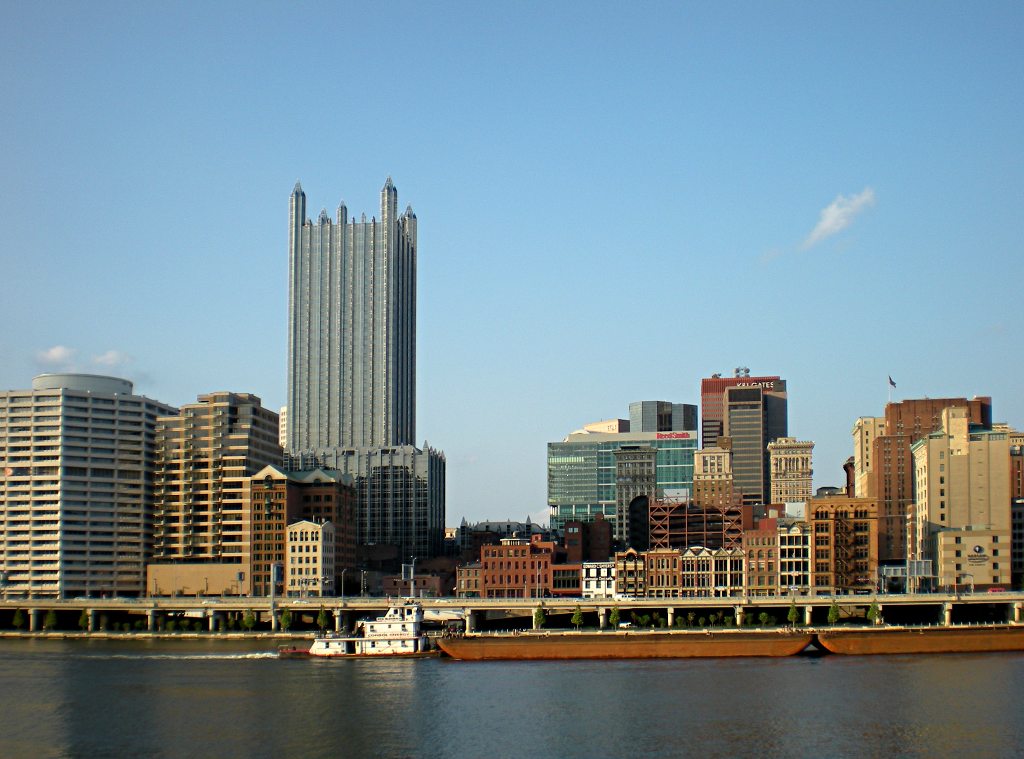
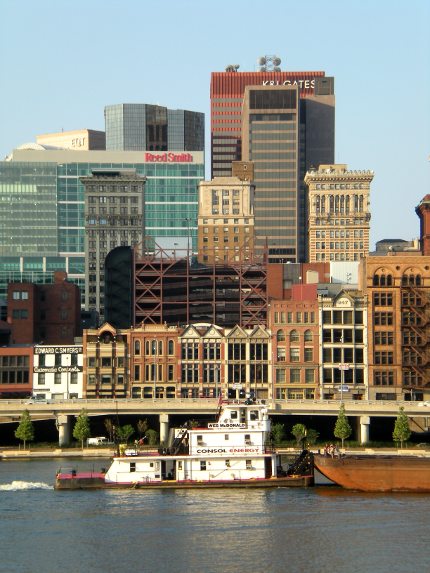
The Monongahela is still very much a working river, and barge trains like this are a common sight. This one is empty and going upstream. Somewhere up there these barges will be filled with coal and come back downstream with their loads.
The boat that pushes the barges from behind is called, defying common sense, a towboat (corrected from “tug,” thanks to the helpful comment of a kind reader). Working on the barge trains is a dangerous business, but river culture has its own romance, with strong traditions passed on through the generations that most of us who spend our days on dry land know nothing about.
You can tell St. Bernard’s congregation is a community of well-off business types, because the church’s Web site has both a mission statement and a page of “goals and objectives.” But the building itself is quite beautiful, especially its gloriously colorful tile roof. The architect was William R. Perry, who also designed, on a somewhat smaller scale but with equally splendid taste, the bandstand in West End Park. These pictures were taken from the Mount Lebanon Cemetery.
Not too many amusement parks are also national historic districts, but Kennywood comes closer to the ειδος or ideal image of an amusement park than just about any other amusement park. It has been in a state of constant evolution since it opened in 1898, but it’s always Kennywood, always more the same than different.
“Pittsburg’s Lost Kennywood,” a sort of Victorian fantasy of an amusement park, is actually the newest section of the park, but it captures the nostalgic atmosphere very well.
The Phantom’s Revenge is a modern steel roller coaster that dominates the Kennywood skyline. It keeps the vulgus happy, while the real connoisseurs come from all over the country to ride the old wooden coasters.
The Pittsburgh Plunge is a very simple ride: you go up, turn around, and come down. It’s what happens at the bottom that makes it memorable.
The Thunderbolt, a revised version of the old Pippin, is pegged as one of the world’s greatest by connoisseurs of wooden roller coasters. Its wooden construction looks terrifyingly slapdash, but it’s actually a marvel of engineering.
And here’s the Thunderbolt’s big surprise. What you can’t see from the entrance is that it will plunge you into a steep ravine overlooking the Monongahela valley, making clever use of the irregular topography of the site.
And of course there’s a carousel, with a real Wurlitzer in the middle.
This 1849 tombstone in Old St. Luke’s churchyard, Woodville, is the work of an unusually talented stonecutter. The calligraphic styles of middle-nineteenth-century penmanship have been imitated precisely in the stone.
Dear old Pa Pitt, please explain what you mean by American Fascist.
Father Pitt is glad to oblige.
The architecture of Hitler’s Germany is famous, or notorious, for its grandiose scale and imitation of Roman imperial ideals. But it was part of a wider worldwide style in governmental architecture. Adapting classical forms to twentieth-century needs, the style conveyed the idea that your government is all-powerful and benevolent—but all-powerful first, benevolent a distant second. We might call the style “fascist” in the root sense of the term, the fasces being an ancient Roman symbol of authority.
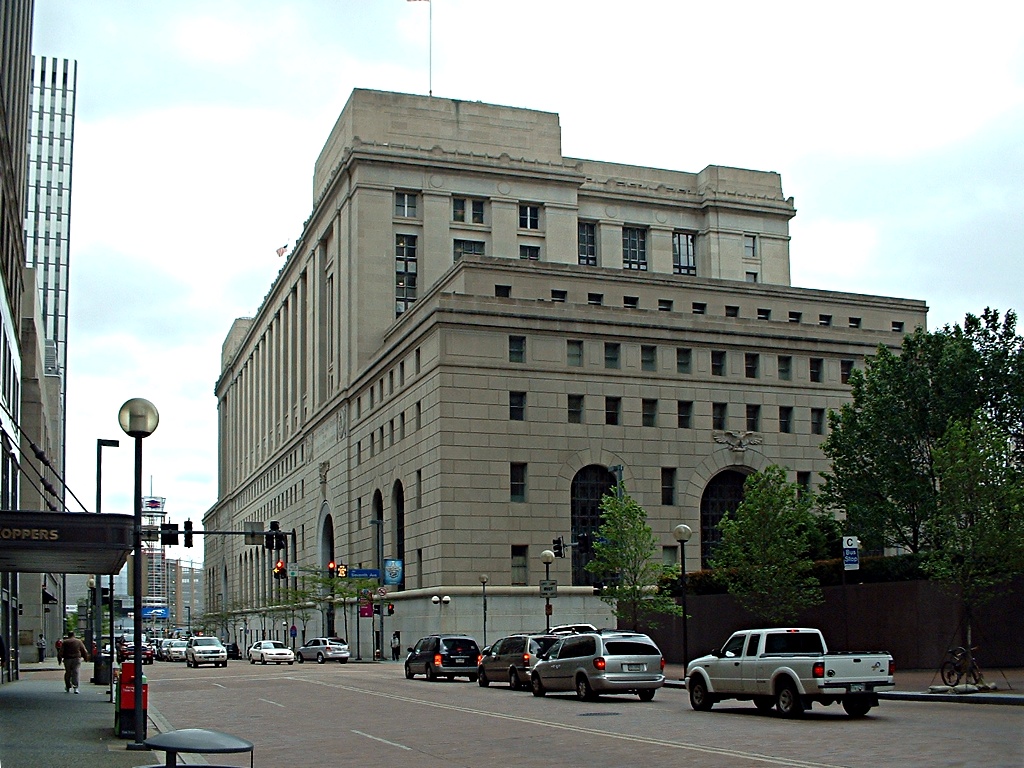
When this style appears in the United States, old Pa Pitt can think of no better term for it than “American Fascist.” The most prominent example in Pittsburgh is the Federal Building on Grant Street:
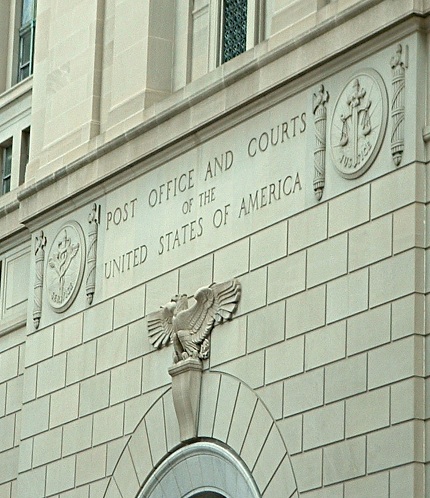
Not only does this massive building strongly echo the parallel developments that would grow up in Nazi Germany, but over each entrance it even carries the very symbol of Fascism, the fasces, a bundle of rods surrounding an axe:
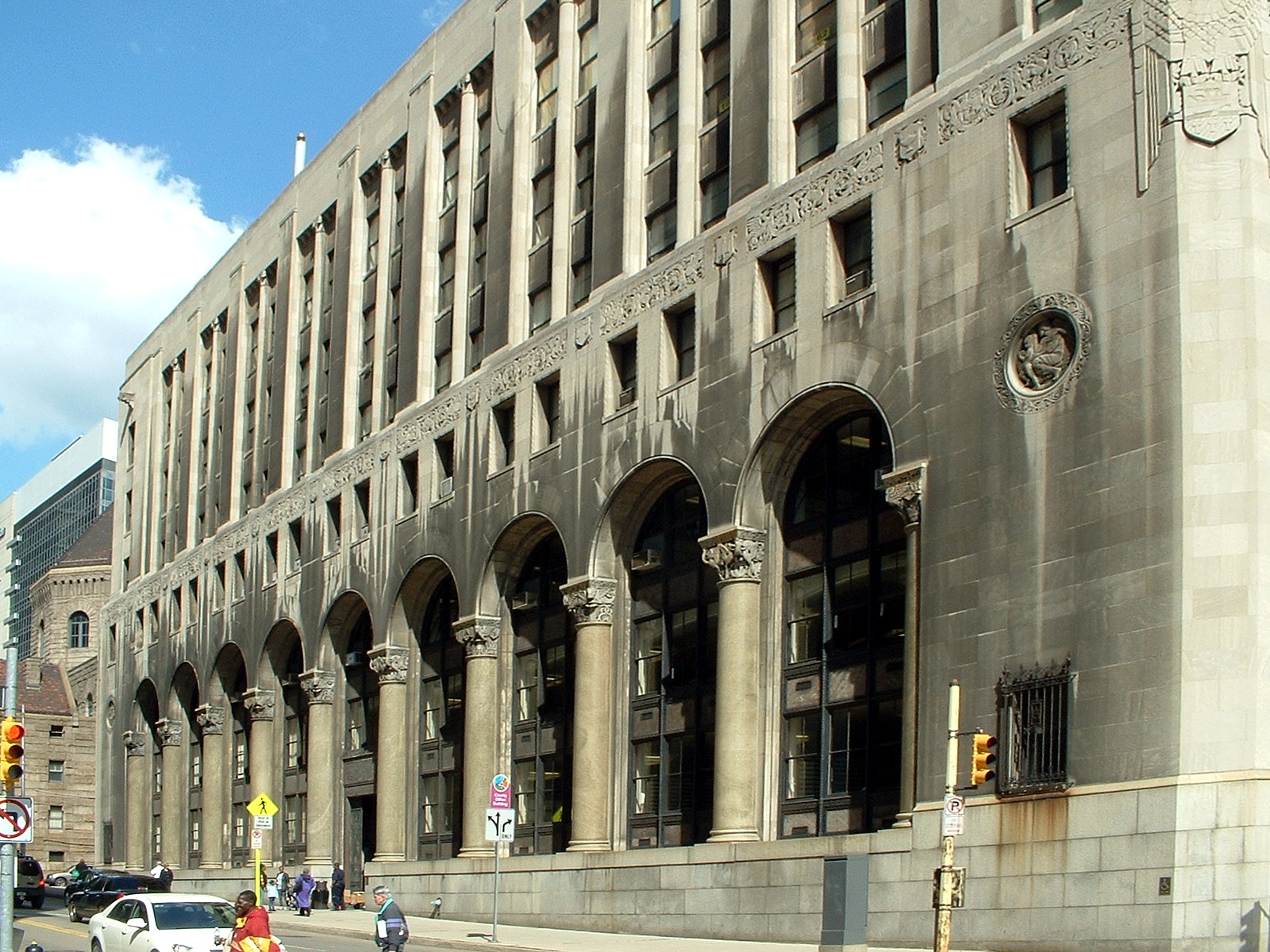
This is the most nakedly Fascist building in Pittsburgh, but there’s more than a little of the style on some other government buildings of the same period. The County Office Building, for example, has a strong whiff of the Fascist about it, although uniquely its architectural inspiration is not classical Roman but medieval Romanesque:
The choice of Romanesque style might seem surprising, but the urban context makes the reason clear. H. H. Richardson’s gigantic courthouse and jail sits right across the street; “Richardsonian Romanesque” became the official architectural style of Allegheny County, and even the strong current of fascism in middle-twentieth-century government architecture would have to take Richardson’s influence into account.





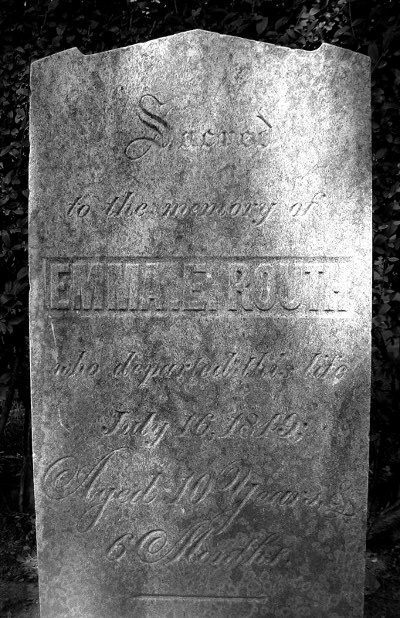 This 1849 tombstone in Old St. Luke’s churchyard, Woodville, is the work of an unusually talented stonecutter. The calligraphic styles of middle-nineteenth-century penmanship have been imitated precisely in the stone.