


A pair of old doorbell buttons on a house on the South Side. They have little windows where the name of the occupant to be summoned could be displayed. The similar button on the front door of the Pitt mansion is connected by a wire to an electrically activated clapper in the basement, which beats against a bell after the manner of an alarm clock as long as the button is pressed. This is enough racket to be heard throughout a large house. One does have to warn guests about it, though; otherwise the first political canvasser who shows up will send them running for the exits thinking the fire alarm has gone off.
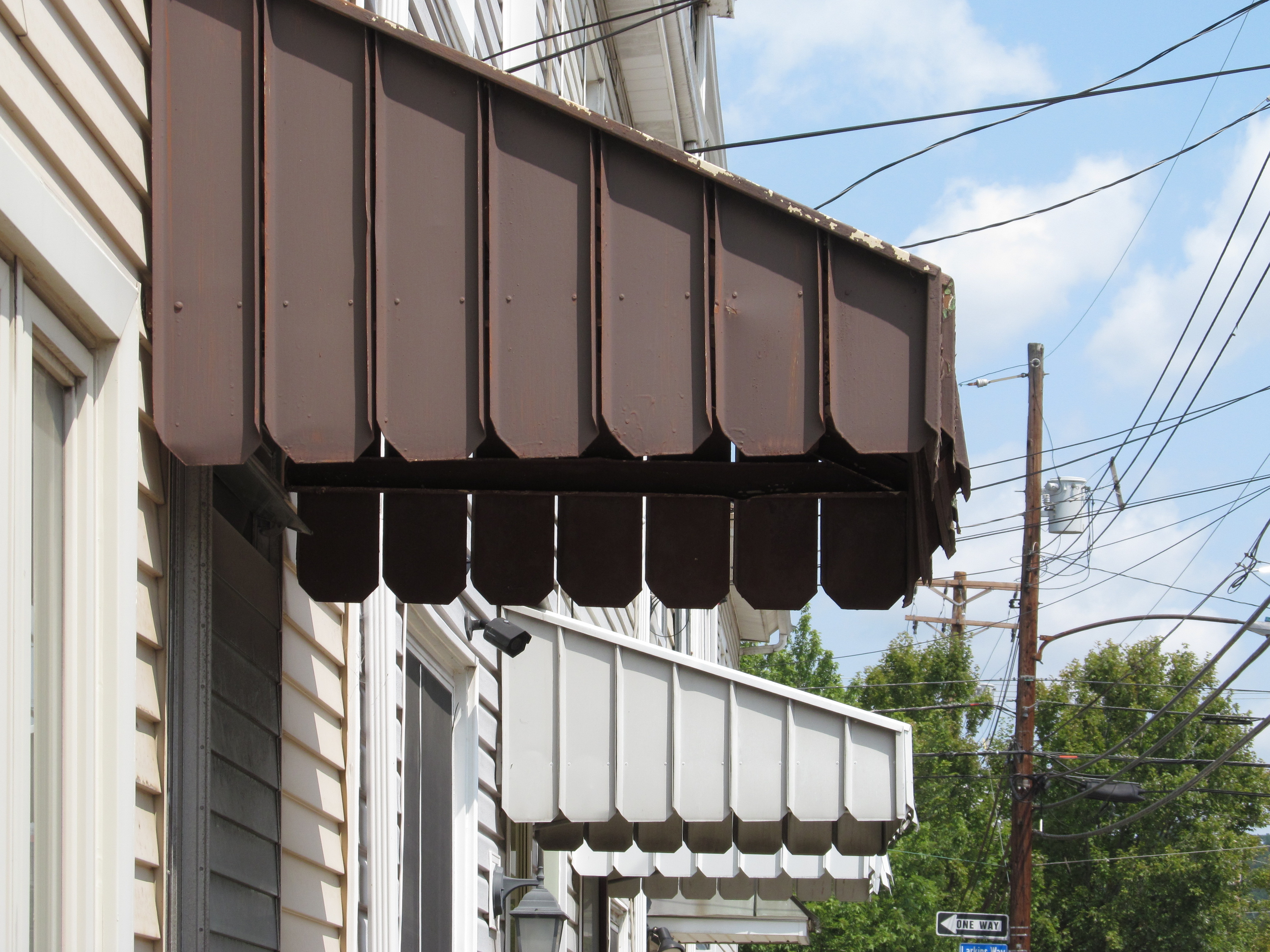
Awnings used to be a big business in Pittsburgh. The awning men would come to your house in the spring and put canvas awnings over your doors and windows for summer shade, and then in the fall they would come around and take down the awnings and take them away to be cleaned and put in storage, and then in the spring you would get fresh awnings again. (You can still find one or two services that will do that for you.)
Obviously you have to spend some money on this service, and that limited it largely to the upper middle classes and above. When someone had the brilliant idea of making awnings out of cheap aluminum, however, the floodgates were opened, and every working-class house could at least have a little awning over its front door to shelter the residents while they fumbled for their keys in the rain.

On some streets—as here on 24th Street—you can still pass one aluminum awning after another, often a bit bedraggled but still clinging to its house.
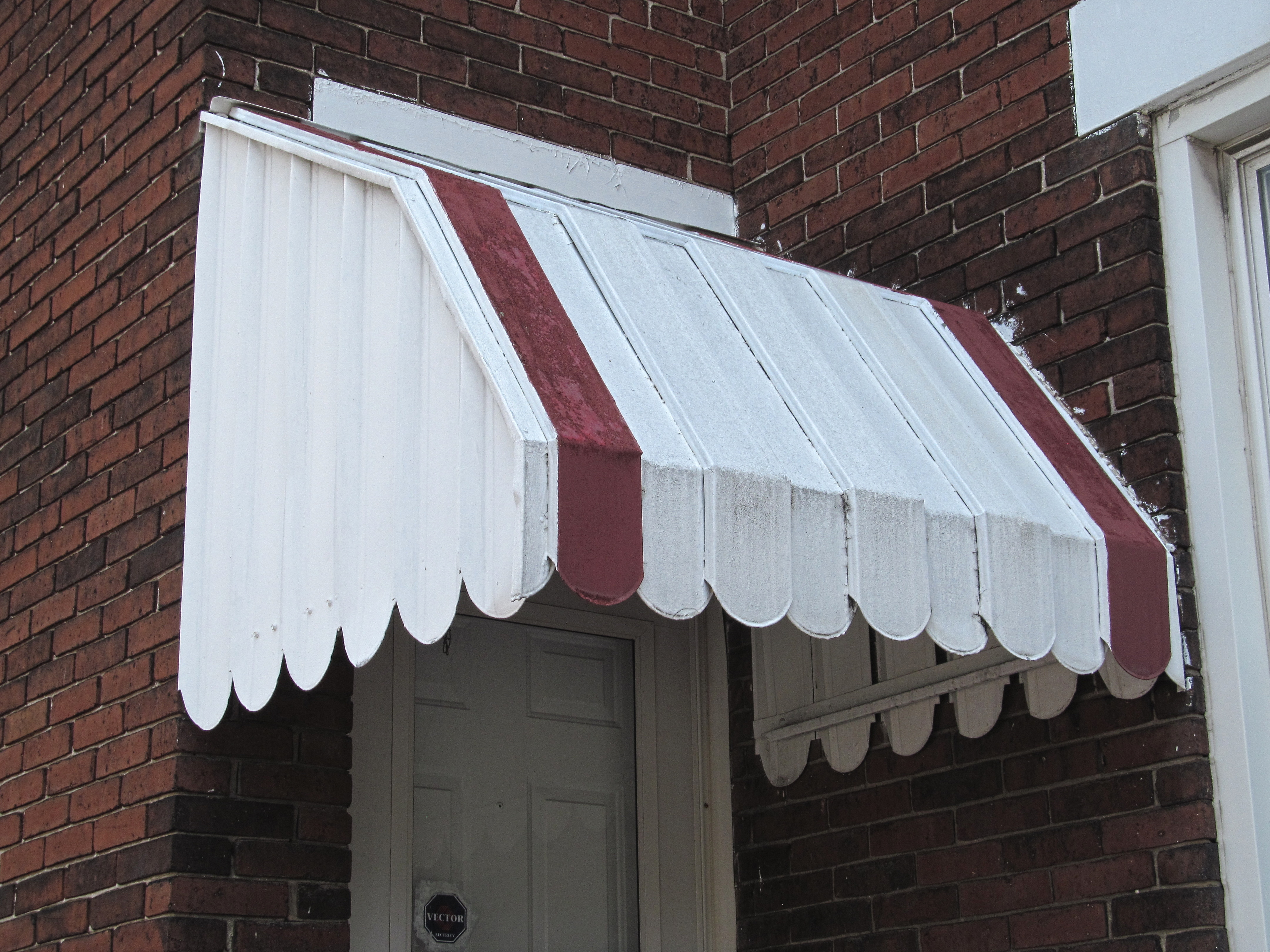
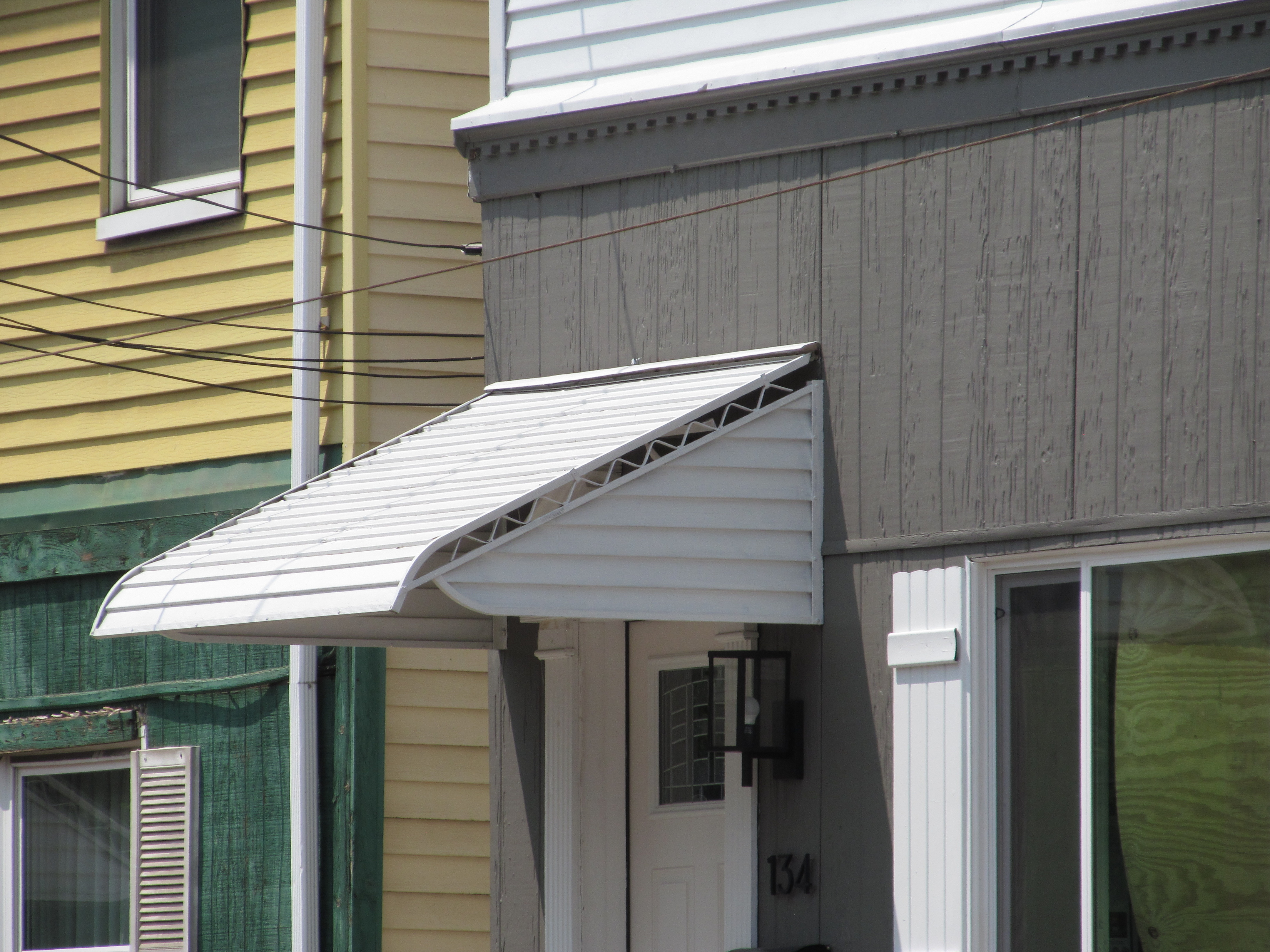
These awnings were made by a number of different manufacturers, and they came in a wide variety of shapes.


Aluminum awnings were supposedly open to the objection that, when the sun was beating on them, they created a pocket of hot air under them. (How much of a worry this really is old Pa Pitt could not tell you, but it sounded plausible in the mouth of a salesman.) The problem was supposedly solved, however, by the ingenuity of the Kool Vent Metal Awning Corp. of America,1 which invented and patented diagonal louvers on the sides of the awning that were supposed to allow the hot air to escape from under the awning—an invention described thus:
An awning adapted to be fastened to a wall or the like support, including a curtain comprising a series of spaced overlapping parallel vertical depending plates, angling outwardly from the awning toward the wall at not more than ninety degrees.

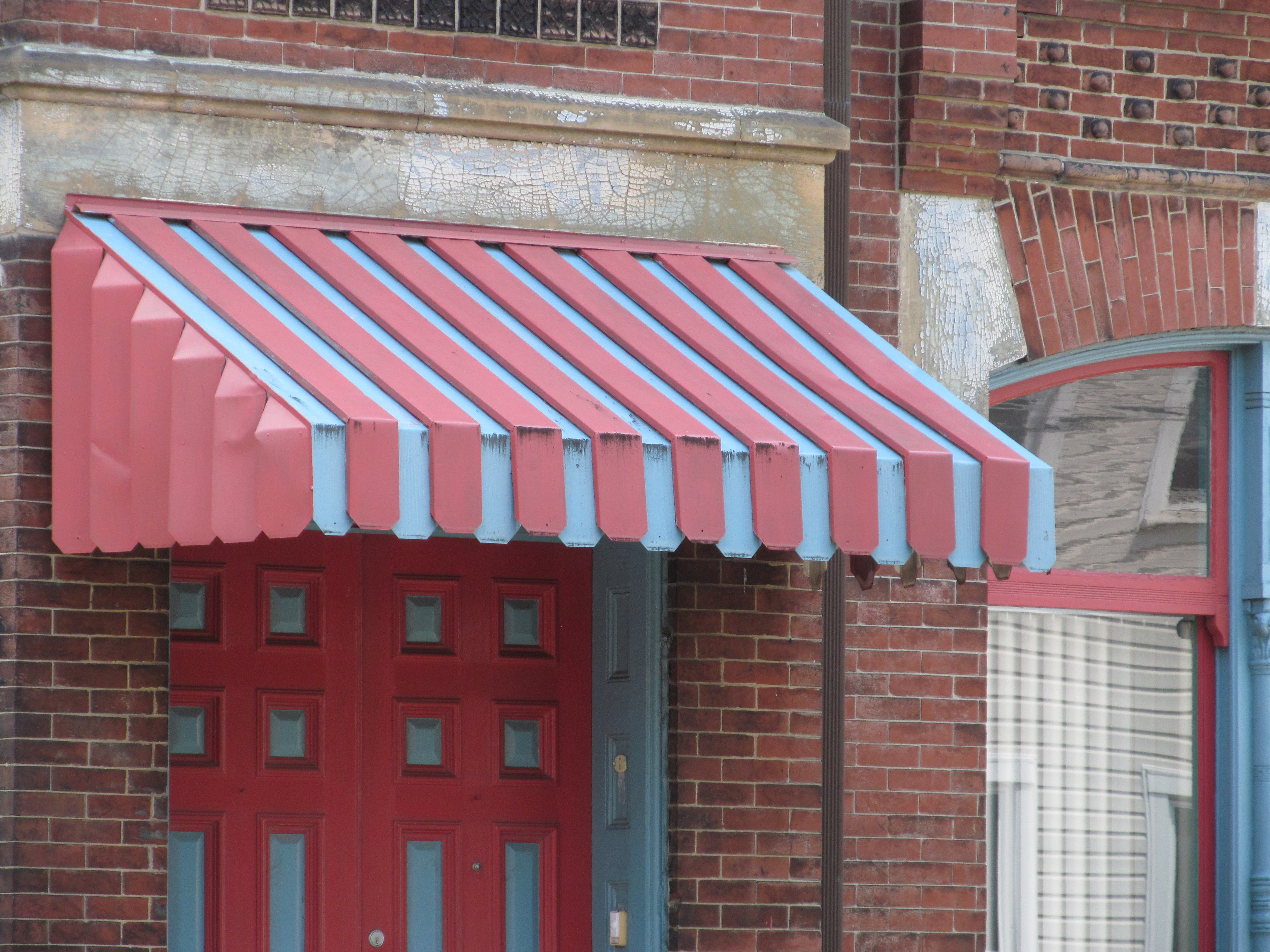
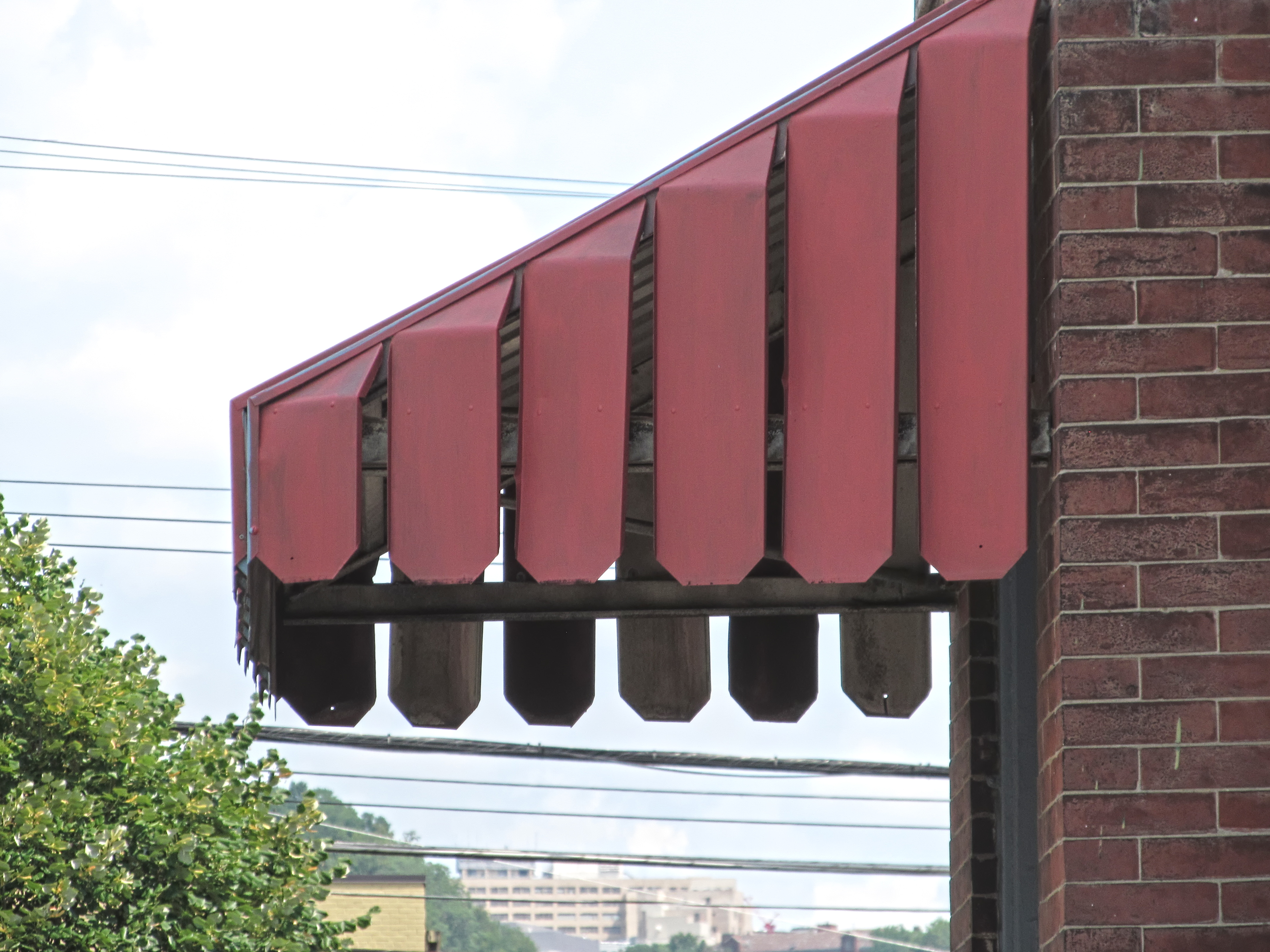
Here we see the diagonal arrangement, designed so that the “vertical depending plates” still provide reasonable shelter from blowing rain but allow air to escape between them. Other awning companies imitated this arrangement, but Kool Vent successfully sued them, enforced its patent, and became the king of the aluminum-awning companies.
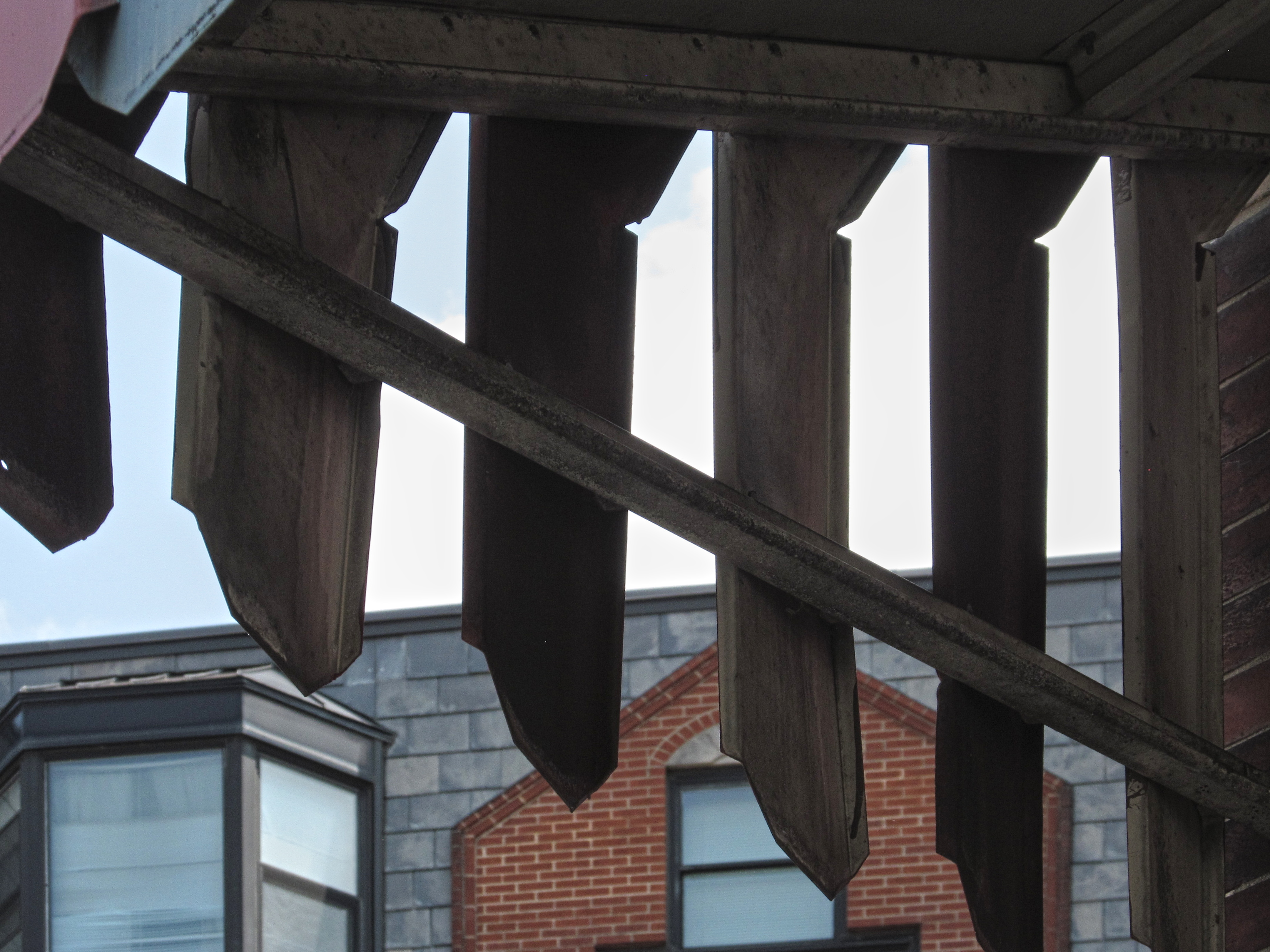
The architectural historian Franklin Toker facetiously suggested that the South Side should be declared a Kool Vent Awning historic district, and although other neighborhoods—Bloomfield, for example, and South Oakland—also have large Kool Vent infestations, the South Side probably preserves Kool Vent awnings and their competitors in greater numbers and density than any other neighborhood. All the awnings in this article were found in one block of South 24th Street.

Formerly a storefront with apartments above, but the storefront—as with many backstreet stores—has been converted to another apartment. The well-preserved Victorian details are picked out with a colorful but tasteful paint scheme.


This little Slovak school, which opened in 1917, was designed by German-American architect Herman Lang, known for some splendid churches (notably St. George’s in Allentown and St. Basil’s in Carrick). He gave it a dignified and symmetrical façade that no one will ever see like this, because it faces a tiny narrow alley with room for one car to squeeze past the buildings on either side. It is impossible to photograph the school without resorting to trickery, but old Pa Pitt has never been above trickery. You will notice the seams if you enlarge this picture, but that is because this is one of the most impossible photographs Father Pitt has ever attempted.
The building is in good shape, having been turned into apartments, like almost every other school on the South Side.

The cornerstone was laid in 1916.


To the south, at the base of the steep South Side Slopes, was a small but crowded neighborhood of workmen and their families. To the north was a huge steel mill, a railroad roundhouse and shops, and a big brewery. In between was a railroad yard with more than twenty tracks to cross. How would the workmen get to work without getting run over by switching locomotives every day? The answer was to extend 33rd Street from the Slopes to the Flats as a pedestrian tunnel under the main line, followed by a long pedestrian bridge over the railroad yards.
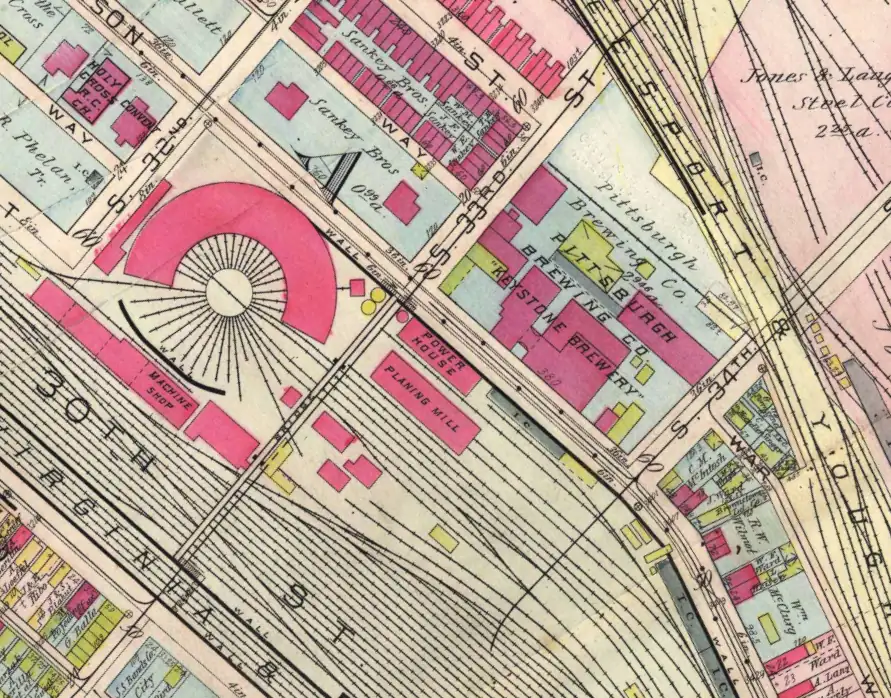
The bridge and the railroad yard are gone now; the tunnel remains, but since it goes nowhere it is blocked. The tunnel entrance is still attractive in its stony simplicity.

All the South Side histories tell us that this school was originally built in 1871, the year before Birmingham was taken into the city of Pittsburgh as part of the South Side. From old maps, however, it appears that only the central part of the school, invisible from the street today, was built that early. The two identical fronts, this one on 15th Street and the other on 14th Street, seem to date from the 1880s. In 1940, the building was sold to St. Adalbert’s parish up the street, which used it as a middle school. It spent more than sixty years as a Catholic school of one sort or another. The last incarnation of the Catholic school closed in 2002, and after that the school—like all the other closed schools on the South Side—was converted to apartments.


Update: The mystery is solved, thanks to an alert reader who has earned old Pa Pitt’s gratitude. This was the Second Methodist Church of East Birmingham, opened in 1872 and sold at a sheriff’s sale in 1874. There must be an interesting story in the short period between those two dates; usually being a Methodist wasn’t such a risky business.
The original text of the article is below.
If anyone knows the history of this building on Larkins Way at 23rd Street, Father Pitt would be happy to hear it. That it was a church at one point is obvious. It fits the pattern of small Pittsburgh churches of the middle and late nineteenth century exactly, and those blocked-in Gothic windows on the end would tell the story if nothing else did. But it was not a church for long before it was converted to four tiny alley houses. It appears without a label as a single undivided building on an 1882 map at the Pittsburgh Historic Maps site, but not in 1872, so it was probably built at some time in the 1870s. By 1890 it is already shown as divided into four parts, probably rental houses, since they were all owned by Jane Morgan. It continued under single ownership through 1923, and that is as much as old Pa Pitt knows about it.
So what kind of congregation failed in less than twenty years’ time? It is an interesting mystery, and Father Pitt has not yet solved it.

