Most of the houses in Schenley Farms were built singly: usually the property owner chose an architect, though the land company built a few houses to sell on spec. But on Schenley Farms Terrace, Janssen & Abbott were hired to design a row of seventeen houses all at once. The result is one of those rare tract-house developments where the houses are little masterpieces that combine to make a beautiful and well-thought-out streetscape.
(The house at extreme left with the colonnaded balcony is not part of the Janssen & Abbott row.)
Similar developments stick to one style, but on Schenley Farms Terrace you come across a Colonial Revival house, and then a crisply modern cottage, and then a Pittsburgh Foursquare, and then a French farmhouse. Somehow they all look comfortable together.
Again, similar developments stick to one scale, but Janssen uses differences in height to make a streetscape that feels as though it just grew there.
We have quite a large number of pictures here, so we put them behind a “more” link to avoid weighing down the front page.
As we mentioned before, we are attempting to photograph every house in the residential part of Schenley Farms. Here is a big album of houses on Bigelow Boulevard, which becomes a residential street as it winds through the neighborhood. Above, Ledge House, the strikingly different home of A. A. Hamerschlag, the first director of Carnegie Tech (now Carnegie Mellon University). It was designed by Henry Hornbostel, who designed the Carnegie Tech campus and taught at Carnegie Tech. It has recently been cleaned of a century’s worth of industrial soot and restored to its original appearance.
Above and below, the D. Herbert Hostetter, Jr., house, architects Janssen and Abbott. Benno Janssen and his partner abstracted the salient details of the Tudor or “English half-timber” style and reduced it to the essentials, creating a richly Tudory design with no wasted lines.
Because we have so many pictures, we’ll put the rest below the metaphorical fold to avoid weighing down the front page here.
We’ll be seeing quite a bit of Schenley Farms in the coming weeks, because old Pa Pitt has taken it upon himself to photograph every house in Schenley Farms. The neighborhood has perhaps the most concentrated collection of superb domestic architecture in a city known for its superb domestic architecture. Here we have an interesting composition by Charles W. Bier, an architect who paid more attention than most Pittsburghers to the breezes of modernism blowing from Germany and Austria on the one side and Chicago on the other. This house compares favorably with the Kiehnel & Elliott house we saw recently: it also fits well with its neighbors while adopting modern Art Nouveau details. This one, unfortunately, has lost its front porch, which would have been a showcase for some interesting woodwork. We get a hint of what it might have been from the porte cochere:
For their client Godfrey Stengel, Kiehnel & Elliott took the basic form of a typical Pittsburgh Renaissance palace, which gave them a box to work with—Richard Kiehnel’s favorite shape. To that canvas the architects applied their trademark Jugendstil-infiltrated-by-Prairie-school decorations. The house was built in 1913, and it must have looked very modern—yet it fits perfectly in Schenley Farms, where other more traditional Renaissance palaces have almost the same shape without the Jugendstil.
Today we have the privilege of peeking into one of those fine Tudor houses in Schenley Farms, through the courtesy of the gracious owners. The architects of this one, built in 1907, were the twin Beezer Brothers, who gave us a number of fine houses and a few distinguished public buildings before moving out west to prosper even more. In Pittsburgh architectural history, they’re mentioned most often as the employers of John T. Comès when he designed the church of St. John the Baptist (now the Church Brew Works) in Lawrenceville, which shows that they had an eye for rare talent. This house shows that the brothers also had a keen eye for detail and meticulous craftsmanship.
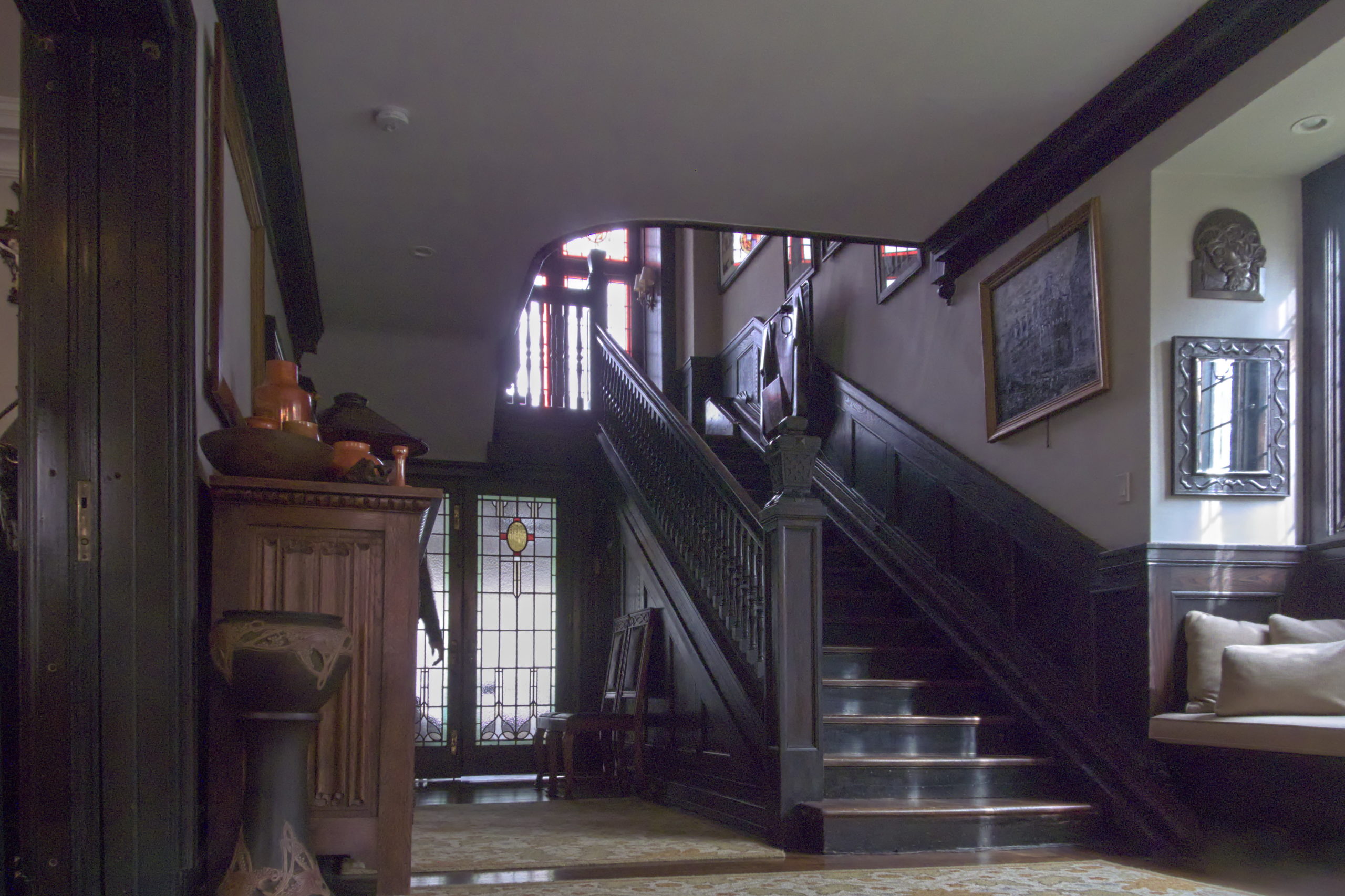
The entry is a good introduction to the house, with its dark woodwork and art glass everywhere. Tudor Revival architecture uses dark wood extensively; in the best Tudor Revival houses, it creates a sense of shelter from the inhospitable elements outside.
If you look closely toward the top of the staircase, you may notice one of the unusual additions to this house: a stair lift that is probably ninety years old or more.
The staircase leads up to a landing with a huge window in the best Tudor Revival style. Light pours in through the window, but the much-divided glass keeps the strong sense of being inside and comfortably protected.
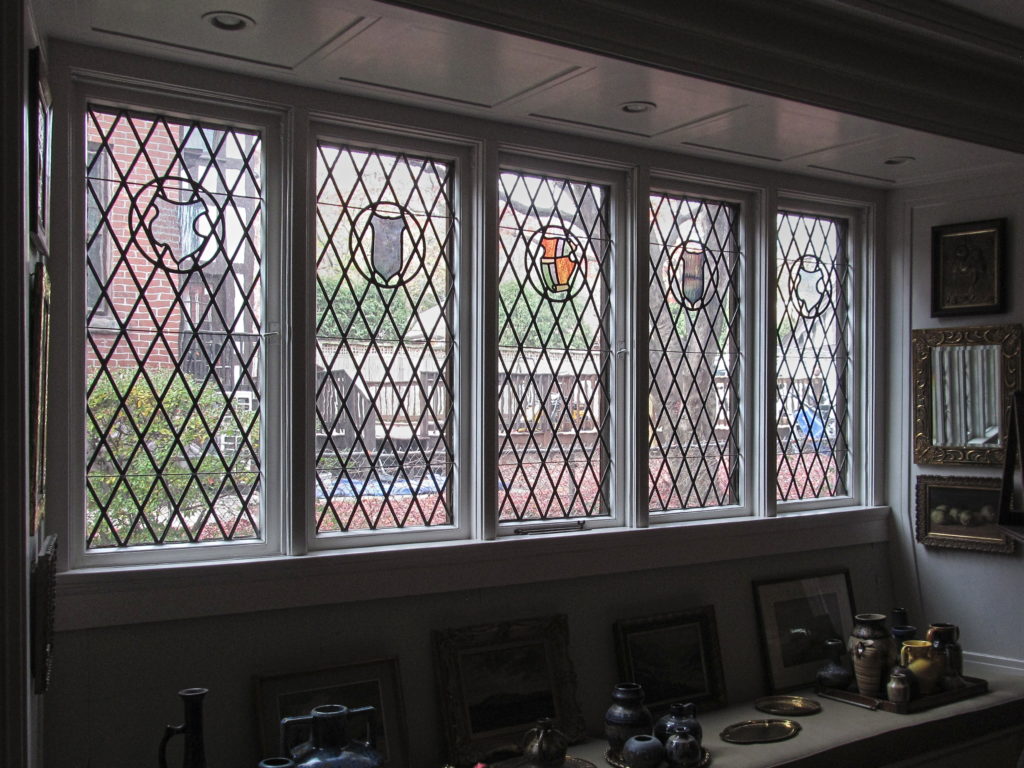
The escutcheons in glass suggest a family tradition of immemorial antiquity, which must be a comforting feeling if you are a former shop clerk who has just made his pile in sewer pipes or corsets.
The dining room is illuminated by windows that permit a view of the world outside (and the back yard next door), but filter it through artistic glass.
The entry is separated from the rooms behind by more glass.
The front entrance is surrounded by glass, which lights up the entry without making it oppressively bright.
The front porch is covered by a roof whose exposed timbers give it a Tudor atmosphere while once again adding to the sense of shelter.
The windows of the front entrance, like several of the other windows in the house, permit a view of the outside world through artistically arranged glass. In effect they Tudorize the great world beyond the house, making it seem more inviting and less threatening. It is almost a disappointment to walk out and find no beruffed nobles on horseback or elegant court ladies waving handkerchiefs.
What houses like this gave their residents was a sense of permanence in a world that might otherwise seem to be running away from them. Living here, you were part of the best traditions of the old world, while enjoying all the comforts modern technology could provide you. The design created spaces that were distinct and sheltering, each adapted perfectly to its purpose, but harmonized into a whole that conveys a consistent impression of comfort and prosperity. The joy of a Tudor house by the Beezer Brothers, or any of the dozens of similarly accomplished architects who were working in Pittsburgh at the same time, is not the joy of seeing old forms burst apart and wonderful new shapes burbling out of the artist’s imagination. They are not free verse by Whitman; they are sonnets by Shakespeare or Spenser or Wordsworth or Millay, in which each artist uses the traditional form, but the pleasure is in how the form brings out the distinct personality of the artist.
This was one of the original houses put up in 1906 by the developers of Schenley Farms. The architects were Billquist & Lee. Billquist is Thorsten E. Billquist, the architect who designed the Allegheny Observatory. Lee is Edward B. Lee, who left Billquist in 19101 to found his own practice and flourished as a designer of theaters and clubs, and as architect of record for the City-County Building (though Lee later said he had only executed drawings from designs by Henry Hornbostel).
American Architect, April 20, 1910: “Mr. Edward B. Lee, architect, announces that he has severed his connection with the firm of Billquist & Lee and has opened offices for the practice of his profession at 318 Berber Building, Pittsburg, Pa.” ↩︎
Louis Stevens designed two houses side by side on Parkman Street for two members of the Terry family—Henry Terry and C. D. Terry. The houses were built about 19161, and they are a good demonstration of how completely different arrangements of the elements can nevertheless be stamped with the architect’s indelible signature.
The Henry Terry house, above, is symmetrical, with twin gables facing us and a porch roof extending from the center entrance.
The C. D. Terry house, on the other hand, is asymmetrical, with a side porch, an entrance with Romanesque-style receding arches, and a single gable facing the street.
In both houses, though, we see the same steeply pitched roof, with its slightly flared roofline, and the same Flemish-bond brickwork. The houses let us know right away that they are the work of the same architect.
Stevens’ best-known work in Pittsburgh is probably the Worthington mansion in Squirrel Hill, which is now part of Temple Sinai. It is on a much larger scale and made with richer materials, but we can see its family resemblance to these two houses.
Our information comes from The Construction Record in 1915, which tells us that Stevens was taking bids on these two houses. ↩︎
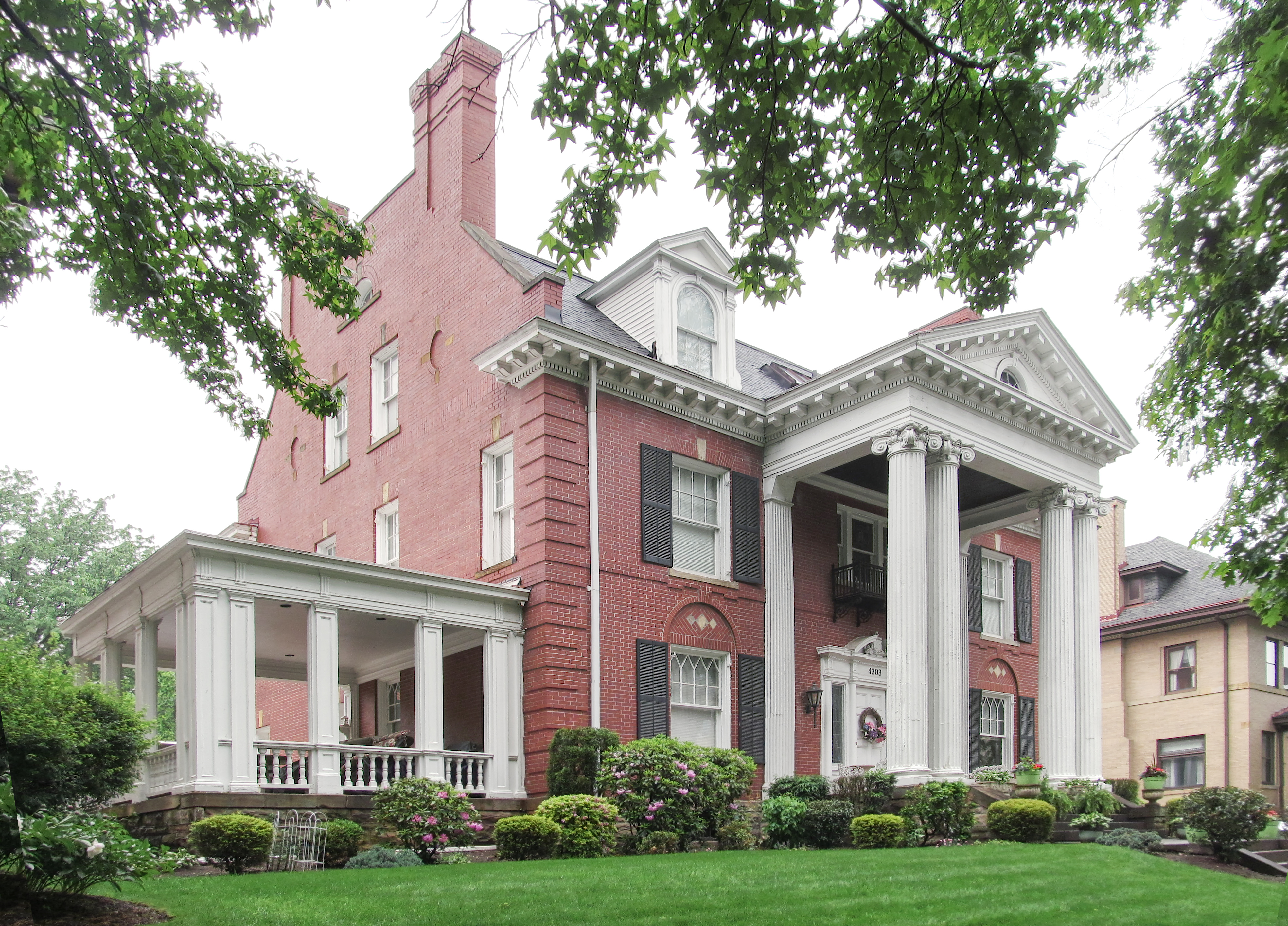
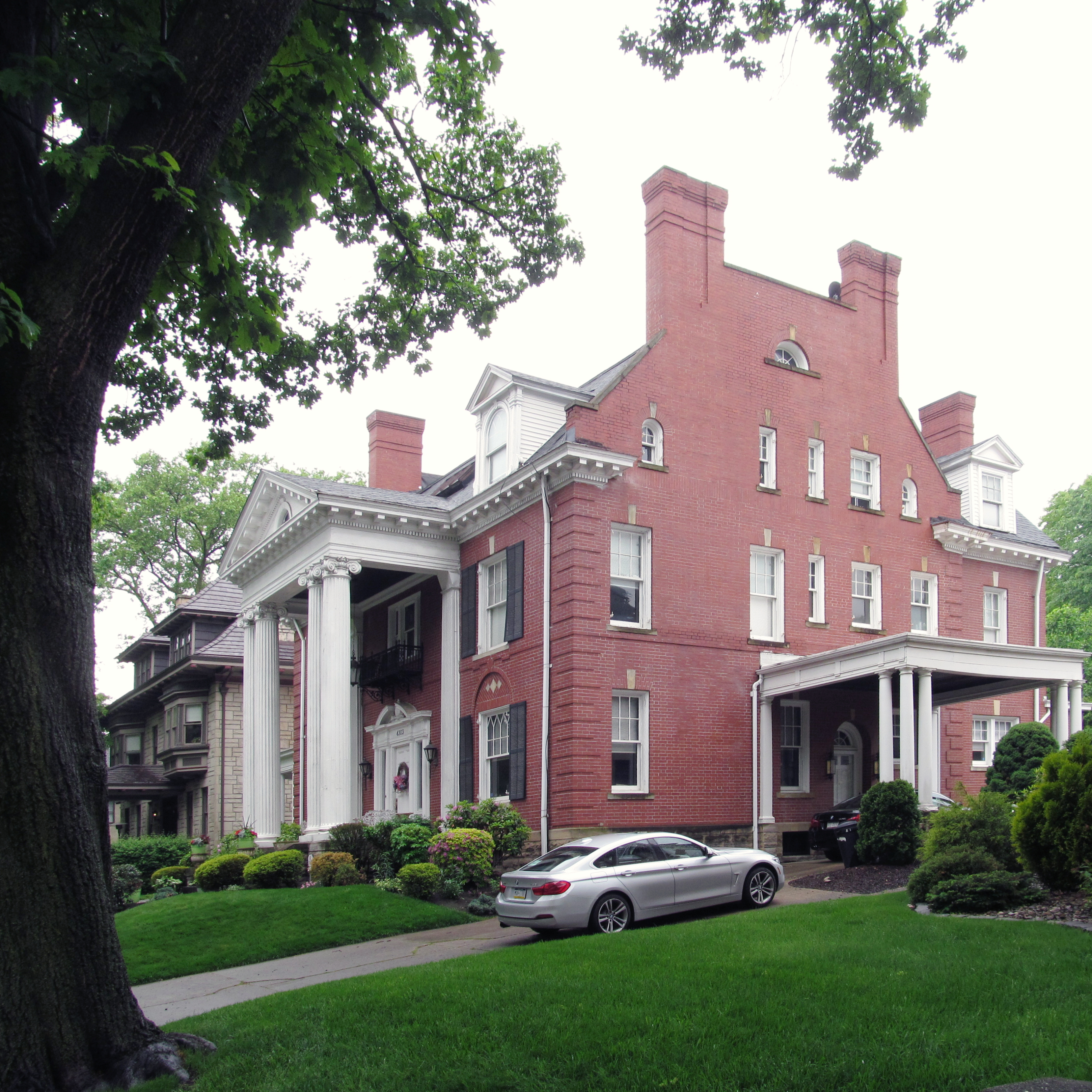
A splendid example of the Georgian revival, which is not a very common style in Schenley Farms. This is one of those domestic masterpieces that make Schenley Farms “a museum of early twentieth century domestic architecture,” in the words of the historical marker put up by the Pittsburgh History and Landmarks Foundation in 1978.
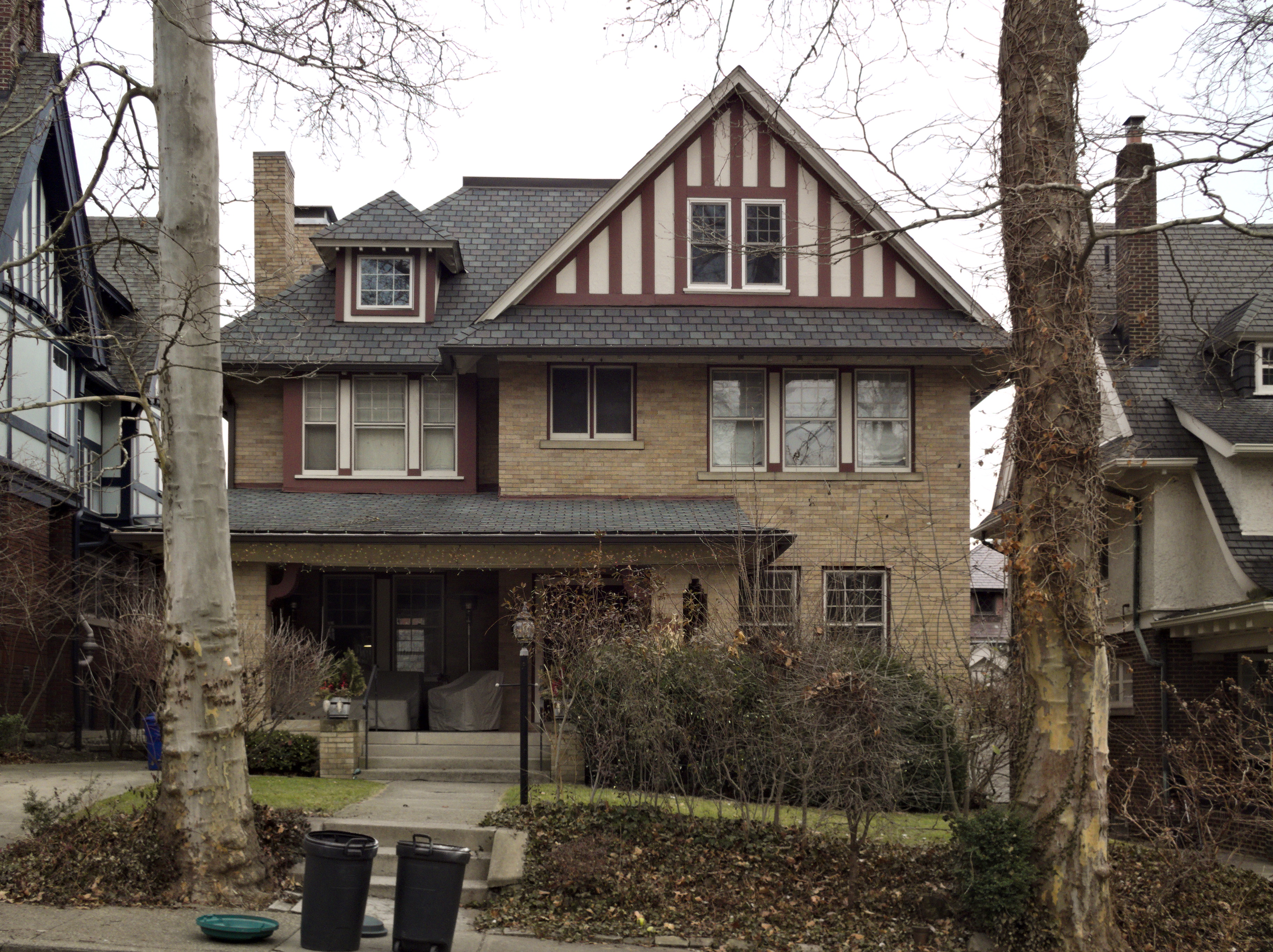
Father Pitt promised more Tudor-style houses in Schenley Farms, and here they are. We are certainly not finished with the Tudor houses in the neighborhood, but we have made a good beginning.