

The spire of Trinity Cathedral is dwarfed by the massive Oliver Building behind it, one of Daniel Burnham’s greatest gifts to Pittsburgh.
Trinity Cathedral is half a block up Sixth Avenue from the Wood Street subway station.
The spire of Trinity Cathedral is dwarfed by the massive Oliver Building behind it, one of Daniel Burnham’s greatest gifts to Pittsburgh.
Trinity Cathedral is half a block up Sixth Avenue from the Wood Street subway station.

These ornaments in relief adorn the exterior of Heinz Hall, formerly the Loew’s Penn movie palace, and now home to the Pittsburgh Symphony. The creation of this first-rate concert hall began the long transformation of the decaying theater district into the bustling and lively cultural attraction it is today.
Heinz Hall is a short walk around the corner from the Wood Street subway station.

A big hole in Stanwix Street marks where the new Gateway Center subway station is under construction below. When the new subway line to the North Side opens, this larger station will replace the old Gateway Center subway station, with its squealing underground loop and single platform.

The Ormsby family were early settlers in the little town of Pittsburgh, coming here in 1768, when their son Oliver was only about a year old. Oliver spent the rest of his life here, and was buried in Trinity Churchyard with a memorial that shows how much wealth he had accumulated in that time. The inscription reads thus:
ERECTED
To the Memory of
OLIVER ORMSBY
Son of John Ormsby
born at Bedford, Pa. Feb. 23, 1767
removed in 1768 to Pittsburgh where he
resided until the period of his decease
the 28th of July A.D. 1832,
leaving to his afflicted family
(who were prematurely bereaved by an
all wise Providence of a devoted father)
a character of unblemished Purity
a fountain flowing with streams
of the noblest virtues for their instruction.
O best of Parents
Long for thee thy Children’s tears shall flow.
Long shall their bosoms heave with woe.
But thanks to our Almighty Father
we mourn not as those without hope
looking with the eyes of faith
for a reunion of our once happy family
in the regions of bliss,
where the spirits of the dust are perfected
through Christ Jesus our Lord.

Pittsburgh’s earliest settlers are buried downtown in the churchyard of Trinity Cathedral, the Episcopal cathedral of Pittsburgh (or at least the cathedral of some Anglican diocese, though which one may be up in the air right now). Next door is First Presbyterian, another colonial-era congregation, and across the street is the Duquesne Club, forming a perfect triangle of old money.


Trinity Churchyard is half a block up Sixth Avenue from the Wood Street subway station.

The gardens of Equitable Plaza, part of the modernist Gateway Center development that was the showpiece of Pittsburgh’s first Renaissance, are always perfectly tended, changing with the seasons.

Equitable Plaza is right next to the Gateway Center subway station.

The top of the CNG tower seen from the Diamond, or “Market Square” as it’s usually called in print. While the rest of the country gripes about slow times, downtown Pittsburgh seems to be in the middle of a building boom, and construction equipment is likely to invade just about any photograph.

A two-car 47S train rolls into the Steel Plaza subway station in early rush hour.
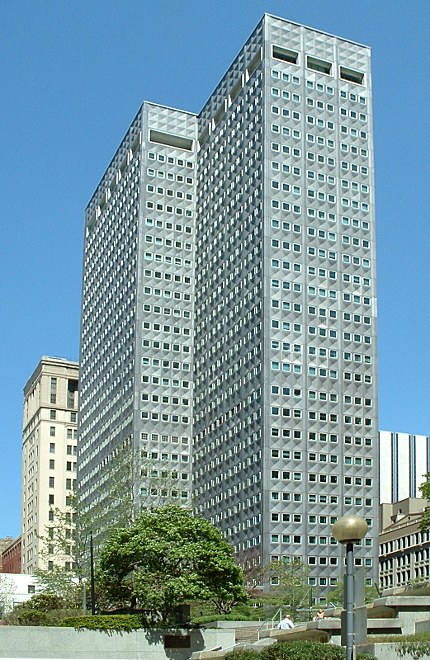
The Alcoa Building, now called the Regional Enterprise Tower (Alcoa has moved across the Allegheny to the North Shore), was supposedly the first all-aluminum skyscraper. From most angles it looks like a giant stack of television sets, but with the clean modernist lines and vegetation of Mellon Square in the foreground, we can picture how the building must have looked in the architect’s imagination.
The Alcoa Building is a short walk down Sixth Avenue from the Ross Street exit of the Steel Plaza Subway Station.
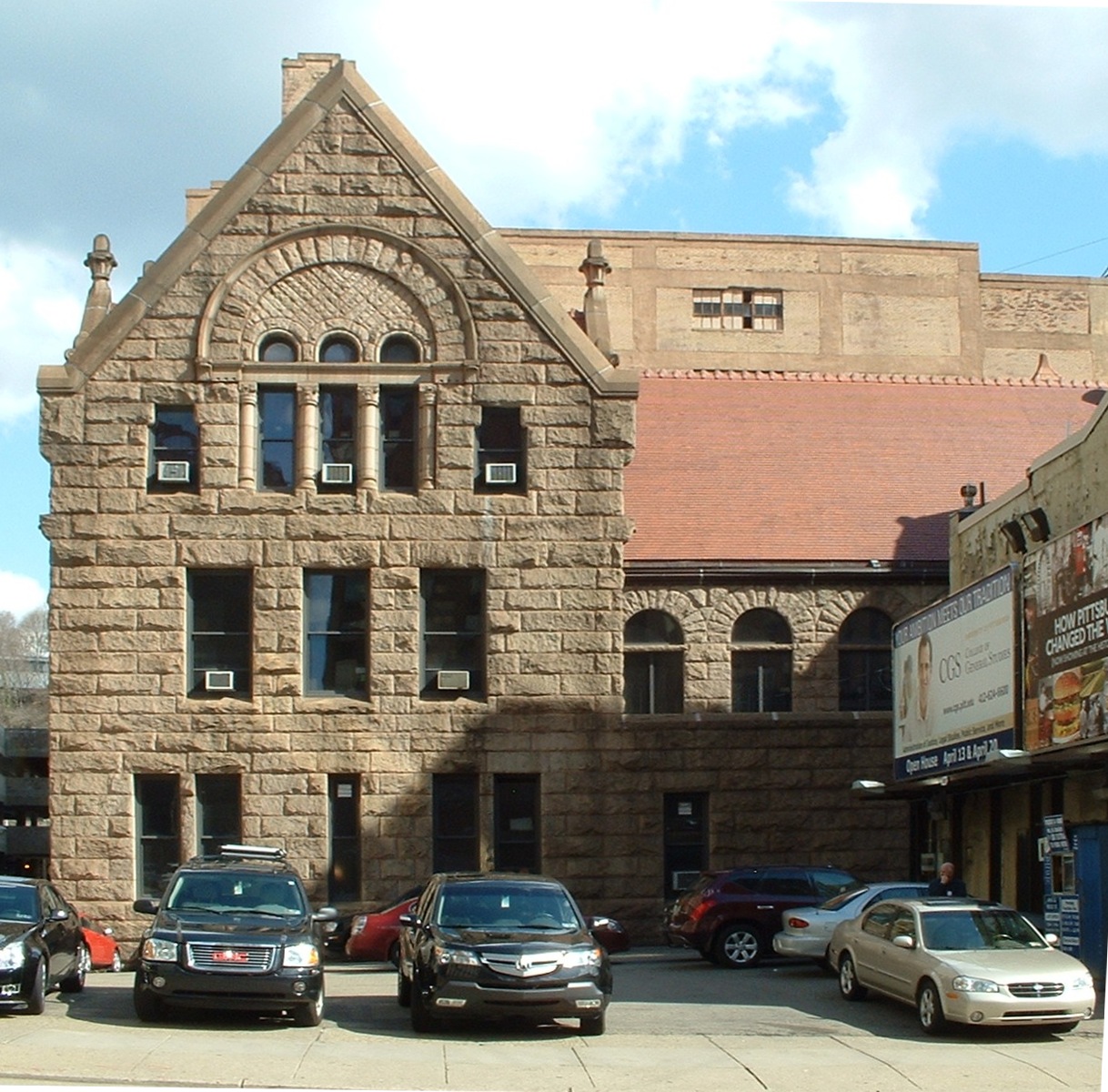
Frederick Osterling designed this atmospherically Romanesque morgue to match Richardson’s courthouse and jail a block away. Generations of Pittsburgh teenagers made a tradition of visiting the morgue after the prom. This curious memento mori is one of those Pittsburgh customs that old Pa Pitt must simply file away as unaccountable, not even attempting an explanation; unless it be that the visit to the morgue, by a direct appeal to all the senses at once, was intended to achieve what Mr. Andrew Marvell attempted to achieve by verse alone.
The morgue is a short walk from the First Avenue subway station.