
Father Pitt

Category: Downtown

  • Gateway Center

    Gateway Center

    The gleaming modernist towers of Gateway Center in afternoon sunshine.

    Gateway Center
    Fountain at Gateway Center

    Did you notice how Father Pitt did not slow down the shutter speed for the flowing water, the way every photography site on the Internet dogmatically insists you must do it? Did you notice the fascinating patterns of falling water that were captured by the deliberately fast shutter? Are you ready yet to abandon the dentist’s-office-wall-decor cliché of slow shutter speeds for waterfalls and fountains? You can join the rebel alliance!

    The picture above is made from three separate photographs at different exposures, which gives us a better range of detail—but it also adds to the complexity of the play of falling water. To approximate the golden color of the late-afternoon sunshine, it was then put through a simulated Kodachrome 64 filter, with many thanks to the obsessive fiddler who did his best to match the color and light response of Kodachrome film so that the rest of us can have at least an echo of that Kodachrome look. Since Kodachrome has been extinct for fifteen years, this is as much as we can do.
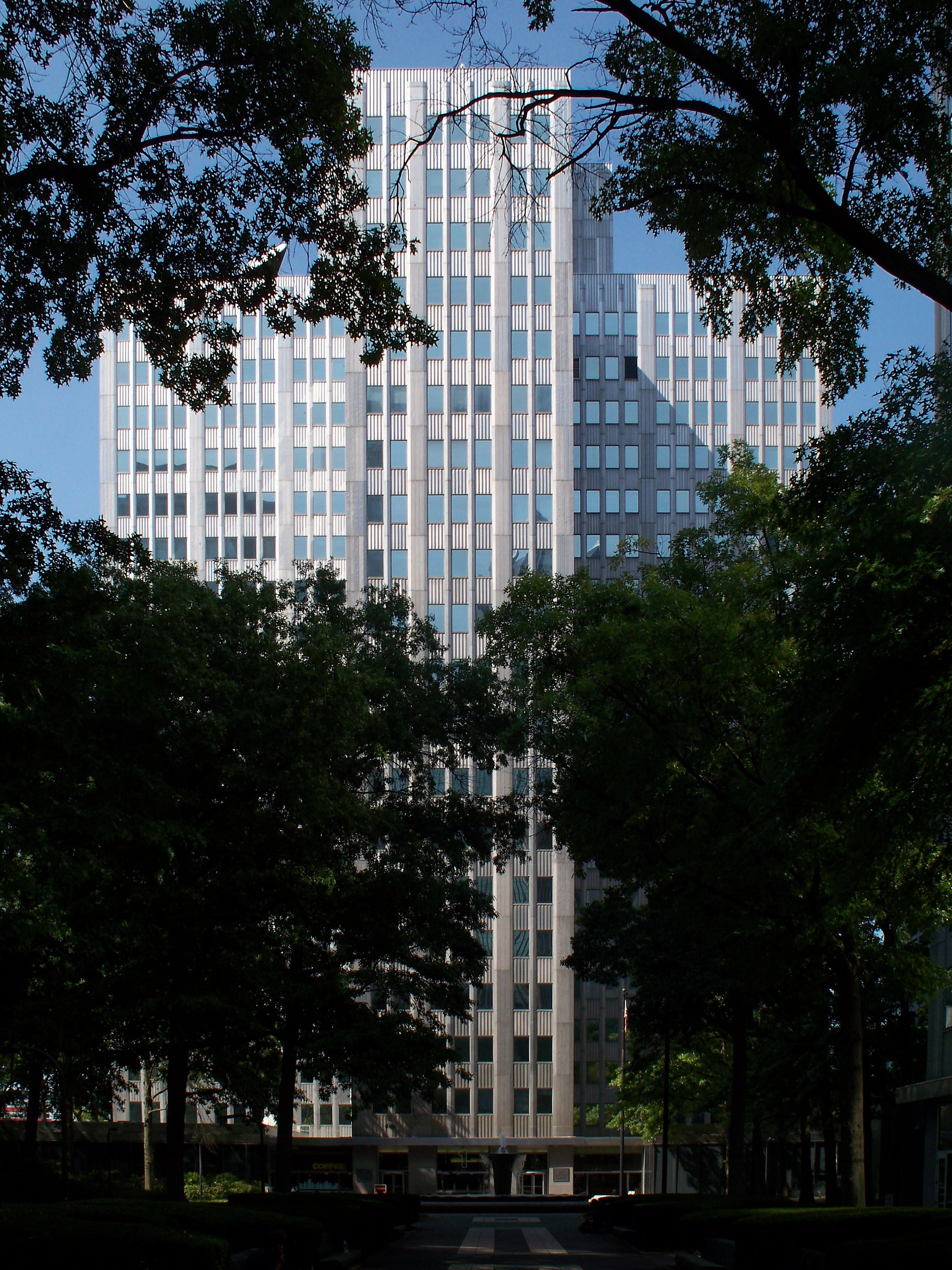
    One Gateway Center
    One Gateway Center
    Gateway Center
    Gateway Center
    Kodak EasyShare Z1285; Canon PowerShot SX150 IS; Samsung Galaxy A15 5G.
  • Gateway Towers

    Gateway Towers

    Gateway Towers was designed by Emery Roth & Sons. It was built in 1964, which tells us that it was the & Sons who were responsible for it, since Emery Roth died in 1948.

    From a distance, this has never been one of old Pa Pitt’s favorite buildings to look at, although he is going to give it a fair chance by presenting multiple angles. Up close, however, it has a sharp classicism in its spare details that makes it much more attractive.

    Entrance

    Good landscaping helps a lot, and all of Gateway Center has very good landscaping. The modernist ideal of towers in a park was never better implemented, and it is because the park part of the scheme was not neglected.

    Gateway Towers
    Gateway Towers
    End of Gateway Towers
    Canon PowerShot SX150 IS; Kodak EasyShare Z1285.
  • Point Fountain

  • Porches of PPG Place

    Porch of 6 PPG Place

    Adopting and heavily modifying an idea from Ludwig Mies van der Rohe, Philip Johnson surrounded the buildings of PPG Place with glass colonnades that create an inviting transition between inside and outside.

    Porch of 6 PPG Place
    Porch of 2 PPG Place
    Kodak EasyShare Z1285.
  • Waterfront Building

    Waterfront Building, First Avenue side

    Built in about 1872, the Waterfront Building is one of the unique row of surviving riverside commercial buildings Pittsburghers call Firstside. It dates from the time when the Monongahela wharf was a chaotically busy place, with steamboats lined up at every available space to load and unload. Now it is separated from the river by a boulevard and an expressway. Above, the First Avenue side; below, the river side.

    Waterfront Building, river side
    Fujifilm FinePix HS10.
  • Market Street, Before and After

    Condemned buildings

    Before.

    Rubble from demolished buildings

    After.

    Preservationists fought a losing battle to save these buildings, not because any one of them was an architectural masterpiece, but because the 100 block of Market Street was one of the few remaining blocks downtown lined with mid-Victorian buildings on both sides. They predated not only the skyscraper age but also the age of six-storey commercial palaces that preceded the skyscrapers.

    Rubble

    If there is any silver lining to the demolition, it is that the open space allows a full view of the buildings on the other side of the street, without resorting to too much photographic trickery.

    West side of Market Street
    100 block of Market Street, west side

    Not that old Pa Pitt has ever been above photographic trickery, as he demonstrated a few months ago with a picture of the whole block of condemned buildings before they came down:

    East side of Market Street before demolition

    Cameras: Canon PowerShot SX150 IS; Fujifilm FinePix HS10.

  • Wood Street

    Wood Street

    The entire length of Wood Street, from Fort Pitt Boulevard in the foreground to Liberty Avenue at the other end.

    Wood Street and area
    Fujifilm FinePix HS10.
  • House Building

    House Building

    This building was put up in two stages. It was built in 1902 as a seven-story building; two years later six more floors were added. Originally it had a cornice and a Renaissance-style parapet at the top, without which it looks a little unfinished.

    Six stories addition to House Building

    From The Builder, April 1904. The architect, as we see in the caption, was James T. Steen, who had a thriving practice designing all sorts of buildings, including many prominent commercial blocks downtown. This was probably his largest project.

    House Building (Four Smithfield Street)
    Fujifilm FinePix HS10.
  • Obelisk and Fountains at PPG Place

  • Wyndham Grand Pittsburgh Downtown

    Hilton Hotel

    This was built as the Pittsburgh Hilton, which opened in 1959. William Tabler, the house architect for Hilton Hotels, designed the main building, which is a box of square windows. Originally the parts between the windows were gold-colored aluminum, but that was painted over to remove the last trace of anything exciting about the building.

    In 2014, after years of delays and a change of ownership, a new lobby addition opened on the front of the building, designed by Stephen Barry of Architectural Design, Inc. In old Pa Pitt’s opinion, the addition does not belong on this building. It belongs on a much more interesting building. Here it looks like some sort of parasite attacking the main structure. Nothing about it matches the original building in shape or color, and it is too interesting not to draw attention to itself as something that does not belong here.

    Wyndham Grand Pittsburgh Downtown
    Fujifilm FinePix HS10.