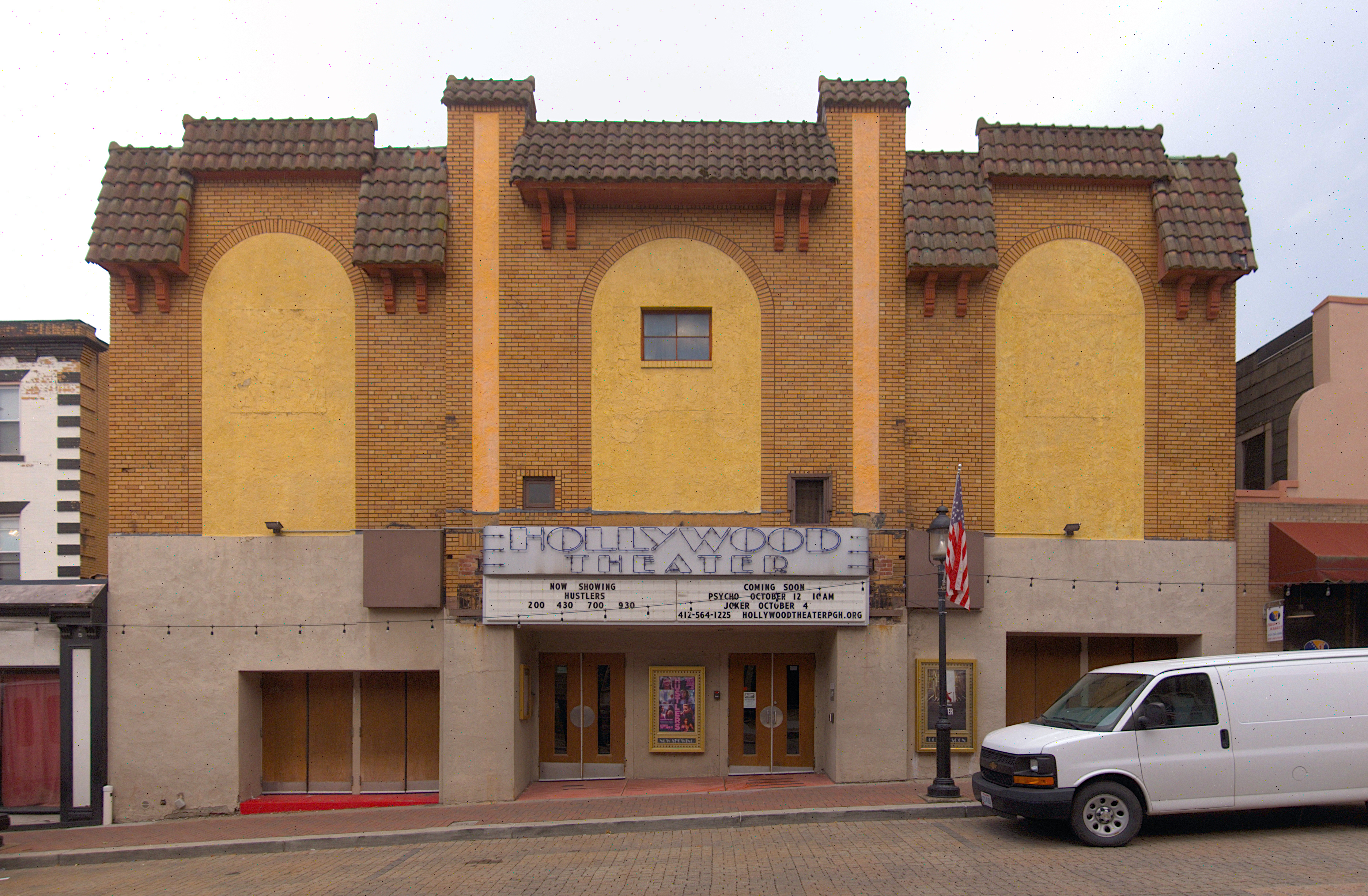
The Hollywood Theater in Dormont is one hundred years old this year, and it is near the end of a thorough refurbishment. It is now owned by the same people who own the successful Row House Theater in Lawrenceville, and it will open after the work with a similar mix of art films, cult films, and revivals. Comparing the picture above with one from 2019 shows how much can be accomplished with paint and some stucco work.
The Hollywood in 2019.
The original 1925 architect was Charles R. Geisler, who was prolific especially in the South Hills (he lived in Beechview within walking distance of this theater). His taste for Mission details is obvious in the roofline, with its very Geislery green-tiled overhangs. In 1948, Victor A. Rigaumont, Pittsburgh’s king of Deco movie houses, supervised a remodeling, and the spare and abstract ground floor is probably his work. This current remodeling uses dark green to link the ground floor with the roof and make the façade look more all of a piece.
There’s something pleasingly simple about this little apartment building just off the Potomac Avenue business district in Dormont. There are almost no decorative details, but the simple pilasters that frame the front give the building enough texture to carry itself with dignity. The stone lintels over the windows on the side of the building are a clue to its history: the front is probably a later addition, replacing open balconies with extra rooms. But the matching white brick makes the change hard to detect without some concentration.
The entrance (we are able to peer into the shadows by combining three different exposures in one picture) surprises us with classical woodwork and ornamental leaded glass—another clue that this building is older than we would have thought from a glance at the front.
Mount Lebanon Baptist Church has been without a congregation since 2013, but it is kept up, and we hope it has or finds a sympathetic owner. In spite of the name, the church is in Dormont, which was in the “Mount Lebanon district” until it became a separate borough.
The church was put up in 1930; the architects were Lawrence Wolfe (the middle term in a dynasty of Wolfes who were in the architecture business for more than a century) in association with Smith & Reif.
This decoration seems to be meant to represent an outdoor pulpit of the sort that was popular in medieval times. It is not functional, or at least not easily used, but it does send the message that the minister could step out here and denounce the whole borough if it became necessary.
For hardware connoisseurs, here are some very elegant door pulls and locks.
Grape vines in Gothic style make up most of the carved decoration.
A tiled overhang and exaggerated brackets to hold it up: these are two markers of the Spanish Mission style that was fantastically popular in the first quarter of the twentieth century. Dormont in particular filled up with apartment and commercial buildings in that style, like this one at Potomac and Glenmore Avenues, which was built in 1923. Here’s a small collection of commercial buildings in the Mission style on Potomac Avenue and West Liberty Avenue, the two main commercial streets of the borough.
It would have been a better composition with the original ground floor, but even so the upper two-thirds are attractive. We attribute this building to William E. Snaman because it is the only apartment building in the vicinity built at the right time to match this listing:
The Construction Record, October 30, 1915. “George E. McKee, Alger street, was awarded the contract for erecting a three-story brick store and apartment building on West Liberty avenue, Dormont, for Mrs. Mary Ivol, 6268 West Liberty avenue, Dormont. Plans by Architect W. E. Snaman, Empire building. Cost $10,000.”
“Transit-Oriented Development” is a favorite catch phrase among urban planners. In the early twentieth century, it was just the way development happened. Most people used streetcars to get to work, to shopping, and to all their amusements, so of course development and transit had to go together. Here we see a typical pattern: a main spine street—in this case, Broadway Avenue in Dormont—divided in two parts, with a broad median for trolleys. Many neighborhood main streets were built this way. Red Line trolleys still run here in Dormont, and Silver Line trolleys on a similar plan in Bethel Park.
Built in 1920 in an angular modern-Gothic style, this church served its original congregation until 2013, the year of the great collapse of Dormont mainline churches, when the Presbyterians, the Methodists, and the Baptists all threw in the towel. The building became a Buddhist temple for a while (the Buddhists gave it the current paint scheme), but it seems not to be active right now. It is, however, kept up well.
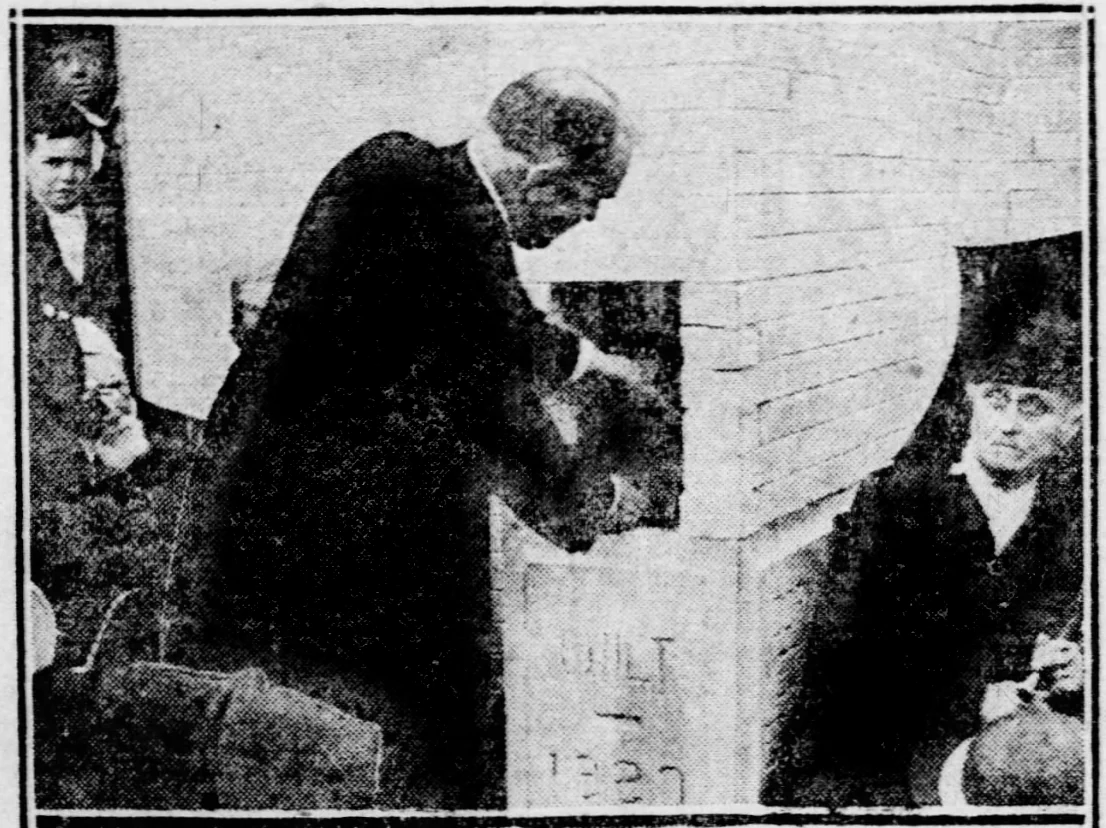
Thanks to the Gazette Times of September 13, 1920, we have a picture of Bishop McConnell of the M. E. Church laying laying “a copy of the Gazette Times containing announcement of the corner stone laying, coins of the present day, a list of trustees and a list of members of the Dormont and Banksville churches, recently combined” in the cornerstone.
This cornerstone is a top contender for the coveted title of Most Awkward Word Break on a Stone Inscription Outside a Country Graveyard.
It seems that another capsule was laid in 2009, four years before the church dissolved.
None of the news stories we found mentioned an architect, but we hope to find a name eventually.
This composite picture is very big if you enlarge it.
Old Pa Pitt’s unending mission is to help the people of Pittsburgh and surroundings see the things they pass right by without seeing. So here is a strip mall. You drive right past it without thinking that there could possibly be anything interesting about it, but this is in fact one of the pioneer strip malls in the Pittsburgh area. It was built in 1940 to a design by Thomas Benner Garman, a Mount Lebanon architect most of whose work was in traditional houses for the upper middle classes. When he designed commercial buildings, though, he adopted a decidedly modern style.
The key to his architectural ambidexterity was his sense of context. “Nature,” he said in 1956, “has a law that fits architecture—namely: Avoid the grotesque and unseemly.”1 What fits a street of suburban homes is not what fits a commercial thoroughfare.
The new Dormont Shops were promoted as a “drive-in one-stop shopping center,” a place where the suburban motorist would have the luxury of parking right out in front of the stores to do all the week’s shopping in one place. From the Pittsburgh Press, April 7, 1940:
The drive-in one-stop shopping center being erected on W. Liberty Ave., Dormont, is nearing completion.
The $250,000 building will be 250 feet long and 75 feet deep. It is set back about 80 feet from the street to provide parking space.
Frank H. Opferman, South Hills contractor, is the owner and builder. J. D. Marshall, real estate broker, is the exclusive rental agent. Thomas B. Garman was the architect.
Site of the building is the historic Fetterman homestead, one of Dormont’s landmarks. The razed house was more than 100 years old.
Old Pa Pitt will do the developers and Mr. Garman the justice to note that the “historic Fetterman homestead” had been butchered long before it was razed for this project. It had spent the last few decades as an apartment building, with various ramshackle additions.
Although the shopping center has been remodeled more than once, we can still get some idea of its original features. The arrangement was typical of the first generation of what we now call “strip malls”: it had two floors, with the main shops on the ground floor and miscellaneous businesses upstairs—along with a bowling alley in the basement.2 (Yes, you could hear the bowling going on in the shops.) The crest right in the middle of the building, which marks the entrance to the second floor, retains some of its Art Deco massing.