Category: Braddock

  • New Hope Baptist Church, Braddock

    New Hope Baptist Church

    Old Pa Pitt will admit that Braddock can be a sad place, but here is something to celebrate. This historic Black congregation is still going after nearly a century and a half, and its neat little building is beautifully kept.

    Cornerstone with date 1906 and the name of the Rev. J. T. Wanzer, D.D.

    The cornerstone of the building was laid late in 1906, when the Rev. Dr. J. T. Wanzer was pastor. The architect of the church was John Lewis Beatty,1 who was one of our most successful designers of Protestant churches. In this case the budget was small, but Mr. Beatty gave the congregation a building to be proud of. Certain economies were necessary: only the front is stone, the rest being ordinary red brick. But that front leaves an impression of solid respectability.

    Perspective view of the church

    The Pittsburg Press used to publish an extensive column of “Afro-American Notes,” and in the edition for December 17, 1905 we find a paragraph about the plans for New Hope’s new building:

    The New Hope Baptist Church of Braddock, Pa., is undoubtedly one of the most progressive churches in Braddock. They are making great preparations to begin their new building in the early spring. The Rev. J. T. Wanzer deserves great credit for the good work he is doing for the upbuilding of religious Christianity among the negro race. He is without doubt a good worker. Services every Sunday morning at 11 a. m. and evening at 7:30 p. m. All are welcome.

    Entrance to the church

    It was not always easy being Black in Braddock. While the plans for the church were in preparation, two of its most prominent members had a run-in with a gang of “hoodlums,” as we read in the Press:

    Much bad feeling is being engendered by a gang of hoodlums, who infest the corner of Fourth street and Hawkins avenue, North Braddock, and attack negroes. Last night Reuben Poles and James Price, the former a trustee of the New Hope Baptist Church, colored, of Braddock, and the latter superintendent of the Sunday School, while on their way home from a church meeting, were called vile names, followed for several squares by five fellows, all over 20 years of age, and finally attacked. Poles was beaten into insensibility with a beer bottle.2

    As we see from the language of the Press report, which describes the assailants as an infestation, most respectable citizens were disgusted and appalled by such “hoodlums.” But they were a fact that Black residents of the borough had to deal with. Undaunted, the members of New Hope finished their church—and they are still here, 120 years later, worshiping in the same building.

    New Hope Baptist Church

    The addition to the left is well matched to the main church; it was probably built in the 1920s or 1930s.

    Front elevation of the church
    Canon PowerShot SX20 IS.
    1. “Will Build Churches,” Press, October 30, 1906, p. 7: “J. A. House, of West Homestead, has the contract for building the New Hope Baptist Church at that place, to cost $14,000. It was designed by Architect J. L. Beatty.” Though the article says the church is in West Homestead, that is an error. The Post for the same day mentions the contract, but leaves out the architect, and places the church correctly in Braddock. Notes of the Builders, Post, October 30, 1906, p. 13: “A two-story brick and stone church for the New Hope Baptist Church of Braddock, to cost $14,000, will be built by Contractor J. A. House, of West Homestead.” ↩︎
    2. “Hoodlums Beat Braddock Negro,” Pittsburg Press, April 11, 1906, p. 3. ↩︎

    Comments
  • First National Bank, Braddock

    First National Bank of Braddock

    William Lee Stoddart was the architect of this bank, whose colossal arch is its distinguishing feature. Stoddart was mainly known for hotels, but he could also turn out a bank, or a large office building like the Nissen Building in Winston-Salem, which old Pa Pitt has also photographed.

    Inscription: “First National Bank”

    The bank has been abandoned for years; like many things in Braddock, it stands empty because no one has the will to restore it or the money to take it down.

    Entrance
    First National Bank
    Fujifilm FinePix HS20EXR.

    Comments
  • Ohringer Building, Braddock

    Ohringer building

    Pittsburgh’s own Harry H. Lefkowitz was the architect of this futuristic tower of furniture, which was built in 1941. The building is one of the chief landmarks of the moderne style in the Pittsburgh area, and by sheer luck it has not been too much damaged over its eighty-five years of existence. It is an astonishing thing to come across while walking or driving through the almost deserted business district of Braddock. Now, at last, it is appreciated: it has been restored, complete with its spectacular sign, as artist residences, and as much of the original modernistic appeal as possible has been kept intact.

    Ohringer Home Furniture sign
    Ohringer building
    Ohringer building
    Ohringer Building
    Sony Alpha 3000 with 7Artisans f/1.4 35mm lens; Canon PowerShot SX20 IS.

    Old Pa Pitt has been wandering in Braddock, and we’ll see many pictures in the next few weeks. Some of what we’ll see is sad, so we begin with good news to show that there are people who love Braddock and have hope for its future.


    Comments
  • Good Shepherd Church, Braddock

    Good Shepherd Church

    Another of the seven closing churches in the inner eastern suburbs. The dominant feature of this one, built as St. Michael’s in 1929–1930, is the huge octagonal lantern.

    Addendum: The architect was Carlton Strong, according to Van Trump & Ziegler’s Landmark Architecture of Allegheny County (1967), p. 163.

    Good Shepherd Church
    Good Shepherd Church
    Good Shepherd Church
    Belfry
    Side entrance
    Windows
    The same windows from the inside
    Window
    Window
    Window
    Entrance
    Interior

    The interior of the church is much more auditorium-like than most Catholic churches of its era, probably because a square lot forced it to make that adaptation.

    Interior looking toward altar
    Chancel
    Chancel
    Chancel
    Interior
    Interior
    Choir loft
    Baptistery
    Stained-glass windows
    Stained-glass windows
    Sony Alpha 3000; Canon PowerShot SX20 IS.

    Comments
  • Braddock National Bank

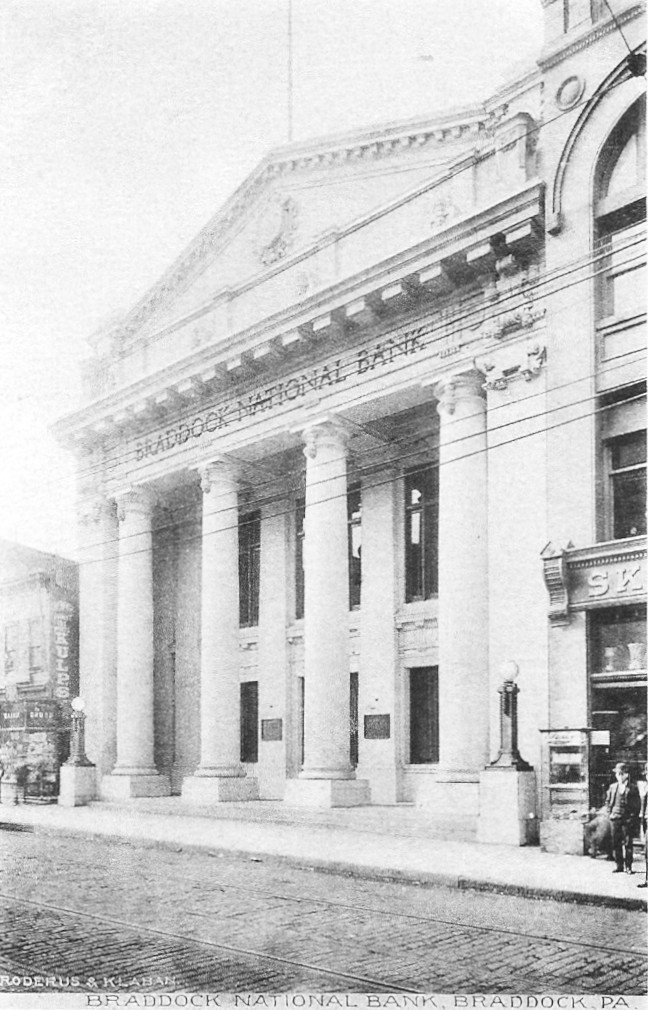
    Braddock National Bank, from an old postcard
    From an old postcard

    This splendid edifice cost about $100,000 when it was built in about 1905. The architects were McCollum & Dowler,1 and that Dowler is the young Press C. Dowler, who would practice architecture for two-thirds of a century and run through every style of his long lifetime, from Romanesque through Art Deco to uncompromising modernism. The building still stands today on Braddock Avenue, and the front still looks about the same.

    1. Source: The American Architect and Building News, July 23, 1904: “Braddock, Pa.—McCollom [sic] & Dowler, Pittsburg, have completed plans for a $100,000 granite and brick bank building for the Braddock National Bank.” ↩︎