A typical backstreet Bloomfield row of frame houses, showing almost every treatment working-class Pittsburghers can think of to apply to the exterior of an old house.
Comments

A typical backstreet Bloomfield row of frame houses, showing almost every treatment working-class Pittsburghers can think of to apply to the exterior of an old house.

Carson Street on the South Side is reputed to be one of the best-preserved Victorian streetscapes in America. Liberty Avenue in Bloomfield may not come quite up to that standard, but it is probably second in Pittsburgh. The commercial district was built up in the 1880s and 1890s. Like Carson Street, it preserves many Victorian commercial buildings, along with a peppering of later styles. These pictures are all of the northeast side, because the sun was behind the southwest side.

A good example of the most basic form of Pittsburgh Rundbogenstil, the German hybrid of classical and Romanesque architecture that old Pa Pitt mentions every chance he gets because he likes to say “Rundbogenstil.” In the 1800s, before it became the most Italian of our Italian neighborhoods, Bloomfield was mostly German.

A Second Empire building from the 1880s.

This building dates from the 1890s. It probably had a date and inscription in that crest at the top of the façade, but later owners obliterated the evidence.

We saw this 1924 building before at dusk; here it is in bright sunlight. The bright light gives us a chance to appreciate the decorative details with a long lens.


This fine new building opened in 1926, and the bank got to enjoy it for five years before it was liquidated in the dark days of the Depression. After that, it sat vacant for a while. Just after Prohibition ended, the Liquor Control Board picked it for a liquor store, but bids for the conversion came in too high, and the board went looking for another location. Later, at some point, it became a bank again. Now the bank has moved out, and it’s ready for its next life.
As you can see from the picture above, the streets do not intersect at a right angle at this corner, so the building is a trapezoid. The upper floors were built as apartments to gain some extra income to pay for the building.


Three different buildings, three different styles: polyphony makes harmony in the streetscape.

Old Pa Pitt does not know what was here before the Pleasure Bar, but whatever it was had only a seventeen-year life—the building was put up in 1924, and the Pleasure Bar has been here since 1941. It’s an elaborate building for its size, with a curious mixture of classical and Art Nouveau detailing, and the inset balconies are unusual.


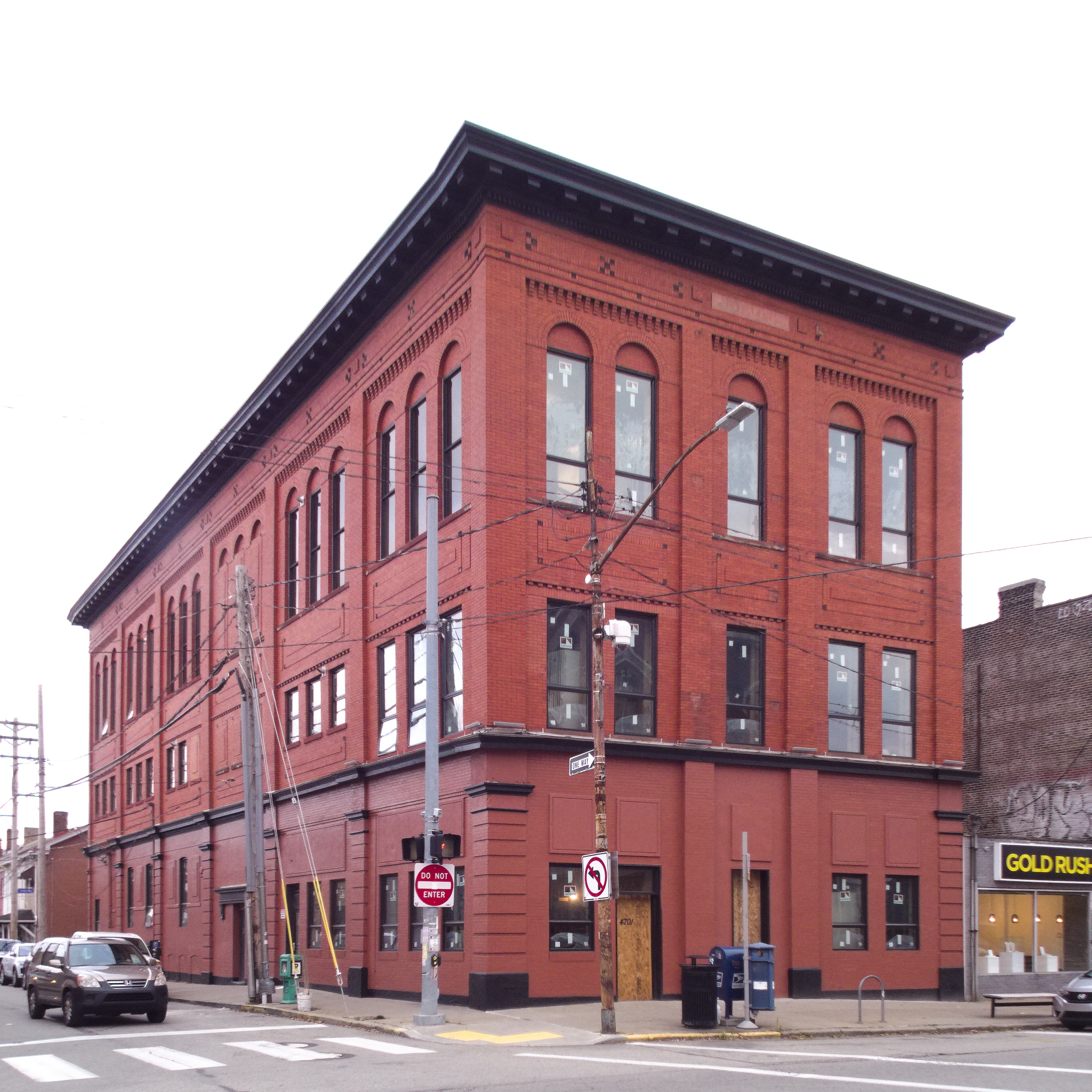
This building was put up between 1903 and 1910, and that is all old Pa Pitt knows about it. The extra-tall third floor looks like a lodge meeting hall, but it does not appear on maps as a lodge. The ground floor was a bank for many years. The building is going through a thorough renovation now, including new windows all around, fortunately the right size for the window openings.
Pearl Street is not quite perpendicular to Liberty Avenue, so this building has the common Pittsburgh problem of an obtuse angle to solve. You might not notice the solution unless you look closely.


For about a century and a third, this church was one of the main centers of life in Bloomfield. Now that all the Catholic churches in Bloomfield are closed, incredible as it may seem in our most Italian neighborhood, an Italian Catholic who lives in Bloomfield cannot walk to Mass without making a serious expedition of it.

The church was built in 1886; the Pittsburgh History & Landmarks foundation attributes it to Adolf or Adolphus Druiding, who also designed Ss. Peter and Paul in Larimer/East Liberty. However, an expert in the works of E. G. W. Dietrich (see the comment below) was kind enough to correct that attribution. The church was designed by the partnership of Bartberger & Dietrich, as we learn both from an article at the laying of the cornerstone and an illustration of the church in the Builder and Wood-Worker for June, 1889, where it is attributed to Bartberger alone. Charles M. Bartberger and E. G. W. Dietrich were partners for about three years, from 1883 to 1886, before Dietrich moved to New York, which he seems to have done while this church was under construction. Father Pitt has updated his attribution based on this evidence, with many thanks to our correspondent.


The rectory next to the church has been damaged by the installation of windows in the wrong size and style, but otherwise is in good shape.


These little stores with living quarters above were built in the 1880s, but the buildings are not much different from thousands that went up throughout the nineteenth century, and indeed they have their stylistic roots in the eighteenth century. They all preserve their properly inset shop entrances, so that doors do not hit passing pedestrians in the face.

These frame houses were built in the 1880s and 1890s. They are detached houses—detached by just enough room for an average person to walk between them. As a group, they form a good document of the things ambitious salesmen could sell to middle-class homeowners in the twentieth century. Not a single one retains its original details: they have all had their siding replaced, and most have smaller windows than the originals. And, of course, several have sprouted aluminum awnings.