Tag: Wilkins Avenue

  • G. P. Rhodes House, Squirrel Hill

    G. P. Rhodes house

    G. P. Rhodes, who appears to have been a banker from the references we find to him in old newspapers, was the owner of this Tudor mansion on Wilkins Avenue. The roof has been replaced with asphalt shingles meant to look like tiles, but otherwise the details are very well preserved.

    Woodwork over the entrance
    Upstairs windows
    Stable

    This garage was probably built as a stable, where Mr. Rhodes’ horses lived better than may of their human neighbors.

    G. P. Rhodes house
    Canon PowerShot SX20 IS.

    Comments
  • W. A. Steinmeyer House, Squirrel Hill

    5320 Wilkins Avenue
    Canon PowerShot SX20 IS.

    Ingham & Boyd were the architects of this very respectable French cottage overlooking Wilkins Avenue from a little service road.1 It was built for W. A. Steinmeyer, vice-president of the Allemannia Fire Insurance Company of Pittsburgh. The placement of the entrance at the left instead of in the center is uncharacteristic of the architects, and we can only assume that some desirable interior arrangement made it worth departing from their usual rule of exact symmetry.

    1. Source: The American Contractor, July 12, 1924. “Res.: $25.000. 2½ sty. & bas. Irreg. Approx. 43×68. Brk. on h. t. 5324 Wilkins av. Archt. Ingram [sic] & Boyd, Empire bldg. Owner Wm. A. Steinmeyer, vice-pres., The Allemannia Fire Insurance Co., 7 Wood st. Gen. contr. let to Hugh Boyce, 1719 Meadville st.” There is no house at 5324, but the lot at 5320 is shown as belonging to W. A. Steinmetz [sic] in 1923. Polk’s City Directory for 1926 shows W. A. Steinmeyer living at 5324 Wilkins Avenue; by 1939 the address of this house is 5320 on the Hopkins plat map. The next address after 5320 on Wilkins Avenue is 5392. ↩︎

    Comments
  • Rafferty Rows, Squirrel Hill

    Rowhouses on Wilkins Avenue

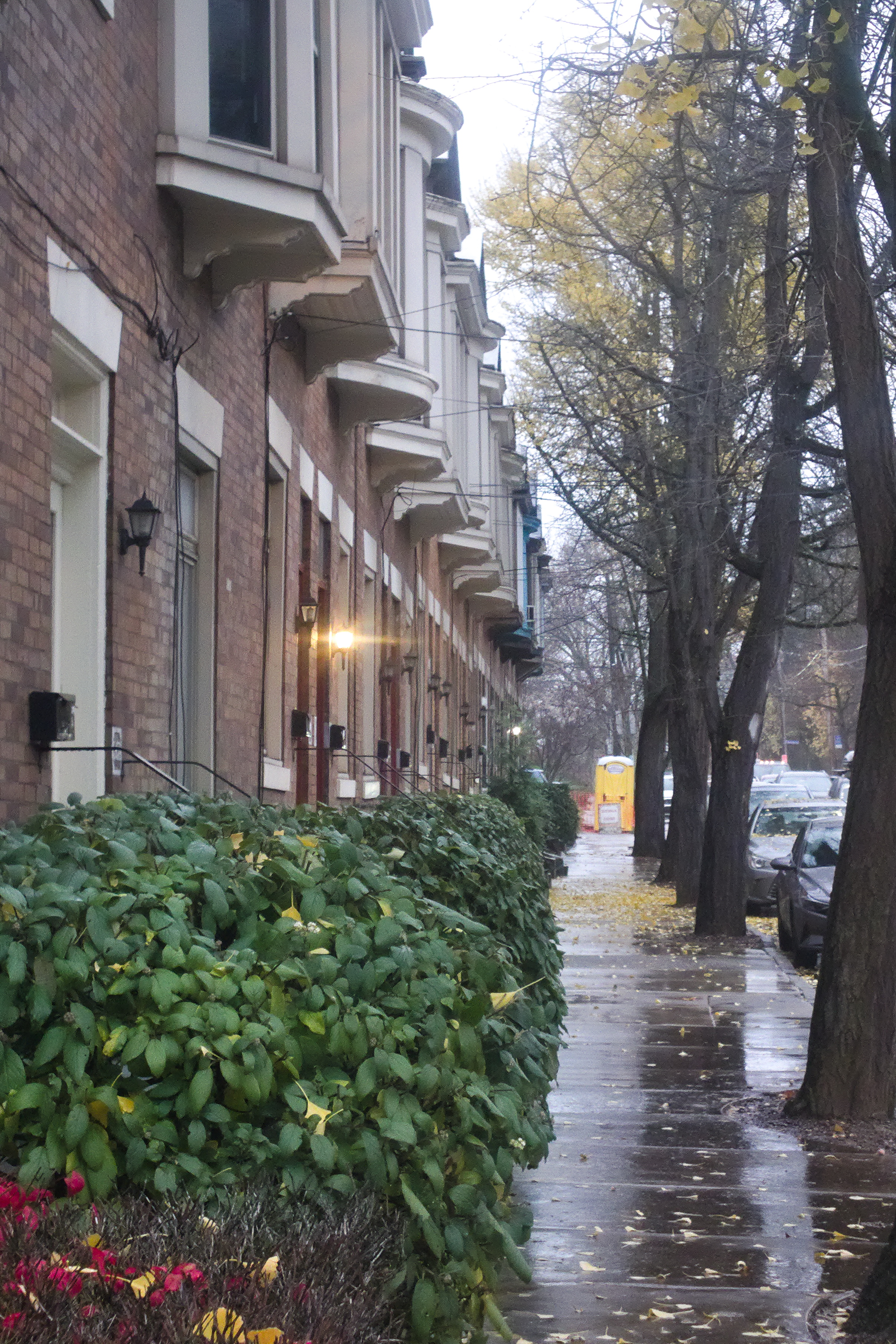
    These two long rows of houses where Beeler Street meets Wilkins Avenue make a striking impression now, but they must have been more striking when they were built in the early 1900s. For several years they sat out in the farmlands of Squirrel Hill, forming a strange urban island (along with two rows of three houses across Beeler Street) in the midst of the otherwise rural East End. We caught them on a dim and rainy evening.

    1910 fire-insurance map.
    Rowhouses on Beeler at Wilkins

    Note how the rhythm of the houses is made more interestingly varied by alternating the peaked and rounded fronts but running the oriels in a series of three.

    Row of houses on Beeler Street
    Fujifilm FinePix HS10.