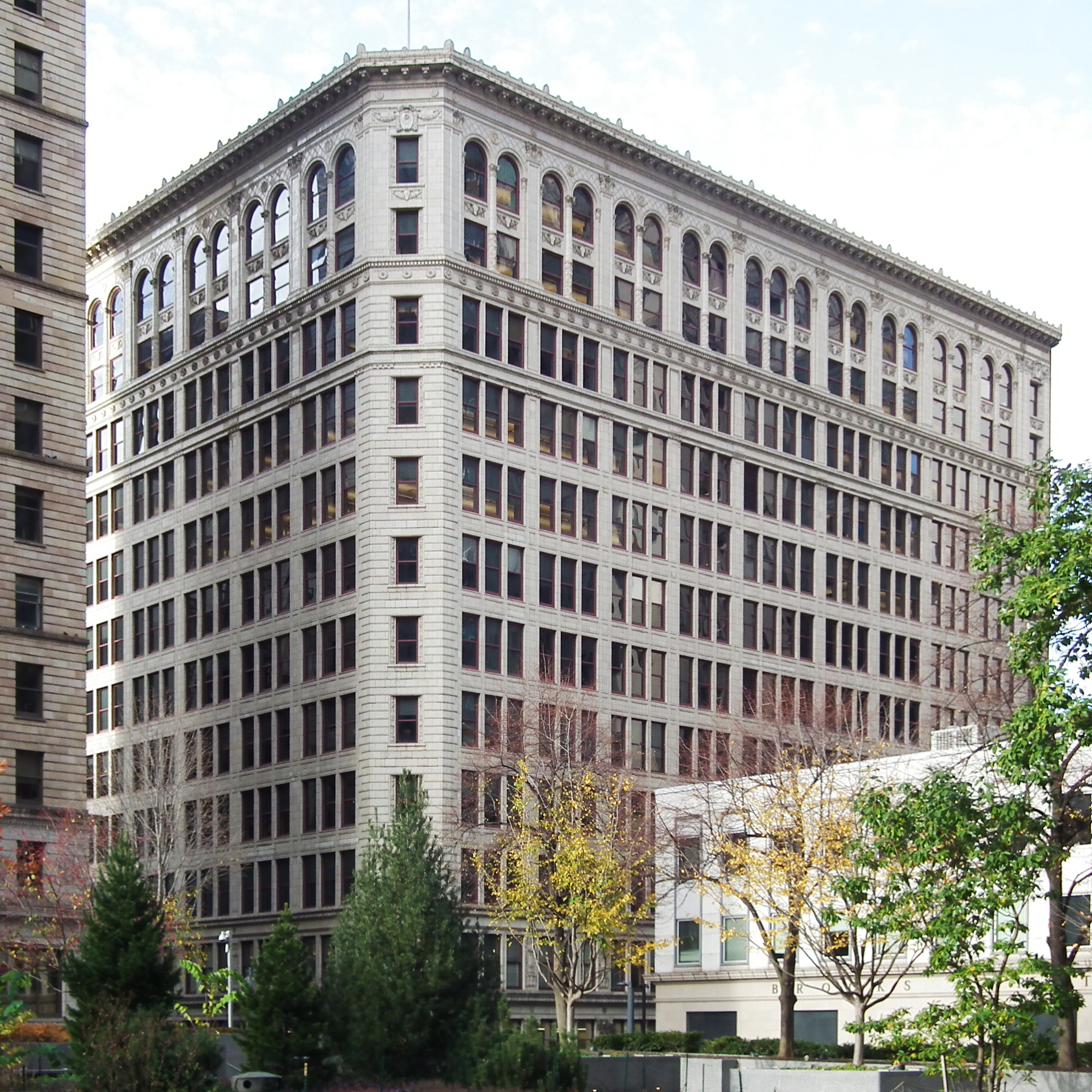
“The Kaufmann & Baer department store is an enormous shiny white terra cotta building, filled with windows and probably good for its purpose.” So the architect Aymar Embury II (did ever an architect have such an architecty name?) dismissed this building in his article about Pittsburgh architecture in 1915,1 when the building was new. It was put up for Kaufmann & Baer—the Kaufmanns being members of the same family as Morris Kaufmann, who ran that other department store with a similar name on Smithfield Street. Most older Pittsburghers remember it affectionately as the Gimbels Building, because Gimbels bought Kaufmann & Baer in 1925 and this building was Gimbels for most of its life as a department store. Starrett & Van Vleck, New York specialists in department stores, were the architects.
Pittsburghers know it as the Gimbels Building, because for most of the twentieth century it was the home of the Gimbels department store in Pittsburgh. But it was built for the Kaufmann & Baer Company, which Gimbels bought out a few years later.
In November of 1913, this colossal department store was still going up. But in the front of the directory that went to every telephone subscriber in Pittsburgh was this beautifully executed rendering, part of a full-page ad to build up enthusiasm for the store’s opening in the spring of 1914. The architects were Starrett & Van Vleck, specialists in department stores; the drawing is signed with a name that Father Pitt could not read, but he is fairly certain it was neither Starrett nor Van Vleck. Probably it was a draftsman in their office, and in old Pa Pitt’s opinion they could not have paid that employee enough. It’s a first-rate piece of work.
“The vast new building of the Kaufmann & Baer Company,” said the advertisement, “having a floor area of about 800,000 square feet (nearly 20 acres), will be opened for business in the Spring 1914. It will be not only the BIGGEST, but also the BEST and MOST MODERN shopping center in the city of Pittsburgh. Its stocks will be the largest and most varied; its prices, the lowest. It will be the store for ALL THE PEOPLE.”
It would not be possible to get a photograph from the same angle, either in 1913 or today, without picking up the Oliver Building and setting it aside somewhere. The closest old Pa Pitt could come to replicating the angle of the drawing with a photograph from his collection was this:
The Kaufmanns in the name, by the way, were a different branch of the same Kaufmann family that owned that other department store a block away.
This was built in 1914 as the Kaufmann & Baer Department Store, the Kaufmanns in the name being brothers of the Morris Kaufmann who owned the Big Store two blocks away. It was bought out by the Gimbel Brothers eleven years later, and for generations of Pittsburghers this was the Gimbels Building. Its name is now officially Heinz 57 Center, but most people still call it the Gimbels Building. The architects, Starrett & van Vleck, were specialists in department stores from New York.
Acres of terra cotta went into decorating the Smithfield Street and Sixth Avenue faces of this building.
And of course there was the clock. It was not as famous or elaborate as the Kaufmann’s clock, but it was another good place to meet someone downtown. This is obviously a good bit more recent than the building itself: it has a streamlined Art Deco look.
This was actually built as the Kaufmann and Baer department store in 1914—the Kaufmann of the name being another branch of the family that owned the even bigger Kaufmann’s department store two blocks away. In 1925 it was taken over by Gimbels, and it remained Gimbels until the chain evaporated in 1986, so every old-timer in Pittsburgh remembers it as the Gimbels Building. The lower floors are occupied by retail stores now; the upper floors are offices.
The architects of the building were the New York firm of Starrett & van Vleck, who were responsible for many of the flagship department stores in big Eastern cities.