This was the last of the five (out of seven) churches old Pa Pitt managed to visit during the open house for St. Joseph the Worker Parish, seven of whose eight churches are closing this month. Because he got there just as the open house was winding up, Father Pitt didn’t get as many pictures as of the other churches, but the ones he did get give a good impression of what the church is like. They also show that it needs some maintenance work, which would probably be expensive.
Addendum: The architect was Pittsburgh-born, Philadelphia-based Harold Wagoner, with Angel Chorne as associate.
It’s always sad to see a church close. However, there is very good news for St. Colman’s School, a 1920s masterpiece by Link, Weber & Bowers. It is undergoing a thorough and expensive restoration for a second life. We took a few pictures of the school on the same visit.
Another of the seven closing churches in the inner eastern suburbs. The dominant feature of this one, built as St. Michael’s in 1929–1930, is the huge octagonal lantern.
The interior of the church is much more auditorium-like than most Catholic churches of its era, probably because a square lot forced it to make that adaptation.
Another one of the seven closing churches in the near eastern suburbs. The exterior has the kind of “noble simplicity” American bishops love to praise, while at the same time maintaining a traditional look.
The best description old Pa Pitt can come up with for the interior is “straightforward.” It is not spectacular, but it works for Christian liturgy, with everything in the right place and room for devotional art of the right sorts.
A dramatic Last Supper painting behind the altar shows all the disciples in characteristic poses, including tortured Judas clutching his bag of money and stewing over what he’s about to do. (Click or tap on the picture to enlarge it.)
The stained glass is also straightforward. To Father Pitt’s nose it has a strong scent of illustrated Sunday-school supplement about it, but it tells the Bible stories in a way that we can immediately recognize. Above, John the Baptist and the Annunciation.
Joseph and the child Jesus (who has made himself a model cross); Jesus praying in the wilderness.
The Transfiguration; the Twelve adoring Mary.
Adam and Eve cast out of the Garden of Eden; the angel staying the hand of Abraham as he is about to sacrifice Isaac.
Manna from heaven; Moses, seeing the golden calf, about the smash the tablets of the Law.
Addendum: The church, built beginning in 1955 as St. Aloysius, was designed by William York Cocken and Edward J. Hergenroeder. The basement, however, was built in 1914 and temporarily roofed over, but multiple delays (including two big wars and a Depression) kept the congregation in that temporary basement church for more than forty years.1
Some of the most important windows in St. Anselm Church, Swissvale, which is scheduled to close this month. These pictures are large enough to show considerable detail; click or tap on the picture to enlarge it. Father Pitt took the time to document the windows in detail because Catholics usually remove the stained glass when they abandon a church.
This beautiful building shows some obvious influence from Henry Hornbostel’s famous Rodef Shalom, but it is original enough to be called a tribute rather than an imitation. The architects were Charles J. and Chris Rieger, and it is a backhanded compliment to these underappreciated brothers that some of their best works have been misattributed to more famous architects. This building in particular is usually attributed to Alexander Sharove, but we are quite sure that the Riegers designed it.1 The cornerstone was laid in 1928, and the building was dedicated in September of 1929.
The entrance, which is where the Hornbostel influence is most obvious, is a feast of polychrome terra cotta and stained glass.
We have seen pictures of the outside of this church before—here, for example, is a picture from May of 2021:
The other day the current inhabitants, the Union Project, were kind enough to turn old Pa Pitt loose in the sanctuary to take as many pictures as he wanted.
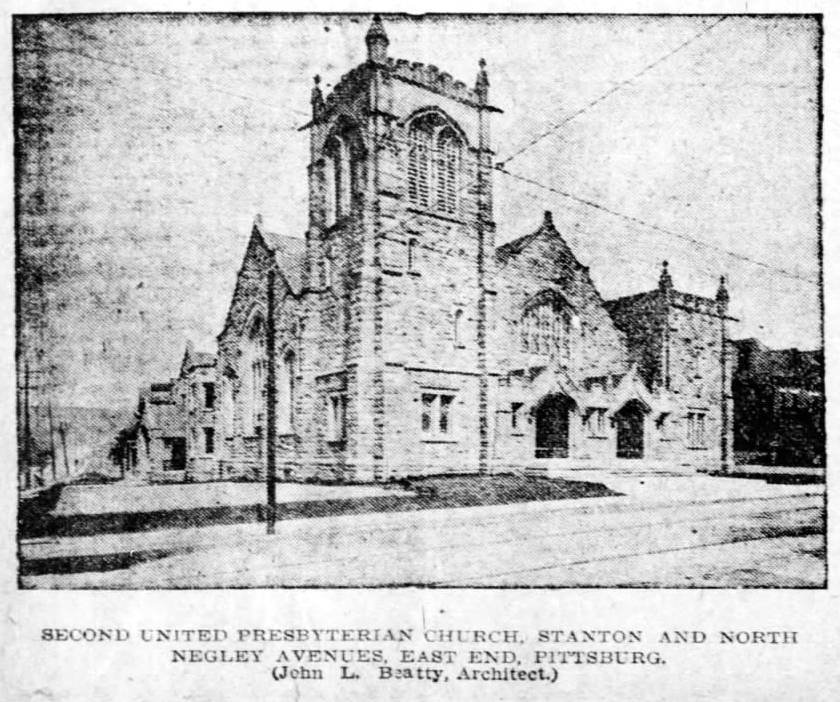
The architect was John L. Beatty, who designed the building in about 1900. A newspaper picture from 1905 (taken from microfilm, so the quality is poor) shows the exterior looking more or less the way it does now.
Pittsburg Press, April 29, 1905.
After a disastrous fire, much was rebuilt in 1915, again under Beatty’s supervision.1 Another fire in 1933 would necessitate rebuilding part of the tower.
The church was built for the Second United Presbyterian congregation, which had moved out to the eastern suburbs from its former location downtown at Sixth Avenue and Cherry Way (now William Penn Place)—exactly one block from the First United Presbyterian Church, which moved to Oakland at about the same time. Later it became the East End Baptist Church, and then was renamed the Union Baptist Church. When that congregation folded, the church was bought by a Mennonite group that founded the Union Project. It is now a community center for pottery, because “everyone should have access to clay.” The sanctuary—which has been preserved mostly unaltered, except for the removal of pews and other furnishings—is available for large events.
The sanctuary is roughly square, which is typical of many non-liturgical Protestant churches in Pittsburgh at the turn of the twentieth century. Above, looking up at the center of the ceiling.
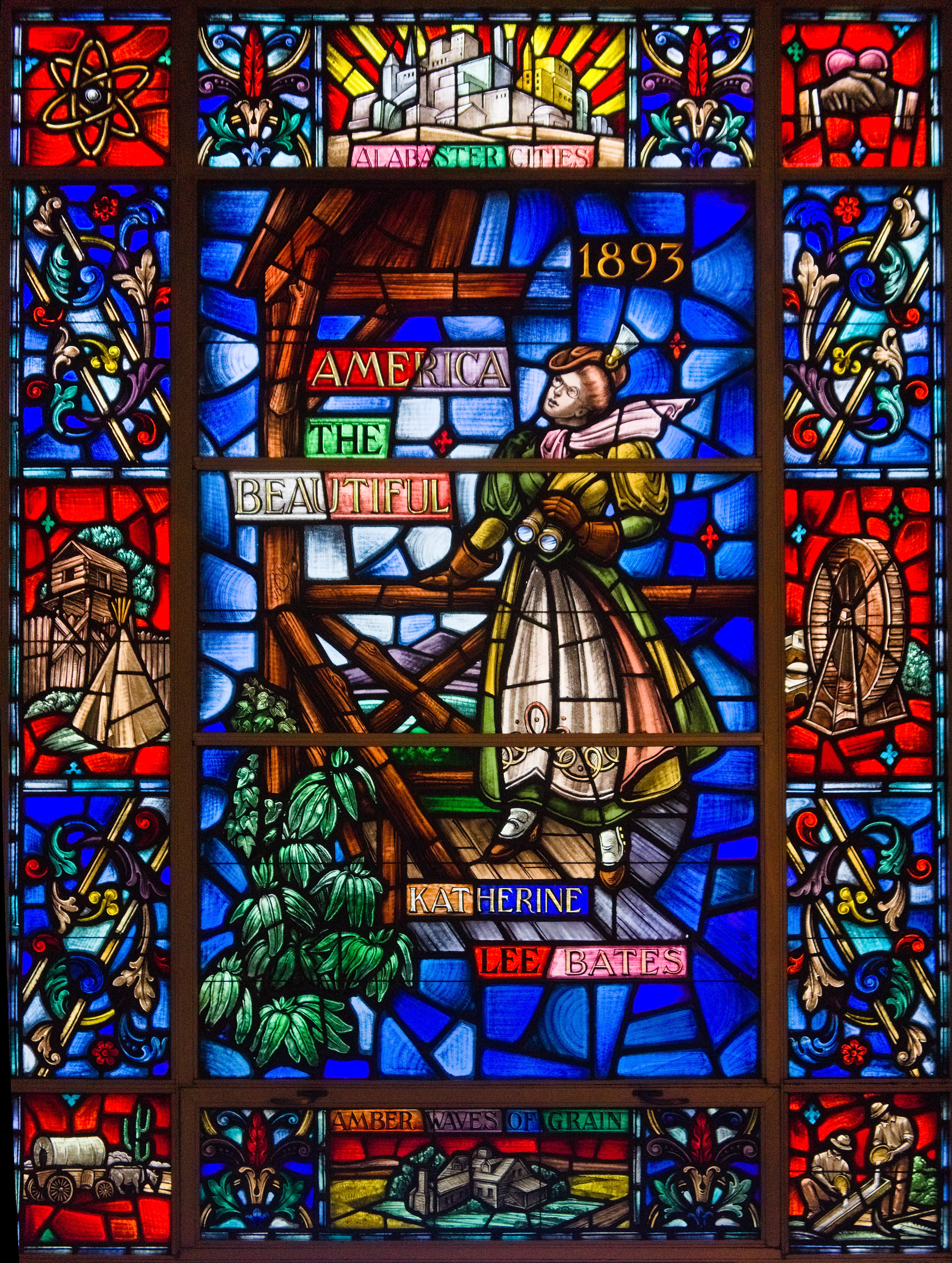
The stained glass was restored as part of a remarkable community effort in which people in the neighborhood learned the art of stained-glass restoration themselves. It would have cost more than a million dollars to have the work done professionally, but volunteers learned priceless skills, and the glass is beautiful.
The vestibule includes some of the original furniture from the church, and some smaller stained-glass windows.
Source: The Construction Record, January 16, 1915: “The Second United Presbyterian Congregation has selected Architect J. L. Beatty, 146 Sixth street, to prepare plans for repairing the church on Stanton and Negley avenues.” ↩︎
This building at the corner of Forbes Avenue and Craig Street was designed by S. A. Hall in 1904.1 It still holds down its corner very well, and most of the original details are preserved—including the art-glass transoms.
Source: Pittsburg Press, April 26, 1904. “Architect S. A. Hall has awarded to the Iron City Construction Co. the contract for the erection of a two-story brick and stone store and apartment building on the corner of Craig and Forbes streets for George A. Charles. The structure will cost $25,000.” The building ended up with three floors instead of two, but Mr. Charles is shown as owner of the property on plat maps. Thanks to David Schwing for the information. ↩︎
These splendid marquees with their Art Nouveau lettering in glass welcome us to the Princess Ann, an apartment building in the Colonial Heights plan in Mount Lebanon. Many of the external details of the building are beautifully preserved and maintained, including the art glass on the marquees and in the stairwells.
The Allegheny Cemetery Mausoleum is now advertised as the Temple of Memories, because our taste has gone in that direction. It’s a very large communal mausoleum, built in 1960, and walking through the doors feels like going through a time portal into the end of the Eisenhower era. By far the most striking feature of the mausoleum is the series of stained-glass windows by Willet in Philadelphia and Hunt in Pittsburgh. They are some of the best modern stained glass in Pittsburgh, and they commemorate great triumphs of religious literature and music. We have a lot of large pictures here, so we’ll put them behind a “read more” link to avoid weighing down the front page.
The current building is only a century old, but the congregation of Montours Church—also spelled Montour’s or Montour, depending on where you look—was founded in 1778, and the adjoining cemetery is full of Revolutionary War veterans.
A modern chapel built in 1978 is as tall as it is long, with a striking window at the far end.
A bell cast in Cincinnati in 1888 sits beside the church; it probably came from the older building that the 1924 church replaced.