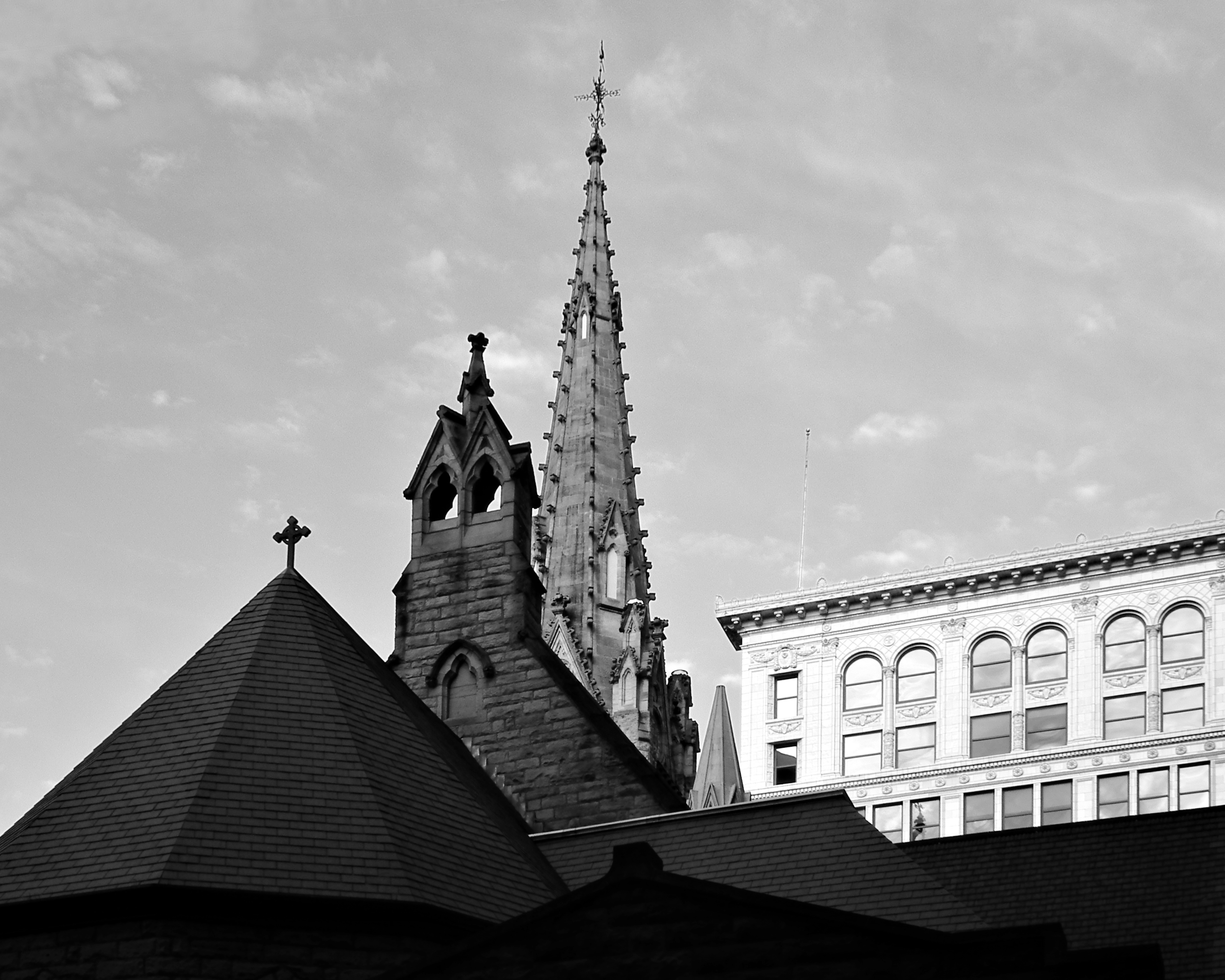
Now the Smithfield United Church of Christ, and it has had several other names. This lacy spire has an honored place in history as the first structural use of aluminum. (The aluminum point on the Washington Monument was just a lump of aluminum set on top, not a structure.) The architect Henry Hornbostel’s other experiment in this building, the use of decorative concrete panels on the exterior walls, has not held up as well; for years the rest of the building has been shrouded in netting to prevent bits of concrete from raining on pedestrians. Below is a picture Father Pitt took of the tower in 2000, before the shrouds went up.
Gustavus Adolphus was a Swedish congregation that began in Lawrenceville, but in 1908 it bought this lot at Evaline Street and Friendship Avenue. O. M. Topp, the favorite architect among Lutherans, was commissioned to design this imposing Gothic building.1
The cornerstone was laid in a howling storm on July 13, 1908,2 and the church was completed in seven months—except for the main auditorium. It seems the congregation ran short of money and worshiped in the basement social room for several years. The main church was finally finished in 1916.
The church is now called Evaline Lutheran, but it is still Lutheran, and its spires still point heavenward—an unusual survival: probably a majority of churches of the era have lost their spires and must be content with bareheaded towers. It also has not been cleaned of its historic soot, making it one of our increasingly rare black stone churches.
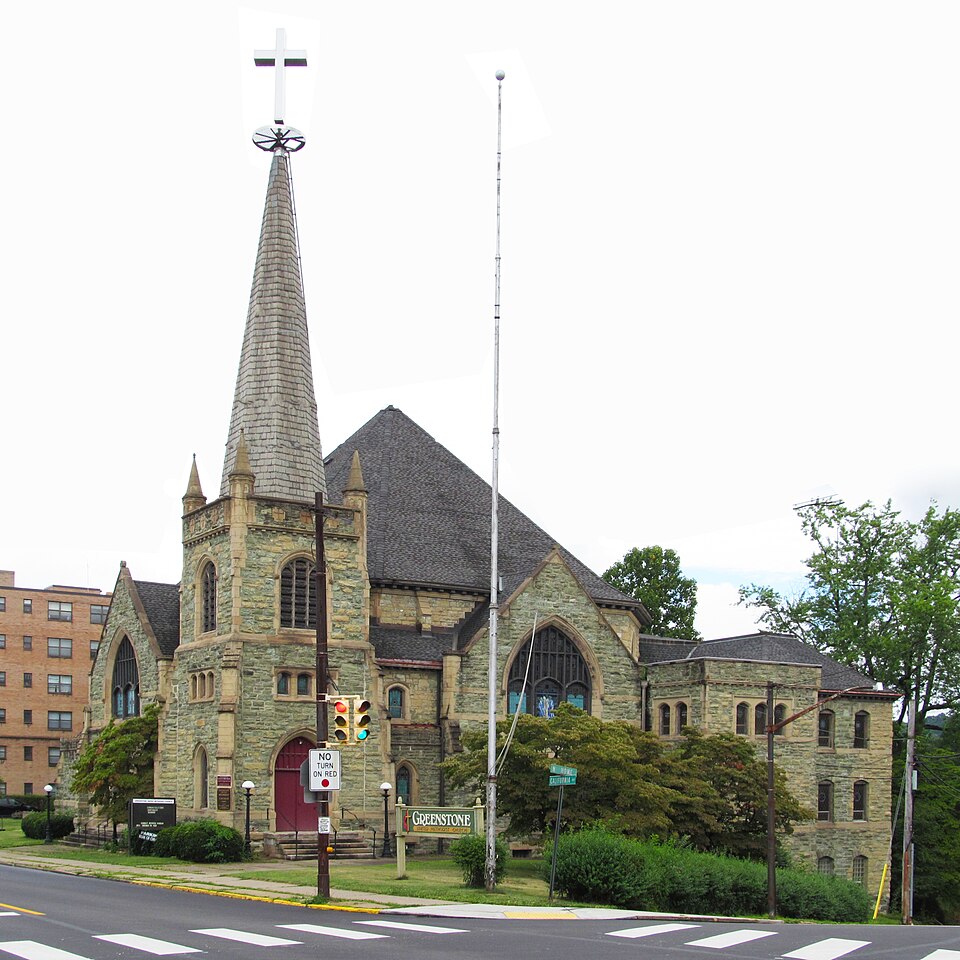
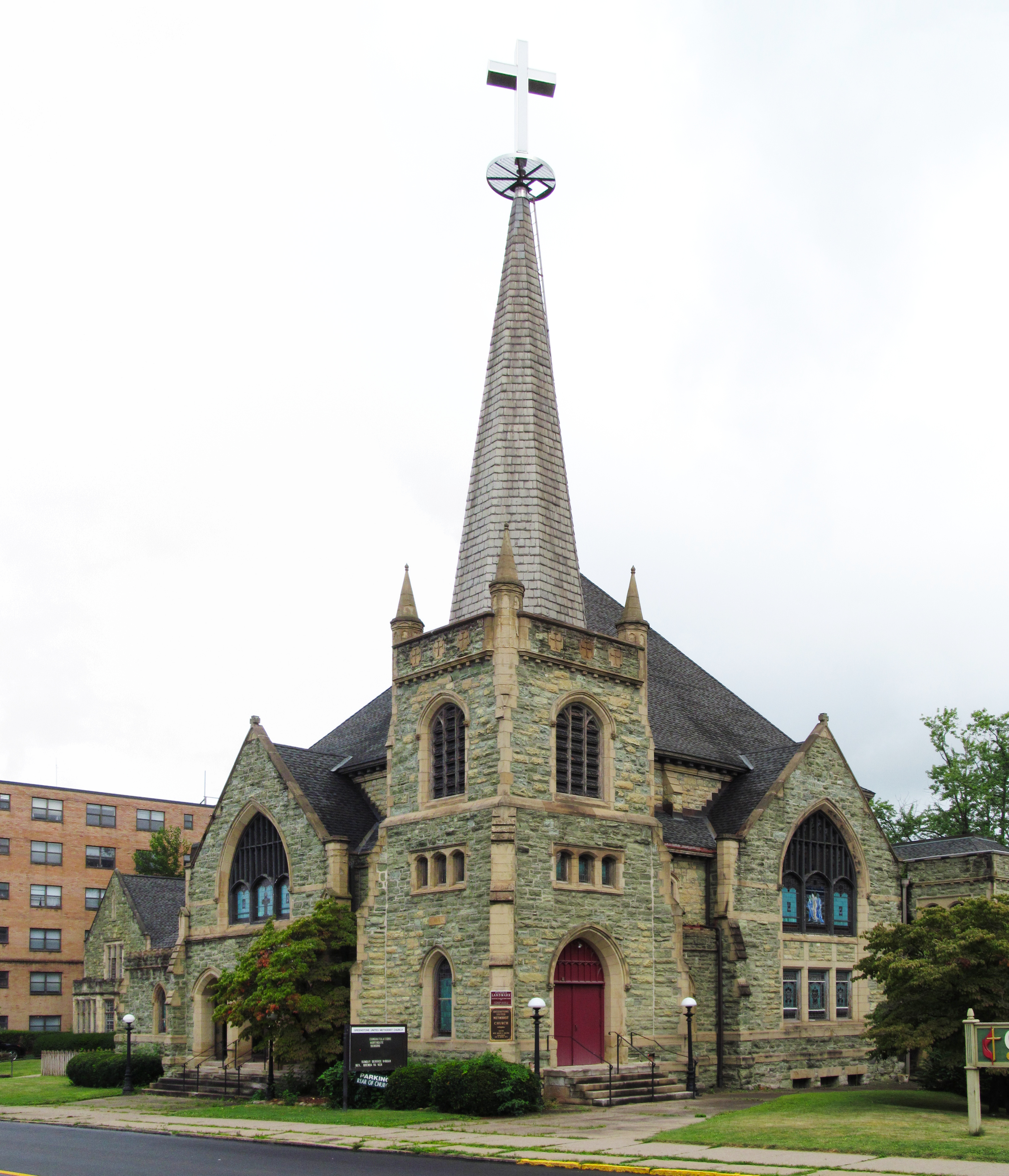
This church was built in 1906; the Pittsburgh History and Landmarks Foundation was unable to identify the architect, and so far Father Pitt has had no better luck. (Update: The architects are now identified as Vrydaugh & Wolfe; see the end of this article.) It used to be called the Bellevue Methodist Church—Methodist Episcopal, as opposed to Methodist Protestant, since there was one of those, too. This one is in Avalon, which used to be called West Bellevue, and its striking green stone gave it the name by which everybody called it. In 1982, the congregation bowed to the popular will and renamed the church Greenstone.
This is one of the relatively few churches of this type that have kept their spires.
The picture above is one of those rare pictures where old Pa Pitt decided to remove all the fat ugly utility cables, because they were just too distracting.
The composite picture above shows some of the matching Sunday-school wing. The stitching worked perfectly for the building, but it made a noticeable break in the car parked on the street, which you can see if you enlarge the picture. Father Pitt left a note on the windshield.
Addendum: Perhaps unsurprisingly, given the style—and especially that low tower with four corner pinnacles—this church was designed by Vrydaugh & Wolfe.1 This means that Vrydaugh & Wolfe had two of the four corners of this intersection covered: diagonally across from this church is their Church of the Epiphany.
Source: The American Architect and Building News, July 23, 1904: “Architects Vrydaugh & Wolfe will be ready for bids in a few days on the Methodist Episcopal Church, of Bellevue. The building will be erected at Lincoln and Home Aves., at an approximate cost of $60,000.” ↩︎
Old Pa Pitt happened to notice that there were very few pictures in Wikimedia Commons of Chatham University, one of the most beautiful college campuses in Pittsburgh or anywhere. That omission had to be rectified. There are now thirty-two more good pictures in the Chatham University category, and we’ll be seeing many of them in the coming days. This is the chapel, a fine Colonial-revival building from 1940.
On city planning maps, Chatham is in Squirrel Hill. The University calls this the Shadyside campus. We put it in both categories.