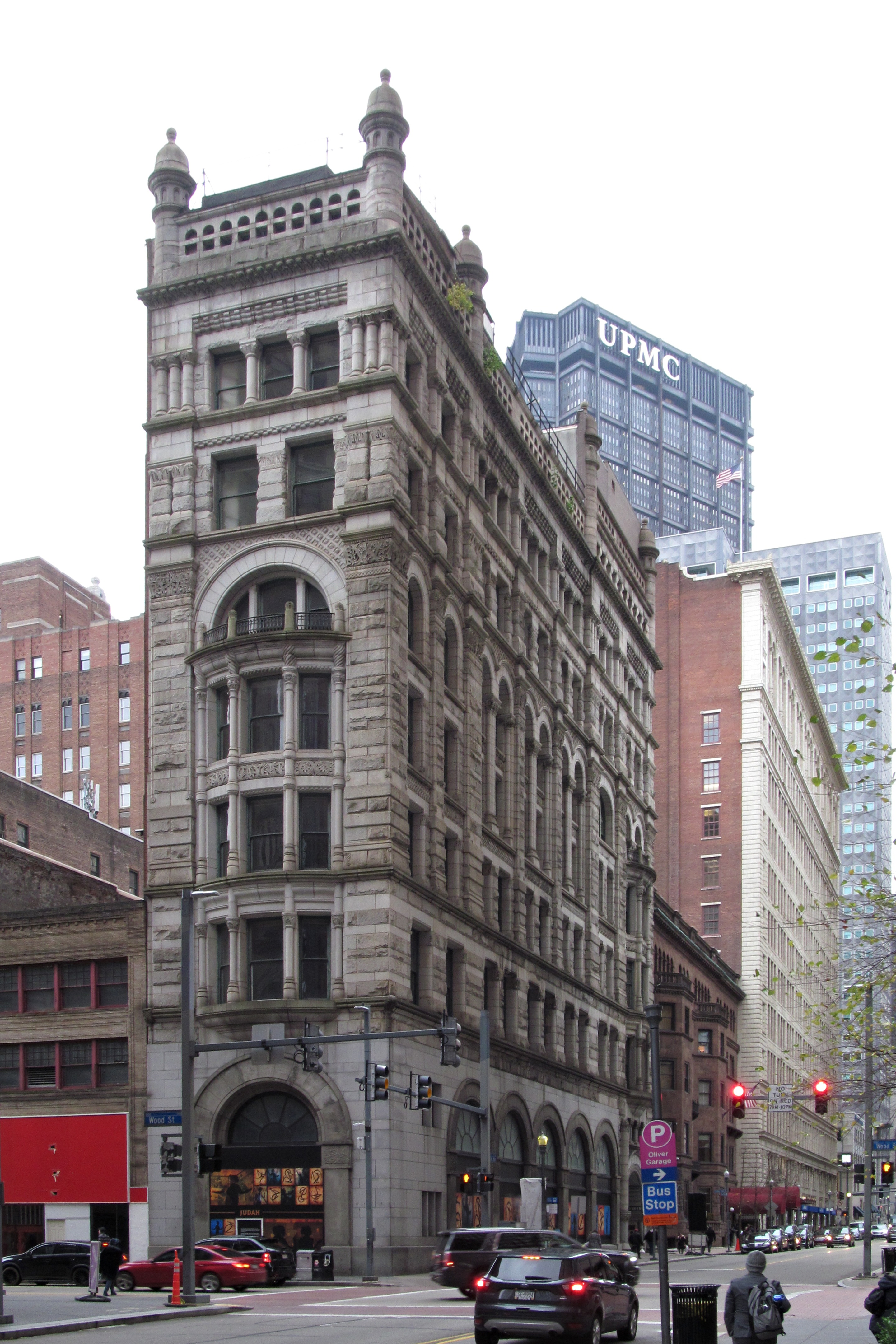
The German National Bank Building, which later took on the name “Granite Building,” was designed by Charles Bickel. It opened in 1890 as one of the wave of Romanesque buildings that followed H. H. Richardson’s County Courthouse. Mr. Bickel pulled out all the stops and used every texture of which stone is capable. To modern eyes it may almost look random, but after one’s eye has been trained to the Victorian Romanesque, the care with which the elements are balanced becomes apparent.
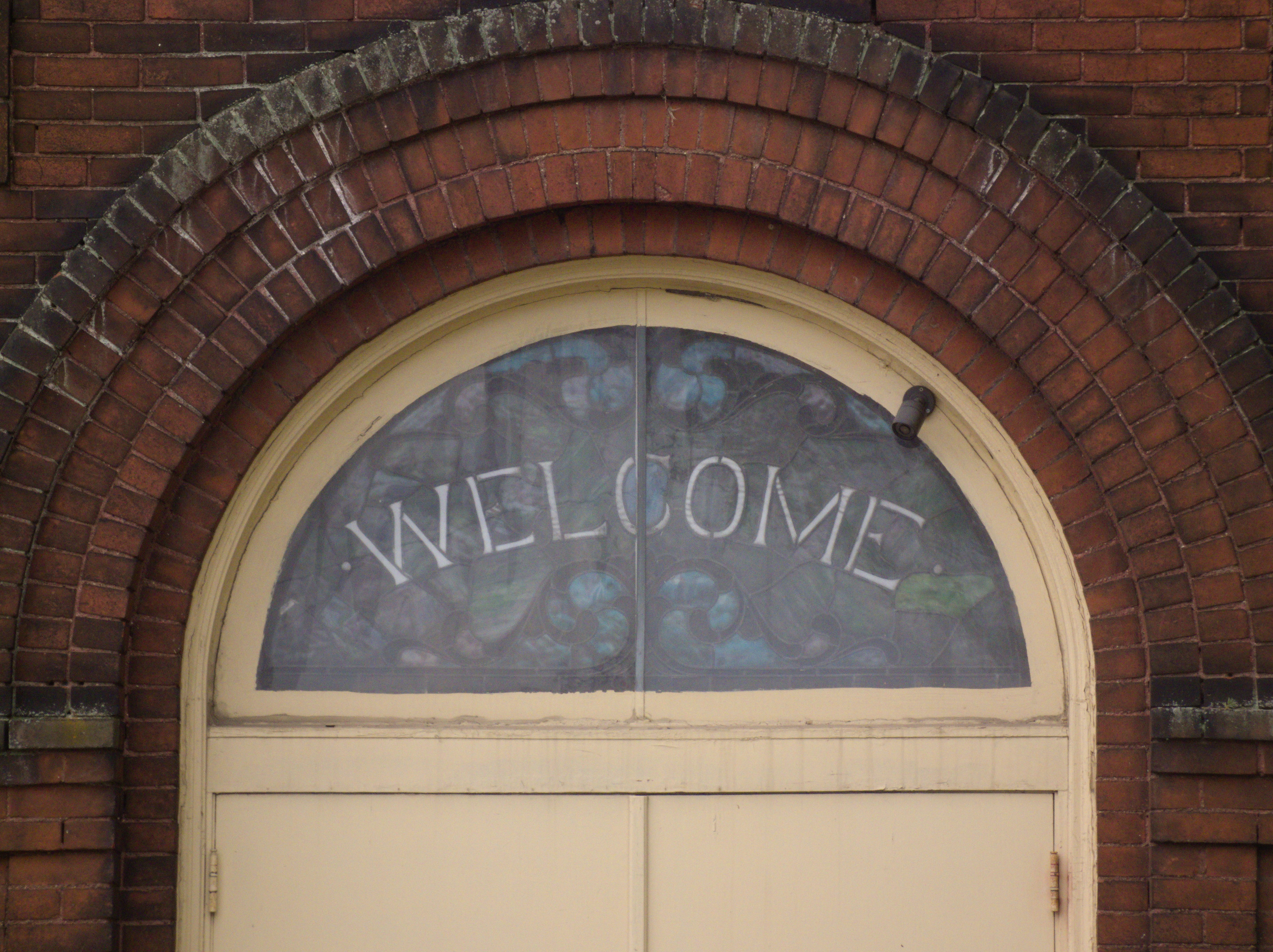
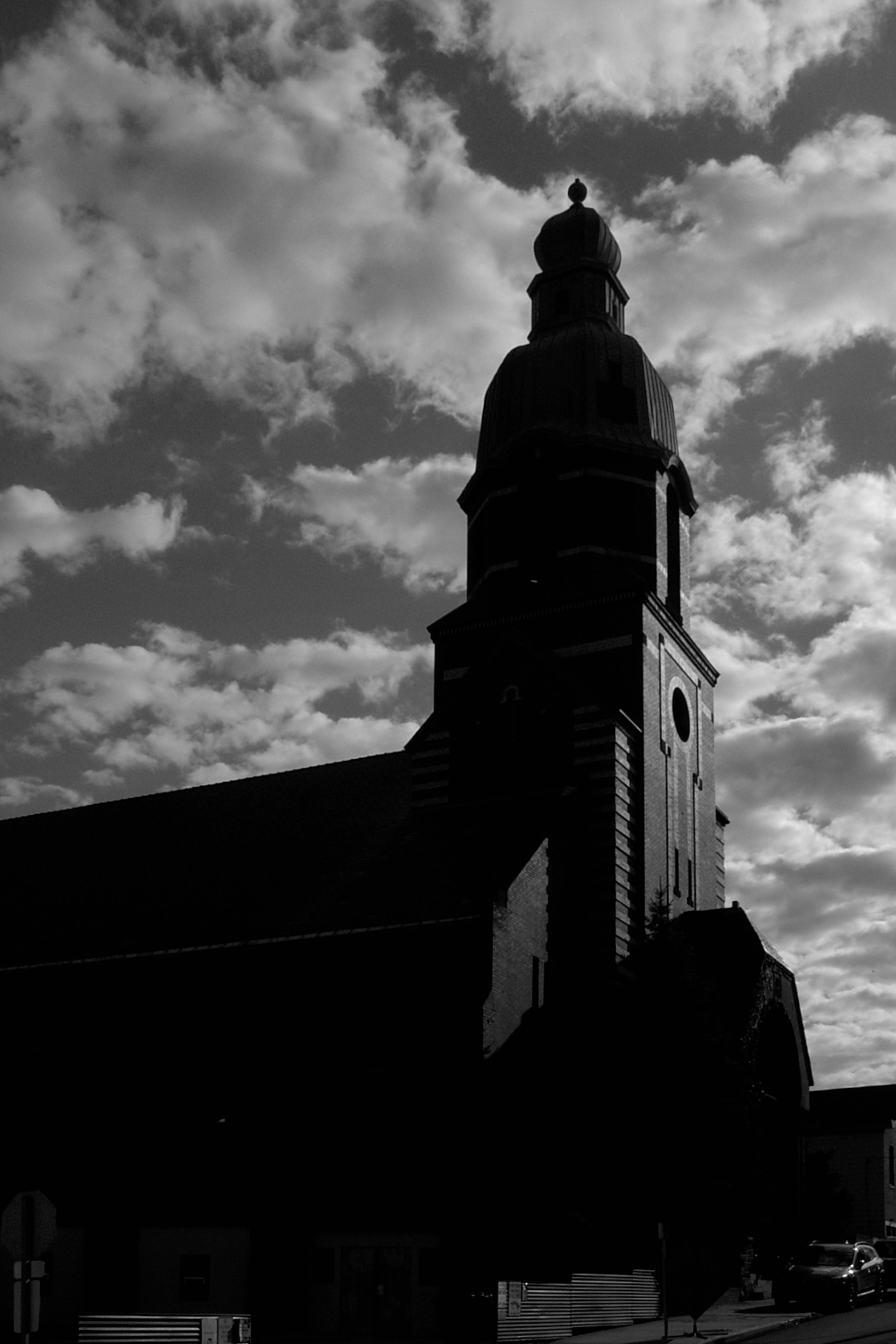
On the end of Juniata Street, where it meets Chateau Street, is a cluster of three Baptist churches all huddled together. Two of them originally belonged to other denominations, but this one has been Baptist all its life. Originally the Beth-Eden Baptist Church, it is now called Pilgrim Baptist Church. The building was put up in 1903, when weighty Romanesque was still a popular style in Allegheny and Pittsburgh. The massive tower and the rounded end make a strong impression.
Addendum: The architect was James N. Campbell. Source: “Pretty New Church to Go Up in Allegheny,” Pittsburg Post, April 17, 1901, p. 2. “The structure is to be erected at Chartiers and Juniata streets… The new church will be a handsome buff brick structure, with stone trimmings… The church will be of simple classic style, with colonial effects. A high tower will grace one of the corners of the structure. The church auditorium will have a seating capacity of 450, while the Sunday school room adjoining the auditorium will accommodate 600. A feature of the Sunday school room will be the arrangement of class rooms and its large gallery. The basement of the church will contain ladies’ parlors, kitchen and dining rooms… The plans were prepared by Architect James N. Campbell.” The drawing accompanying the article shows a plan somewhat different from the final building, but in a similar style.
A Romanesque church whose immense chimney dwarfs its stubby little tower, this is probably the only church in the neighborhood still serving its original congregation.
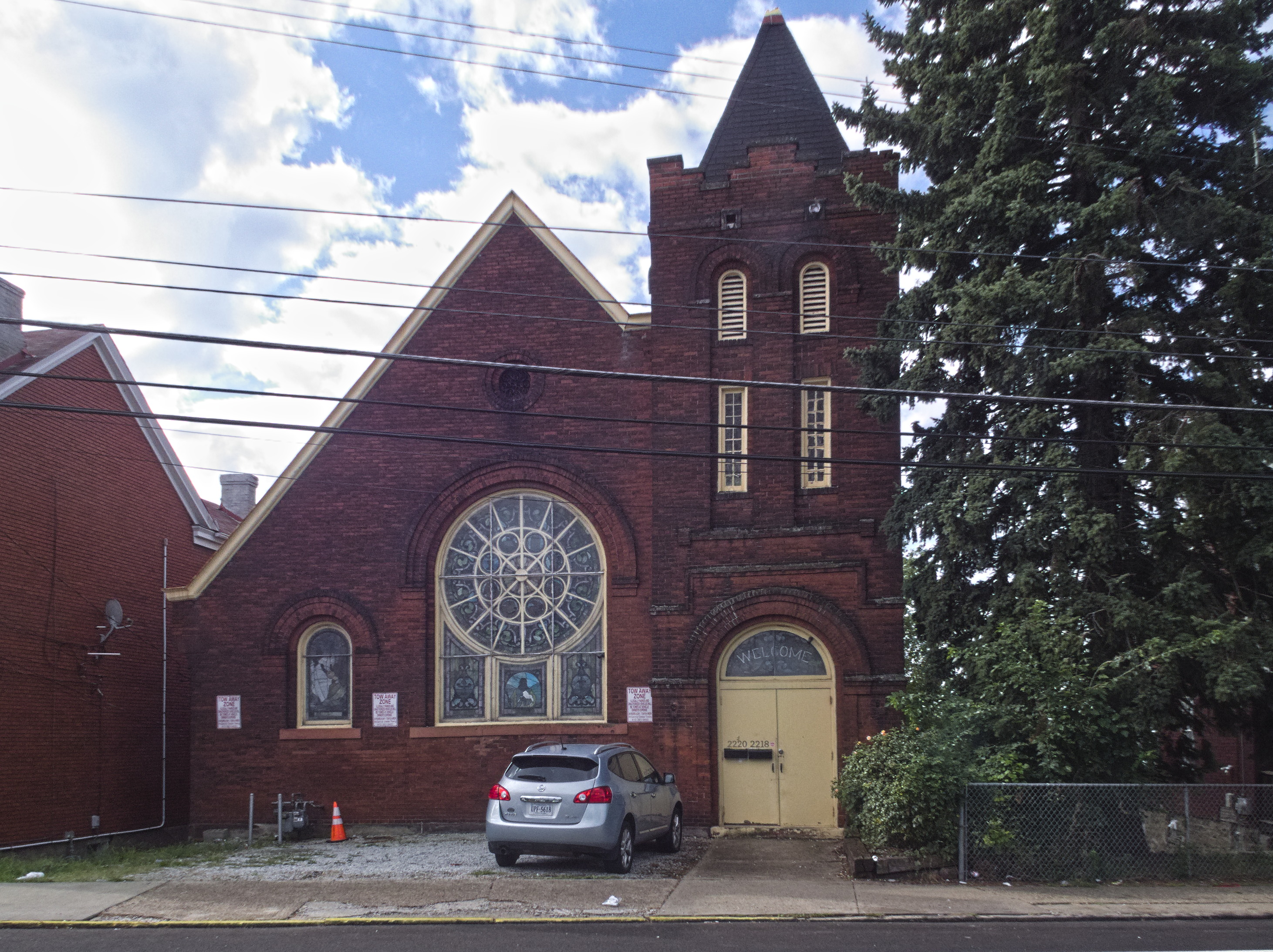
A small church whose weighty Romanesque design makes it seem larger than it is. Of course we have the usual Pittsburgh feast of utility cables in front, which old Pa Pitt is too lazy to take out. The building now belongs to a nondenominational congregation called the Holy Faith Tabernacle Church.
Until 1939, there were two main streams of Methodism in the United States: the Methodist Episcopal Church and the Methodist Protestant Church. Both were represented in Knoxville: we saw the First Methodist Protestant Church of Knoxville earlier.
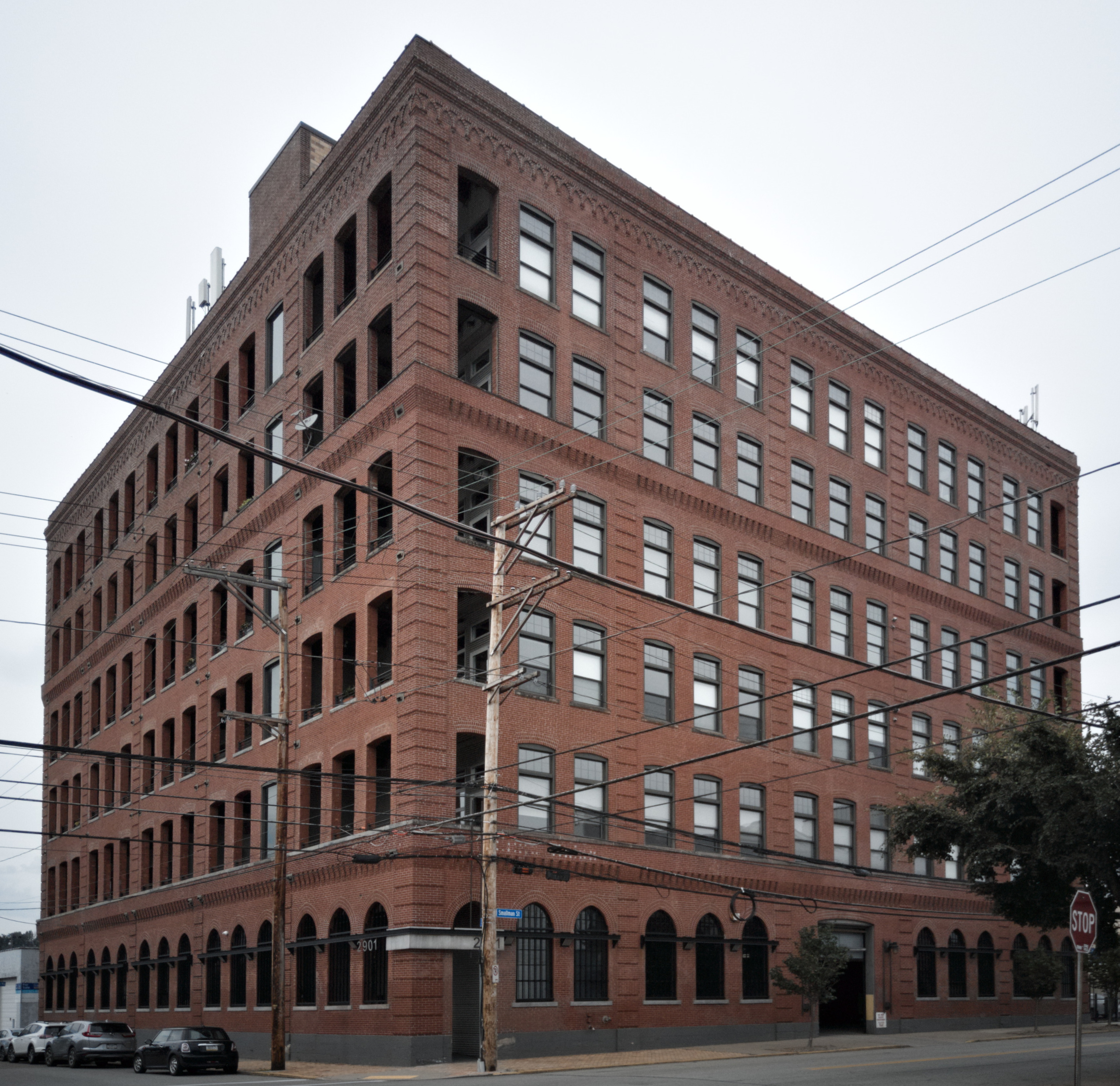
A dignified industrial building now converted to loft apartments. It was built in the 1890s as a machine shop for the Bair & Gazzam Manufacturing Company, and by 1910 it belonged to the Ruud Manufacturing Company, makers of those marvelous automatic water heaters. The style is very much in line with the industrial Romanesque that was popular in the late 1800s; but if we look carefully at the arches on the ground floor, we notice that they are very subtly pointed.
Father Pitt does not know the whole history of this building, but it looks as though the top two floors were a later addition.
This building has been much altered and diminished. There was originally more building behind it, and the façade has been drastically remodeled. The front entrance is now a pair of windows, and the original grand arches have been bricked in, with small and mismatched windows. The city’s Hilltop architectural inventory (PDF) classed this as a building with low architectural integrity. But it is very interesting for two reasons. First, the front gives us a good lesson in urban archaeology: enough is left so that we can try to imagine how the original building looked. Second, the fact that there was such a thing as a prominent school of rhetoric in Knoxville is itself an interesting window into times past. The briefest exposure to any of our politicians today will be enough to convince us that a school of rhetoric would be welcome in these parts.
Addendum: The building was originally the First Methodist Protestant Church of Knoxville. When the church moved a block away, Mr. King bought the building and had it completely remodeled by Knoxville’s own favorite architect, E. V. Denick. A newspaper account in the Pittsburgh Post, March 5, 1911, described the school and the renovations:
WILL BUILD FOR SCHOOL.
Byron W. King’s Institution to Be Housed in Own Home in Knoxville.
A school of oratory is to be erected in Knoxville. Byron W. King, well known as a teacher of elocution and kindred Subjects, has purchased the property of the Knoxville Methodist Protestant Church, Zara street and Virginia avenue, and will have it remodeled to suit his purposes.
Plans for the remodeling have been made by Architect Edwin V. Denick, and work will begin at once on the transformation. When completed the building will be a three-story brick that will have all of the appointments necessary for Mr. King’s purposes.
A large auditorium and classrooms will be placed on the first floor. On the upper floors will be dormitories and other accessories that have been figured on by Mr. King. In the basement will be a large dining hall, a kitchen and the heating apparatus.
With the remodeling of the old structure and the brightening up of both its exterior and interior, together with the Y. M. C. A. building across the street, the corner will be a lively one and will put on quite a metropolitan air.
The new church of the Knoxville Methodist Protestant congregation is at Georgia avenue and Zara street. King’s School of Oratory and Dramatic Culture is now in Sixth street, Pittsburgh.