Tag: Peebles (Andrew)

  • Some Details of the Triangle Building

    McCance Block or Triangle Building

    Originally called the McCance Block after its owner, this came to be known as the Triangle Building for obvious reasons. As Father Pitt has mentioned before, it fills what may be one of the smallest downtown city blocks in the country, so that every side of a relatively small building faces the street.

    Andrew Peebles was probably the architect—but old Pa Pitt has not sorted that out completely yet, because he has also heard of Thomas Scott as the architect. His current hypothesis is that the building rose in two stages: the first four floors by Peebles, and the top two floors, which are simpler and built with brick of a very slightly different shade, by Scott some years later. The building has recently been refurbished for (you guessed it) luxury apartments.

    Smithfield Street entrance
    Lantern
    Capital
    Canon PowerShot SX20 IS.

    Comments
  • First English Evangelical Lutheran Church

    First English Evangelical Lutheran Church, Pittsburgh
    Canon PowerShot SX20 IS.

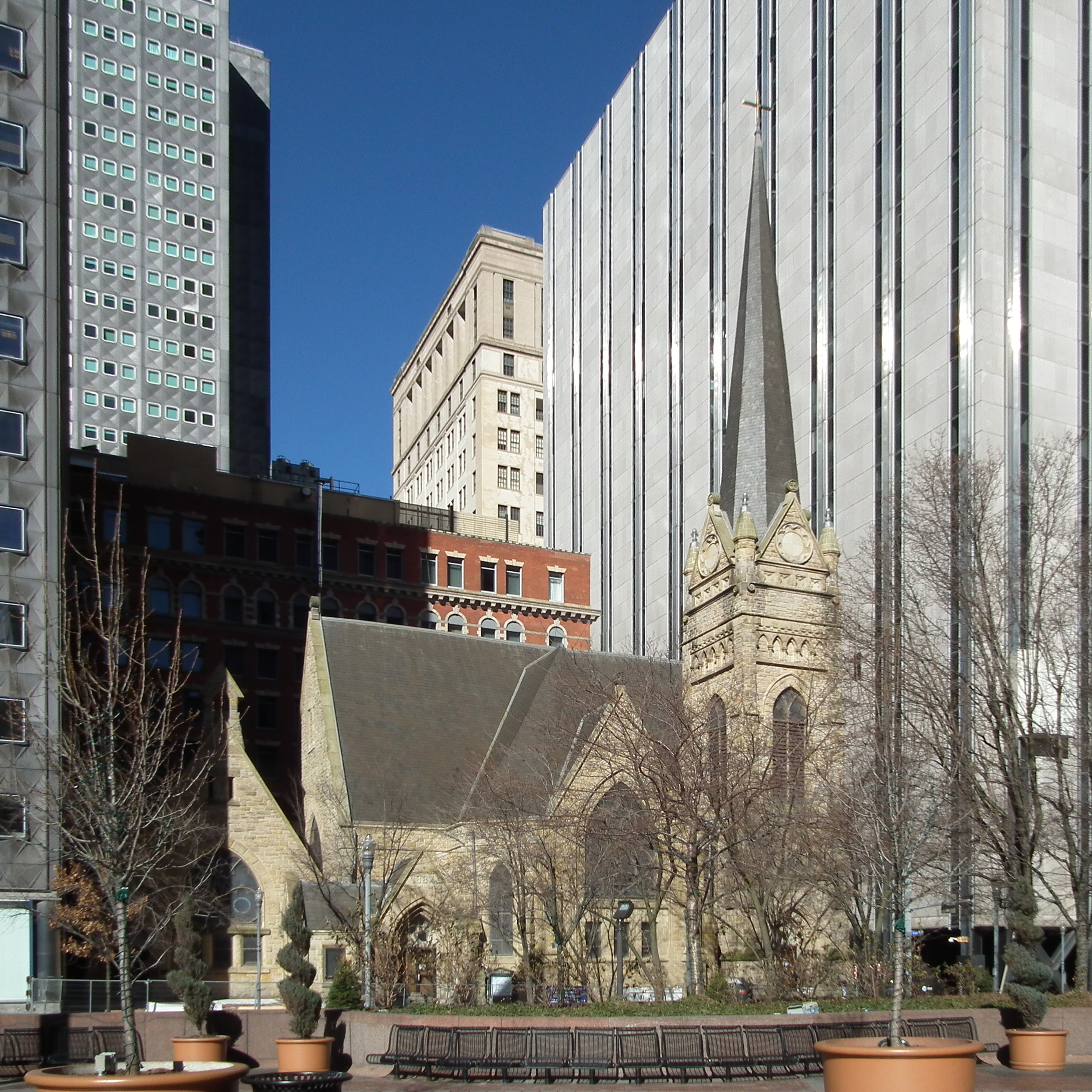
    Andrew Peebles, who also designed St. Peter’s on the North Side, designed this church, which was quite large when it was built but looks like a toy next to the skyscrapers of Grant Street. Built in 1887, it is now the oldest building on the street.

    More pictures of First Lutheran.

  • St. Peter’s Church, North Side

    St. Peter’s Church

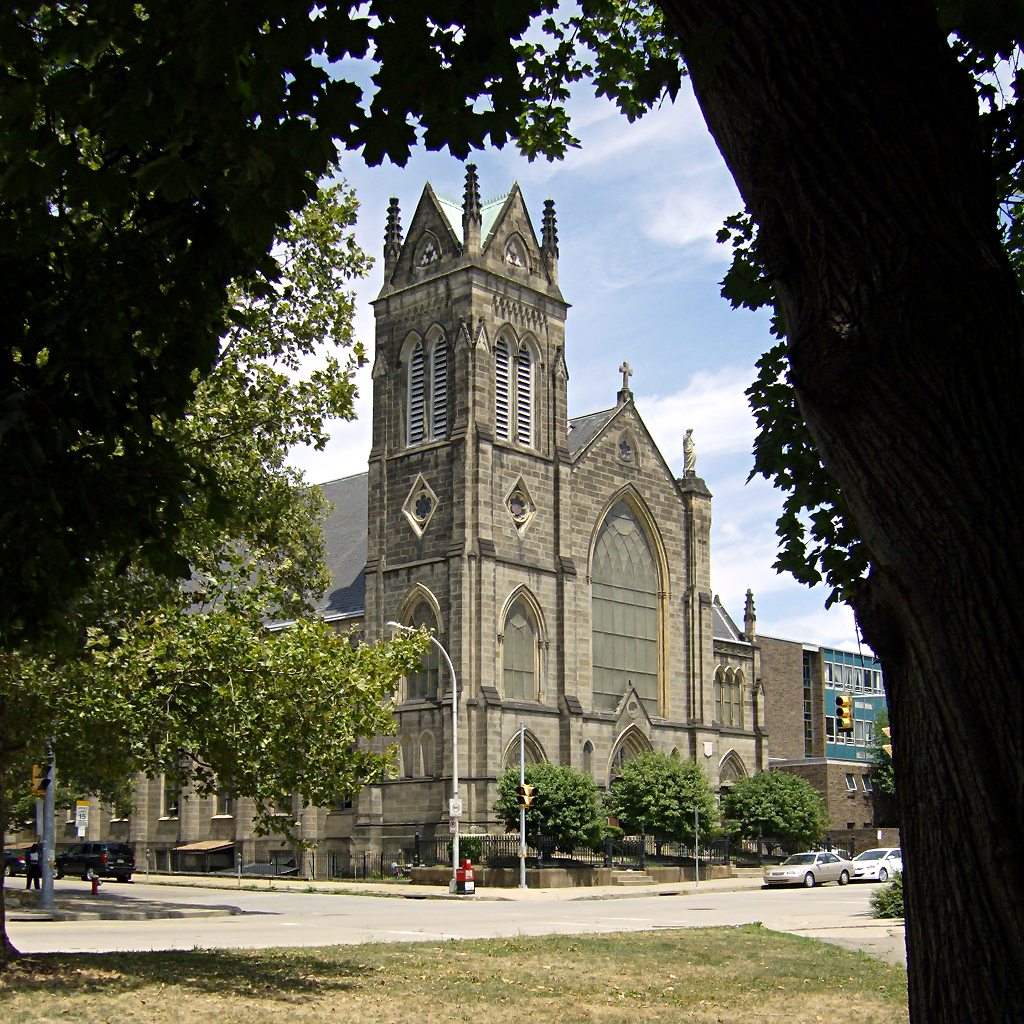
    Andrew Peebles was the architect of St. Peter’s, which was dedicated in 1874. In 1876, it became the cathedral of the new Roman Catholic Diocese of Allegheny, carved out of the Diocese of Pittsburgh, which was left with all the debt while the new Diocese of Allegheny took all the rich churches. That went about as well as you might expect, and in 1889 the Diocese of Allegheny was suppressed and its territory reabsorbed by Pittsburgh. But a church never quite gets over being a cathedral.

    West front of St. Peter’s, North Side

    In 1886, a fire ravaged the building and left nothing but the walls standing. Fortunately Peebles’ original plans were saved, and so the restoration, which took a year and a half, was done to the original design.

    Perspective view
    St. Peter’s
    St. Peter’s
    Front of the rectory

    The rectory was built with a stone front to match the church, but the rest of the house is brick.

    Rectory
    Rectory
    Nikon COOLPIX P100.

    We also have a picture of the front of St. Peter’s at night.


    Comments
  • First English Evangelical Lutheran Church

    First English Evangelical Lutheran Church

    Designed by Andrew Peebles, this church, which would be the most magnificent thing in many a neighborhood, is dwarfed by the Grant Street behemoths around it. Other even grander churches on Grant Street (St. Paul’s Roman Catholic Cathedral and St. Peter’s Episcopal) were displaced by commercial interests, but this one has somehow survived since 1887, which may make it the oldest standing building on Grant Street. It’s currently getting some restoration.

    Entrance and 1887 date stone
    Inscription: First English Evangelical Lutheran Church
    False belfry
    Roof ornament
    Grant Street face
    First Lutheran
  • St. Peter’s Church, North Side

    St. Peter’s Church

    Built in 1872 from a design by Andrew Peebles, this cathedral-sized church did become a cathedral about three years later for the short-lived Catholic Diocese of Allegheny, which was formed by taking the rich half away from the diocese of Pittsburgh and leaving all the debt with the poor half. The diocese was suppressed in 1889, but old dioceses never die, and there is still a titular Bishop of Allegheny. The current holder of the title is a retired auxiliary bishop of Newark.

    Resurrection relief

    This relief of the Resurrection takes on added drama at night.

    We also have pictures of St. Peter’s by daylight.

  • St. Peter’s Church, North Side

    This splendid old church may look a bit prouder than the ordinary Catholic parish church, and it has every right to its pride: for a little more than a decade, it was the cathedral for the Diocese of Allegheny. In 1876 the rapidly growing Diocese of Pittsburgh was split, with Allegheny (then an independent city) as the seat of the new diocese. It was a bad plan from the beginning: Allegheny had all the wealthiest parishes, but Pittsburgh was generously allowed to keep all the debt. The shockingly un-Christian infighting that resulted ended only in 1889, when the Diocese of Allegheny was suppressed. But a Catholic diocese isn’t that easy to get rid of, and there is still a titular Bishop of Allegheny. He lives in Newark, where in his day job he is auxiliary bishop of the diocese there.

    St. Peter’s is just across Arch Street from the National Aviary, a short walk from the North Side subway station.

    Addendum: This church was built in 1872; the architect was Andrew Peebles, who also designed First English Lutheran downtown.