Five houses on Parkman Avenue, and once again we take our attributions with gratitude from the anonymous Google Maps user who built a map of Architects of Schenley Farms Residences. The one above was designed by Louis Stevens and built in 1910.
Designed by D. Simpson & Co. and built in 1915.
Designed by Louis Stevens and built in 1915.
Designed by Maximilian Nirdlinger and built in 1911.
Maximilian Nirdlinger, who rests near the top of Father Pitt’s list of architects whose names are most fun to say, designed this striking house, which is unique in a row that otherwise consists mostly of Pittsburgh Foursquares. Nirdlinger was one of the giants of the first half of the twentieth century in Pittsburgh. He was a pupil of the Philadelphia titan Frank Furness, but left the master to come to Pittsburgh in 1899. By the early 1900s, he had his own practice.1 He quickly caught the eye of the fashionable set: four of the original houses in Schenley Farms, for example, were designed by Nirdlinger.
Nirdlinger worked in many different styles: he could give you a Renaissance palace or a Tudor mansion with equal flair. For this Art Nouveau cottage, designed in 1916 for C. R. Caldwell, he seems to have taken a lot of hints from those German art magazines that circulated among our architects before the First World War.
Much of our information on Nirdlinger comes from “Maximilian Nirdlinger: Architect, Interrupted,” by Angelique Bamberger, in Western Pennsylvania History, Winter 2023-24. ↩︎
Originally this house on Tennyson Avenue was a Renaissance palace with a little whiff of Prairie Style. It was built in 1910 for Martin G. Bauer, Jr. The architect, Maximilian Nirdlinger, drew it in the common shape of the Pittsburgh Renaissance palace, with exaggerated brackets that look westward to Chicago but also recall the Italianate houses of a generation earlier.
At some point, the owners decided what they really wanted was a Southern plantation mansion. They amputated the porch and left a house-wide scar filled in with stucco that only draws attention to it, and then added a two-storey round portico, spending a lot of money to leave the house looking socked in the face.
We can imagine what the house looked like with the porch intact. But we don’t have to work very hard at it, because across the street is a very similar house, built one year earlier and designed by the same architect:
Here we see how the houses were both intended to look. The front porch emphasizes the breadth of the house, making it look long and low in spite of its three floors.
Now we can turn back to the Bauer house and see what it was trying to be. In old Pa Pitt’s opinion, it is always best to stick to the original style of a house in making additions or alterations. Any attempt to make the house into something it is not draws attention to the fact that it is not that thing.
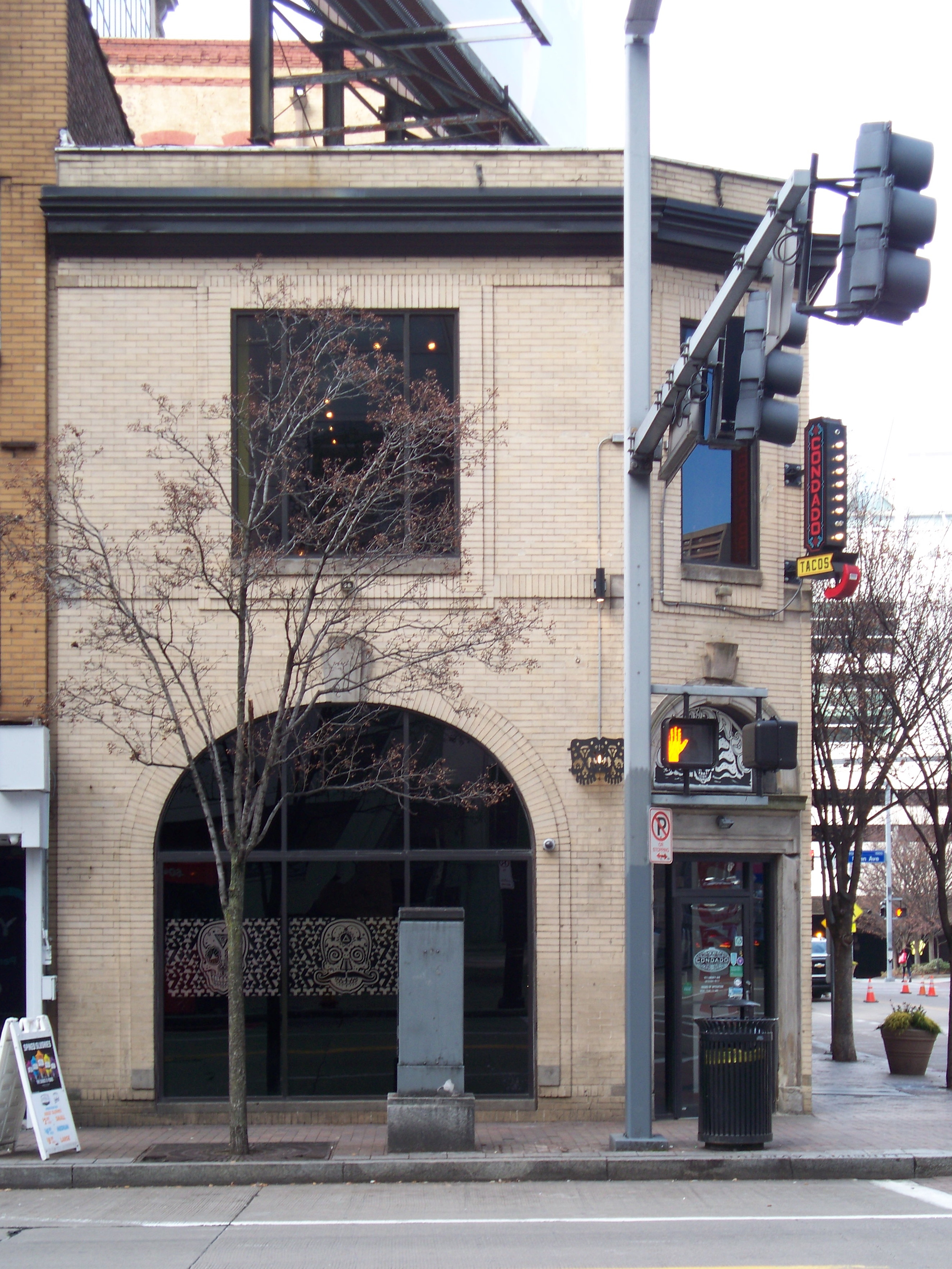
Maximilian Nirdlinger, who is on old Pa Pitt’s short list of architects whose names are most fun to say, designed this little store building in 1914, and we would guess it was completed by 1915. It was a very small and inexpensive project for downtown, but Nirdlinger made sure it was a tasteful one; and it has been updated without losing its essential character, which is classical by way of German-art-magazine modern.
A Tudor house in Schenley Farms recedes into the woods, looking more and more like something from a fairy tale.
Addendum: According to a Google Maps user who has documented most of the houses in Schenley Farms, this house was designed by Maximilian Nirdlinger in 1911 for E. H. Kingsley.