Father Pitt

Tag: Murals

  • A Walk on Boyle Street, North Side

    Boyle Street street sign

    A short evening stroll on two blocks’ worth of Boyle Street, one of those narrow rowhouse-lined streets on the North Side near Allegheny General Hospital. The street sign above is on a corner house; the sign probably dates from the late 1800s, and the house, though altered with new windows and other adaptations, may date from before the Civil War.

    1300 Boyle Street

    The basement door makes us think of Alice in Wonderland.

    Houses in the 1200 block

    This Second Empire row was probably put up in the 1870s or 1880s, replacing earlier smaller houses. Thirty years ago this was a poor neighborhood, but now much restoration is being done, without wholesale displacement of the older residents.

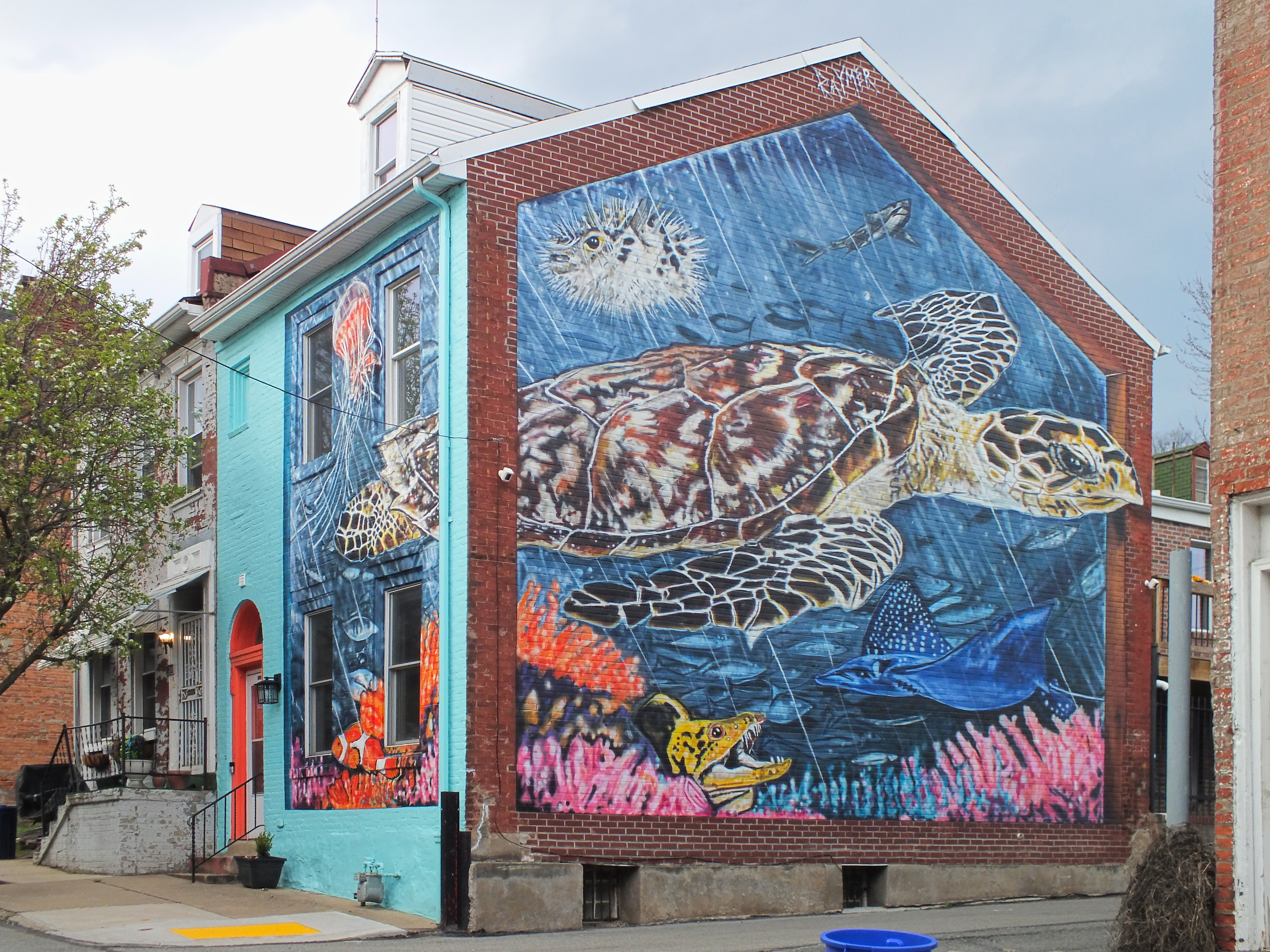
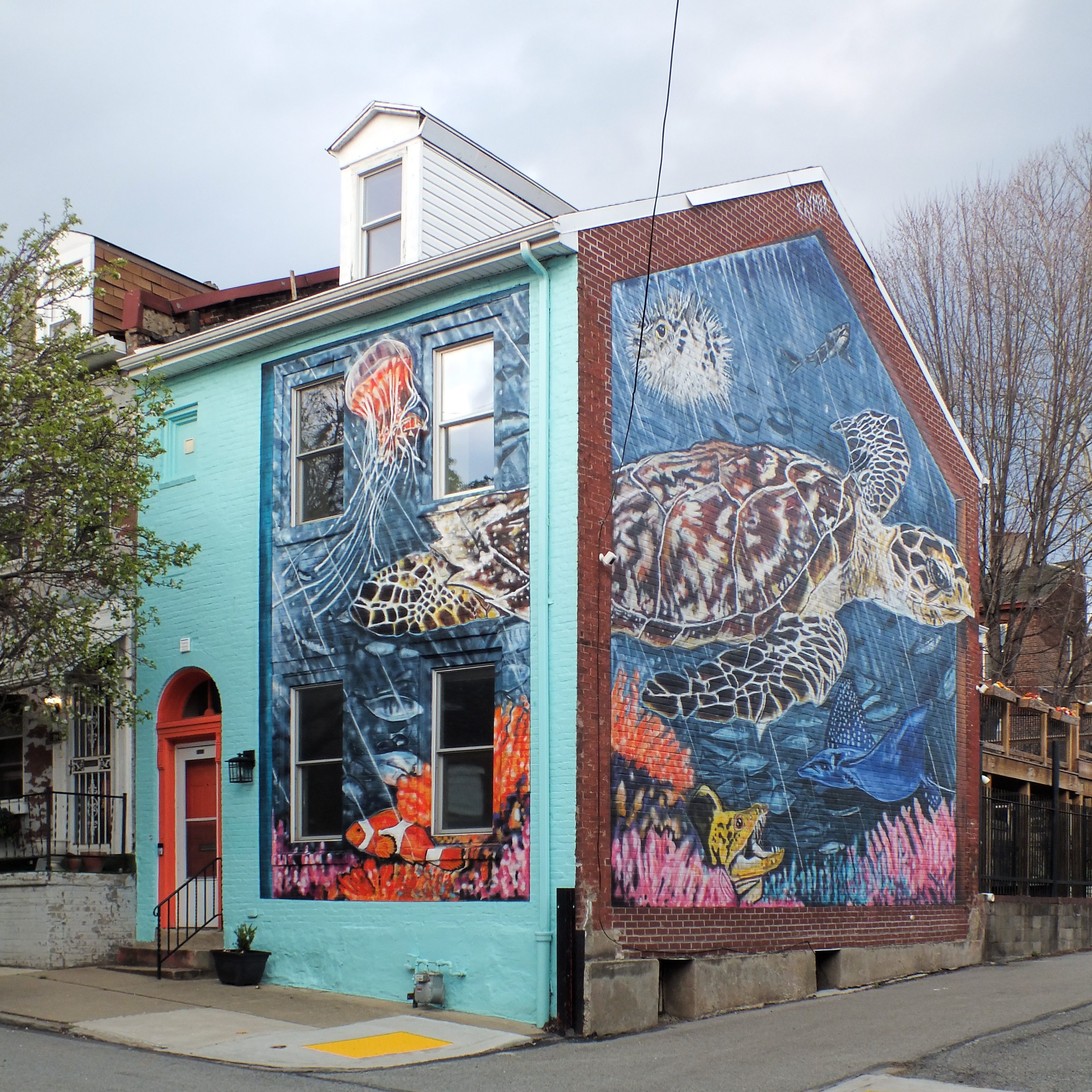
    Rowhouse with sea-turtle mural

    You have a blank wall facing an alley? We can do something about that. The mural is by Jeremy Raymer, who has beautified many spots around the city, especially in Lawrenceville and on the North Side.

    Rowhouse with sea-turtle mural
    An Italianate house

    An Italianate house, again altered with new windows, but preserving a splendid doorframe and some original carved wooden brackets.

    Woodwork above the front door
    Brackets
    1320 Boyle Street
    Small apartment building

    An unusually attractive small apartment building whose details are well preserved. Addendum: It was built in about 1910, and the architects were Allison & Allison.1

    Front elevation of the apartment building
    Fujifilm FinePix HS20EXR.
    1. Philadelphia Real Estate Record & Builders’ Guide, October 27, 1909, p. 684: “Architects Allison & Allison, Westinghouse Building, have prepared plans for a brick and cement apartment house, to be erected at Boyle and Hemlock streets, North Side, for W. B. Nelson. It will be of brick, with stone trimmings, hardwood finish, steam heat and electric lights.” Thanks to David Schwing. ↩︎

    Comments
  • A Relic of the Middle 1800s

    628 Smithfield Street

    Here is a remnant of the old middle-nineteenth-century commercial Pittsburgh, when a large part of the population lived downtown and shopkeepers often lived above their shops. In addition to being an unusual relic of the mostly obliterated past of downtown, this particular building is famous for its mural, “The Two Andys,” by Tom Mosser and Sarah Zeffiro.

    Building with The Two Andys
    Canon PowerShot SX20 IS.

    Comments
  • Reference Department

    Reference Department

    One of the chief attractions of the main Carnegie Library is the Reference Department, a huge room with a vaulted ceiling where you can walk in and ask a librarian for help on any topic, and then have librarians scurrying back into the stacks looking for obscure volumes to aid you in your research. Think of it this way: at no cost to you, simply by walking into this room, you can have the experience of being a supervillain with an army of minions.

    Reference Department
    Coffered ceiling

    The coffered ceiling was originally full of skylights—a maintenance headache rendered less necessary by bright modern lighting.

    Imprint of Aldus Manutius

    Mural decorations—lost for years behind paint, found accidentally in 1995, and carefully restored—pay tribute to famous printers of the Renaissance. A report by Marilyn Holt (PDF) describes the murals in detail. Above, the mark of Aldus Manutius, perhaps the greatest of them all.

    Reginaldus Chalderius panel

    Reginaldus Chalderius (or Regnault Chaudière, as he would have been called at home), French printer at the sign of L’homme sauvage.

    Balthasar Moretus

    Balthasar Moretus, Antwerp printer of the middle 1600s.

    Thielman Kerver panel

    Thielman Kerver, Parisian printer at the sign of the Unicorn.

    Noli altum sapere

    Noli altum sapere—“Do not be proud”—say the Estiennes, Parisian printers.

    Vincit prudentia vires

    Jean de la Caille reminds us that prudence beats force—Vincit prudentia vires.

    Simon Vostre panel

    Simon Vostre, early French printer.

    Corner pilaster

    Many of the details in the decorations are picked out in gold leaf.

    Pilaster capital
    Egg-and-dart and dentil moldings
    More moldings
    Looking into the Reference Department
    Fujifilm FinePix HS10.

  • Going Upstairs in the Library

    Looking up at the ceiling of the stairwell

    Just walking upstairs in the main Carnegie Library is an aesthetic adventure.

    Looking up past the light fixture
    Detail of the ceiling decorations
    Stairwell
    Light fixture
    Base of the light fixture
    Looking at the stairwell from the second-floor corridor
    Second-floor corrido

    The second-floor corridor. At the ends of the corridor are two cherub medallions, identical except for the motto.

    Omne labore

    Omne labore—“Everything with effort.”

    Vivere est cogitary
    Fujifilm FinePix HS10; Samsung Galaxy A15 5G.

    Vivere est cogitare—“To live is to think,” as Cicero said.

  • Unloading at Cape Town, by Edward Trumbull

    “A series of unusually artistic mural paintings by Trumbull always interests visitors to ‘The Home of the 57,’ ” says a 1924 Heinz advertisement in The Delineator. For many years the Heinz factory tour was one of Pittsburgh’s chief attractions, and Edward Trumbull’s murals in the headquarters building were much admired. The tour is no longer offered, but this advertisement reproduces one of Trumbull’s famous murals: “Scene at Capetown, South Africa. A symbol of Heinz world-wide distribution.”