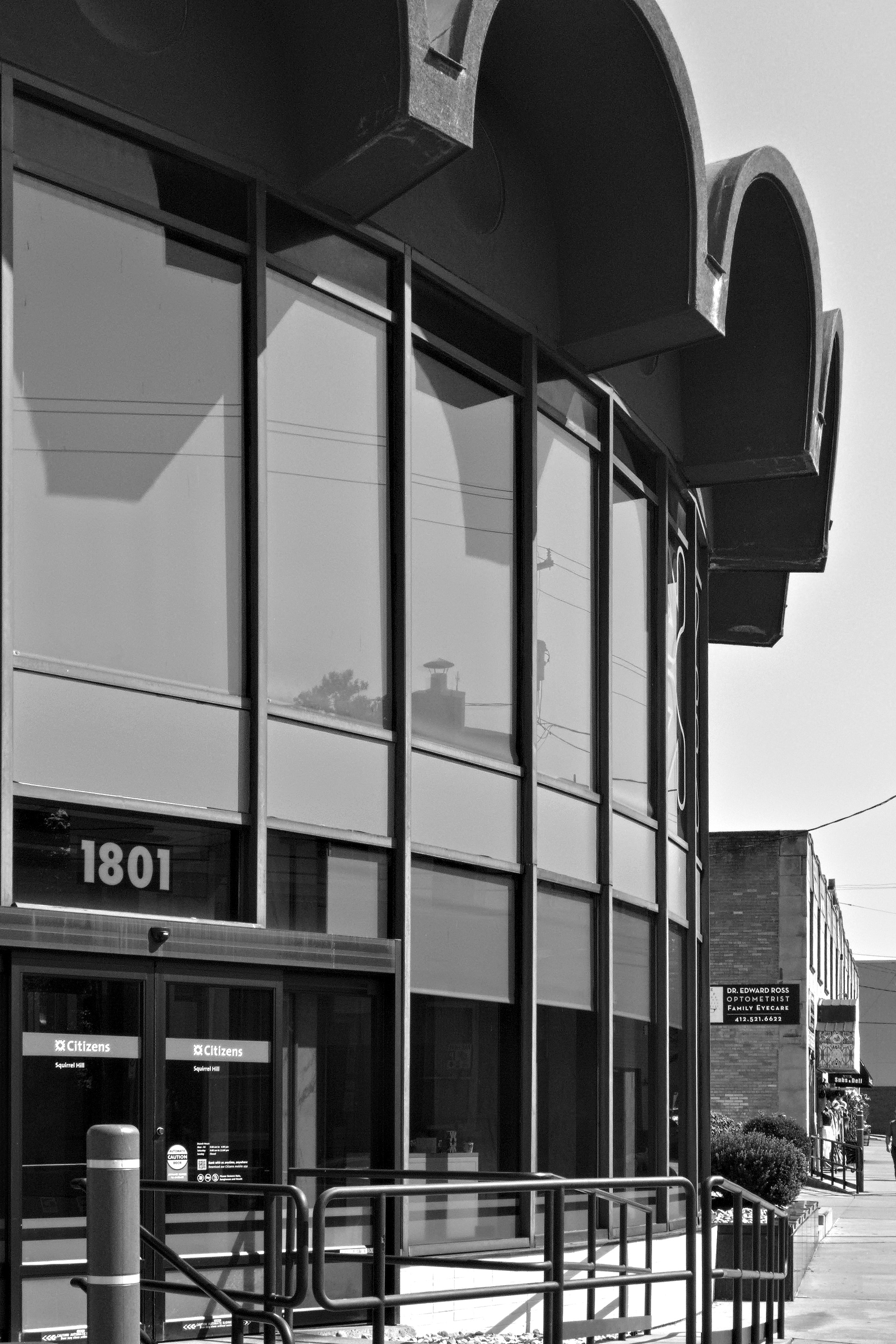
We saw Neville House in color earlier. These three monochrome pictures were taken with a Kodak Retinette made in the middle 1950s. Above, the exit from the porte cochere under the building. Below, the main entrance, including the porte cochere and the patio in front of it.
Kodak Retinette with Kentmere Pan 100 film.
Thanks to Bodega Film Lab for developing the film and making it worth taking the Retinette out for a walk.
As some vast heart that high in health Beats in its mighty breast, So, to and fro, thy living wealth Throbs through the boundless West. Thy keels the broad Ohio plow, Or seek the Atlantic main; Thy fabrics find the Arctic snow, Or reach Zahara’s plain!
Toil on, huge Cyclop as thou art, Though grimed with dust and smoke, And breathing with convulsive start— There’s music in each stroke! What if the stranger smirch and soil Upon thy forehead sees? Better the wealth of honest toil Than of ignoble ease!
And yet thou’rt beautiful—a queen Throned on her royal seat! All glorious in emerald sheen, Where thy fair waters meet. And when the night comes softly down, And the moon lights the stream, In the mild ray appears the town, The city of a dream!
——“Pittsburgh” by E. M. Sidney in Graham’s American Monthly Magazine of Literature and Art, Vol. XXX (1847), p. 249.
One of several round banks Mellon Bank built in the modernist era. It is still a bank, now belonging to Citizens Bank, Mellon’s successor in retail banking.
This tasteful lantern is actually one of the two flanking the parking lot for the firm that now inhabits the William Penn Snyder house on Ridge Avenue; it took some careful manipulation of angles to make it look like something other than a parking-lot decoration.
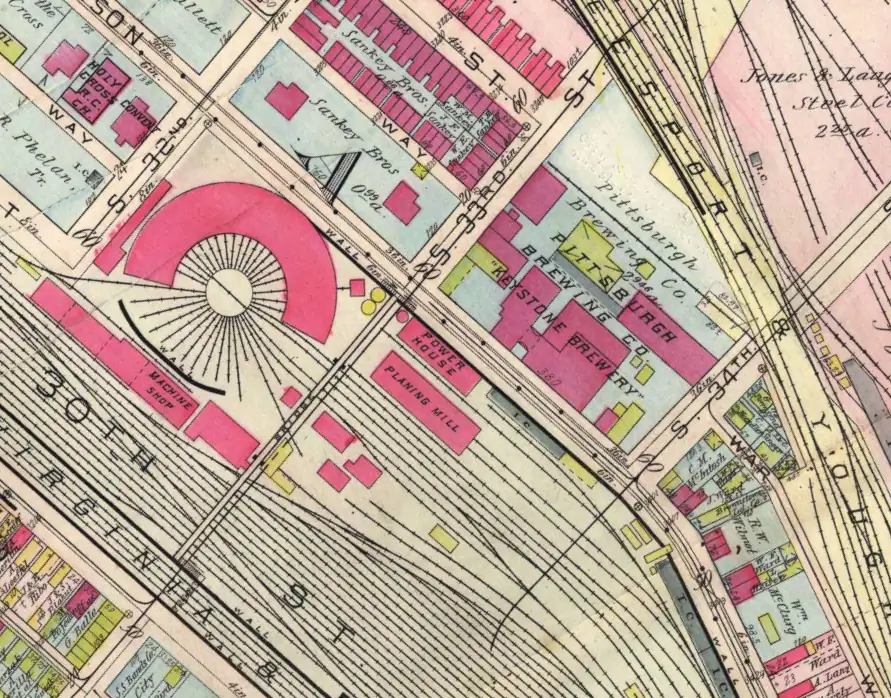
To the south, at the base of the steep South Side Slopes, was a small but crowded neighborhood of workmen and their families. To the north was a huge steel mill, a railroad roundhouse and shops, and a big brewery. In between was a railroad yard with more than twenty tracks to cross. How would the workmen get to work without getting run over by switching locomotives every day? The answer was to extend 33rd Street from the Slopes to the Flats as a pedestrian tunnel under the main line, followed by a long pedestrian bridge over the railroad yards.
Hopkins real-estate plat map from 1923, showing the 33rd Street bridge and tunnel.
The bridge and the railroad yard are gone now; the tunnel remains, but since it goes nowhere it is blocked. The tunnel entrance is still attractive in its stony simplicity.