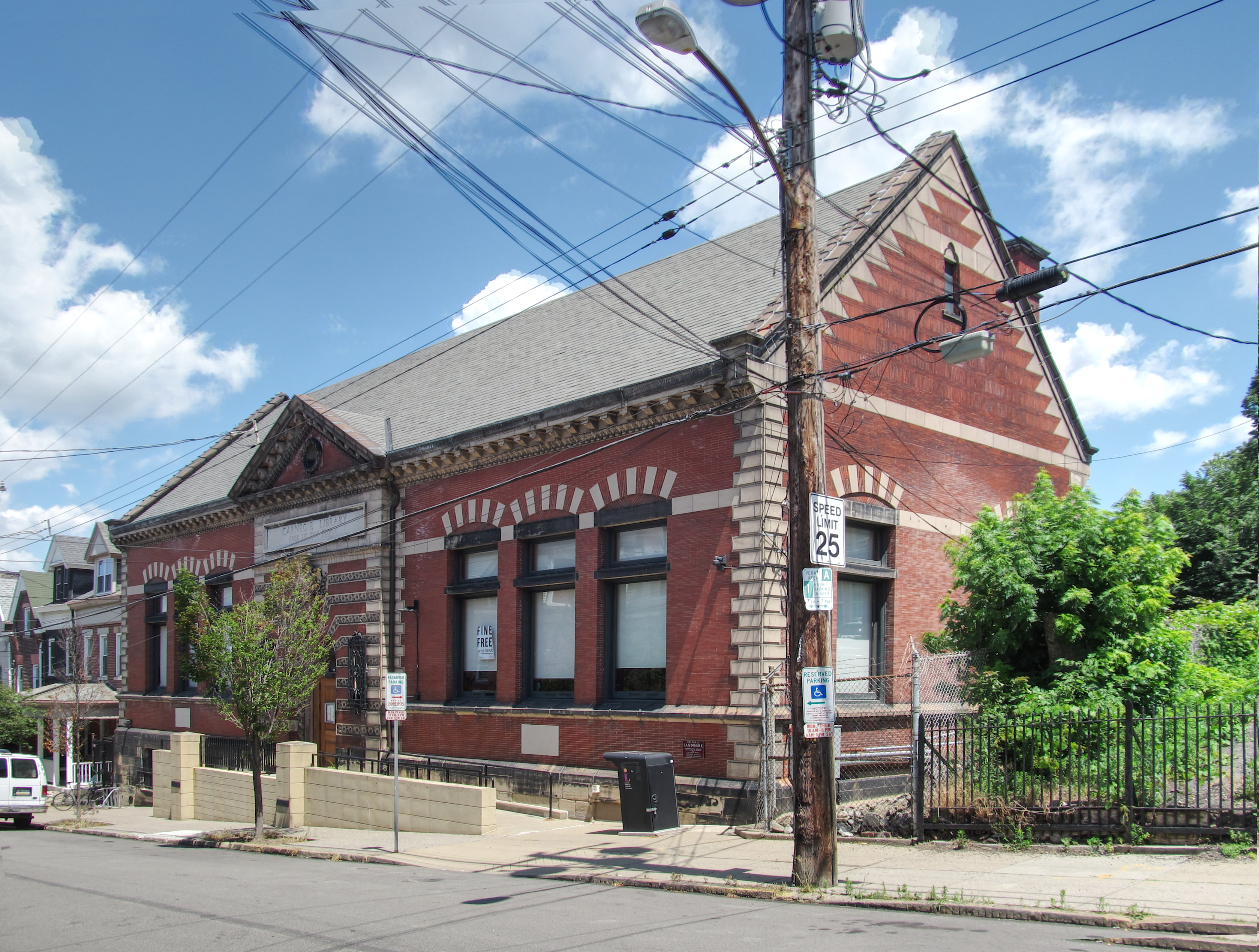
There is often a greeter standing in the lobby of the main Carnegie Library in Oakland to say “Welcome to the Library” to every patron who walks through the door. But even when the greeter isn’t greeting, the building itself conveys the same message.
Ornate light fixtures hang in the vestibule and lobby.
This little library was the second of Carnegie’s branch libraries, after the one in Lawrenceville; like all the original branch libraries, it was designed by Alden & Harlow.
The city of Allegheny was conquered by Pittsburgh in 1907, but the Carnegie Free Library of Allegheny—the first municipally run public library—was an independent institution until 1956. The main library was in the center of Allegheny, where it still stands (though the library has moved out). It had one branch library, opened here in 1916; the first librarian was Helen R. Langfitt, a 1916 graduate of the Carnegie Library School. This little arts-and-crafts building cannot match the elegance of the Alden & Harlow branch libraries in Pittsburgh, but it was a pleasant ornament to the neighborhood.
In 1964, the library moved to a modern building around the corner on Woods Run Avenue—a building that itself became dated and was remodernized in 2006.
Brutalism is the school of modernist architecture that uses raw building materials, especially concrete, as its main aesthetic statement. Father Pitt is not a great lover of the style, but some Brutalist buildings work better than others. The Hillman Library at the University of Pittsburgh has a cool elegance lacking in many other Brutalist buildings. The vertical window bays give us shading that keeps the wall from becoming monotonous, and they also flood the interior with natural light.
It is very hard to explain who designed this building. Wikipedia says, “Design of Hillman Library was led by Celli-Flynn and Associates who served as coordinating architects. Kuhn, Newcomer & Valentour served as associated architects with Harrison & Abramovitz acting as consulting architects to the university. Dolores Miller and Associates consulted on the interior design, and Keyes Metcalf served as a library consultant.”
An architect might be able to sort out the nuances of coordinating, associated, and consulting. Harrison & Abramovitz gave us numerous skyscrapers downtown, but Wikipedia adds that “In 1996, architect Celli-Flynn and Associates and Kuhn, Newcomer & Valentour won the Timeless Award for Enduring Design from the Pittsburgh chapter of the American Institute of Architects for its design of Hillman Library.” This suggests that Harrison & Abramovitz really were consultants rather than responsible for the design; perhaps their role was to say, “No, you can’t do that, or it will fall down.”
Kuhn, Newcomer & Valentour still exists as “DRAW Collective,” based in Mt. Lebanon. Celli-Flynn and Associates was absorbed into Buchart Horn Architects, based in York, but maintaining the staff and office of the Pittsburgh company. It is an interesting commentary on architectural trends that both firms’ recent projects, as displayed on their Web sites, lean toward a timid neoneoclassicism. It does not have the courage to break completely with modernist dogmas and go back to Vitruvius, but neither does it have the daring to invent its own forms and make something new. We get the impression that the clients will be satisfied—but satisfied as in “Yeah, it’s okay,” not satisfied as in “They gave me a masterpiece.”
Another elegant little branch library by Alden & Harlow. Although the branch library moved a short distance away to a larger modern building, this one was fortunately taken over by a mosque and is therefore still loved and kept up.
One of the little neighborhood libraries designed by Alden & Harlow, this one has a prime location on Grandview Avenue, making it possibly the library with the best view in the world.
This fine little Renaissance palace, built in 1896, was the first of Carnegie’s branch libraries, and thus arguably the vanguard of the whole idea of branch libraries. It was also the first public library with open stacks, where patrons would just walk to the shelf and pick up the book by themselves. In other libraries—including much of the main Carnegie in Oakland until a few years ago—the patron would ask for the book at the desk, and a librarian would run back to the mysterious stacks and fetch it.
Like all the original libraries in the Carnegie system, this was designed by Alden & Harlow.
This is the neighborhood library every neighborhood dreams of. It was designed by Alden & Harlow (according to Wikipedia, Howard K. Jones, who worked for the firm, may have been principally responsible for this library), and it is the most palatial of their branch libraries in the city. Most of the others are classical, but this is institutional Gothic. Restored to its original splendor, it is kept immaculately beautiful, and it seems to be busy. Old Pa Pitt promised the librarian he would not capture any patrons in the interior shots—which necessitated some patience, because people would keep walking in front of the woodwork.
Andrew Carnegie peppered the city with neighborhood libraries designed by his favorite architects, Alden & Harlow. They’re all little gems. This one has been abandoned for years, since a new library was built in the mostly empty business district of Hazelwood on Second Avenue. (That block of Second Avenue now seems to be the center of the Hazelwood neighborhood revival.) It is still in good shape, and—unlike an abandoned church or synagogue—it would be a relatively easy building to adapt to new uses.