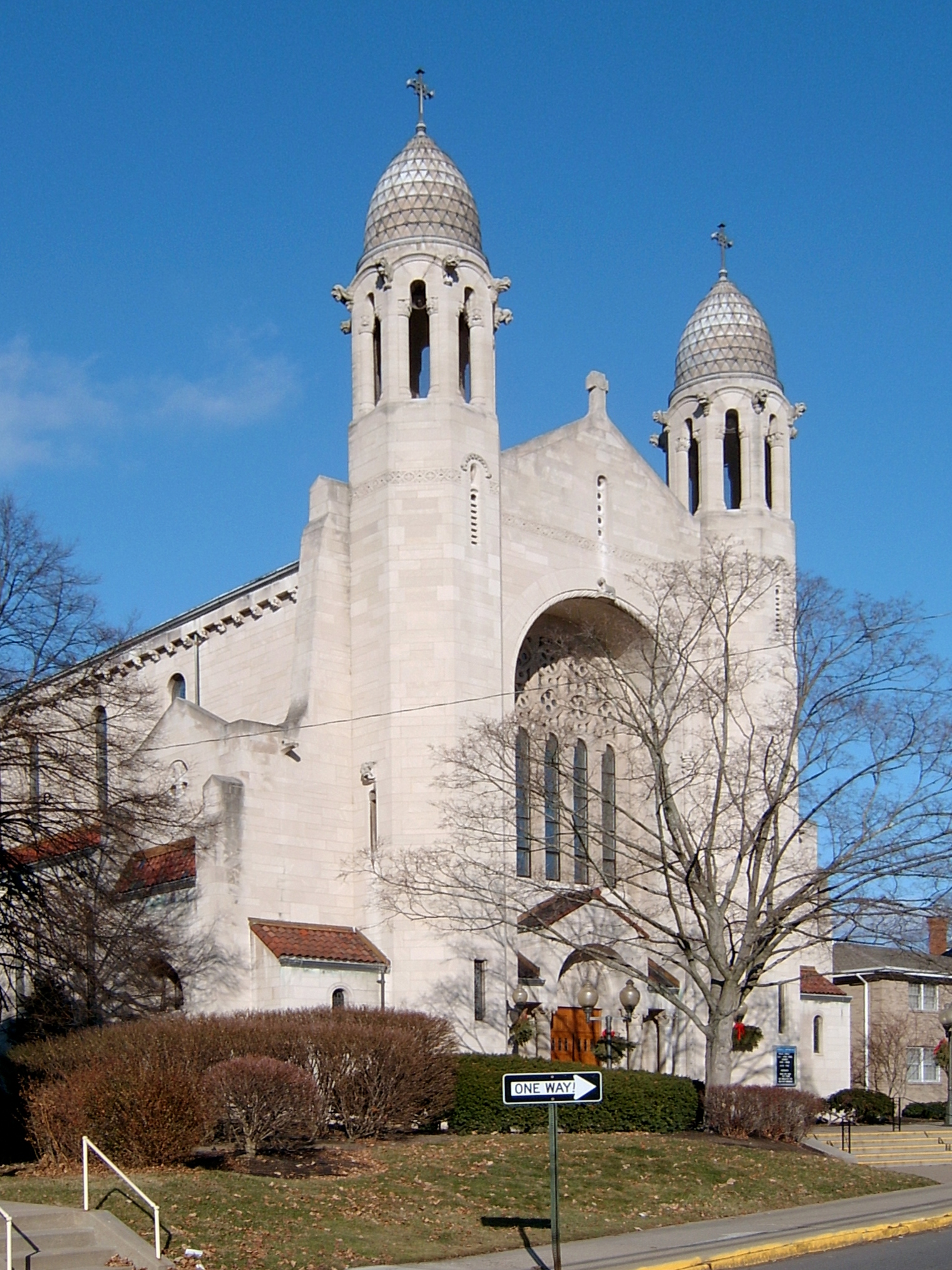
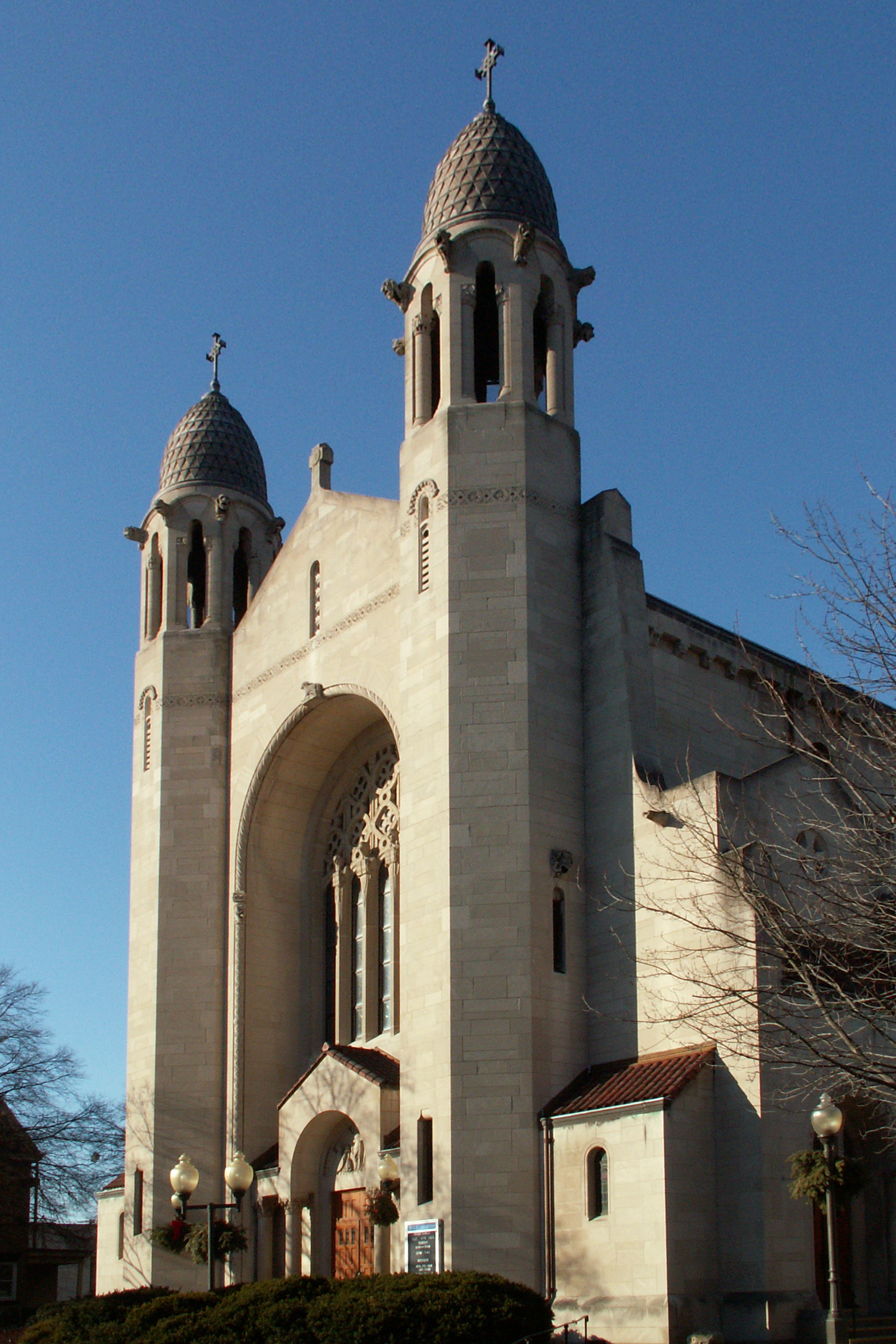
Leo McMullen of Comès, Perry & McMullen was the architect of the grandest church in his hometown of Bellevue. We have seen this church in detail before, including the front, the interior, the carvings of Adam and Eve at the entrance, the gargoyles, the curious grotesque brackets, and the stained glass. But a cathedral-sized church like this always has more to show us, and the changing season brings us the added delight of fall color.
The school was built first, in 1926, so we begin with the school. The architect was William P. Hutchins, who chose the “collegiate Gothic” style to send the twin messages that this was a school and it was Catholic.1
The congregation, meanwhile, worshiped in a small frame church for more than twenty years. After the Second World War, Leo McMullen was hired to design a new church and school expansion.2 Both the era and McMullen’s taste dictated a simpler style, but the new building fits well with the school to which it is attached.
The pictures of the church are from back in March; the pictures of the school are from last week. Yes, it does sometimes take old Pa Pitt that long—or longer—just to complete a set of pictures.
The Venerable Bede was the great light of the Dark Ages, the author of the Ecclesiastical History of the English Nation, which is the best source for very early English history. Here he is depicted pausing to think while writing one of his books. Bede was exceptionally good at thinking, which set him apart in the early 700s.
“Tremendous Building Program Looms in Pittsburgh Diocese,” Pittsburgh Catholic, March 28, 1946. “St. Bede’s, Rev. John F. Enright, pastor: Combined school and church building; Leo A. McMullen, architect.” ↩︎
The gargoyles on the Church of the Assumption capture the true medieval spirit of inspired grotesquerie and goofiness and filter it through a twentieth-century sensibility. This gargoyle is having a bad day.
This one on the side of the building seems to be above a chimney vent. It demonstrates, in a silly way that would have appealed to the medieval sense of humor, one of the torments prepared for the damned.
Leo McMullen, a disciple of the great John T. Comès, put his own unique Art Deco spin on traditional Romanesque architecture to give us a remarkably successful melding of medieval and modern sensibilities. McMullen was a native of Bellevue, and it looks as though he decided to put his hometown on the map by giving it a church that would be the envy of any city in the world. He succeeded.
Father Pitt took so many pictures of this glorious church that he is forced to split them up into multiple articles. And even with dozens of pictures, he has hardly begun to catalogue the artistic treasures to be found here. If you appreciate architecture, stained glass, painting, and sculpture, you owe yourself a visit to the Church of the Assumption.
This splendid church was designed by Bellevue’s own Leo A. McMullen, an architect and organist who is almost forgotten today, but whose works were highly regarded in his time. The American Institute of Architects counted him as one of “six architects who shaped Pittsburgh,” according to his obituary in 1963.
The four evangelists—Mark, Matthew, John, and Luke, in that order—are lined up on the façade, each holding open a book that displays the first words of his Gospel.